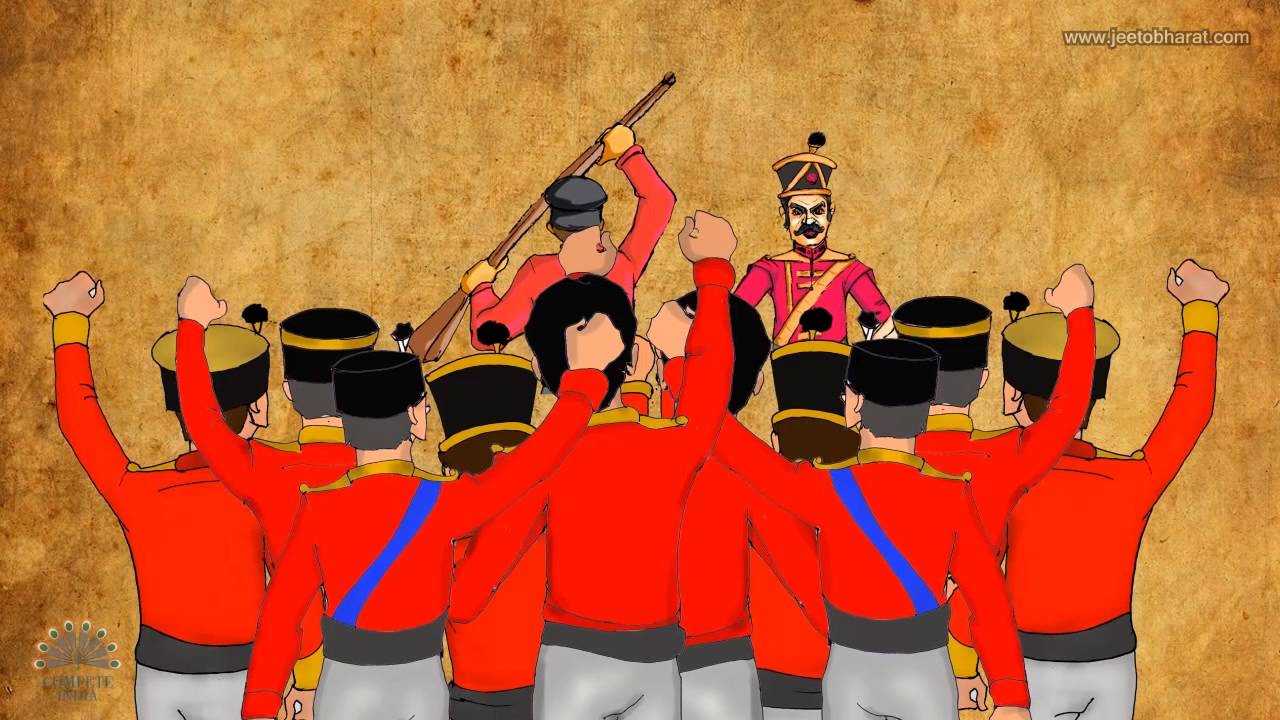
The 1857 Revolt, often called India’s First War of Independence, was a major turning point in Indian history that directly challenged British rule. This large-scale uprising grew out of deep trouble caused by money problems, political unfairness, unhappiness in the army, and rising religious concerns across the land. Brave leaders like Rani Laxmibai of Jhansi, Nana Saheb, and Kunwar Singh led the fight against British forces. For students preparing for competitive exams, learning about its causes, main centers, brave leaders, reasons for failure, different historical views, and long-term results is essential to understand how India's freedom movement truly began.
🎯 In this chapter, you will understand:
- The economic, political, and military causes of the 1857 Uprising.
- Key rebellion centres and the regional leaders who led the resistance.
- The structural reasons why the revolt ultimately failed against British forces.
- How the shift to Crown rule changed India's governance and military.
💡 Why this topic matters: It marks the end of East India Company rule and the start of modern Indian national consciousness.
🧠 Core Idea: Widespread public anger across different sections of society erupted into a massive but uncoordinated war against colonial power.
Analysis of the 1857 Great Indian Revolt: Causes, Impact, and Aftermath
The 1857 Revolt was a watershed moment that grew from a dangerous mix of financial, political, and military problems that weakened British control in India. This intense public pushback showed the deep anger felt by farmers, craftspeople, landholders, and Indian soldiers (sepoys), who were all suffering under British rule. Though widespread, the uprising lacked central planning and coordination.
- (i) Harsh tax collections and the loss of local industries pushed millions of ordinary people into deep poverty.
- (ii) Unfair political decisions, like taking over native states and ruling from a distant homeland (absentee sovereignty), created strong anger among Indian rulers and nobles.
- (iii) Bad working conditions, low pay, and disrespect for local religious customs inside the army acted as the final spark for open rebellion.
Multi-Faceted Causes Sparking the 1857 Uprising
This huge rebellion did not happen overnight. It was the final result of long-standing anger built up by extreme financial hardship, unfair political actions, and deep military dissatisfaction that turned ordinary people against foreign rule.

Economic Roots: Discontent in Agrarian and Artisan Communities
British money policies broke down traditional village life. High tax demands ruined farmers, while cheap British factory goods destroyed local businesses.
- (i) Strict tax systems like the Mahalwari and Ryotwari setups forced farmers into heavy debt and often caused them to lose their family land.
- (ii) The flooding of Indian markets with cheap British cloth ruined traditional weavers and craft workers, leaving millions without work.
- (iii) Unfair taxes on Indian goods prevented local factories from growing, turning India into a simple supplier of raw material for Britain.
Political Annexations and Absentee Sovereignty: Political Causes
Taking over native kingdoms created fear and distrust among Indian rulers, stripping them of their land, power, and respect.
- (a) The aggressive takeover rule called the Doctrine of Lapse, introduced by Lord Dalhousie, was used to grab states like Jhansi, Satara, and Nagpur, deeply hurting local rulers.
- (b) The problem of absentee sovereignty meant the true rulers lived far away in Britain and did not care about the daily needs of Indian people.
- (c) People felt the government was interfering in local religious and social customs through new laws and missionary work, creating deep suspicion.
Military Discontent and Sepoy Grievances: Immediate Causes
Indian soldiers formed the main strength of the army, but they faced poor treatment, bad pay, and direct threats to their religious traditions.
- (i) Indian soldiers received much lower pay and fewer promotions compared to British soldiers doing the exact same work.
- (ii) The new Enfield Rifle required soldiers to bite cartridges rumor-backed to contain cow and pig fat, which offended both Hindu and Muslim religious feelings and triggered the immediate fight.
- (iii) Earlier small revolts, like the Vellore Mutiny in 1806, showed a long history of dissatisfaction within the army ranks.
Major Centres of Revolt and Courageous Regional Leaders
The fight spread fast across Northern and Central India. Local leaders stepped up in different cities to lead the fight against British control.
- (i) Delhi: Soldiers captured the city and named the old king Bahadur Shah II (Zafar) as Emperor, though real military control was led by General Bakht Khan.
- (ii) Kanpur: Led by Nana Saheb, the adopted son of the last Peshwa Baji Rao II, who fought back after the British cut off his rightful pension.
- (iii) Lucknow: Led by Begum Hazrat Mahal for her young son after the British unfairly took over Awadh.
- (iv) Bareilly: Organized by Khan Bahadur Khan, who gathered local forces to rebuild regional governance.
- (v) Bihar: Led by the brave old landowner Kunwar Singh of Jagdishpur, who fought energetic battles against British troops despite his old age.
- (vi) Faizabad: Inspired by Maulvi Ahmadullah (known as Danka Shah), who traveled widely preaching resistance against foreign rule.
- (vii) Jhansi: Led by the famous Rani Laxmibai, who took up arms after her state was taken under the Doctrine of Lapse and fought bravely until her death.
- (viii) Baghpat: A local farmer revolt organized by Shah Mal, who brought together village communities to fight local British rule.
Strategic British Officials in Suppression of the Revolt
After early losses, British forces reorganized and used disciplined troops, strong planning, and better weapons to systematically put down the scattered uprisings across India.
British Recapture of Delhi and Key Figures
Taking back Delhi was crucial for British morale. The fighting was severe and costly for both sides.
- (i) Lieutenant Willoughby defended the city weapons store, John Nicholson led the hard assault on Delhi but was killed in battle, and Lieutenant Hudson captured King Bahadur Shah II and killed his sons.
Kanpur and Lucknow Recapture Campaigns
Retaking Kanpur and Lucknow took long military campaigns and involved several top British officers.
- (a) In Kanpur, Sir Hugh Wheeler was defeated first, but Sir Colin Campbell later retook the city from Nana Saheb.
- (b) In Lucknow, Henry Lawrence died defending the Residency. Generals Henry Havelock and James Outram fought their way in, and Sir Colin Campbell secured final control.
Subduing Central India and Benaras
Fighting in Central India focused on defeating Rani Laxmibai, while severe actions were taken in Benaras to stop early warning signs of revolt.
- (i) Jhansi and Gwalior:Sir Hugh Rose led the campaign in Central India, capturing Jhansi and defeating forces where Rani Laxmibai fell in battle.
- (ii) Benaras:Colonel James Neill used harsh measures and quick punishments to stop early rebel actions in Benaras and Allahabad.
Structural and Strategic Causes of Failure
Despite immense bravery, the revolt failed to drive out British rule due to poor planning, lack of resources, and missing central leadership.
- (i) The revolt did not cover the whole country. It stayed mainly in Northern and Central India, while Southern, Western, and Eastern parts stayed mostly quiet.
- (ii) Many wealthy Indian landowners, moneylenders, and powerful princes (like the Scindia of Gwalior and the Nizam of Hyderabad) supported the British to protect their own interests.
- (iii) Indian fighters had old weapons and limited supplies, while the British army used modern rifles, organized communication, and strong supply lines.
- (iv) There was no single leader or central command to connect different regions. Leaders fought hard locally but did not coordinate a master plan.
- (v) The rebels lacked a clear political vision for what kind of government would rule India after driving out the British.
Diverse Interpretations and Nature of the 1857 Uprising
Historians hold different views about what the 1857 event truly was—a small army mutiny, a backward-looking noble revolt, or India's first real national fight for freedom.
Viewpoints by Indian Historians
Indian scholars have studied how widely national feelings were shared during the uprising.
- (i) Historians like R.C. Majumdar and S.N. Sen noted that the revolt was not an organized national movement in the modern sense because it lacked unity and shared goals.
- (ii) R.C. Majumdar famously wrote that it was "Neither first, nor National, nor War of Independence" due to its regional nature and divided aims.
- (iii) In contrast, V.D. Savarkar argued strongly in his book The Indian War of Independence that it was a planned national war to end foreign rule.
British and Western Interpretations of the Event
British writers often tried to downplay the event as a simple military problem or a local conspiracy.
- (a) British writers like Lawrence and Seeley described it as a mere sepoy mutiny, ignoring the huge involvement of ordinary citizens.
- (b) T.R. Holmes wrongly called it a fight between civilization and barbarism to justify harsh British actions.
- (c) James Outram claimed it was a political plan using religious fears to turn people against the government.
- (d) Modern scholar Eric Stokes viewed it as a struggle led mostly by traditional noble groups trying to protect their old power.
⚡ Quick Revision Capsule: Overview of 1857 Revolt Leaders and Centers
Use this simple table to quickly revise the main locations, leaders, and suppressing officers of the 1857 uprising.
| Centre of Revolt | Indian Leader | British Official Who Suppressed It |
|---|---|---|
| Delhi | Bahadur Shah II & General Bakht Khan | John Nicholson & Lieutenant Hudson |
| Kanpur | Nana Saheb & Tatya Tope | Sir Colin Campbell |
| Lucknow | Begum Hazrat Mahal | Sir Colin Campbell |
| Jhansi & Gwalior | Rani Laxmibai & Tatya Tope | Sir Hugh Rose |
| Bihar (Jagdishpur) | Kunwar Singh | William Taylor & Vincent Eyre |
📝 Summary
The 1857 Revolt was a huge, historic uprising driven by long-held anger over unfair tax rules, political land-grabbing, and religious disrespect within the army. While brave leaders like Rani Laxmibai, Nana Saheb, and Kunwar Singh fought hard, the revolt failed because of poor organization, lack of unity, and superior British firepower. Even so, it ended Company rule and placed India directly under the British Crown in , laying the groundwork for India's modern freedom movement.
🚀 Quick Revision Points
Essential facts to review before examinations:
- (i) Immediate Cause: Introduction of greased cartridges for the new Enfield Rifle.
- (ii) Governance Shift: Passing of the Government of India Act 1858 ended East India Company rule.
- (iii) New Position: Creation of the Secretary of State for India to oversee Indian administration.
- (iv) Army Reform: Recommendations by the Peel Commission increased the proportion of British soldiers to prevent future revolts.
- 💡 Exam Tip: Pay special attention to matching rebel leaders with their respective centers and the British officers who suppressed them, as this is frequently asked in matching-type exam questions.
❓ Frequently Asked Questions (FAQ)
Q1: What was the immediate cause of the 1857 Revolt?
A1: The immediate cause was the introduction of the new Enfield Rifle, where cartridges were rumored to be greased with cow and pig fat, hurting the religious feelings of Hindu and Muslim soldiers.Q2: How did governance change after the 1857 Revolt?
A2: The British Parliament passed the Government of India Act 1858, which ended East India Company rule and placed India directly under the British Crown.Q3: Why is Rani Laxmibai remembered as a hero in Indian history?
A3: Rani Laxmibai of Jhansi fought bravely against British forces after her kingdom was taken under the Doctrine of Lapse, becoming a lasting symbol of courage and resistance against colonial rule.