The Revolt of 1857, often called the First War of Independence, was a turning point in Indian history against foreign control. This big uprising started in . It was mainly sparked by strong religious worries, especially regarding the new Enfield rifle cartridges. The movement spread fast from Meerut to central hubs like Delhi, Awadh, Kanpur, Lucknow, and Jhansi. It brought together Indian soldiers and local citizens, creating a landmark chapter for learners and exam candidates studying modern history.
🎯 In this chapter, you will understand:
- The underlying causes and religious triggers that ignited the uprising in .
- How the rebellion broke out in Meerut and spread across northern and central regions.
- The political role of Mughal Emperor Bahadur Shah Zafar as the unifying head.
- Key regional storm centres, local civilian support, and famous leaders of resistance.
💡 Why this topic matters: Understanding this uprising reveals how diverse social groups united against colonial economic, religious, and political policies.
🧠 Core Idea: What started as a military mutiny over greased cartridges turned into a massive popular resistance movement across India.
⚡ Spark of Rebellion, Causes, and Spread of the 1857 Uprising: The Beginning and Expansion ()
Deep religious fears and long-standing discontent among native troops acted as the primary cause of the sudden uprising.
The long-simmering discontent among the sepoys—Indian soldiers in the British Army—finally erupted into an open rebellion. This was fueled by perceived insults to their religious customs and identity, driven by administrative insensitivity and offensive practices.
- (i) A common rumor spread that the flour (atta) given to troops was mixed with bone dust. This practice offended both Hindus and Muslims, creating widespread distrust toward the administration.
- (ii) The immediate trigger was the new Enfield rifle cartridge, which soldiers had to bite before loading. Reports stated these cartridges were greased with cow and pig fat, deeply offending Hindu soldiers (who revere the cow) and Muslim soldiers (who avoid pig products).
- (iii) The military leadership failed to address these religious concerns with clear solutions, which made the anger among soldiers grow rapidly.
- (iv) As a result, the cartridge issue became the main spark that released years of built-up political, economic, and social frustration against foreign rule.
🔥 Starts at Meerut: The Uprising Begins and Spreads ()
Meerut served as the central point where the revolt broke out on , swiftly spreading across North and Central India.

Early Signs of Resistance Before the Meerut Outbreak
Smaller acts of defiance occurred months earlier, showing growing anger among native regiments.
- (i) At Berhampore, the 19th Native Infantry refused to use the new rifles in , leading to the unit being disbanded in .
- (ii) Heroic resistance came from Mangal Pande of the 34th Native Infantry at Barrackpore. He attacked a British officer, was executed on , and his unit was disbanded in .
- (iii) The 7th Awadh Regiment refused orders on , showing that defiance was spreading to various garrisons before being disbanded.
The Definitive Spark at Meerut: Open Rebellion on
Resentment among soldiers led to direct conflict in Meerut, turning quiet defiance into armed revolt.
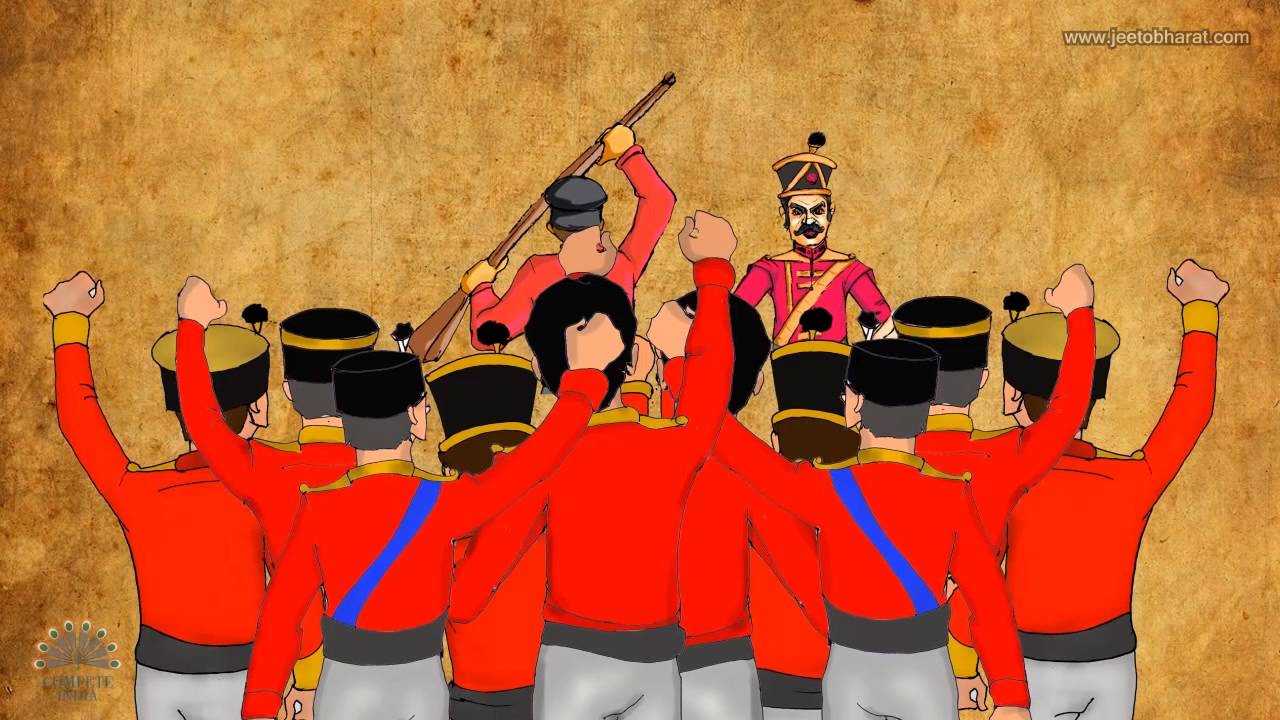
- (i) On , ninety soldiers of the 3rd Native Cavalry refused to use the greased cartridges.
- (ii) On , eighty-five of these soldiers were publicly court-martialed and jailed, which angered their fellow troops.
- (iii) On , remaining troops revolted, freed their jailed comrades, killed officers, and marched toward Delhi to launch the full uprising.
👑 Choice of Bahadur Shah as Symbolic Head: Unifying the Rebellion under the Mughal Banner
Rebels reaching Delhi named the elderly Emperor Bahadur Shah Zafar as their leader, giving the military revolt official political backing.
The Pivotal Role of Bahadur Shah Zafar
Though his real power was limited, the last Mughal ruler's name brought unity and historical legitimacy to the movement.
- (i) After arriving in Delhi, rebels removed European officers, including Political Agent Simon Fraser, taking full control of the city.
- (ii) Proclaiming Bahadur Shah Zafar as the Emperor of India created a political center for the rebellion.
- (iii) Local leaders, princes, and soldiers rallied under the Mughal name, giving the movement wider political authority.
- (iv) The Emperor wrote to various Indian rulers, asking them to form a confederacy to fight against foreign rule together.
👥 Civilians Join: Expanding the Social and Geographical Scope of the Rebellion
The movement quickly expanded beyond military camps as ordinary citizens joined the struggle against British policies.
The People's Revolt: Civilian Role in the Uprising
Peasants, local leaders, and workers joined the fight, targeting institutions linked with foreign rule.
- (i) People from many walks of life joined, including farmers, artisans, shopkeepers, local landlords (zamindars), religious figures, and former civil servants.
- (ii) Villagers and farmers attacked moneylenders, burned debt documents, and targeted government offices, courtrooms, and police stations.
- (iii) Over lost their lives in Awadh alone during the crackdown, showing how deeply the public was involved.
- (iv) Capturing Delhi encouraged surrounding districts, allowing the movement to spread through northern and central regions within a month.
⚔️ Storm Centres and Leaders of the Revolt: Iconic Figures of Resistance
Different regions developed into strong centers of resistance, each guided by prominent local leaders.
Delhi: The Symbolic Heart of the Revolt
Delhi remained the main center, where daily leadership was handled by military commanders alongside the Emperor.
- (i) Symbolic leadership belonged to Bahadur Shah Zafar.
- (ii) Practical military direction was led by General Bakht Khan, who brought troops from Bareilly and formed a council of soldiers.
- (iii) Difficulties in coordination and supply management made long-term defense against counter-attacks challenging.
Kanpur: Nana Saheb and the Peshwa Title
At Kanpur, resistance gathered around the adopted son of the last Maratha Peshwa.
- (i) The movement was led by Nana Saheb, adopted son of Baji Rao II, who claimed his title as Peshwa.
- (ii) He accepted Bahadur Shah Zafar as the Emperor to maintain unity among different rebel groups.
- (iii) British commander Sir Hugh Wheeler surrendered on , followed by heavy fighting in the city.
Lucknow: Begum Hazrat Mahal's Resistance
In Awadh, local forces rallied around the royal family to challenge British control.
- (i) Resistance was led by Begum Hazrat Mahal, who named her young son Birjis Qadir as the ruler (Nawab) of Awadh.
- (ii) Forces surrounded the British Residency for months, during which Chief Commissioner Sir Henry Lawrence was killed.
- (iii) British troops retook Lucknow in , though rural fighters continued guerrilla warfare through .
Jhansi: Rani Laxmibai, Symbol of Valor
Rani Laxmibai headed the uprising in Jhansi after her state was taken over under official annexation rules.
- (i) Her decision to fight was driven by opposition to Lord Dalhousie's Doctrine of Lapse, which had annexed Jhansi.
- (ii) She teamed up with commander Tantia Tope to capture Gwalior after Jhansi fell.
- (iii) British forces under Sir Hugh Rose recaptured Jhansi after intense battles in , where the Rani died fighting bravely.
Other Key Centres and Prominent Leaders
Prominent figures across various regions led regional forces against foreign administration.
- Bareilly: Led by Khan Bahadur Khan, a descendant of Rohilkhand rulers, who organized an army of over 40,000 soldiers.
- Bihar (Jagdishpur): Led by the elderly landlord Kunwar Singh, who fought mobile battles alongside local sepoys at Arrah.
- Faizabad: Guided by Maulvi Ahmadullah, who mobilized troops and proved to be a persistent opponent in Awadh.
- Pargana Baraut (Baghpat, Uttar Pradesh): Organized by local figure Shah Mal, who rallied villagers to cut off communication lines.
Shah Mal's Guerrilla Campaign
- (a) Local groups attacked administrative posts, broke bridges, and disrupted communication networks.
- (b) Shah Mal died in battle against British officer Dunlap in .
⚡ Quick Revision Capsule: Key Storm Centres and Leaders of 1857
A structured quick summary of the major locations, key leaders, and opposing British commanders during the revolt.
| Storm Centre | Indian Leader(s) | British Suppressor |
|---|---|---|
| Delhi | Bahadur Shah Zafar, General Bakht Khan | John Nicholson, Archdale Wilson |
| Kanpur | Nana Saheb, Tantia Tope | Sir Colin Campbell, Sir Hugh Wheeler |
| Lucknow | Begum Hazrat Mahal, Birjis Qadir | Sir Henry Lawrence, Colin Campbell |
| Jhansi & Gwalior | Rani Laxmibai, Tantia Tope | Sir Hugh Rose |
| Bihar (Jagdishpur) | Kunwar Singh, Amar Singh | William Taylor, Vincent Eyre |
📝 Summary
The Revolt of 1857 began as a military uprising over greased cartridges in but grew into a wide-ranging anti-colonial movement. Prominent leaders like Bahadur Shah Zafar, Nana Saheb, Begum Hazrat Mahal, Rani Laxmibai, and Kunwar Singh organized resistance across northern and central India. Although suppressed by , it ended the East India Company rule and transferred governance directly to the British Crown, setting the stage for India's national freedom struggle.
🚀 Quick Revision Points
Essential facts to review before examinations:
- (i) The primary immediate cause was the introduction of Enfield rifle cartridges greased with cow and pig fat.
- (ii) The first main outbreak occurred at Meerut on , following earlier protests by Mangal Pande.
- (iii) Bahadur Shah Zafar served as the symbolic head of the national resistance.
- (iv) The conflict led to the Government of India Act , replacing Company administration with direct Crown rule.
- 💡 Exam Tip: Focus on matching storm centers (Delhi, Kanpur, Lucknow, Jhansi, Jagdishpur) with their respective leaders and British officers for quick exam scoring.
❓ Frequently Asked Questions (FAQ)
Q1: What was the immediate trigger for the Revolt of 1857?
A1: The immediate trigger was the introduction of Enfield rifle cartridges rumored to be coated with cow and pig fat, which offended Hindu and Muslim soldiers.Q2: Who was chosen as the national leader of the uprising?
A2: The rebels declared the last Mughal Emperor, Bahadur Shah Zafar, as the symbolic leader and Emperor of India.Q3: How did the Revolt affect the administration of India?
A3: It led to the end of the East India Company rule, and British governance was directly taken over by the British Crown through the Act of .