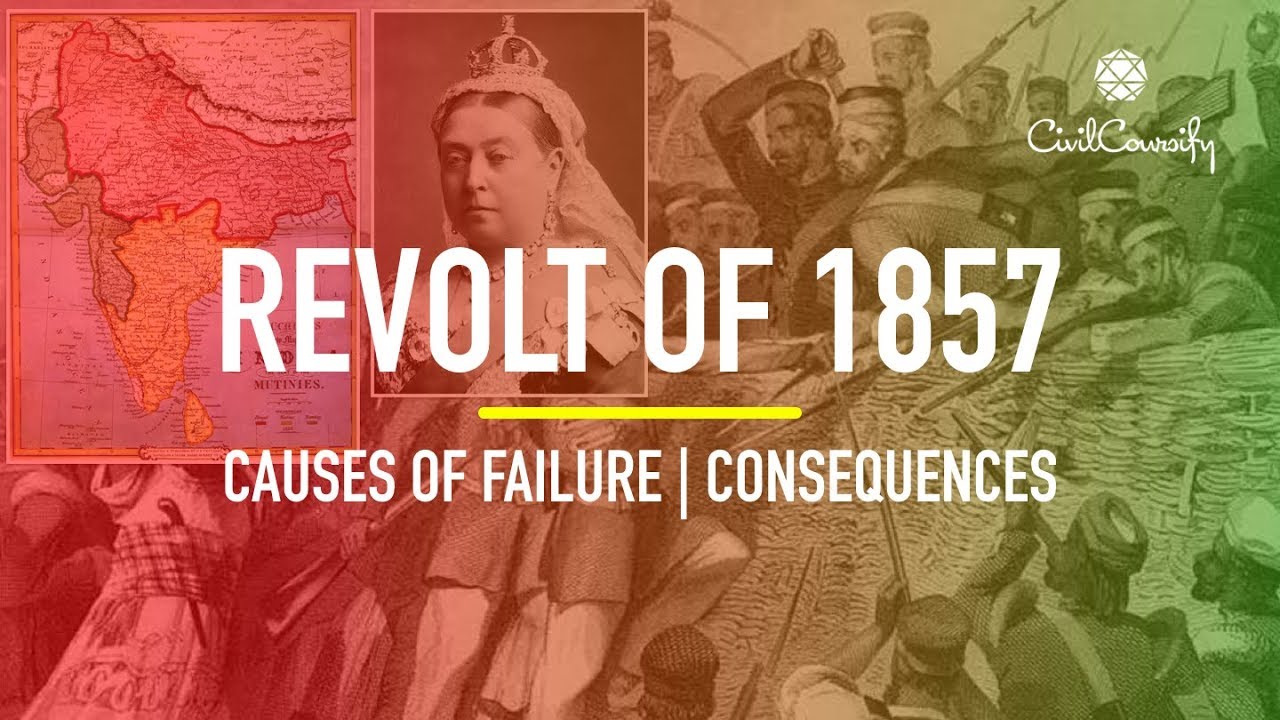
The Revolt of 1857, often called the First War of Indian Independence, was a huge turning point in Indian history. It permanently changed how the British ruled India, leading to major administrative changes and new government policies. From the historic Queen’s Proclamation of 1858 to the harsh and decisive suppression of the uprising, its outcomes deeply reshaped India's political, military, and social setup. For students and test takers, understanding its causes, how it was put down, and its long-term effects is essential for preparing modern history topics.
🎯 In this chapter, you will understand:
- How power transferred from the East India Company directly to the British Crown.
- The key promises made in the Queen's Proclamation of 1858.
- How British military forces put down the revolt across key Indian cities.
- The major social and administrative policy changes made after 1857.
💡 Why this topic matters: It marks the official start of direct British government rule over India and set the stage for future national movements.
🧠 Core Idea: The uprising forced the British to stop ruling through a private company, adopt direct rule, rebuild the army, and proceed with cautious social policies.
📌 Consequences and Suppression of the 1857 Revolt: Key Impacts, Administrative Reforms, and British Retaliation
The watershed moment of the Revolt of 1857 immediately triggered major administrative, military, and policy changes that redefined British rule in India.
The massive uprising marked the end of Company rule under the East India Company and transferred political power directly to the British Crown. At the same time, the crushing of the rebellion showed the strong military power and strict control of British forces.
- (i) The Act for the Better Government of India (1858) ended the long-standing system of Company rule and made Queen Victoria the official ruler of India.
- (ii) The Queen’s Proclamation aimed to calm Indian worries by promising religious freedom, equal treatment under the law, and respect for the titles and lands of local Indian princes.
- (iii) A complete reorganization of the British Indian Army began right away, lowering the number of Indian soldiers and increasing European troops to ensure long-term control.
🏛️ Governance Restructuring: Administrative and Policy Consequences of the 1857 Revolt
The disruption from the revolt ended the double system of Company governance and started a centralized era of direct Crown management, creating long-lasting political effects across the region.

Shift to Direct Crown Rule and Administrative Overhaul
The administrative framework in India was dismantled and rebuilt to create a direct line of control from the British Parliament, removing the old system run by the East India Company.
- (i) The 1858 Act officially removed Company authority, replacing the Board of Control and Court of Directors with a new Secretary of State for India supported by a 15-member Council.
- (ii) After this law, Queen Victoria was named ruler over all of India, turning the country into an official part of the British Empire.
- (iii) This new system concentrated authority closely under the British Parliament, represented locally by the Governor-General, who was also given the title of Viceroy.
Queen’s Proclamation (1858): Assurances to Indian Rulers and Subjects
Announced to rebuild trust and win over the Indian elite, the Proclamation changed the direction of governance from aggressive expansion to cautious protection and respect for old treaties.
- (a) The announcement was read by the last Governor-General and first Viceroy, Lord Canning, at a large gathering in Allahabad on .
- (b) It promised not to interfere in Indian social customs or religion, stopping the active social reform policies that had upset many people before the revolt.
- (c) It guaranteed respect for the honor of Indian princes and assured them that the practice of taking over new territories would stop completely.
Reorganization of the Army: The Peel Commission and Racial Balance
The structure of the army was overhauled based on recommendations from the Peel Commission, aiming to prevent future mutinies by separating different caste and regional groups.
- (i) The number of European troops in India was increased while the count of Indian troops was reduced, maintaining a clear balance designed to prevent joint uprisings.
- (ii) New soldiers were recruited mainly from groups named "martial races" (such as Sikhs, Gurkhas, and Pathans) who supported the British during 1857, while hiring from regions that led the revolt was cut back.
- (iii) The Army Amalgamation Scheme of 1861 combined troops, transferring all European soldiers who had served the Company into Crown service.
The White Mutiny: Discontent Among European Troops (1859)
Even European soldiers showed discontent after the power shift, creating unexpected issues for the British government during its transition.
- (i) A large group of European soldiers previously under the East India Company objected to being shifted automatically to Crown service without receiving an option to discharge and re-enlist for a bonus payment.
- (ii) The main disagreement was over the removal of extra allowances, known as batta, and other expected cash benefits.
- (iii) The problem was settled when the government allowed thousands of unhappy soldiers to leave, filling their places with fresh recruits from Britain.
Ideological Policy and Societal Shifts: The Conservative Turn
The impact of the uprising altered British policy, moving it away from active reform to a cautious approach that kept traditional structures intact.
- End of Reformist Zeal: Shocked by the revolt, the British stopped pushing social reform laws (such as the Sati ban or Widow Remarriage Act) and adopted a cautious stance toward local traditions.
- Policy of Divide and Rule: To avoid a unified Indian response, the British intentionally widened social gaps among different castes and communities, while keeping a strict distance between Europeans and Indians in everyday life.
- Conceptual Change in Sovereignty: Historian Bernard Cohn noted that the British began viewing themselves not as temporary external reformers, but as permanent rulers focused on protecting their control.
Long-Term Legacy and Significance of the 1857 Revolt for India
Though put down militarily, the revolt held lasting meaning for both the British government and the Indian public, setting the foundation for future movements.
- (i) For the British, it served as a clear warning that exposed weakness in earlier Company methods and required a more careful policy.
- (ii) For Indians, the resistance showed by figures like Rani Lakshmi Bai and Tantia Tope inspired future leaders in the freedom struggle and built a memory of standing up against foreign rule.
- (iii) Looking at the broader path of Indian history, the revolt marked an early step toward a shared national awareness and joint resistance across regions.
⚔️ Brutal Retaliation: Suppression of the 1857 Revolt by British Forces
The response to the revolt was quick and harsh. British forces systematically broke up the uprising through military action, executions of key leaders, and strict measures, gaining full control back by early .
Fall of Delhi and the Fate of Bahadur Shah II
Taking back Delhi was an important victory for the British, as it removed the main central center of the uprising.
- (i) British troops retook the city of Delhi on , after a long and heavy battle.
- (ii) British leaders suffered casualties, including John Nicholson, who was fatally hurt in the final fight. The leader chosen by the rebels, Bahadur Shah II, was captured and sent away to Rangoon in Burma, where he later passed away.
- (iii) Lieutenant William Hodson shot and killed the Emperor's sons and grandson, ending the remaining line of the Mughal royal family.
Crushing the Rebellion in Regional Centers: Defeat of Key Leaders
Experienced British commanders were assigned to take back key regions, defeating local leaders who had led protests across northern and central India.
- (a) Under Sir Colin Campbell, British troops took back Kanpur. Following this, Nana Saheb left for the border regions of Nepal.
- (b) Commander Tantia Tope (Ramchandra Pandurang) used guerrilla tactics for several months but was eventually betrayed, captured in , and executed.
- (c) Rani Lakshmi Bai of Jhansi died fighting in battle in near Gwalior after leaving Jhansi.
- (d) Other leaders, including Kunwar Singh from Jagdishpur, military commander Bakht Khan, and Maulvi Ahmadullah of Faizabad, died or were killed in battle by .
- (e) Begum Hazrat Mahal of Awadh moved to Nepal after her forces were defeated in battle.
- (f) The uprising around Benaras was put down by Colonel James Neill through strict punishments and public actions meant to end protests quickly.
Restoration of British Control and Financial Burden
Using force and organized supply lines, British control was re-established across all regions to stop any immediate future uprisings.
- (i) By , through military actions and strict measures, British authority was restored across India.
- (ii) The military effort relied on fresh British troops, updated weapons, and equipment brought in quickly from overseas bases.
- (iii) A heavy financial result of the war was that the total cost of putting down the revolt was placed onto Indian tax revenues, adding strain to the local economy.
⚡ Quick Revision Capsule: Key Leaders & Events of 1857 Revolt
A quick summary of primary centers, leaders involved, British commanders, and outcomes of the 1857 Uprising:
| Center of Revolt | Indian Leader(s) | British Commander & Outcome |
|---|---|---|
| Delhi | Bahadur Shah II, Bakht Khan | Recaptured by John Nicholson and William Hodson; Bahadur Shah II exiled to Rangoon. |
| Kanpur | Nana Saheb, Tantia Tope | Recaptured by Sir Colin Campbell; Nana Saheb escaped to Nepal. |
| Jhansi & Gwalior | Rani Lakshmi Bai, Tantia Tope | Defeated by Sir Hugh Rose; Rani Lakshmi Bai killed in battle in . |
| Lucknow (Awadh) | Begum Hazrat Mahal | Recaptured by Sir Colin Campbell; Begum took refuge in Nepal. |
| Bihar (Jagdishpur) | Kunwar Singh | Defeated by William Taylor and Vincent Eyre; Kunwar Singh died of battle wounds. |
📝 Summary
The Revolt of 1857 was a major turning point in modern Indian history. It brought an end to the East India Company's rule and started direct control under the British Crown via the Act for the Better Government of India (1858). Announced by Lord Canning on , the Queen’s Proclamation promised no interference in local religious practices and stopped territorial expansion. The British reorganized the army through the Peel Commission to maintain racial balance and prevent future revolts. Although the uprising was put down by with the loss of leaders like Rani Lakshmi Bai and Tantia Tope, it left a lasting legacy that inspired the later freedom movement.
🚀 Quick Revision Points
Essential facts to review before examinations:
- (i) Government of India Act 1858 transferred power directly from the East India Company to the British Crown.
- (ii) Lord Canning read the Queen's Proclamation at Allahabad on .
- (iii) The Peel Commission was set up to reorganize the army, increasing European soldiers and hiring from "martial races."
- (iv) The White Mutiny occurred in 1859 among European Company troops over transfer terms and batta allowances.
- 💡 Exam Tip: Remember that Lord Canning was both the last Governor-General under Company rule and the first Viceroy under Crown rule. Always link the Peel Commission with army restructuring post-1857!
❓ Frequently Asked Questions (FAQ)
Q1: What was the main administrative change after the Revolt of 1857?
A1: The main change was ending East India Company rule and establishing direct governance under the British Crown through the Act for the Better Government of India (1858).Q2: What was the Peel Commission and why was it formed?
A2: The Peel Commission was formed to reorganize the British Indian Army after 1857, increasing the proportion of European troops and recruiting from designated "martial races."Q3: What was the White Mutiny of 1859?
A3: The White Mutiny was a protest by European soldiers previously employed by the East India Company, who opposed being transferred to Crown service without receiving a re-enlistment bonus or extra allowances.