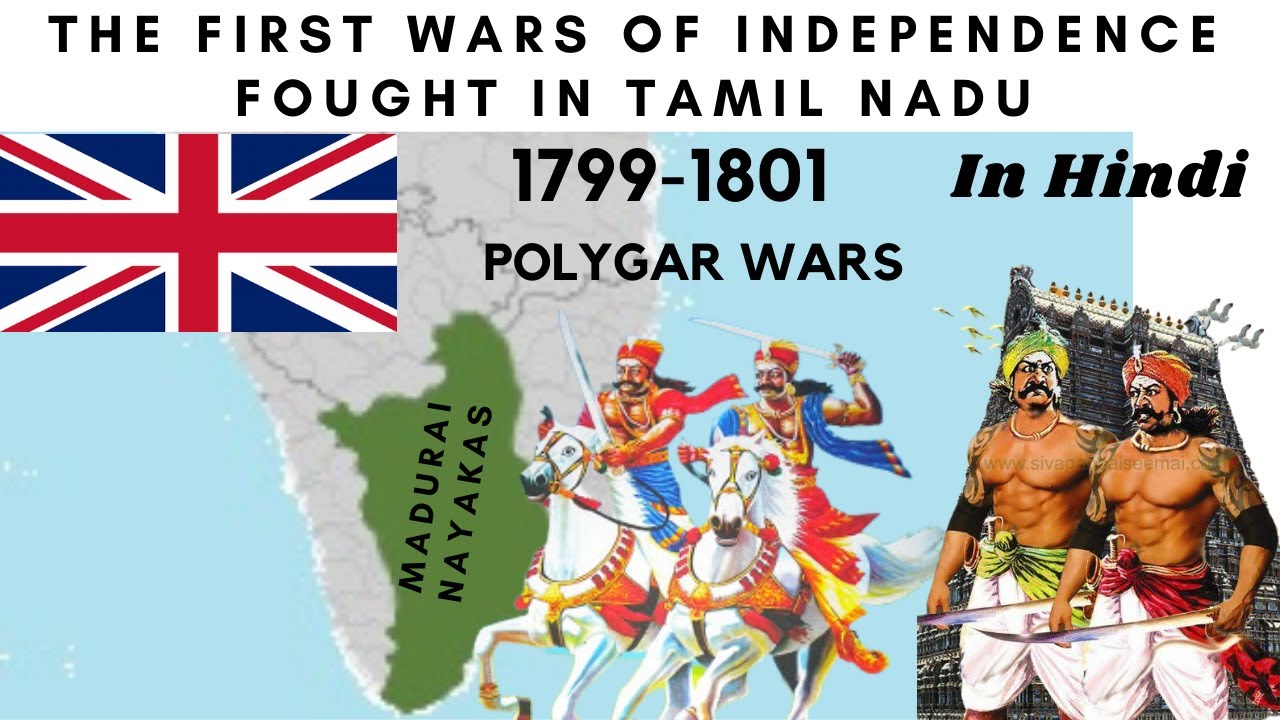
The Poligars’ Revolt (), also called the Palayakkarar Wars, is an important event in the history of South India. It was one of the earliest organized fights against the growing power of the British East India Company. Brave leaders like Kattabomman Nayakan and his brother Oomathurai led this rebellion. Fighting took place mainly in Tinneveli, Ramanathapuram, and Madurai because local rulers hated British financial and political control. Understanding this revolt helps history students and exam takers learn about the fight for local independence and early anti-colonial movements.
🎯 In this chapter, you will understand:
- The main reasons behind the Poligar resistance against British rule.
- The leadership of Kattabomman Nayakan during the First Poligar War.
- The alliance between Oomathurai and the Maruthu brothers in the second phase.
- The North Arcot uprising and the overall outcome of the revolt.
💡 Why this topic matters: It highlights the earliest armed resistance against British tax collection and land rights in Southern India.
🧠 Core Idea: Traditional local military chiefs (Poligars) fought to protect their ancestral lands and tax rights from the East India Company.
The Context of the Revolt: The Seeds of Discontent Among the Poligars
The Poligars (locally called Palayakkarargal) were traditional military leaders and local administrators. Great southern kingdoms appointed them to collect taxes and keep peace in their lands. Their fight against the British from to started because the East India Company tried to take away these traditional rights.
Loss of Traditional Autonomy
The Poligars enjoyed complete financial and military freedom within their territories, called palayams. When the British tried to collect taxes directly, the Poligars saw it as an attack on their freedom.
- (i) The main areas of uprising included Tinneveli (also known as Thirunelveli), Ramanathapuram, Sivaganga, Sivagiri, Madurai, and parts of North Arcot.
- (ii) Trouble started in when the Nawab of Arcot, who owed money to the British, gave tax collection rights of Tinneveli and the Carnatic region to the East India Company. This treaty angered local chiefs and sparked the Poligar Wars.
Initial Uprising: The First Poligar War and the Valiant Stand of Kattabomman Nayakan
The first part of the rebellion was led by Kattabomman Nayakan. His fight inspired many other regional leaders to resist British rule together.

The Leadership of Kattabomman Nayakan ()
Veerapandiya Kattabomman, the Poligar of Panjalankurichi, became the primary leader of this early movement against unfair taxes.
- (i) Between and , he led armed resistance from his fort at Panjalankurichi and refused to pay the high taxes demanded by British officers.
- (ii) After his forces defeated British troops in early battles, the Company declared a reward for his capture.
- (iii) He hid in the forests of Pudukottai, but Ettappan, the Raja of Pudukottai, betrayed him to the British. Kattabomman was captured and publicly hanged in .
Second Phase of Rebellion: Sustained Resistance Under Oomathurai and the Marudus
Even after Kattabomman died, the rebellion continued. His brother Oomathurai and other local leaders immediately restarted the fight.
The Alliance of Oomathurai and the Marudus and its Fierce Campaign
The second war was larger and more organized. It began with a jailbreak and the capture of key British positions.
- (a) In , Oomathurai and other jailed leaders escaped from Palamcotta prison and quickly captured the coastal town of Tuticorin.
- (b) They joined hands with the Marudus (Maruthu brothers), including Marathu Pandian (Chinna Maruthu), the chief minister of Sivaganga.
- (c) British forces launched a massive attack and destroyed the fort at Panjalankurichi. By , the rebellion was crushed, and both Oomathurai and the Marudus were executed.
Later Rebellions and the Eventual Outcome of the Poligars’ Struggle
Fighting also broke out in northern areas after southern forts fell, showing that resistance to British taxation was widespread across the region.
The North Arcot Rebellion () over Kaval Fees
The final uprising happened when the British stopped an old security fee tradition.
- (i) Poligars in North Arcot fought back when the British took away their right to collect kaval fees (protection taxes).
- (ii) The Poligar of Yedaragunta and the dispossessed chief of Charagallu led this northern movement.
- (iii) British troops ended the fight by . Defeated leaders were moved to Madras or given small pensions in exchange for giving up their rights.
Widespread Anti-Colonial Demonstration
This final phase proved that anti-British sentiment existed throughout South India. After suppressing the revolt, the British completely ended the palayam system and established direct tax management.
⚡ Quick Revision Capsule: Key Phases of the Poligars' Revolt
A quick comparison of the major phases, key leaders, and primary locations of the conflict:
| Phase | Key Leaders | Major Regions |
|---|---|---|
| First Phase () | Veerapandiya Kattabomman | Panjalankurichi, Tinneveli |
| Second Phase () | Oomathurai, Chinna Maruthu (Marudu Brothers) | Sivaganga, Tuticorin, Palamcotta |
| Final Uprising () | Poligars of Yedaragunta and Charagallu | North Arcot |
📝 Summary
The Poligars’ Revolt () was a major early challenge to the British East India Company in South India. Regional leaders like Kattabomman Nayakan and Oomathurai fought to keep their traditional tax and administrative rights. The conflict covered Tinneveli, Madurai, and North Arcot. The revolt ended the traditional palayam system and helped pave the way for later Indian national movements.
🚀 Quick Revision Points
Essential facts to review before examinations:
- (i) The revolt started because the Company took over tax rights from the Nawab of Arcot in .
- (ii) Kattabomman was betrayed by Ettappan and executed in .
- (iii) The Maruthu brothers formed a major anti-British alliance in .
- (iv) The final conflict in North Arcot () was caused by the loss of kaval fees.
- 💡 Exam Tip: Focus on the cause of each phase: tax rights in 1795, alliance/jailbreak in 1801, and abolition of kaval fees in 1803.
❓ Frequently Asked Questions (FAQ)
Q1: Who were the Poligars?
A1: They were local military chiefs and administrative heads in South India responsible for collecting revenue and keeping order.Q2: Why did Kattabomman rebel against the British?
A2: He protested against the British imposing direct control and demanding higher taxes from his palayam.Q3: What were kaval fees?
A3: Kaval fees were traditional protection taxes collected by local chiefs in North Arcot for maintaining security.