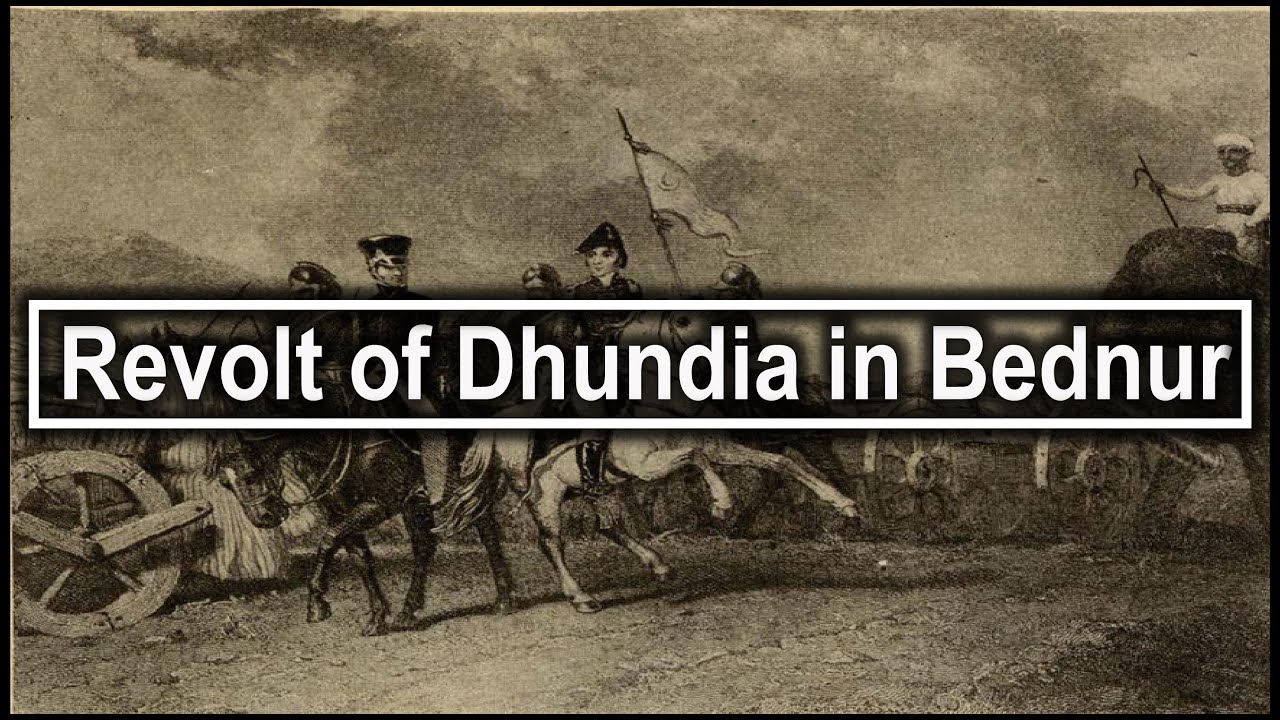
The Revolt of Dhundia in Bednur () stands as a key event right after the fall of Tipu Sultan. This local uprising showed the strong anti-colonial stance of the Maratha leader Dhundia Wagh against the growing British military and political power in Mysore and nearby areas. For students preparing for exams, this chapter explains how local leaders gathered forces and started early resistance against British rule in South India.
🎯 In this chapter, you will understand:
- How Dhundia Wagh mobilized forces immediately after the fall of Seringapatam in .
- The military tactics and alliance-building efforts used to challenge British forces.
- The final confrontation near Konagal led by Arthur Wellesley in .
- The historical significance of early regional revolts as precursors to larger anti-colonial movements.
💡 Why this topic matters: It highlights how early regional leaders organized local resistance against foreign rule right after major political shifts in South India.
🧠 Core Idea: Local leaders utilized power vacuums to build multi-regional alliances against British expansion.
Dhundia Wagh's Revolt Against British Power in Bednur (1799–1800): Genesis and Force Mobilization
This revolt broke out right after the British conquered Mysore in , with Dhundia emerging as a tough challenger to British rule.
This period marked the start of an organized anti-British movement in the area. Dhundia Wagh regrouped scattered troops and used the power vacuum created after the fall of Seringapatam to build his strength.
- (i) In the immediate aftermath of the British conquest of Mysore in , the victorious English East India Company faced strong opposition from local leaders who had lost their power.
- (ii) The leader of the revolt, Dhundia Wagh, was a Maratha commander who was forced to convert to Islam while serving under Tipu Sultan, and was later imprisoned by the Sultan for his disruptive activities.
- (iii) When Seringapatam fell and Tipu's rule ended, Dhundia was released from prison. Taking advantage of the chaos, he quickly built an anti-British force and set up a small region under his control.
Dhundia’s Campaign and Early Setbacks: The Active Resistance Against the British
The campaign led by Dhundia Wagh involved direct military actions and efforts to form regional alliances against the dominant British forces.

Initial Military Challenges and Strategic Retreat of Dhundia
Despite quick troop mobilization, Dhundia Wagh faced the stronger organizational power of the English forces early on, forcing him to retreat and regroup.
- (i) In , Dhundia Wagh suffered a defeat against the English army, forcing him to retreat into Maratha territory to rebuild his forces.
- (ii) He gathered his scattered troops and tried to build strong military and political alliances with local rulers who were worried about growing British power.
- (iii) His main goal was to unite these different local groups into a strong anti-colonial coalition capable of mounting a serious challenge.
Dhundia's Alliance-Building Efforts and Anti-British Coalition
The efforts of Dhundia were both military and political. He aimed to use local discontent against British expansion to build a unified front across different regions.
- (a) Mobilization of Discontented Elements: He brought together unhappy soldiers, small local chiefs, and common people loyal to the former rulers of Mysore and nearby Maratha border states.
- (b) Exploitation of Border Regions: Operating along the borders of Mysore, the Nizam's territory, and Maratha lands gave him space to move and avoid quick capture by the British.
- (c) Symbolic Resistance Leader: By uniting these groups, he became a symbol of hope for those who wanted to end British control and restore local rule.
Death and Legacy: A Symbol of Early Anti-Colonial Resistance
The death of Dhundia Wagh in a final battle ended his local rebellion, but his actions remained an important early example of resistance against British expansion in South India.
Conclusive Defeat and Death of Dhundia Wagh
The British sent experienced officers to stop Dhundia, which brought the uprising to an end.
Artistic representation of early 19th-century military resistance forces in South India. - (i) In , Dhundia Wagh was killed in battle against British forces led by Arthur Wellesley (later the Duke of Wellington) near Konagal village.
- (ii) Although he was defeated, his efforts demonstrated courage and determination against a well-equipped colonial power.
Legacy of Dhundia’s Revolt and its Historical Significance
The story of Dhundia Wagh's rebellion became part of local history as an act of resistance against foreign rule.
- (a) Popular Memory and Leadership: Despite his defeat, Dhundia was remembered as a local leader who fought against foreign control.
- (b) Symbol of Local Sovereignty: His uprising represented early organized resistance to consolidating British colonial power in South India at the turn of the 19th century.
- (c) Precursor to Later Uprisings: This event helps us understand the pattern of early regional revolts that occurred before the larger anti-colonial uprisings of the mid-19th century.
⚡ Quick Revision Capsule: Revolt of Dhundia in Bednur
Key details and events summarizing Dhundia Wagh's early anti-colonial uprising:
| Event / Aspect | Details & Key Terms | Historical Impact |
|---|---|---|
| Outbreak Period | , following the fall of Seringapatam | Created an immediate challenge for the English East India Company in Mysore. |
| Key Leader | Dhundia Wagh (Former Maratha commander) | Escaped imprisonment and organized local soldiers and chiefs. |
| Early Setback | defeat by British forces | Retreated into Maratha territories to build a multi-regional coalition. |
| Final Battle | near Konagal village | Dhundia was killed fighting forces under Arthur Wellesley. |
| Historical Role | Early anti-colonial uprising in South India | Served as a precursor to larger 19th-century resistance movements against British rule. |
📝 Summary
The Revolt of Dhundia Wagh () was one of the earliest organized challenges to British rule in India after the fall of Tipu Sultan. Although Dhundia Wagh was defeated and killed by forces led by Arthur Wellesley in , his efforts reflect the spirit of regional resistance in Mysore and nearby Maratha borderlands. For students, this uprising is an important case study showing how local leaders formed early resistance movements well before the major revolts of the 19th century.
🚀 Quick Revision Points
Essential facts to review before examinations:
- (i) The revolt broke out in immediately after the fall of Seringapatam.
- (ii) Dhundia Wagh was a Maratha leader who organized discontented soldiers and local chiefs.
- (iii) He operated along the border areas of Mysore, the Nizam's territory, and Maratha lands.
- (iv) He was defeated and killed in near Konagal by British forces led by Arthur Wellesley.
- 💡 Exam Tip: Focus on the timeline (), the main leader (Dhundia Wagh), the opposing British commander (Arthur Wellesley), and the geographic significance of the border areas of Mysore and Maratha regions.
❓ Frequently Asked Questions (FAQ)
Q1: Who was Dhundia Wagh?
A1: Dhundia Wagh was a Maratha military leader who escaped imprisonment after the fall of Tipu Sultan in and organized an early revolt against the British in Bednur.Q2: Who led the British forces against Dhundia Wagh?
A2: The British forces were led by Arthur Wellesley, who later became famous as the Duke of Wellington.Q3: What was the outcome of the Revolt of Dhundia Wagh?
A3: Dhundia Wagh was killed in battle near Konagal in , ending the localized revolt, though it stood as an important early symbol of anti-colonial resistance.