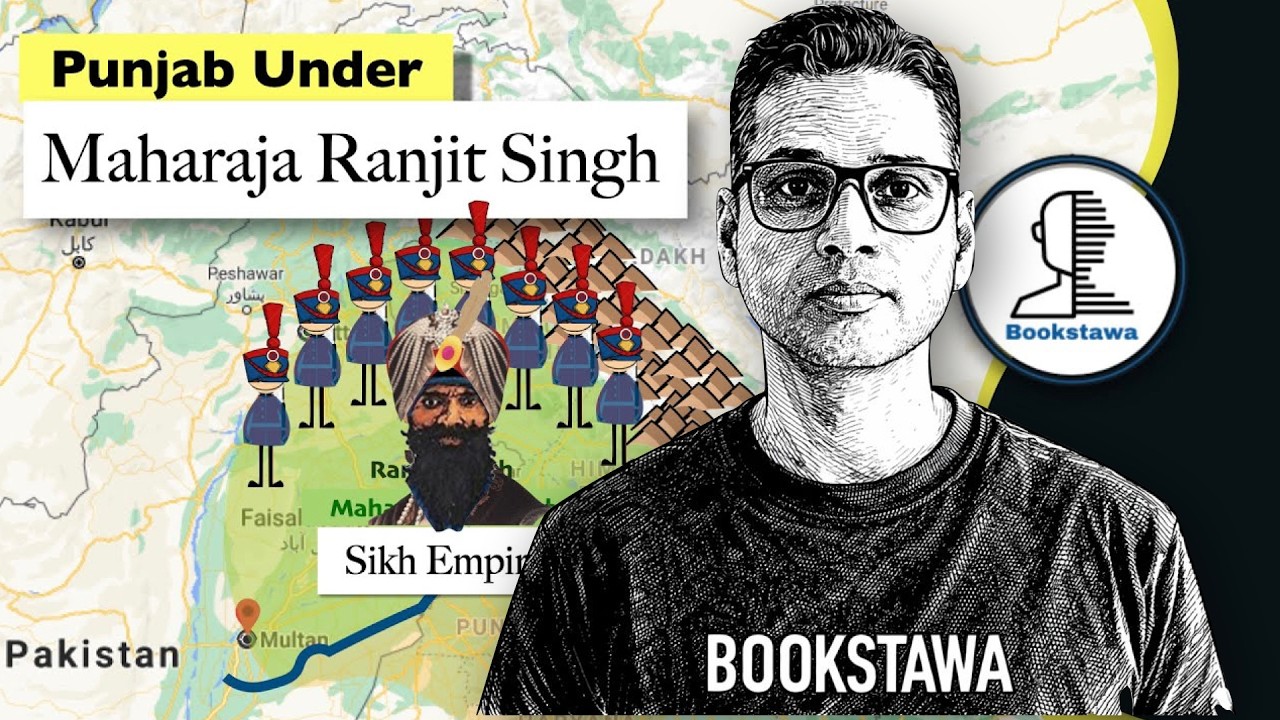
The political story of Maharaja Ranjit Singh involves his careful talks with the growing British East India Company and the eventual fall of the Sikh Empire. This forms an important part of Indian history. Major milestones, starting from the Treaty of Amritsar (1809) to the challenging period under Rani Jindan and young Daleep Singh, shaped the future of Punjab. For students preparing for exams, understanding these events helps explain Sikh-British relations, the power vacuum after Ranjit Singh's death, and the rise of British influence in North-West India.
🎯 In this chapter, you will understand:
- The terms and strategic impacts of the Treaty of Amritsar (1809).
- How Ranjit Singh expanded his territory westward toward Multan, Kashmir, and Peshawar.
- The political leadership crisis and chaos in Punjab after .
- The role of court rivalries and regency rule leading up to British control.
💡 Why this topic matters: It explains how strategic agreements delayed British expansion while internal leadership struggles eventually led to the annexation of Punjab.
🧠 Core Idea: Strong diplomacy and central rule maintained Sikh power under Maharaja Ranjit Singh, but internal disputes after his death made British expansion easier.
Maharaja Ranjit Singh’s Strategic Diplomacy, the Treaty of Amritsar, and the Erosion of the Sikh Empire (1807–1845)
Initial diplomatic efforts failed, leading to the Treaty of Amritsar, which fixed clear geographic boundaries for Ranjit Singh’s expansion.
At first, Ranjit Singh tried to build strong alliances to protect his young empire from outside threats, especially from the West. However, changing European politics involving the threat from Napoleon made the British take a firmer stance. This situation pressured him into accepting the terms of the Treaty of Amritsar (1809).
- (i) In , fearing a combined French and Afghan effort, Governor-General Lord Minto sent envoy Charles Metcalfe to Lahore to discuss an alliance with Ranjit Singh.
- (ii) Ranjit Singh asked the British to recognize him as the sole ruler of all Sikhs, including the cis-Sutlej territories east of the Sutlej River. The British refused this condition, creating a pause in negotiations.
- (iii) As the French threat faded, the British East India Company took a firmer position. This pushed Ranjit Singh to sign the Treaty of Amritsar on .
The Treaty of Amritsar (1809) and its Geo-Political Impact on Sikh Expansion
This agreement stopped Ranjit Singh from expanding east across the Sutlej River. As a result, he redirected his military focus toward the North and West.

Strategic Limitations and Political Realities of the Treaty
The Treaty of Amritsar recognized British influence in the east, setting borders that kept peace between the two powers for almost thirty years.
- (i) The Sutlej River became the official boundary separating British territory from Ranjit Singh’s kingdom.
- (ii) This boundary prevented him from uniting the Phulkian Misls and other groups in the cis-Sutlej region under his central government in Lahore.
Ranjit Singh’s Consolidating Expansion Towards the West and North
Blocked from moving east, Ranjit Singh turned his attention to expanding his territory into wealthy areas in the North and West.
- (a) The territory of Multan, ruled by the Durranis, was taken in , adding state revenue and securing the southern border.
- (b) Kashmir was conquered in after a successful campaign, opening up important trade routes.
- (c) The city of Peshawar came under Sikh control in , marking the maximum reach of the Sikh Empire.
The Tripartite Treaty of 1838: An Act of Compelled Diplomacy
In his later years, Ranjit Singh faced growing pressure from the British as they sought to protect their interests in Afghanistan.
- (i) Ranjit Singh joined the Tripartite Treaty in alongside the British and exiled ruler Shah Shuja to help restore Shuja to the Afghan throne.
- (ii) He refused to allow British troops to march directly across Punjab, forcing them to take a longer path to reach Dost Mohammad in Afghanistan.
- (iii) Relations with the British remained cautious and uneasy until his death in .
The Political Vacuum in Punjab After Maharaja Ranjit Singh (1839–1843)
The death of Ranjit Singh led to a lack of strong leadership, causing court rivalries and creating opportunities for British intervention.
The Succession Crisis and the Onset of Court Chaos
A quick succession of short reigns and unexpected deaths destabilized the government at Lahore.
- (i) His successor, Kharak Singh, struggled to manage court politics, which encouraged factions to form among the nobles.
- (ii) Kharak Singh died in , and his son Prince Nav Nihal Singh died in an accident on the same day while returning from the funeral.
- (iii) These events created a leadership crisis that weakened administrative control across the state.
The Deterioration and Discontent of the Sikh Khalsa Army
Without firm guidance, the disciplined Khalsa Army grew increasingly political and began making demands on the central government.
- (a) The loss of experienced generals like Mohkam Chand, Dewan Chand, Hari Singh Nalwa, and Ram Dayal left a gap in military leadership.
- (b) Unpaid soldiers became dissatisfied, while political promotions lowered discipline in the ranks.
- (c) Allowing British forces to pass near Punjab's borders created local disruption and highlighted the court's growing weaknesses.
Rani Jindan and Daleep Singh: The Regency Period and Intensified Instability (1843-1845)
During this regency period, internal court struggles reached a critical point right before conflict broke out with the British.
Court Intrigues and Political Turmoil Under Rani Jindan’s Regency
Regent Rani Jindan worked to maintain authority, but rivalry among court factions led to frequent changes in leadership.
- (i) Sher Singh, another son of Ranjit Singh, held power briefly before he was killed in .
- (ii) Young Daleep Singh was named Maharaja, with his mother Rani Jindan as regent and Hira Singh Dogra as Wazir.
- (iii) Hira Singh was killed in during further rivalries inside the court.
The Ascension of Lal Singh and Teja Singh to High Command
New figures took charge of the government and the army during a period of rising tensions with the East India Company.
- (a) Jawahar Singh served as Wazir for a short time until he was killed by army factions in .
- (b) Lal Singh became Wazir, taking charge of civil administration.
- (c) Teja Singh was appointed as Commander-in-Chief of the army ahead of the First Anglo-Sikh War.
⚡ Quick Revision Capsule: Timeline of Key Sikh Empire Events (1807–1845)
A quick summary of key diplomatic agreements, conquests, and succession events during this period.
| Year / Period | Key Event / Agreement | Historical Significance |
|---|---|---|
| Treaty of Amritsar | Fixed the Sutlej River as the boundary between British areas and the Sikh state. | |
| Western & Northern Expansion | Conquest of Multan (), Kashmir (), and Peshawar (). | |
| Tripartite Treaty | Agreement involving the British, Ranjit Singh, and Shah Shuja regarding Afghanistan. | |
| Death of Maharaja Ranjit Singh | Led to a leadership crisis and court disputes in Lahore. | |
| Regency of Rani Jindan | Young Daleep Singh named Maharaja amid shifting court leadership before war. |
📝 Summary
The historical period from the Treaty of Amritsar (1809) to the regency of Rani Jindan shows both the expansion and the difficulties faced by the Sikh Empire. Maharaja Ranjit Singh’s careful diplomacy helped preserve his state's independence during his lifetime. However, after his death in , political rivalries, short reigns, and lack of unity weakened the state's defenses. This internal instability paved the way for increasing British influence in Punjab during the middle of the .
🚀 Quick Revision Points
Essential facts to review before examinations:
- (i) The Treaty of Amritsar (1809) made the Sutlej River the official boundary.
- (ii) Westward campaigns added Multan, Kashmir, and Peshawar to the empire.
- (iii) Succession struggles began immediately after Ranjit Singh’s death in .
- (iv) Regency rule under Rani Jindan for minor Daleep Singh ended with new leadership before the First Anglo-Sikh War.
- 💡 Exam Tip: Focus on how geographic limits set by the treaty redirected expansion westward, and note the key figures involved in the Lahore court after .
❓ Frequently Asked Questions (FAQ)
Q1: What was the main geographic effect of the Treaty of Amritsar (1809)?
A1: It established the Sutlej River as the boundary, stopping expansion to the east and focusing campaigns toward the west and north.Q2: Which major territories were annexed by Ranjit Singh after 1809?
A2: Key annexations included Multan (), Kashmir (), and Peshawar ().Q3: Who were the leaders of the Lahore Durbar right before the First Anglo-Sikh War?
A3: Young Daleep Singh was Maharaja with Rani Jindan as regent, Lal Singh as Wazir, and Teja Singh as Commander-in-Chief.