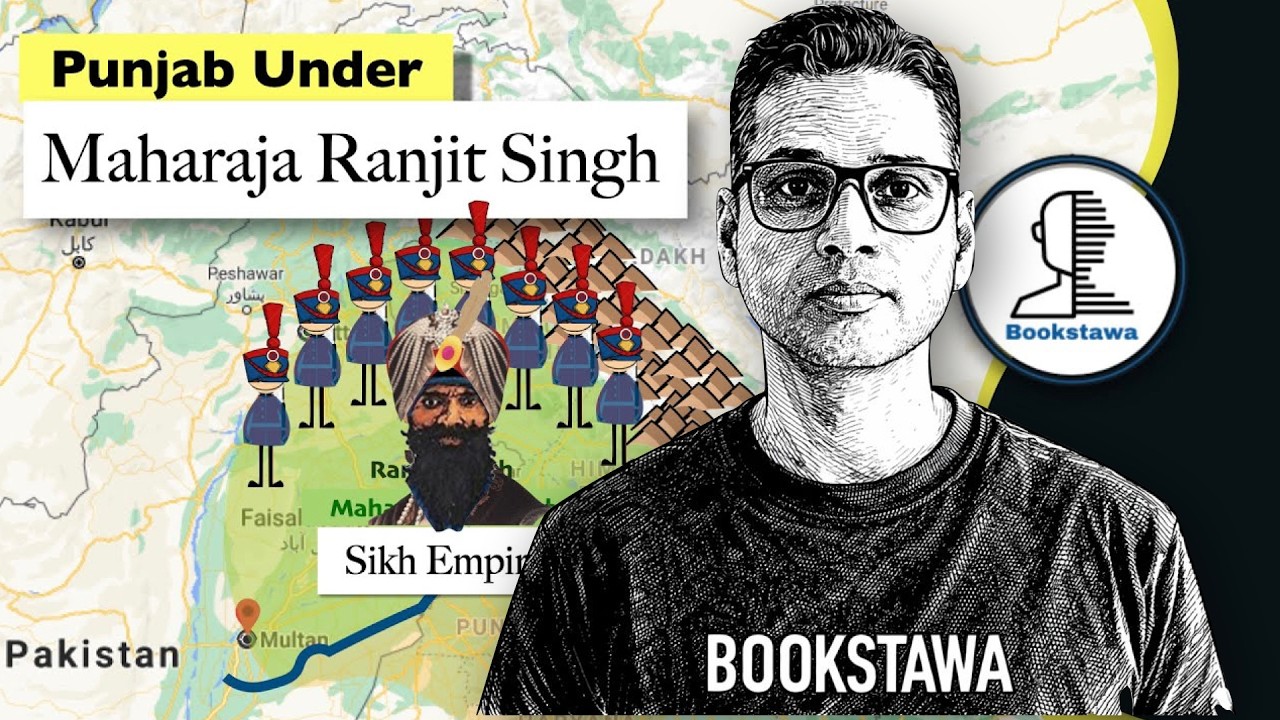
The rise of the Sikhs in Punjab after the fall of the Mughal Empire and the disruptions from Afghanistan is a key moment in Indian history. This movement started with armed resistance led by Banda Bahadur, developed into the structured army known as the Dal Khalsa, and led to a single state under Maharaja Ranjit Singh. His rule created the strong base for the Sikh Empire. For students preparing for history exams, learning about this era helps explain how small military groups transformed into a strong state.
🎯 In this chapter, you will understand:
- How early Sikh leaders built military resistance against Mughal oppression.
- The military structure of the Dal Khalsa and the division into twelve autonomous misls.
- How Maharaja Ranjit Singh consolidated territorial control across Punjab.
- The strategic military reforms and political alliances that enabled empire building.
💡 Why this topic matters: It highlights the transition of Sikh military bands into a unified empire before British expansion in North-Western India.
🧠 Core Idea: Strategic unity, decentralized local misls, and modernization under Maharaja Ranjit Singh built a powerful sovereign kingdom in 18th-century Punjab.
📌 Consolidation of Sikh Power in Punjab and the Rise of Maharaja Ranjit Singh
Following periods of political instability, Sikh leaders united local power bases to secure control over the Punjab region.
The Era of Early Sikh Resistance and the Leadership of Banda Bahadur
The military spirit built by the Sikh Gurus gained strength as the community fought back against oppressive imperial rule.
- (i) After the tenth Guru, Guru Gobind Singh, passed away, leadership of the military struggle went to Banda Bahadur, who led major uprisings against the imperial forces.
- (ii) After early victories, Banda Bahadur was captured by forces loyal to Emperor Farrukhsiyar in and executed in .
- (iii) His death briefly left the movement divided into two groups: the Bandai, who favored a flexible interpretation of traditions, and the Tat Khalsa, who maintained strict adherence to doctrines.
- (iv) In , the scholar Bhai Mani Singh resolved these internal disputes and reunited the groups.
📌 Formation, Organization, and Impact of Dal Khalsa and the Misls
A unified military framework became necessary to defend territory and maintain stability across Punjab.

Unification of the Khalsa under Nawab Kapur Singh
Scattered military units were brought together under a single central organization for strategic defense and expansion.
- (i) In , Kapur Singh (later known as Nawab Kapur Singh Faizullapuria) reorganized the community's defense forces into the Dal Khalsa.
- (ii) The army was split into two wings: the Budha Dal (veteran troops responsible for defense and community guidance) and the Taruna Dal (younger forces handling rapid operations).
Political Turmoil and Conditions Favoring Sikh Consolidation in Punjab
Weakened central authority and external attacks allowed local forces to build lasting regional influence.
- (i) The weakening of the central government along with repeated invasions led by Ahmad Shah Abdali created a power vacuum across Punjab.
- (ii) The unified Dal Khalsa used this opportunity to expand its political authority and secure regional territories.
Rise of Misls: Decentralized Sikh Military Brotherhoods
Territorial areas were governed by independent regional units that shared mutual defense commitments.
- (i) The community organized itself into twelve self-governing regional military units known as misls, each led by a local chief.
- (ii) The term misl comes from an Arabic word meaning equal, alike, or state.
- (iii) Between and , these brotherhoods controlled regions stretching from Saharanpur to Attock, and from the Himalayas down to Multan.
📌 The Dominance of the Sukarchakiya Misl and the Birth of Ranjit Singh
Leadership within the Sukarchakiya misl helped bring unity among rival regional brotherhoods.
Birth, Lineage, and Early Leadership
Strategic leadership built from early family responsibility helped set the foundation for a unified kingdom.
Territorial extent of the Sukarchakiya and neighboring misls - (i) Birth of Ranjit Singh: He was born on , when twelve major misls operated across Punjab, including the Ahluwalia, Bhangi, Ramgarhiya, and Sukarchakiya.
- (ii) Governance Structure: Political decisions across misls were guided by the Gurumatta Sangh, a central decision-making council.
- (iii) Assumption of Power: Son of chief Mahan Singh, young Ranjit Singh became chief of the Sukarchakiya misl at the age of 12 following his father's death.
- (iv) Decline of Rival Misls: By the late 18th century, internal conflicts weakened rival misls, leaving the Sukarchakiya misl as the primary power in Punjab.
📌 Maharaja Ranjit Singh: Consolidation, Military Might, and Imperial Expansion
Through military reforms and strategic diplomacy, Ranjit Singh formed a strong centralized administration.
Exploiting Instability and Initial Territorial Gains
Decisive administrative moves helped bring central towns under single governance.
- (i) Taking advantage of internal conflicts in Afghanistan, Ranjit Singh brought local chiefs under unified control.
- (ii) In , Afghan leader Zaman Shah recognized his authority by appointing him governor of Lahore.
- (iii) By , he acquired Jammu and Amritsar, establishing Lahore as the political capital and Amritsar as the religious center.
Strategic Alliances and Strengthening the Army
Modern military organizational methods helped protect borders against regional threats.
- (a) He formed key defense alliances with regional groups including the Dogras and Gurkhas.
- (b) He recruited soldiers from diverse communities to modernize his army against outside forces.
⚡ Quick Revision Capsule: Key Phases in the Rise of Sikh Power
A summary table highlighting major developments during the 18th century.
| Time Period | Leadership / Organization | Key Historical Event |
|---|---|---|
| Banda Bahadur | Led organized armed resistance against Mughal forces until his execution in . | |
| Bhai Mani Singh | Reconciled internal differences between the Bandai and Tat Khalsa factions. | |
| Nawab Kapur Singh | Formed the Dal Khalsa, divided into the Budha Dal and Taruna Dal. | |
| 12 Misls | Autonomous brotherhoods established territorial control from Saharanpur to Attock. | |
| Maharaja Ranjit Singh | Captured Lahore () and Amritsar (), uniting Punjab into a powerful empire. |
📝 Summary
The rise of power across Punjab during the shows how local military units united into a strong state system. Actions by Banda Bahadur, the formation of the Dal Khalsa, and the administration of Maharaja Ranjit Singh changed regional politics. The creation of the Sikh Empire built a strong state during the decline of foreign control. Studying this period helps students understand the political landscape encountered by the British East India Company.
🚀 Quick Revision Points
Essential facts to review before examinations:
- (i) Guru Gobind Singh passed leadership of the struggle to Banda Bahadur in the early .
- (ii) The Dal Khalsa was structured by Nawab Kapur Singh to manage military operations.
- (iii) Twelve autonomous misls managed regional governance through the Gurumatta Sangh council.
- (iv) Maharaja Ranjit Singh modernized the military and established Lahore as his political capital in .
- 💡 Exam Tip: Focus on the structural evolution: Banda Bahadur's early revolts → Dal Khalsa division (Budha/Taruna Dal) → Misl governance → Centralized Empire under Ranjit Singh.
❓ Frequently Asked Questions (FAQ)
Q1: Who organized the Dal Khalsa and what were its main divisions?
A1: Nawab Kapur Singh organized the Dal Khalsa in , splitting it into the Budha Dal (veterans) and Taruna Dal (younger forces).Q2: What was the role of the Gurumatta Sangh?
A2: The Gurumatta Sangh served as the central assembly and decision-making body for the autonomous misls.Q3: Why were Lahore and Amritsar politically significant under Maharaja Ranjit Singh?
A3: Ranjit Singh designated Lahore as the political capital in and Amritsar as the religious capital in .