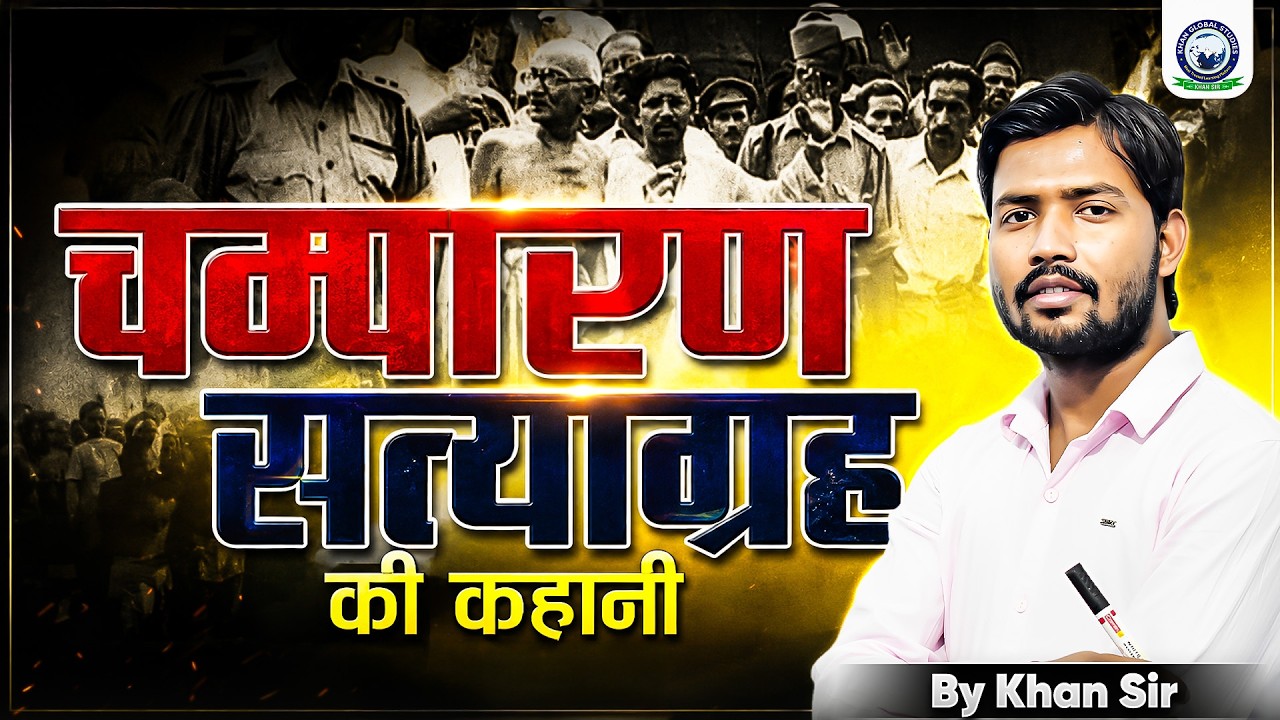
The Champaran Satyagraha of was the first major movement in which Mahatma Gandhi applied the method of civil disobedience in India. It highlighted the exploitation of local farmers under the tinkathia system and marked a major turning point in India's freedom struggle. For history students, this movement shows how non-violent resistance could challenge colonial power.
🎯 In this chapter, you will understand:
- How the exploitative tinkathia system forced farmers into severe economic distress.
- How Mahatma Gandhi launched his first civil disobedience movement on Indian soil in .
- The role of key associates and local leaders who supported the movement in Bihar.
- The long-term impact of the official inquiry that abolished forced indigo farming.
💡 Why this topic matters: The Champaran movement proved that non-violent mass resistance could successfully force the British administration to grant key reforms.
🧠 Core Idea: Ordinary farmers, organized through peaceful defiance and strong leadership, successfully ended decades of agricultural oppression.
Champaran Satyagraha: Gandhi’s First Civil Disobedience Movement of 1917 and Its Historical Significance
The story of India's freedom struggle took a new direction when an invitation brought Gandhi to a small district in Bihar. The protest grew from the quiet suffering of local peasants, turning a regional issue into a powerful testing ground for political change.
The movement started when Rajkumar Shukla, a persistent local leader, met Gandhi to explain the plight of the Champaran peasants.
- (i) The conflict centered on the tinkathia system, which forced farmers to grow indigo on a fixed portion of their land.
- (ii) This fight brought European land owners and local peasants into direct confrontation, paving the way for larger national movements.
- (iii) The event demonstrated that ordinary citizens could stand up against unfair laws without relying on violence.
The Agrarian Crisis: Understanding the Exploitative Tinkathia System
To grasp why the protest happened, one must look at the rules that drained the resources and spirit of the peasants across Bihar.

The Forced Cultivation of Indigo and Economic Strain
Under the tinkathia system, European planters legally required peasants to cultivate indigo on 3/20ths of their total land holdings. This rule prioritized commercial trade over food security for farming families.
- (i) When synthetic dyes developed in Germany reached the global market, natural indigo lost its value.
- (ii) Instead of freeing the farmers, land owners imposed higher rents (Sharahbeshi) and illegal extra taxes (Abwabs) to cover their losses.
- (iii) Peasants remained trapped because they were forced to sell their crops at fixed, low rates set by European buyers.
Gandhi’s Strategic Leadership: The Birth of Satyagraha in India
When Gandhi arrived in , he brought a calm, organized method of peaceful defiance that challenged colonial officials.
The Brain Trust: Gandhi’s Associates and Local Support
Gandhi gathered a team of dedicated lawyers and educated supporters who helped record detailed statements from thousands of local farmers.
- (a) Key leaders like Rajendra Prasad and Mazharul-Haq offered legal guidance and local knowledge across Bihar.
- (b) Core team members included:
- (i) Mahadeo Desai and Narhari Parekh, who managed record-keeping and communications.
- (ii) J.B. Kripalani, who helped connect with local students and youth.
Defiance of Authority: The First Act of Civil Disobedience
A central moment occurred when local authorities viewed Gandhi's inquiry as a threat to public order and instructed him to leave the district.
The Philosophy of Non-Violent Refusal
Instead of complying with the order to leave Champaran, Gandhi respectfully declined to obey.
- (a) He stated that he would accept whatever legal punishment was given rather than follow an unjust directive.
- (b) This action marked the first successful display of civil disobedience within India.
- (c) The refusal forced government officials to suspend the order and permit an official investigation into peasant complaints.
The Success and Lasting Legacy of the Champaran Movement
The resolution gave peasants relief from unjust demands and lifted the confidence of people participating in the national movement.
Institutional Victory: The Committee of Inquiry and Reforms
The administration created an official committee to inspect farming conditions, appointing Gandhi as one of its members.
- (i) Gandhi presented clear evidence showing that compulsory indigo farming needed to stop entirely.
- (ii) Landowners agreed to return 25% of the money they had collected through illegal charges.
- (iii) Within ten years of this agreement, European planters left their Champaran estates completely.
The Power of Collective Leadership in Bihar
Dedicated regional organizers worked constantly in nearby villages to maintain unity and peaceful conduct.
- (a) Brajkishore Prasad and Anugrah Narayan Sinha provided legal support and organized regional committees.
- (b) Ramnavmi Prasad and Shambhusharan Varma coordinated directly with village families to support the effort.
⚡ Quick Revision Capsule: Champaran Satyagraha Key Aspects
This table summarizes the core elements, key figures, and outcomes of the Champaran movement for quick review.
| Aspect | Details | Historical Significance |
|---|---|---|
| Year & Location | in Champaran, Bihar | First instance of organized civil disobedience led by Gandhi in India. |
| Primary Issue | The forced tinkathia system (3/20 land for indigo) | Exposed economic pressure on peasants caused by colonial commercial demands. |
| Key Initiator | Rajkumar Shukla | Demonstrated the power of local initiative in bringing national attention to grassroot issues. |
| Core Associates | Rajendra Prasad, J.B. Kripalani, Mahadeo Desai | Established a strong network of legal and organizational support across Bihar. |
| Major Outcome | Abolition of tinkathia & 25% refund of illegal dues | Proved that peaceful collective action could secure tangible administrative remedies. |
📝 Summary
The Champaran Satyagraha of stands as the starting point of Mahatma Gandhi's leadership in India's national movement. By removing the tinkathia system and protecting peasants from high rents, it proved that non-violent resistance could achieve practical success. The event marked a shift toward broad public participation across the nation, as documented in various historical accounts of India's Struggle for Independence.
🚀 Quick Revision Points
Essential facts to review before examinations:
- (i) The movement challenged the mandatory growing of indigo under the tinkathia system.
- (ii) Gandhi used peaceful defiance when ordered to leave the district by local authorities.
- (iii) The official committee recommended ending forced indigo farming completely.
- (iv) European land holders refunded 25% of illegal taxes and eventually left the region.
- 💡 Exam Tip: Remember that Sharahbeshi refers to rent increases, while Abwabs refers to illegal extra charges levied on peasants.
❓ Frequently Asked Questions (FAQ)
Q1: What was the main cause of the Champaran Satyagraha?
A1: The main cause was the tinkathia system, which forced peasants to grow indigo on 3/20ths of their land alongside extra taxes imposed by European owners.Q2: Who invited Gandhi to visit Champaran in 1917?
A2: Rajkumar Shukla, a local leader from Champaran, requested Gandhi's help to address the grievances of farming families.Q3: What was the final result of the Champaran movement?
A3: The government abolished the tinkathia system, land owners returned 25% of illegally collected fees, and European planters eventually withdrew from the area.