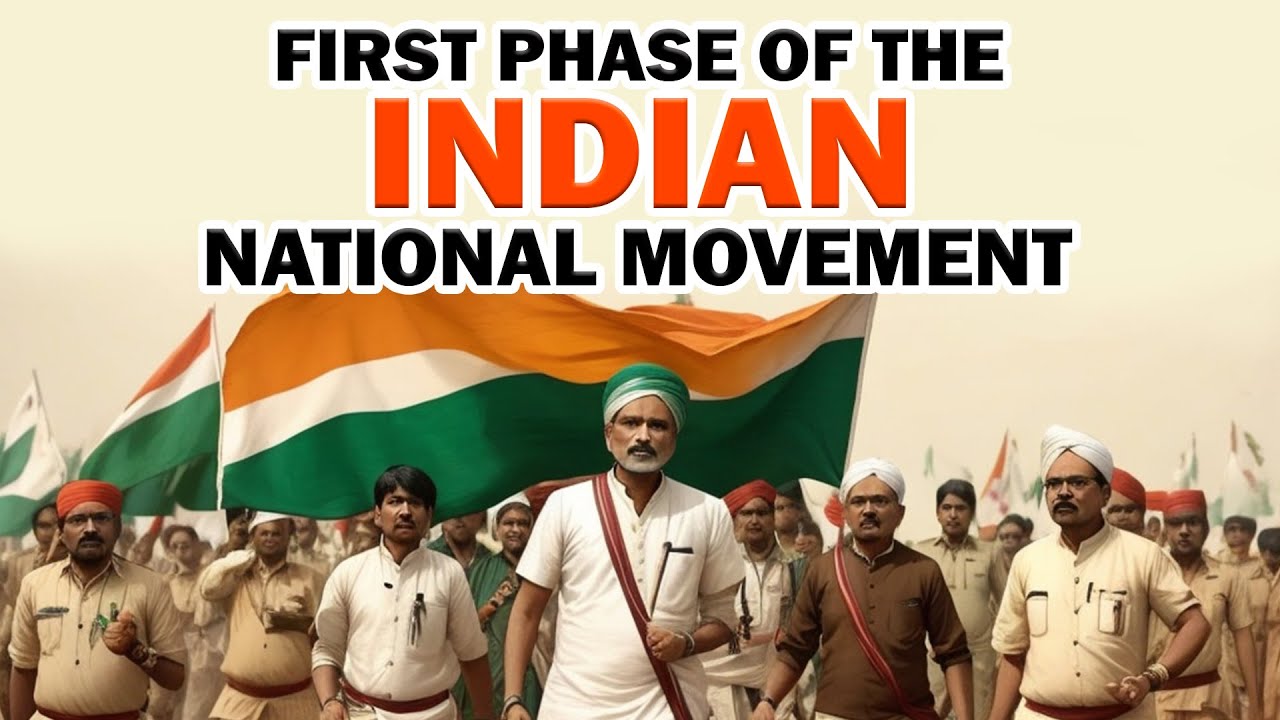
The early nationalists of India’s freedom movement played a pivotal role in awakening political consciousness and laying the foundation for a future mass-based nationalist struggle. Their contributions, though limited in mass mobilization, shaped the ideological and organizational framework of the Indian national movement, making this a cornerstone topic for students and competitive exams.
🎯 In this chapter, you will understand:
- How early leaders helped build political awareness and national unity between .
- The core ideological principles used to expose colonial economic exploitation.
- Differing historical perspectives on the Moderates from scholars and critics.
- The shifting stance of the British Indian Government toward the Indian National Congress.
💡 Why this topic matters: It explains how Indian political thought transitioned from early reform efforts to a structured, nation-wide movement for self-rule.
🧠 Core Idea: Before launching a mass movement, early leaders had to build national awareness, teach democratic habits, and expose the economic harms of foreign rule.
Significant Contributions of Early Indian Nationalists in the Freedom Movement:
The early nationalists led the spread of political awareness, modern ideas, and a sense of national unity, despite challenges in gathering mass support.
Acting as the intellectual guide of a growing nation, these leaders began a systematic awakening of the Indian people. They realized that before a physical struggle could begin, a mental and ideological change was needed to unite a diverse country under one national identity.
- (i) Their work was rooted in their role as progressive thinkers who led essential social reforms and the modernization of Indian society.
- (ii) Important progress included building a strong national consciousness that brought Indians together across regional lines to stand against foreign rule.
- (iii) This groundwork matters because their focus on political training and civic awareness set up the first principles of democratic practice in the country.
Comprehensive Analysis of Ideological Contributions and Political Awakening
The early nationalist phase was defined by a step-by-step approach to showing the true nature of foreign rule while building a solid internal political structure.

Foundational Principles of Nationalist Thought and Political Work
These leaders shifted the focus of the Indian national movement from localized complaints to a unified demand for governance based on Indian interests.
- (i) Expose of Colonial Exploitation: They carefully highlighted the harmful economic policies of colonial rule, which weakened its moral and legal standing.
- (ii) Practical Political Approach: Their strategies were based on real-world facts and practical logic rather than emotion or religious arguments.
- (iii) Core Political Principle: They clearly stated that India must be governed mainly for the benefit of the Indian people.
- (iv) Foundation for Future Movements: By setting up an organizational framework, they created the necessary base for the stronger mass movements that followed in later years.
- (v) Limited Democratic Base: While successful in building ideas, their political demands did not yet reach common citizens at the grassroots level.
Notable Perspectives and Opinions of Key Nationalist Thinkers and Critics
The work of the early nationalists has been studied through different viewpoints, from those who saw them as key architects to critics who felt their methods were too passive.
Intellectual Leadership and Historical Viewpoints
Prominent figures gave insights that helped shape nationalism, showing the growth of India's freedom movement.
Justice Mahadeo Govind Ranade ()
Justice Ranade offered a long-term view on building political habits among citizens.
- (i) He stated that organizing political work for the public was a new effort in India and needed to continue for years without expecting instant results.
- (ii) He believed in the gradual and steady development of civic responsibility among the people.
Pattabhi Sitaramayya and Bipan Chandra’s Historical Assessment
Both historians recognized the crucial foundational role played by early leaders.
- (i) Pattabhi Sitaramayya: He compared their work to the deep foundation of a building, which later supported self-government and full independence.
- (ii) Bipan Chandra: He named the period from as the "seed time" of Indian nationalism, where the seeds of freedom were planted.
Lala Lajpat Rai’s Critical Perspective
Lala Lajpat Rai presented a more critical view of the Moderates' methods.
- (i) From a critical angle, he described the early movement's cautious methods as overly reliant on petitions.
- (ii) He argued that this gentle approach left room for endless delays under the name of political patience.
The Role of the Masses and the Limitations of the Social Base
During this moderate phase, the nationalist movement had a narrow social base, which shaped its overall strategies and interactions with the colonial government.
Mass Participation and Strategic Restraint of the Moderates
Early nationalist leaders had a cautious relationship with the broader population, which limited their ability to directly challenge British authority.
- (i) Perception of the Public: Leaders often felt that the general public lacked political experience, leading to limited direct public involvement.
- (ii) Need for National Unity: They believed that firm unity across different social groups was needed before launching active political struggles.
- (iii) Avoiding Aggressive Tactics: Without broad public participation, the Moderates intentionally avoided aggressive methods.
- (iv) Voice of the Nation: Despite limited public outreach, early leaders stood as a unified voice for Indian interests against colonial rule.
Attitude of the British Indian Government: From Suspicion to Hostility
The British Indian administration looked at the movement with caution at first, but as early nationalists grew more vocal, official responses turned hostile.
Colonial Response and Suppression Tactics Against the Congress
The government used several tactics to reduce the influence of the Indian National Congress and prevent unity among Indians.
- (i) Growing Opposition: While suspicious at first, the government turned openly hostile after as Congress started criticizing colonial economic policies directly.
- (ii) Critical Labeling: Officials like Lord Dufferin tried to lessen the movement's impact by calling Congress a "factory of sedition" and labeling its members as "disloyal babus."
- (iii) Divide and Rule Policy: The administration encouraged opposing leaders, such as Sir Syed Ahmed Khan, to build a counter-narrative against the nationalist movement.
- (iv) Failure to Divide: Despite attempts to divide leaders or split the movement along communal lines, national consciousness continued to grow.
⚡ Quick Revision Capsule: Early Nationalist Movement ()
A quick comparison of key aspects, viewpoints, and colonial responses during the early phase of the freedom struggle:
| Aspect / Theme | Key Details & Figures | Historical Impact |
|---|---|---|
| Primary Goal | Constitutional reforms, administrative training, and political awareness. | Built the first organizational network across India. |
| Economic Critique | Exposed the "Drain of Wealth" caused by colonial rule. | Weakened the moral legitimacy of foreign rule. |
| Key Historian Views | Bipan Chandra named this period the "seed time" of nationalism. | Highlighted long-term foundational work. |
| Social Base | Mainly educated, urban professionals with cautious outreach. | Limited immediate mass mobilization. |
| British Stance | Hostility after , using "divide and rule" tactics. | Unintentionally strengthened national resolve over time. |
📝 Summary
In conclusion, the early nationalists built the foundations of political consciousness in India. By creating the organizational, moral, and economic arguments for the freedom struggle, they gave future generations a strong framework. Their work in educating citizens and exposing wealth drain during the 19th and early 20th centuries remains essential reading in Indian History for students and exam preparation.
🚀 Quick Revision Points
Essential facts to review before examinations:
- (i) Early nationalists led political education from through a systematic economic critique.
- (ii) Moderates prioritized national unity and civic training over immediate mass protests.
- (iii) Key thinkers like Justice Ranade stressed long-term political habits over quick gains.
- (iv) British official policy turned hostile after , attempting divide-and-rule tactics against the Indian National Congress.
- 💡 Exam Tip: Focus on the economic critique of colonial rule (Drain Theory) and how the British attitude toward Congress shifted after when answering descriptive exam questions.
❓ Frequently Asked Questions (FAQ)
Q1: What was the main contribution of early nationalists in India?
A1: They created political awareness, established democratic traditions, and exposed how colonial rule economically drained the nation.Q2: Why was their social base considered limited?
A2: Their membership consisted mostly of urban educated professionals who believed national unity and political training were required before involving the general public.Q3: How did the British administration react to the early Congress?
A3: The administration shifted from cautious observation to active hostility after , as documented in historical studies like India's Struggle for Independence.