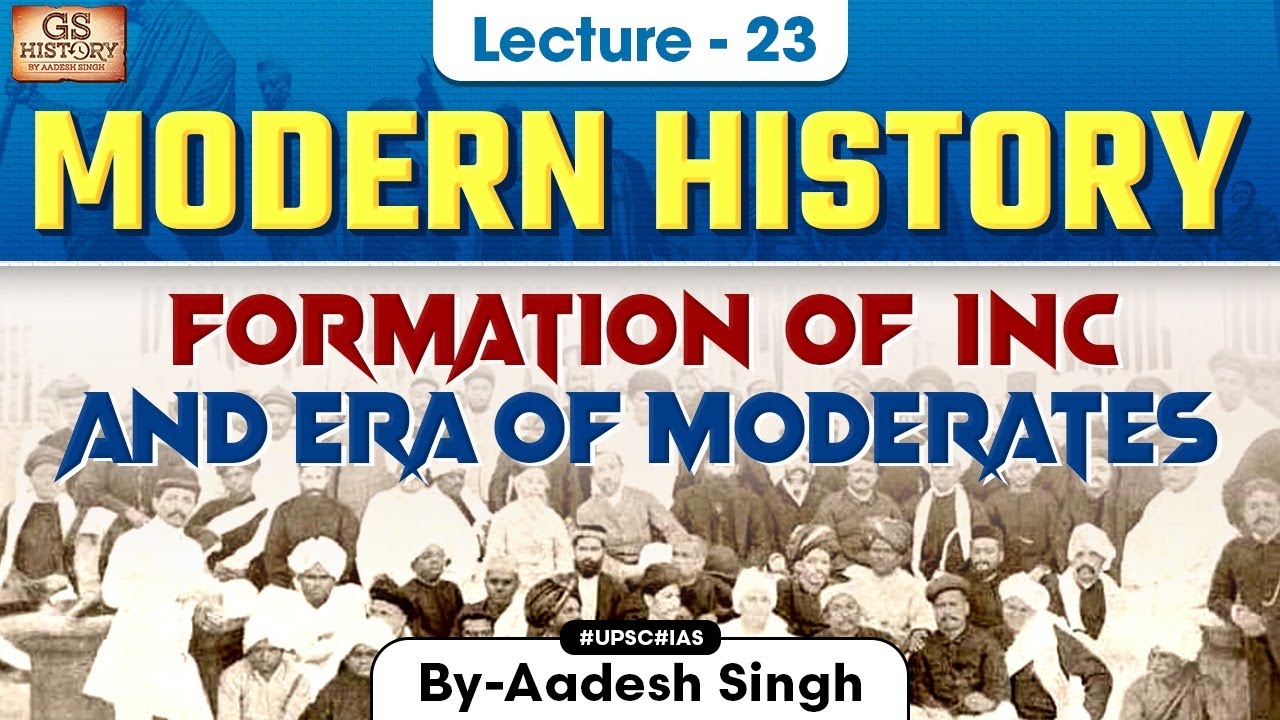
The era of Moderates in India's freedom struggle () witnessed the rise of leaders advocating constitutional reforms, public awareness, and moderate political methods. Their goal was to gradually transform colonial governance into a more representative system without direct confrontation, shaping the initial phase of India's nationalist movement, making it a cornerstone topic for students and competitive exams.
🎯 In this chapter, you will understand:
- The key founding leaders who led the early nationalist movement through constitutional means.
- The core ideology and methods behind constitutional agitation and public opinion building.
- How early Indian nationalists established political links in London to influence British policy.
- The overall historical impact and lasting significance of the Moderate phase ().
💡 Why this topic matters: It explains how India's first unified national political platform was formed and how legal advocacy laid the framework for freedom.
🧠 Core Idea: Achieving political and governance reforms through peaceful education, petitions, and legal constitutional agitation within the British system.
Important Leaders and Constitutional Methods of the Era of Moderates in India’s Freedom Struggle: 1885-1905
A distinguished group of pioneering intellectuals and statesmen steered the early nationalist movement through a framework of moderate political ideology.
The foundational phase of the Indian National Congress was defined by a specific leadership style that prioritized intellectual discourse and legal advocacy over radical action. These figures laid the groundwork for organized political thought in the subcontinent, focusing on a long-term vision of reform and equity.
- (i) The foundational background of this era was anchored by key figures such as Dadabhai Naoroji, Pherozshah Mehta, D.E. Wacha, W.C. Bonnerjea, and S.N. Banerjea, who provided the intellectual and organizational backbone of the movement.
- (ii) These leaders adhered strictly to the principles of liberalism and moderate politics, which led to them being designated as Moderates; this distinction became particularly clear when contrasted with the Extremists or neo-nationalists who emerged in the early twentieth century.
- (iii) This context matters because it highlights the transition from localized grievances to a unified national platform that sought to engage the British through their own legal and ethical standards.
Strategic Moderate Approach to the Indian National Movement: Methods and Ideologies
The Moderates functioned on the core belief that British rule could be improved from within, emphasizing constitutional agitation and the enlightenment of the masses as the primary catalysts for change.

Constitutional Agitation and the Awakening of Public Opinion
The methodology employed by the Moderates was rooted in the belief that political change should be an orderly and legal process, avoiding the chaos of sudden upheaval.
- (i) Methodological Order: All political actions were channeled through legal and constitutional methods, ensuring that the movement maintained a high degree of discipline and respectability in the eyes of the world.
- (ii) British Fairness: The Moderates held a unique perspective that the British authorities were inherently capable of fairness but remained largely unaware of the true, deteriorating Indian conditions, which necessitated a massive effort in public education.
- (iii) Presentation of Demands: Their primary strategy involved the systematic presentation of demands through formal resolutions, detailed petitions, and organized meetings to bridge the information gap between the rulers and the ruled.
Dual Objectives of the Moderate Strategy
The Moderate leadership operated with two distinct goals to ensure steady progress toward political reforms:
- (a) Creating Public Opinion: One major goal was to create strong public opinion that would serve to awaken national consciousness, effectively uniting various sections of society on common political platforms.
- (b) Government Persuasion: The second objective was to persuade the British government and the British public to accept and implement the reforms suggested by Indian nationalists.
- (c) Prayer and Petition: This process was famously characterized by the method of 'prayer and petition', with constitutional agitation serving as a final recourse when initial efforts were ignored.
International Engagement and Strategic Political Links with Britain
Understanding that the heart of colonial decision-making resided in London, the Moderates expanded their reach to the British capital to influence the colonial administration at its source.
Their international outreach aimed to directly influence British parliamentarians and taxpayers through systematic information campaigns.
- (i) Institutional Presence: A vital step was taken in with the establishment of a British committee of the Indian National Congress in London, which launched a journal titled India to keep the British public informed.
- (ii) Leadership Abroad:Dadabhai Naoroji, often referred to as the Grand Old Man of India, dedicated immense time and personal resources to live in Britain and advocate for India's cause directly in the halls of power.
- (iii) Global Planning: In , the movement showed its growing ambition by planning an INC session in London for , though the British elections of 1891 caused this specific plan to be postponed and eventually abandoned.
- (iv) Rationale for Connection:Moderate leaders remained convinced that maintaining political connections with Britain was essential during this formative stage, as it allowed for a gradual alignment of colonial rule with Indian national interests.
⚡ Quick Revision Capsule: Era of Moderates (1885-1905)
This table outlines the foundational elements, prominent figures, and strategies of the early nationalist phase:
| Key Aspect | Details & Description | Timeframe / Significance |
|---|---|---|
| Primary Period | Foundational phase of the Indian National Congress | |
| Key Leaders | Dadabhai Naoroji, Pherozshah Mehta, D.E. Wacha, W.C. Bonnerjea, S.N. Banerjea | Pioneered early liberalism |
| Main Ideology | Belief in legal mechanisms, constitutional agitation, and gradual reform | Non-confrontational approach |
| Methods Used | Petitions, resolutions, public meetings, and educational campaigns | 'Prayer and Petition' strategy |
| London Branch & Media | British Committee of INC established; published the political journal India | Established in |
📝 Summary
The Moderate leaders of the period spanning successfully laid the indispensable foundation for India's nationalist movement by championing constitutional reform and public opinion. Through their strategic engagement with the British, they popularized the use of petitions and education as tools of self-governance. Their legacy provided the structural and ideological framework that sustained the long-term struggle for freedom, making this era a vital study for students and competitive exams exploring the evolution of Indian political thought.
🚀 Quick Revision Points
Essential facts to review before examinations:
- (i) The Moderate phase lasted from , led by early intellectuals like Naoroji and Banerjea.
- (ii) Key strategies included creating public awareness and sending petitions to colonial authorities through constitutional agitation.
- (iii) The British Committee of the INC was formed in London in and published the journal India.
- (iv) This phase built the national political structure that paved the way for future freedom struggle movements.
- 💡 Exam Tip: Remember that the Moderates relied on '3 Ps' (Petition, Prayer, and Protest) within legal boundaries, distinguishing them from the Extremists who favored direct action after 1905.
❓ Frequently Asked Questions (FAQ)
Q1: Who were the main Moderate leaders of the Indian National Congress?
A1: Major Moderate leaders included Dadabhai Naoroji, Pherozshah Mehta, D.E. Wacha, W.C. Bonnerjea, and Surendranath Banerjea.Q2: What was the primary strategy of the Moderates during 1885–1905?
A2: Their main strategy was constitutional agitation, using petitions, public speeches, and resolutions to persuade the British government to grant administrative reforms.Q3: What journal was published in London to represent Indian nationalist views?
A3: The British Committee of the Congress launched the journal India in to inform the British public about Indian political issues.