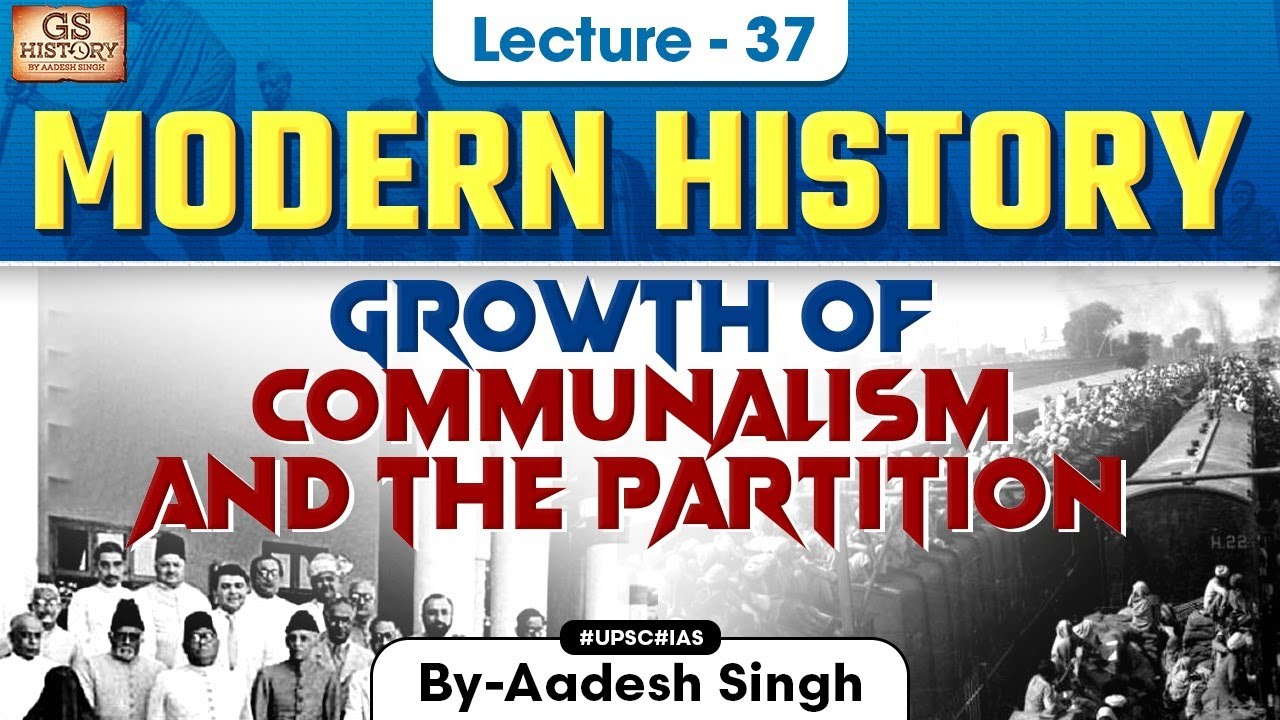
The history of communalism in India tracks the background, social conditions, money matters, and political choices that shaped society in India from the until the . Learning about these community frictions is vital for students getting ready for history and political science tests, as it brings to light policies of the British and various movement efforts for national freedom.
🎯 In this chapter, you will understand:
- How religious identity was changed into a political tool during the colonial era.
- The three distinct phases of communal thinking and their global connections.
- The economic, educational, and historical causes that created divisions among communities.
- The key events and policy choices that led straight to the 1947 Partition.
💡 Why this topic matters: It reveals how socio-economic gaps and political choices transformed religious differences into severe national political divisions.
🧠 Core Idea: Communalism in India evolved across three distinct stages, fueled by colonial strategies, middle-class job competition, and rewritten history.
📌 Historical and Socio-Political Evolution of Communalism in India during the 19th and 20th Century
A simple overview of how communal divisions grew to challenge Indian togetherness shows that the narrative goes well beyond basic faith differences. It reveals how social, financial, and political shifts gradually turned religious identity into a tool for politics, taking strong root in the and permanently altering the national movement for freedom.
Key moments in this early growth include the following steps:
- (i) It first stood out clearly in the as a reaction to new political systems.
- (ii) The movement guided political groupings and raised religious awareness among ordinary people.
- (iii) Its effects lasted throughout modern history, deeply influencing both national unity efforts and community-based campaigns.
📌 Detailed Characteristics and Modern Types of Communalism
To understand the friction within society, one must look at communalism as a changing set of ideas that appeared across distinct phases.

The Three Stages: Communal Nationalism, Liberal Communalism, and Extreme Communalism
The progression moved from a belief in shared interests to total conflict in the period before .
- (i) Communal Nationalism: This early step was built on the belief that people of the same faith share identical secular and non-religious interests.
- (ii) Liberal Communalism: In this middle phase, the belief grew that different religious communities have separate secular interests in money and politics, though living together peacefully was still seen as achievable.
- (iii) Extreme Communalism: The final and most dangerous phase was the firm belief that the political and financial interests of different religious groups are completely opposite and cannot exist together.
Comparative Global Phenomena and Modern Roots of Division
The rise of community-focused thinking in India was not an isolated event, as it reflected darker moments in world history.
Comparative Phenomena and Global Links
- (i) Indian community divisions share clear structural similarities with Fascism and anti-Jewish prejudice seen in other societies.
- (ii) Just like those movements, it relied on treating another group as the enemy to unite its own base.
The Role of Modern Mass Politics
- (i) Growing out of British ruling tactics and the start of large-scale public politics, faith identity was regularly used as a political weapon.
- (ii) Personal faith awareness was deliberately pushed into organized community political awareness to help specific political goals.
📌 Socio-Economic Disparities and Educational Factors Contributing to Communalism
Behind the religious talk were deep financial worries and colonial methods that made community splits much wider.
Middle Class Aspirations and the Impact of British Colonial Policy
The fight for jobs and social standing among the growing educated middle classes provided fertile ground for community divisions to spread.
- (i) The expanding middle classes frequently pushed group interests to secure government jobs and economic advantages for their own group.
- (ii) The British ruling authorities intentionally favored particular groups to grow their own support network and weaken national unity.
- (iii) Financial and social differences often matched up directly with religious lines, making existing tensions worse.
The Gap in Educational Advancement and Industrial Participation
Access to modern education turned into an area where gaps created feelings of fear and anger between communities.
- (a) Looking back at history, Muslims fell behind Hindus in modern western schooling and factory businesses during the .
- (b) A lack of open job positions for educated Muslims fueled requests for special consideration and reserved quotas.
- (c) These learning gaps widened splits, as one group felt left out while the other was seen as holding power.
📌 The Infamous British Divide and Rule Policy and Its Strategic Role
The British government used community-dividing strategies as a shield to protect themselves against the growing Indian national freedom movement.
Strategic Concessions and the Influence of Key Leaders
By giving special favors to specific religious groups, the British kept the population divided against colonial power.
- (i) After the , the British actively used political favors to win over Muslim leaders as a counterbalance to the Indian National Congress.
- (ii) Important leaders like Sir Syed Ahmed Khan were encouraged to focus on loyalty to the British government and center their work on separate Muslim interests.
📌 The Manipulation of History: Communalism in History Writing
The way historical events were written down and taught in schools played a huge role in fixing religious splits in people's minds.
Imperialist Interpretations and the Distortion of the Past
Colonial historians often presented Indian history as a never-ending fight between religions rather than a shared, blended culture.
- (i) Writers frequently split history into Hindu and Muslim periods, completely ignoring how people lived and worked together peacefully.
- (ii) By portraying old political disputes as purely religious wars, they gave a false justification for the community conflicts of the .
📌 Religious Reform Movements and the Rise of Militant Nationalism
Even organizations created to improve society sometimes accidentally helped community divisions grow.
Internal Reform and the Rise of Militant Identity
As groups worked to clean up and improve their faith traditions, the focus often turned toward a more aggressive and exclusive group identity.
- (i) Groups such as the Wahabi movement among Muslims and the Shuddhi movement among Hindus contained aggressive elements that increased religious friction.
- (ii) These reform efforts highlighted differences instead of common ground, creating an us-versus-them mindset.
The Overlap of Militant Nationalism and Religion
While early freedom fighters stayed non-religious, the later aggressive national movement started using religious symbols to gather public support.
- (i) Early national leaders kept religious matters out of politics to maintain broad unity against British control.
- (ii) However, later assertive national leaders included religious elements, such as public faith festivals, which made minority communities feel left out.
📌 The Cycle of Reactionary Elements and Communal Responses
Community division was never a one-sided problem; it worked as a continuous loop of action and reaction across society.
Hindu Reactionary Elements and the Formation of Groups
The growth of organized Muslim community politics triggered a matching organizational response from Hindu groups.
- (i) Hindu political feelings grew stronger as a direct response to specific Muslim political demands, leading to the creation of the Punjab Hindu Sabha.
- (ii) Groups like the Rashtriya Swayamsevak Sangh (RSS) were formed to unite Hindu identity amidst changing political conditions.
📌 The Two-Nation Theory and the Partition of India in 1947
The final outcome of decades of British tactics and community-based politics was the painful split of the Indian subcontinent.
The Foundation of Division (1887-1916)
- (i) : The British administration began openly supporting leaders who opposed the Indian National Congress to slow down the national movement.
- (ii) : The Muslim League was formed, focusing on loyalty to the British government and requesting separate voting lists.
- (iii) : In an effort to work together, Congress accepted the Muslim League's demand for separate voting rights through the Lucknow Pact.
The Rise of Extreme Demands (1920-1939)
- (iv) : Despite working together briefly, community divisions surfaced during the Khilafat protest as religious symbols took center stage.
- (v) : During the Civil Disobedience Movement, participation from Muslim groups was lower, and community tensions increased.
- (vi) : The Communal Award gave Muslims and other minority groups separate voting lists, breaking social unity even further.
- (vii) : Mohammad Ali Jinnah began making firm political demands that made reaching a peaceful deal with Congress very difficult.
The Final Break (1940-1947)
- (viii) : The Pakistan Resolution was passed in Lahore, officially asking for independent states.
- (ix) : The British government, weakened by the world war, supported the creation of Pakistan in as part of their departure plan.
⚡ Quick Revision Capsule: Evolution of Communalism
A quick summary table showing the main phases, key dates, and driving factors behind communalism in India:
| Phase / Event | Timeframe / Date | Key Features & Impact |
|---|---|---|
| Early Phase | Religious identity transforms into political awareness among the rising middle classes. | |
| Muslim League Founded | Focus on loyalty to the British and demanding separate voting lists (separate electorates). | |
| Lucknow Pact | Congress accepts separate voting representation to build temporary political unity. | |
| Communal Award | Colonial government grants separate voting rights to minorities, deepening social splits. | |
| Pakistan Resolution | Passed in Lahore, formally adopting the Two-Nation Theory and calling for separate states. |
📝 Summary
Studying communalism in India gives us important insights into how British policies, economic differences between groups, and reform movements can change a nation's direction. For students, mastering key dates—from the founding of the Muslim League to the —is necessary to understand the roots of modern religious divisions. This topic remains a core pillar for understanding the Indian freedom movement and its lasting impact.
🚀 Quick Revision Points
Essential facts to review before examinations:
- (i) Communalism evolved through three main stages: Communal Nationalism, Liberal Communalism, and Extreme Communalism.
- (ii) British ruling tactics used separate voting lists to keep national movements divided.
- (iii) Uneven access to modern education and government job competition among middle classes worsened group friction.
- (iv) Historians in the colonial era divided history strictly by religion, creating a false idea of unending conflict.
- 💡 Exam Tip: Focus on linking socio-economic causes (like middle-class job competition) with political milestones (like separate electorates in 1906 and the 1940 Lahore Resolution) when writing long-answer exam responses.
❓ Frequently Asked Questions (FAQ)
Q1: What are the three main stages of communalism in India?
A1: The three stages are Communal Nationalism (belief in shared non-religious interests), Liberal Communalism (belief in separate group interests with peaceful coexistence), and Extreme Communalism (belief that group interests are completely incompatible).Q2: How did education affect community divisions in the 19th century?
A2: Gaps in adopting modern western education left some groups with fewer government jobs, creating anxiety and demands for special reservations.Q3: What was the impact of the Lucknow Pact of 1916?
A3: In the Lucknow Pact, Congress accepted separate voting lists for Muslim representatives, which achieved short-term political agreement but officially recognized group-based political representation.