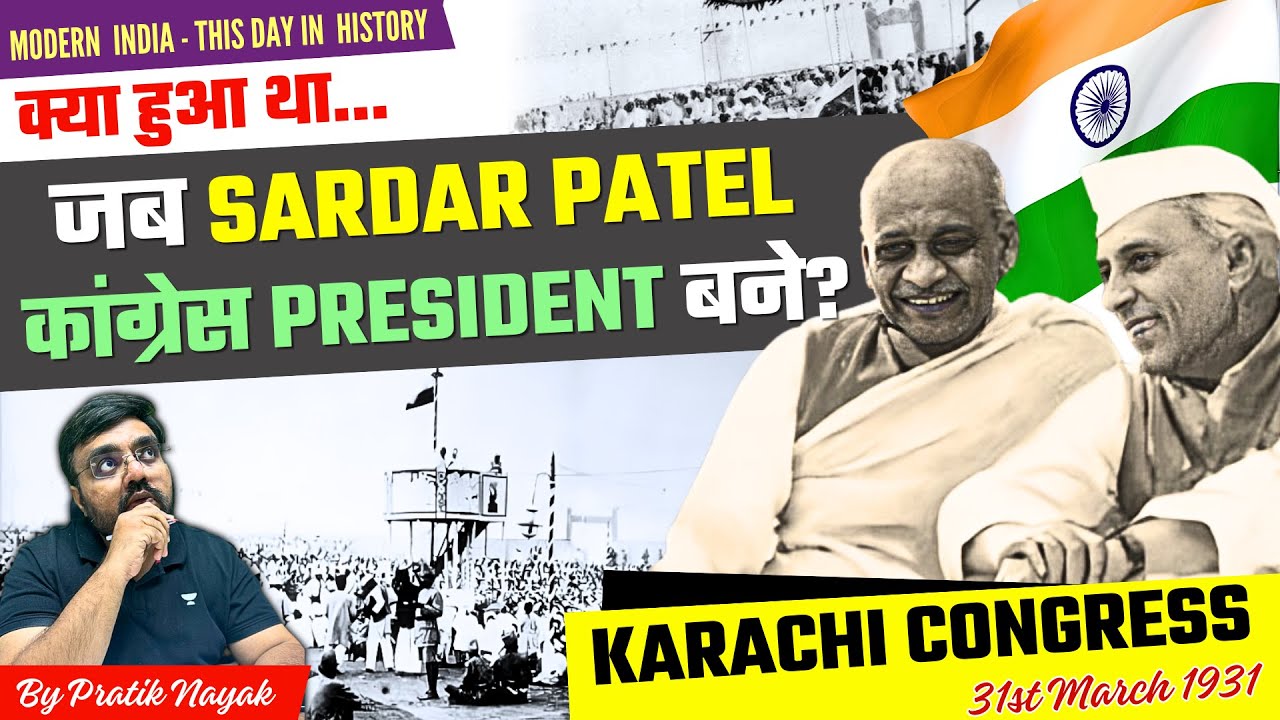
The Karachi Congress Session of 1931 was a vital turning point in India's freedom struggle, taking place right after the execution of Bhagat Singh, Sukhdev, and Rajguru in . It endorsed the Gandhi-Irwin Pact and set out key resolutions on political, social, and economic rights. For any student of Indian history, this session shows how the Indian National Congress balanced political strategy with a bold vision for civil liberties and social welfare.
🎯 In this chapter, you will understand:
- The historic background and emotional setting of the Karachi Session in .
- The key political resolutions passed, including the support for the Gandhi-Irwin Pact.
- The breakthrough resolution on basic civil liberties drafted by Jawaharlal Nehru.
- The National Economic Programme and how it shaped the future Constitution of India.
💡 Why this topic matters: It marks the first time the freedom movement clearly defined what Swaraj meant for ordinary workers, farmers, and marginalized communities.
🧠 Core Idea: True independence requires both political self-rule and guaranteed economic and social rights for every citizen.
Karachi Congress Session of 1931: Overview, Resolutions, and Significance
The historical events leading up to Karachi created a deeply emotional backdrop for all discussions during this annual meeting.
- The background and context of the Karachi Session shaped its direction and debates
The gathering took place during a time of great sorrow and political tension. The recent execution of young revolutionary heroes forced the leaders to balance diplomatic talks with the British government alongside the passionate demands of Indian youth.
- (i) The session was called in to formally approve the Gandhi-Irwin Pact, which was created to bring temporary peace and open talks.
- (ii) Six days before the session started, on , Bhagat Singh, Sukhdev, and Rajguru were hanged, causing widespread public anger.
- (iii) As Mahatma Gandhi traveled to Karachi, members of the Punjab Naujawan Bharat Sabha greeted him with black flag protests because he could not secure a reprieve for the three martyrs.
Congress Resolutions and Economic Programme at Karachi 1931
The official Congress resolutions at Karachi expressed deep respect for the martyrs, ratified the Gandhi-Irwin Pact, and firmly restated the nation's goal of achieving complete independence or Purna Swaraj.

Political Resolutions at the Karachi Session
The leaders managed a delicate task. They officially gave their support to peaceful diplomatic methods while recognizing the strong revolutionary spirit throughout the country. By accepting the Delhi Pact, they agreed to join the upcoming Round Table Conference, while making it clear that complete freedom was non-negotiable.
- (i) Even though the party did not support political violence, it praised the great sacrifice of Bhagat Singh, Sukhdev, and Rajguru.
- (ii) The delegates formally approved the Delhi Pact / Gandhi-Irwin Pact.
- (iii) The session strongly declared that Purna Swaraj remained the core goal of the nation.
Resolution on Fundamental Rights
This gathering became a historical milestone because it spelled out clear civil liberties and democratic protections for all citizens. Drafted largely by Jawaharlal Nehru, it laid out a vision for a fair and secular society. This document directly inspired parts of the future Constitution of India to protect minorities and weaker sections through equal legal rights and universal adult franchise.
- (i) Freedom of speech and a free press.
- (ii) Right to form peaceful unions and associations.
- (iii) Right to assemble peacefully without arms.
- (iv) Universal voting rights for all adults.
- (v) Equal rights under the law regardless of caste, religion, or gender.
- (vi) Complete neutrality of the state in religious matters.
- (vii) Free and compulsory primary education for children.
- (viii) Full protection of minority languages, cultures, and scripts.
Resolution on the National Economic Programme
This landmark declaration demonstrated the party's commitment to social and economic justice for farmers and workers. It expanded the freedom movement beyond simply changing rulers by demanding an end to economic exploitation and calling for state control over vital industries to help the common person.
Focusing on workers and farmers in 1931 - Land Reform: Significant cuts in land taxes and rent payments for small farmers.
- Relief for Farmers: Exemption from rent on poor-yielding land holdings and debt relief measures.
- Usury Controls: Strict rules to control high-interest moneylending and prevent unfair practices against the poor.
- Worker Protections: Safe workplace rules, fair living wages, fixed work hours, and special protections for female workers.
- Labor Rights: Guarantees for farmers and workers to form their own unions.
- Key Industries: Direct state ownership or control over major industries, transport systems, and mineral mines.
Significance and Legacy of the Karachi Congress Session
The Karachi Resolution was the very first attempt by the national movement to explicitly connect political independence with economic relief. It made sure everyone understood that freedom meant ending poverty and exploitation, while guaranteeing equal rights for all citizens.
Historical Importance and Future Impact
The ideals written in clearly shaped the Directive Principles of State Policy and Fundamental Rights in modern India. By explaining Swaraj in clear terms that working people and farmers could easily appreciate, the national movement became a truly broad struggle for social and economic freedom.
- (i) Explained independence as both political self-rule and economic security.
- (ii) Created a practical balance between peaceful talks and popular revolutionary feelings.
- (iii) Set the core social and economic policy goals for the nation in later decades.
⚡ Quick Revision Capsule: Karachi Session 1931 Highlights
Here is a quick snapshot of key facts regarding the session for fast review:
| Key Aspect | Details & Highlights | Historical Significance |
|---|---|---|
| Year & Location | Held in Karachi in | Organized during a crucial turning point in the independence movement. |
| Key Context | Took place right after the execution of Bhagat Singh, Sukhdev, and Rajguru | Reflected public grief and highlighted the tension between radical youth and moderate paths. |
| Major Political Step | Ratified the Gandhi-Irwin Pact and restated Purna Swaraj | Allowed participation in the Round Table Conference without giving up complete freedom as the final goal. |
| Civil Rights Blueprint | Passed the Resolution on Fundamental Rights drafted by Jawaharlal Nehru | Formed the foundational basis for human rights and democracy in the Constitution of India. |
| Economic Policy | Adopted the National Economic Programme for farmers and workers | Pledged state ownership of key industries, land rent cuts, and worker safeguards. |
📝 Summary
The Karachi Congress Session of remains an essential historical topic because it established the official vision for a free India. By uniting political freedom with concrete social and economic rights, it ensured that the goal of Swaraj directly served the welfare of every citizen.
🚀 Quick Revision Points
Essential facts to review before examinations:
- (i) Met in following the martyrdom of Bhagat Singh, Sukhdev, and Rajguru.
- (ii) Formally approved the Gandhi-Irwin Pact while maintaining the goal of Purna Swaraj.
- (iii) Passed a groundbreaking Resolution on Fundamental Rights drafted by Jawaharlal Nehru.
- (iv) Adopted a forward-looking National Economic Programme that guided the future Constitution of India.
- 💡 Exam Tip: Always highlight that Jawaharlal Nehru drafted the Karachi Resolution on Fundamental Rights, and mention its direct link to the Directive Principles of State Policy.
❓ Frequently Asked Questions (FAQ)
Q1: Who drafted the Resolution on Fundamental Rights at the Karachi Session in 1931?
A1: The resolution was drafted primarily by Jawaharlal Nehru.Q2: What was the main political agreement endorsed during this session?
A2: The session formally endorsed the Gandhi-Irwin Pact (also called the Delhi Pact).Q3: How did the Karachi Session influence the future Constitution of India?
A3: Its goals on civil liberties, free primary education, adult voting rights, and economic welfare were later built into the Constitution of India as Fundamental Rights and Directive Principles of State Policy.