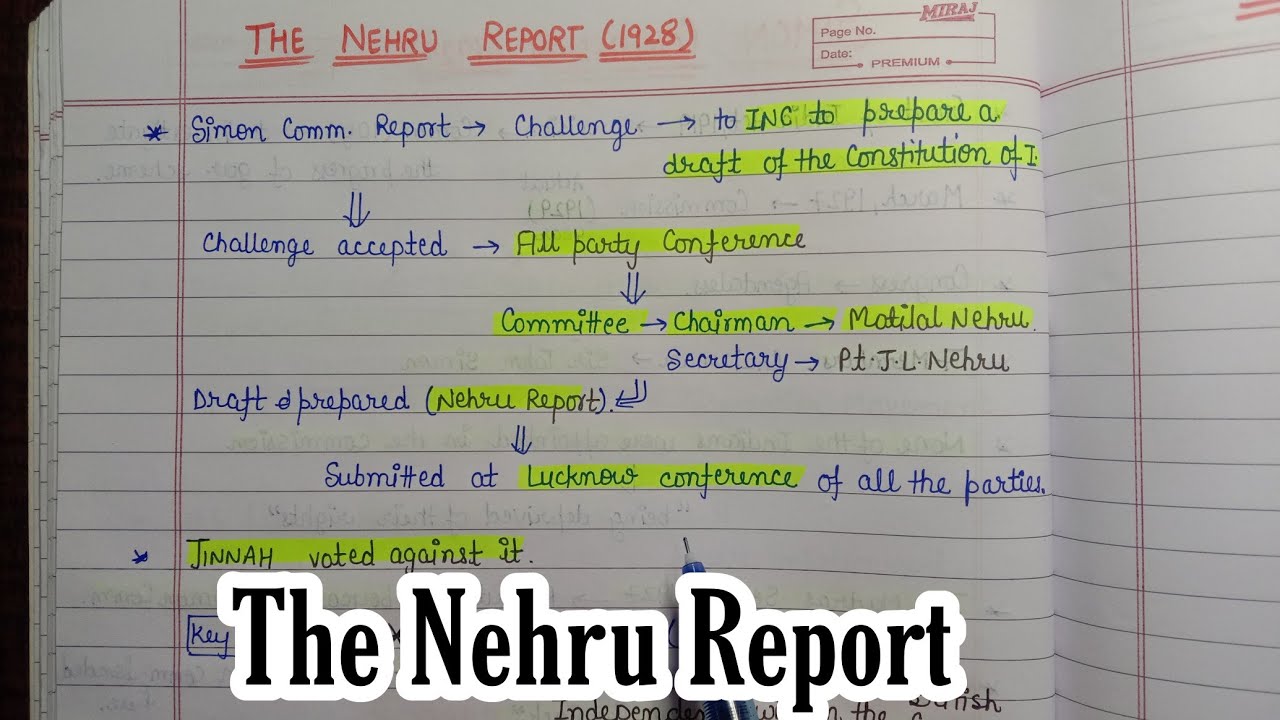
The Nehru Report written in is a major milestone in Indian constitutional development. It was the first big attempt by Indian leaders to write a Constitution of India. A team led by Pandit Motilal Nehru created this document to address key questions on communal unity, fundamental rights, and a democratic parliamentary structure. This report helps students and exam candidates learn about the path that led to Purna Swaraj (complete independence) in .
🎯 In this chapter, you will understand:
- The historic background behind the drafting of the Nehru Report in .
- The proposed system of Dominion Status, fundamental rights, and secular governance.
- The plan for a central Parliament, Prime Minister, and an independent Supreme Court.
- How the report proposed managing finance, national defence, and new linguistic states.
💡 Why this topic matters: It showed that Indian leaders could come together and write their own modern system of law and rights.
🧠 Core Idea: The report created a complete plan for self-rule inside the British Commonwealth with equal rights for all citizens.
Nehru Report 1928: A Blueprint for India’s Constitutional Framework
Indian leaders joined together to respond to challenges from British rulers, creating a shared vision for self-government.
During , national efforts grew stronger as leaders showed that India was ready to govern itself. The Nehru Report provided a legal structure to bring different political groups together under one national identity.
- (i) The main committee was led by Pandit Motilal Nehru and included key figures like Subhas Chandra Bose and Sir Tej Bahadur Sapru to plan rules for future governance.
- (ii) Leaders shared draft ideas with many political groups to build strong national agreement and strengthen communal unity.
- (iii) The British government rejected this report, which led the Indian National Congress in to stop asking for Dominion status and demand full Purna Swaraj instead.
Sovereign Status, Legal Operation, and Fundamental Liberties
The report wanted India to be a self-governing country with clear laws and protected personal rights.

The Transition to Commonwealth Status and the Dominion Model
The Nehru Report aimed to give India the same legal standing as self-governing British territories.
- (i) It requested that India become the Commonwealth of India with equal status to Canada, Australia, New Zealand, South Africa, and the Irish Free State.
- (ii) The plan established an elected Parliament with full law-making power and an executive team answerable to that Parliament.
Supremacy of Law and Territorial Reach
A single set of laws was planned so that the Constitution would remain the highest authority across all regions.
- (i) All laws passed by the main Parliament were to apply equally to courts and citizens in every province.
- (ii) The government's authority was set to cover all Indian territorial waters to protect coastal borders.
Guaranteed Fundamental Rights and Secular Equality
To treat everyone fairly, the committee created a list of essential fundamental rights for every citizen.
- (i) State Neutrality: The state would have no official religion, keeping public governance completely secular.
- (ii) Education Rights: Schools funded by public money could not force students to take part in religious classes.
- (iii) Equal Access: No person could be denied a public job based on their religion, caste, or creed.
- (iv) Gender Equality: The document stated that men and women must hold equal rights as full citizens.
Parliament, Executive Authority, and the Judiciary
The proposal included a two-house parliament and an accountable executive team to lead the nation.
Structure of the Bicameral Parliament
Law-making power was split into three main parts within the Commonwealth to maintain balance.
- (i) Legislative power was shared between the British monarch, a Senate, and a House of Representatives.
- (ii) A Governor-General would serve as the official representative head of state.
- (iii) The Senate was planned to have 500 members chosen by provincial councils through the Hare system of proportional voting.
- (iv) The House of Representatives was set for 500 members elected using universal adult suffrage for adults over age 21.
Commonwealth Executive and Cabinet Responsibility
Real executive power was designed to rest with ministers who represent the voters.
- (i) The Governor-General could only act on advice given by the Executive Council.
- (ii) This council would feature a Prime Minister and up to six ministers working with collective responsibility to Parliament.
- (iii) The Governor-General had to follow the explicit advice of the Prime Minister when naming ministers.
Provincial Governance and Local Management
Provinces were given local control through a similar leadership system.
- (i) Provincial law-making was shared between the monarch and a local legislative council.
- (ii) A local Governor would appoint a Provincial Executive Council with up to five ministers.
- (iii) These ministers managed daily departments and gave advice to the Governor.
Establishment of an Independent Supreme Court
To protect the Constitution, an independent judicial body was created to solve legal questions.
- (i) A main judicial court was planned, with its exact legal powers decided by Parliament.
- (ii) Led by a Lord President and associate judges, members could only be removed through a formal vote by Parliament.
Fiscal Policy, National Defence, and Administrative Reorganization
The report explained plans for national finance, military defence, and government services.
Revenue Management and Financial Duties
The new government would take control of state money, properties, and older financial obligations.
- (i) All public revenues and land rights were given to the Governor-General in Council.
- (ii) The new administration agreed to pay past debts left by the East India Company using India's revenues.
National Defence and Strategy
Military leadership was organized under a special council for national security.
- (i) A specialized Committee of Defence was planned, featuring the Prime Minister, Defence Minister, and military commanders.
- (ii) Two technical experts would join this committee to give advice on defense needs and national policy.
Civil Service Personnel Rights
Public officials and soldiers were guaranteed job security during the change in government.
- (i) Existing civil servants would become Commonwealth officers under a central Public Service Commission.
- (ii) Members of the armed forces kept their current pay scales, job rights, and pension benefits.
Diplomacy with Princely States
The new government planned to handle all relationships with local royal territories.
- (i) The main administration took over all existing treaties with the Indian States.
- (ii) Any disagreements with these states could be brought to the Supreme Court if approved by the Governor-General.
Linguistic Provinces and Voting Formulas
To help regional groups, the report created new province boundaries and an election plan.
- (i) Linguistic Boundaries: State lines were to be redrawn using local languages while keeping practical budgets in mind.
- (ii) Electoral System: The committee favored joint elections rather than separate voter groups, with temporary seat reservations for small communities.
- (iii) Regional Changes: Recommendations included separating Sind from Bombay, creating a new Karnataka province, and raising the governance status of the North-West Frontier Province.
- (iv) Time Limit: Reserved seats for minority groups were limited to to build long-term national unity.
⚡ Quick Revision Capsule: Nehru Report Key Recommendations
A quick summary of the constitutional proposals made in 1928:
| Feature Area | Key Proposal | Details & Timelines |
|---|---|---|
| Political Status | Dominion Model | Equal status to Canada and Australia within the Commonwealth. |
| Fundamental Rights | Equal Rights & Secular State | Guaranteed civic equality, gender parity, and freedom of religion. |
| Voting System | Universal Adult Suffrage | Direct voting rights for all citizens aged 21 and above. |
| Minority Rights | Joint Electorates | Reserved seats for minorities limited to . |
| State Map | Linguistic Reorganization | Provinces split by language, such as separating Sind from Bombay. |
📝 Summary
The Nehru Report 1928 stands as a landmark text in the history of Indian self-rule. It provided a detailed blueprint for fundamental rights, democratic parliament leadership, and local state autonomy. While British leaders did not accept these points—leading to the call for complete independence (Purna Swaraj) in —its central ideas became the foundational blocks for the final Constitution of India.
🚀 Quick Revision Points
Essential facts to review before examinations:
- (i) Created in under committee leader Pandit Motilal Nehru.
- (ii) Demanded Dominion status along with full universal adult suffrage.
- (iii) Included 19 basic fundamental rights, including gender equality and secularism.
- (iv) Proposed redrawing provincial boundaries based on regional languages.
- 💡 Exam Tip: Remember that the refusal of British leaders to accept the Nehru Report within one year led directly to the Lahore Session of 1929 and the demand for complete independence (Purna Swaraj) in 1930.
❓ Frequently Asked Questions (FAQ)
Q1: Who prepared the Nehru Report in 1928?
A1: It was drafted by a committee appointed by the All Parties Conference, chaired by Pandit Motilal Nehru with Subhas Chandra Bose and other leaders as members.Q2: What voting system was suggested in the report?
A2: The report recommended universal adult suffrage for everyone over 21 and rejected separate electorates in favor of joint electorates with temporary seat reservations.Q3: How did the Nehru Report influence the future Constitution of India?
A3: Many key features of today's Constitution of India—such as fundamental rights, secular governance, universal adult voting, and an independent Supreme Court—were first outlined in this document.