Explore the legendary journey of Subhash Chandra Bose, the revolutionary Netaji who redefined the freedom movement. From his resignation from the ICS to leading the Indian National Army (INA), this detailed guide is essential for students and competitive exam preparation focusing on British colonialism and armed resistance.
🎯 In this chapter, you will understand:
- The early political life and ideology of Subhash Chandra Bose.
- His international strategy, including visits to Germany and Japan.
- The establishment and military campaigns of the Indian National Army.
- The historical impact of the Red Fort trials and Netaji's lasting legacy.
💡 Why this topic matters: It highlights how armed resistance and global diplomatic alliances shaped India's final struggle against British rule.
🧠 Core Idea: Bose mobilized Indian resources across foreign lands to challenge colonial power directly through the Indian National Army.
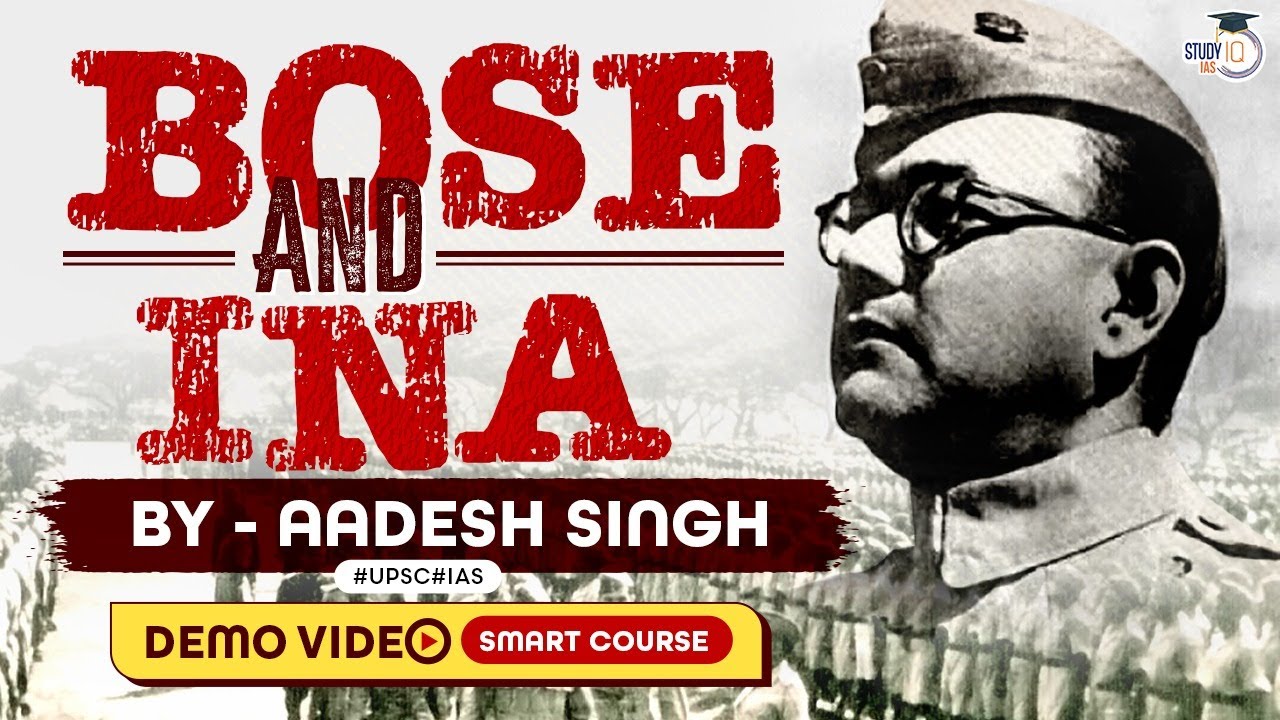
Subhash Chandra Bose and the Indian National Army: Comprehensive Leadership Journey and Revolutionary Impact (1921–1945)
The ideological foundation and political evolution of Netaji Subhash Chandra Bose began long before the world stage.
The story of Bose is one of defiance and intellectual brilliance, where a young man from Cuttack transformed into the Supreme Commander of a liberation army. His early life was a constant battle against European insults and imperial arrogance, setting the stage for a lifetime of militant nationalism.
- (i) From his youth, Bose was known for his militant reactions whenever he witnessed insults directed at Indians by Europeans, signaling his future role as a revolutionary leader.
- (ii) Demonstrating exceptional intellect, he secured the 4th rank in the prestigious Indian Civil Services exam, yet his conscience led him to resign in to dive headfirst into the freedom struggle.
- (iii) Under the mentorship of Chittaranjan Das, he entered local politics and achieved the significant milestone of becoming the mayor of Calcutta in .
- (iv) Over time, he grew disillusioned with Mahatma Gandhi’s methods of non-violence, believing that an independent revolutionary path was the only way to break the chains of British colonialism.
The Anti-Compromise Conference, German Alliance, and the Strategic Formation of the INA
By , Bose realized that India’s independence required a global strategy, leading him to seek alliances with Britain's enemies during World War II.

The Anti-Compromise Conference and the Dawn of Radical Resistance
In the early , Bose intensified his internal opposition to British war policies, demanding immediate and total independence without any middle ground.
- (i) In March , he convened the historic Anti-Compromise Conference at Ramgarh, a move designed to unite all radical elements against British exploitation.
- (ii) During National Week on April 6, , he made a clarion call for a massive resistance movement against the use of Indian resources for Britain’s imperial war efforts.
- (iii) Following his arrest in July , he utilized a hunger strike as a political weapon, eventually executing a daring escape from house arrest in January via Peshawar.
The Berlin Connection: Bose’s Journey to Germany and the Freedom Army
Subhash Chandra Bose's escape led him to the heart of the Axis powers, where he sought to build a military force capable of invading India from the outside.
- (i) Using the alias Orlando Mazzotta, he reached Germany and successfully secured an audience with Adolf Hitler to discuss Indian independence.
- (ii) At Dresden, with Axis backing, he founded the Mukti Sena (Freedom Army), which was primarily composed of Indian POWs captured by the Germans.
- (iii) Through the establishment of the Free India Centre in Germany, he popularized the iconic patriotic greeting “Jai Hind”.
- (iv) By , recognizing the shifting tides of war, he undertook a perilous submarine journey to Japan and Singapore to assume control of the Indian National Army.
The Genesis and Growth: The First Phase of the Indian National Army
The INA was not built overnight; it was the result of the initial vision of Indian military officers in Southeast Asia who saw an opportunity in the British defeats.
- (i) The original concept of the INA was pioneered by Mohan Singh, an officer of the British Indian Army who sought Japanese support to recruit Indian POWs in Malaya.
- (ii) The movement saw rapid growth, and by late , the INA's strength had swelled to approximately 40,000 disciplined troops.
- (iii) A crucial condition of its formation was that the INA would act under the Indian National Congress’ guidance to prevent Japanese misconduct or imperialist intentions.
- (iv) However, internal friction and disagreements over the scope of the army led to the detention of Mohan Singh by Japanese authorities, momentarily stalling the movement.
The Golden Era of Leadership: Bose as Supreme Commander of the INA
The arrival of Netaji in Southeast Asia breathed new life into the struggling nationalist army, turning it into a formidable political and military entity.
The Transition of Command
Arriving in Tokyo in June , Bose was greeted as a savior and officially took over the leadership mantle from the veteran revolutionary Rashbehari Bose. On August 25, , he was formally declared the Supreme Commander of the Indian National Army.
Establishment of the Arzi Hukumat-e-Azad Hind
On October 21, , in Singapore, he proclaimed the Provisional Government of Free India, gaining diplomatic recognition from several nations. It was in Malaya where he delivered his most famous ultimatum: “Give me blood, and I will give you freedom”, fueling the "Chalo Delhi!" march.
The Military Campaign: From the Heights of Kohima to the Decline
The INA’s march toward the Indian mainland was a saga of bravery, logistical nightmares, and eventual tragedy against the backdrop of a world at war.
- (i) INA forces reached the Indian soil of Kohima and Imphal, and in a moment of great pride, the INA flag was hoisted at Moirang (Manipur) in April .
- (ii) Despite their courage, the soldiers faced severe discrimination from the Japanese regarding rations and arms, which significantly hampered their operational morale.
- (iii) The campaign faced a definitive halt following the surrender of Japan on August 15, , after the atomic bombings.
- (iv) The journey of Netaji ended in mystery; he reportedly died in a plane crash in 1945, a subject that remains a point of intense historical debate.
The Lasting Legacy: Evaluating Subhash Chandra Bose’s Impact on Modern India
While the INA may have been defeated on the battlefield, its existence ensured that the British could no longer rely on the loyalty of the Indian military.
The Ideological Blueprint: Unity and Militant Nationalism
Bose provided a structural and psychological alternative to the mainstream nationalist movement, emphasizing a secular and unified Indian identity.
- (i) He successfully introduced a militant alternative to the Gandhian philosophy of non-violence, proving that Indians were ready to fight for their freedom.
- (ii) The INA was a melting pot of cultures, promoting total unity among Indians regardless of their caste, religion, or regional background.
- (iii) He gifted the nation with powerful taglines and iconic slogans like “Jai Hind” and “Chalo Delhi”, which continue to resonate in the Indian psyche.
The INA Trials and the Final Push for Independence
The legal battle following the war became the final catalyst for the end of the British Raj in India.
- (i) The Red Fort trials of INA officers in triggered unprecedented nationwide protests, bridging the gap between different political ideologies.
- (ii) This movement inspired Indian soldiers within the British Indian Army to question their loyalty to the crown, leading to incidents like the Royal Indian Navy Revolt.
- (iii) These events collectively strengthened the irreversible push towards total independence, finally achieved in .
⚡ Quick Revision Capsule: Key Milestones of Netaji & the INA
A quick chronological breakdown of Subhash Chandra Bose's key contributions to the Indian independence struggle.
| Year | Key Event / Milestone | Historical Significance |
|---|---|---|
| Resignation from the Indian Civil Services (ICS) | Chose active political participation in the freedom movement. | |
| Convened the Anti-Compromise Conference at Ramgarh | Rallied radical nationalists against British imperialistic war efforts. | |
| Escape to Germany & establishment of Mukti Sena | Sought foreign alliances and mobilized captured Indian POWs. | |
| Proclamation of Arzi Hukumat-e-Azad Hind in Singapore | Established a provisional government and took full command of the INA. | |
| Red Fort Trials of INA officers | Sparked public protests and triggered the Royal Indian Navy Revolt. |
📝 Summary
The life of Subhash Chandra Bose and the struggles of the Indian National Army represent a pivotal chapter in the freedom movement. For students, understanding his militant approach and the Red Fort trials during is crucial for grasping the complexity of British colonialism. Netaji’s legacy of sacrifice and “Jai Hind” remains a cornerstone of Indian nationalism.
The Historical Significance of Netaji for Future Generations
Netaji’s leadership proved that Indian national sentiment was strong enough to organize an army and establish a provisional government abroad. His contribution transformed the anti-colonial struggle into an international issue, inspiring military uprisings that made continued British rule unviable.
🚀 Quick Revision Points
Essential facts to review before examinations:
- (i) Bose resigned from the ICS in and later founded the Forward Bloc.
- (ii) He formed the Mukti Sena in Dresden, Germany, using Indian prisoners of war.
- (iii) Mohan Singh initially founded the INA before Netaji took leadership in .
- (iv) The Red Fort trials sparked widespread anti-British resistance across the country.
- 💡 Exam Tip: Focus on the transition from Mohan Singh to Subhash Chandra Bose in the INA and the impact of the Red Fort trials on the British Indian Army.
❓ Frequently Asked Questions (FAQ)
Q1: Who initially conceptualized the Indian National Army?
A1: The initial idea was conceived by Mohan Singh with Japanese support in Southeast Asia.Q2: What was the Arzi Hukumat-e-Azad Hind?
A2: It was the Provisional Government of Free India declared by Bose in Singapore in .Q3: What was the historical impact of the INA trials?
A3: As detailed in historical accounts like The INA Trials, the trials unified public opinion and inspired events like the Royal Indian Navy Revolt.