The Three Major Upsurges of 1945-46 were powerful moments in India's journey toward freedom. These events were driven by large public protests against the INA trials and ongoing colonial oppression. Major demonstrations in places like Calcutta and Bombay showed strong anti-British sentiment among students, everyday citizens, and armed forces personnel. Learning about these events is valuable for students studying modern Indian history, as they show how public anger helped speed up the end of British rule.
🎯 In this chapter, you will understand:
- The main events and dates of the three major protest waves in and .
- The three-stage pattern showing how local student protests grew into nationwide movements.
- The historic strike by the Royal Indian Navy ratings on HMIS Talwar.
- How political leaders like Mahatma Gandhi and Sardar Patel viewed these violent protests.
💡 Why this topic matters: These upsurges showed that even the armed forces were losing faith in the British government, making it clear that colonial rule could no longer continue smoothly.
🧠 Core Idea: Widespread public anger and military strikes combined to show strong unity across different groups, pushing India closer to independence.
Three Major Upsurges in India: The Final Blow to British Colonialism (1945-46)
During the winter of , India experienced three main waves of protest that shook the foundation of the British administration. These events grew out of strong national feelings, where public anger over the trial of Indian National Army (INA) officers brought many people into the streets. The cities of Calcutta and Bombay were at the center of these activities.
Three distinct timeline moments defined this short period:
- (i) : The first protest began in Calcutta as students and local residents gathered to express anger over the INA trials held at the Red Fort.
- (ii) : Protests broke out again in Calcutta when crowds gathered to object to the seven-year prison sentence given to INA officer Rashid Ali.
- (iii) : A major turn took place in Bombay, where sailors of the Royal Indian Navy started a strike against unequal treatment and poor working conditions.
The Dramatic Evolution: A Three-Stage Pattern of the Anti-British Upsurgences
The Three Major Upsurges followed a clear three-step pattern. They began as small student rallies and gradually grew into large citywide shut-downs that disrupted standard daily operations.

Stage I: The Spark of Local Defiance and Initial Repression
In the first phase, small organized student groups led peaceful marches to express their views. When police used force to stop them, local anger grew quickly.
Case Study: The 1945 Calcutta Student Procession
- (i) On , a student procession in Calcutta was stopped by police using baton charges and gunfire.
- (ii) The death of Rameshwar Banerjee during the event turned a student march into a widely supported public movement.
Stage II: Explosion into City-Wide Participation and Mass Resistance
After news of student injuries spread, working-class citizens and local shopkeepers in Calcutta and Bombay joined the protests, halting regular daily work in many areas.
- (i) Citywide strikes (Hartals) took place, and large meetings were organized at locations such as Deshbandhu Park.
- (ii) Protesters targeted official buildings, government post offices, and police posts to show their opposition to colonial authority.
Stage III: Reaching the Zenith of National Solidarity and Armed Dissent
In the final phase, support spread into other towns and reached servicemen in the military forces, showing that public concern had extended beyond civilian groups.
- (i) Sympathy strikes occurred in distant towns, demonstrating shared views across various regions.
- (ii) Servicemen expressed agreement with the civilian crowds, showing that old routines of strict control were changing rapidly.
The Historic Rebellion by Royal Indian Navy (RIN) Ratings in 1946
The strike on by naval ratings in Bombay became one of the most noted military actions of that era, showing that Indian sailors were no longer willing to accept unfair treatment.
Detailed Account of the RIN Strike and the Siege of HMIS Talwar
The strike started on the naval establishment HMIS Talwar, where around 1,100 ratings stopped work to protest against poor living conditions and unequal status.
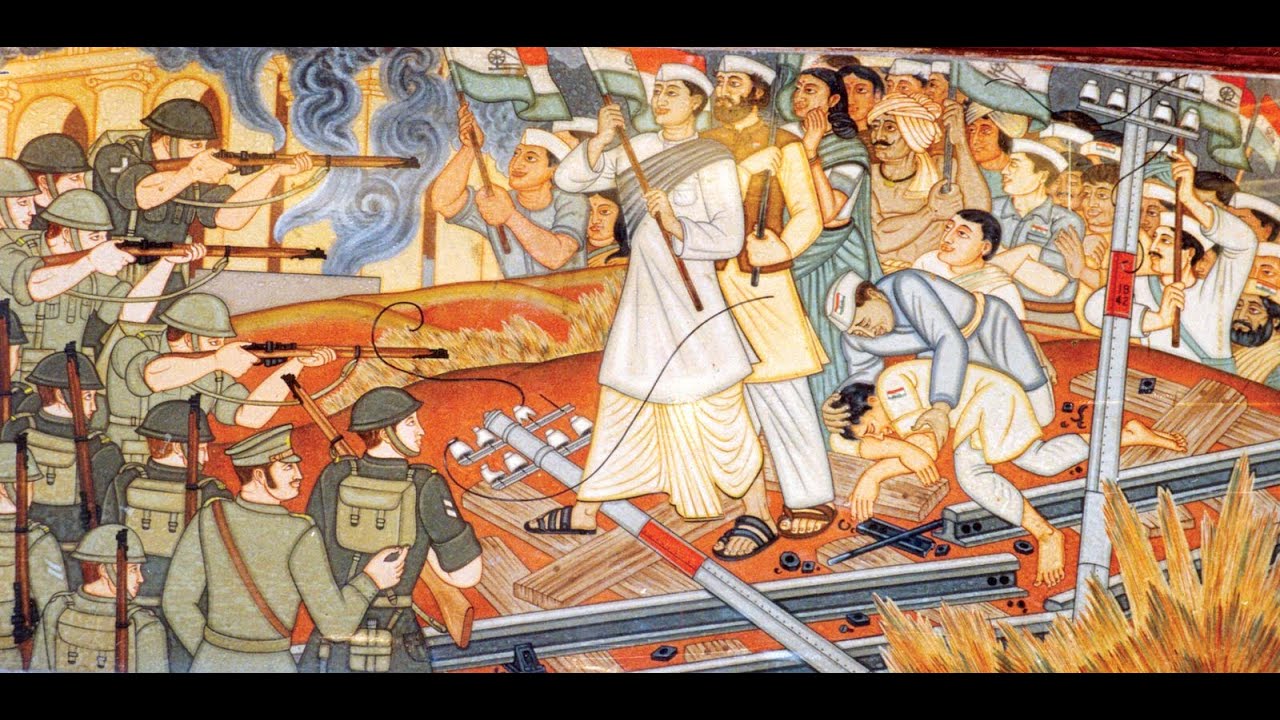
Naval ratings protesting aboard HMIS Talwar in Bombay, 1946. - (i) Ratings raised concerns about unpalatable food (poor quality dal and chapatis), harsh words from senior officers, and the ongoing INA trials at the Red Fort.
- (ii) Protesters raised the flags of the Congress, the Muslim League, and leftist groups together on ship masts, and marched through Bombay to show common purpose.
- (iii) Local residents in Bombay helped the sailors by offering food, milk, and essential items during the event.
⚡ Quick Revision Capsule: Key Protests of 1945-46
Here is a short summary table listing the main protest events, dates, primary locations, and key highlights for quick revision.
| Date / Time | Location & Movement | Key Highlights & Focus |
|---|---|---|
| Calcutta Student March | Protest against INA trials; resulted in police firing and the death of Rameshwar Banerjee. | |
| Calcutta Demonstration | Organized public response to the 7-year prison sentence given to Rashid Ali. | |
| Bombay RIN Naval Strike | 1,100 sailors on HMIS Talwar struck over racial discrimination and poor food. | |
| Citywide Hartals | Widespread shutdowns in urban centers targeting post offices and government offices. | |
| Political Negotiations | British government sent the Cabinet Mission to discuss political transition steps. |
📝 Summary
The Three Major Upsurges of showed that both urban citizens and military personnel shared strong feelings regarding independence. By bringing people together across different walks of life, these events speeded up official talks, leading toward the end of British rule in .
🚀 Quick Revision Points
Essential facts to review before examinations:
- (i) Protests in and were triggered by the INA trials.
- (ii) The movement grew from student rallies to citywide strikes and military actions.
- (iii) Ratings on HMIS Talwar protested against bad food, unfair comments, and inequality.
- (iv) Main political leaders preferred peaceful, structured negotiations as guided by Mahatma Gandhi.
- 💡 Exam Tip: Remember that these upsurges were mostly centered in major cities like Calcutta and Bombay, and were key reasons why the British sent the Cabinet Mission in 1946.
❓ Frequently Asked Questions (FAQ)
Q1: What started the first wave of protests in November 1945?
A1: The initial protest in Calcutta was started by students objecting to the INA trials taking place at the Red Fort.Q2: What were the main complaints of the Royal Indian Navy ratings on HMIS Talwar?
A2: The ratings protested against bad quality food, unequal treatment, harsh remarks from officers, and the ongoing INA trials.Q3: How did national leaders view the RIN strike?
A3: Leaders like Mahatma Gandhi and Sardar Patel advised against violent actions, preferring organized political discussions to manage the transition to Swaraj.