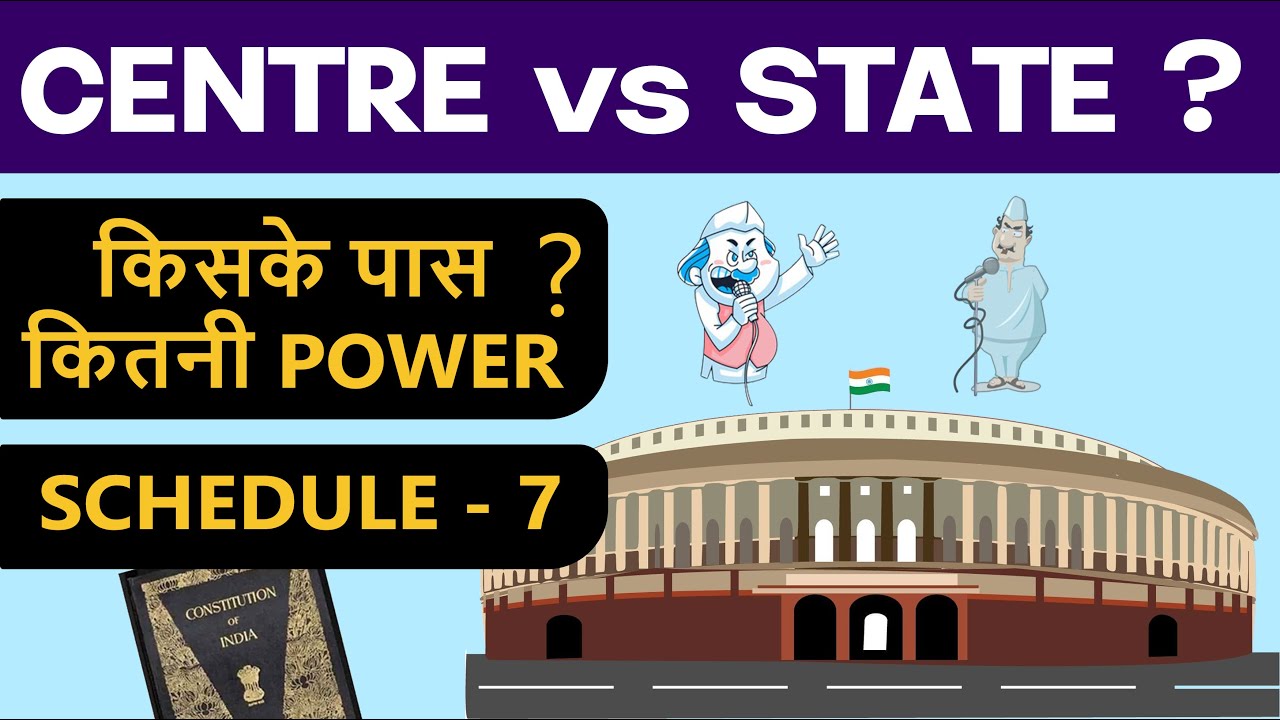
Explore how our country shares power between the central government in New Delhi and the various state governments. The Constitution of India, which came into force on , sets up a clear system where both levels of government work together. Understanding legislative relations (how laws are made), administrative relations (how daily rules are carried out), and financial relations (how tax money is collected and shared) helps students, teachers, and civil service exam candidates learn how Indian Polity keeps the entire nation united and strong.
🎯 In this chapter, you will understand:
- How the law-making powers are divided between the central national government and state governments under the Constitution of India.
- How the central executive team coordinates with state leaders so that public rules run smoothly everywhere.
- How money raised from taxes is shared fairly across the entire country using official guidelines.
- How water disputes, emergency conditions, and special financial grants are managed peacefully by official constitutional councils.
💡 Why this topic matters: India is a vast country made of many diverse states. Knowing these rules explains how the national government in Delhi and local state leaders work like a single team to build schools, fix roads, protect borders, and handle public emergencies.
🧠 Core Idea: The federal system gives the national government enough strong authority to protect the entire country while giving state governments enough local space to care for their own people.
📌 Articles Related to Centre-State Relations: Legislative, Administrative, and Financial Overview
The Constitution of India builds a structure with two main levels of leadership: the central national government (also called the Union) and individual local governments (called States). Think of the central government like a school principal who looks after the entire school, while state governments are like classroom teachers who look after individual classrooms. Power is distributed carefully so that the country stays safe and united while allowing each region to solve its own unique local problems.
This power-sharing mechanism relies on three distinct branches of daily cooperation:
- (i) The legislative branch decides where laws apply and which authority gets to write rules about specific topics like defense, police, or health.
- (ii) The administrative branch makes sure government officers and offices carry out those rules in complete harmony.
- (iii) The financial branch manages the money collected from taxes so both central and state teams have enough funds to run public services.
📌 Centre-State Legislative Relations
Legislative relations explain who has the official legal power to write laws for the country or for a specific state. To keep things clean and organized, the Constitution of India lists exactly what topics belong to the national government, what topics belong to state governments, and what topics both can work on together.
Foundations of Legislative Authority
The story of making laws starts by defining geographic boundaries (where a law works) and subjects (what a law is about) under the rules of the Constitution of India.
- (i) Article : Sets the basic geographic rules. It says that Parliament can make laws for the entire country of India or any part of it, while a State Legislature can make laws only for its own state territory.
- (ii) Article : Explains the famous three-list system. The Union List has topics like defense and foreign affairs for Parliament. The State List has local topics like police and public health for state leaders. The Concurrent List has shared topics like education and forests where both can make laws.
- (iii) Article : Gives Parliament special permission to build extra courtrooms and appoint judges to ensure national laws are followed properly.
📌 Points to remember: Article 245 defines geographic limits, Article 246 sets up the three subject lists, and Article 247 lets Parliament set up extra courts.Parliamentary Supremacy and Residuary Powers
Sometimes new inventions appear that were never thought of when the Constitution was written, like the internet or computer software. During unexpected national events, Parliament is given extra powers to keep the entire nation safe and united.
- (i) Article : Covers extra topics called residuary powers. Any new subject that is not written in any of the three main lists automatically goes directly to Parliament.
- (ii) Article : Says that if the Rajya Sabha (the Council of States) passes a special vote declaring that a subject is of national importance, Parliament can temporarily step in to make a law on a topic normally handled by states.
- (iii) Article : States that when an official national emergency is declared, Parliament gets the power to make laws on any item in the State List for the entire country.
Resolving Legislative Inconsistencies
When state laws and national laws cover similar grounds, clear rules determine which law must be followed.
- (i) Article : Explains that if a normal state law clashes with a national law made under Article 249 or Article 250, the national law made by Parliament takes priority while the emergency or special reason exists.
- (ii) Article : Acts as the ultimate referee when a state law and a central law on a shared Concurrent List topic disagree. The central law made by Parliament wins, unless the state law received special approval from the President of India.
📌 Points to remember: Residuary powers belong to Parliament under Article 248, and national laws take precedence over conflicting state laws under Article 254.Cooperative and International Legal Frameworks
Our federal setup allows states to ask the central team for help, and allows the central team to honor promise deals made with other nations across the world.
- (i) Article : Explains that if two or more state legislatures pass resolutions asking Parliament to make a shared law for them, Parliament can write that law for those consenting states.
- (ii) Article : Gives Parliament the full authority to pass laws for any part of India to fulfill international treaties, peace pacts, or global trade agreements signed with foreign countries.
- (iii) Article : Clarifies that if a legal recommendation or prior permission from a Governor or the President was accidentally missed before passing a bill, the final Act is still valid as long as final assent was given later.
📌 Points to remember: Article 252 allows states to request joint central laws, and Article 253 lets Parliament enforce international treaties.

📌 Centre-State Administrative Relations
Administrative relations are all about how police officers, civil servants, government offices, and agencies carry out day-to-day work. Both the central and state governments must coordinate smoothly so that public services, transport systems, and safety networks work without interruption.
Obligations and Union Control
The central government holds supervisory authority to make sure all state executive offices obey national laws and preserve public properties like railways and highways.
- (i) Article : Requires every single state executive team to follow central laws passed by Parliament, ensuring smooth legal enforcement everywhere.
- (ii) Article : Explains that state executive powers must not block or harm central executive actions. It allows the central government to issue direct guidelines to states on maintaining national highways, military pathways, and railway networks.
- (iii) Article : Previously allowed the central government to deploy armed military or paramilitary forces into states to handle severe order issues (this article was later repealed by the 44th Constitutional Amendment in ).
📌 Points to remember: Article 256 demands compliance with national laws, and Article 257 protects national transport routes like railways and highways.Inter-Governmental Delegation and Recognition
Our system encourages cooperative federalism, which means central and state teams can share workloads or assign officers to help each other on big tasks.
- (i) Article : Permits the President of India, with the consent of a state government, to hand over central administrative duties to that state's officers.
- (ii) Article : Allows a Governor of a state, with the consent of the national government, to hand over state administrative duties to central officers.
- (iii) Article : Permits the central government to take over executive, legislative, or judicial duties over foreign lands outside India if agreed upon by treaty.
- (iv) Article : Sets up the rule of "Full Faith and Credit". This means public records, official government acts, and legal court decisions made in one state must be respected and accepted across every other state in India.
📌 Points to remember: Articles 258 and 258A allow mutual work sharing between the Centre and States, while Article 261 makes legal court orders respected nationwide.Dispute Resolution and Inter-State Coordination
When neighboring states disagree on vital natural resources like river water, specialized bodies help solve problems peacefully without long court battles.
- (i) Article : Gives Parliament the exclusive power to set up special tribunals to settle disputes regarding the use, control, or distribution of water in inter-state rivers or river valleys. Normal courts cannot interfere with these river tribunals.
- (ii) Article : Empowers the President of India to set up an Inter-State Council to investigate common issues, recommend better policies, and encourage friendly teamwork across states.
📌 Points to remember: Article 262 resolves shared river water disputes, and Article 263 allows the President to build Inter-State Councils for team decisions.
📌 Centre-State Financial Relations
Running a country requires funds for roads, hospitals, schools, and defense. Financial relations outline how taxes are collected and how money is shared fairly so both central and state governments have steady income to serve the public.
Distribution of Revenues and Taxation
Detailed rules explain which government levies specific taxes, who collects the money, and who gets to keep the revenue.
- (i) Article : Covers stamp duties on legal papers. These duties are set by the central government, but collected and kept directly by the state where the papers were stamped.
- (ii) Article : Covers taxes on the sale or trade of goods moving between different states. These are collected by the central government, but the money is handed over to the states where goods were traded.
- (iii) Article : Details how major central taxes (like income tax) are gathered in a single central pool and then divided between the national government and state governments.
Special Surcharges and Grants
In times of need or for specific national goals, special financial rules are applied.
- (i) Article : Allows Parliament to add an extra charge called a surcharge on certain taxes, with all earnings going exclusively to the central government.
- (ii) Article : Authorizes Parliament to give extra financial assistance called grants-in-aid to specific states that need additional funding for welfare projects or tribal development.
📌 Points to remember: Article 270 creates a shared tax pool, while Article 275 provides extra grants-in-aid to states in financial need.The Role of the Finance Commission
An independent team of economic experts ensures money is split fairly across the nation without political bias.
- (i) Article : Mandates that the President of India must form a neutral Finance Commission every five years to give official advice on how tax funds should be divided between the national government and states.
- (ii) Article : Mandates that every recommendation report written by the Finance Commission must be presented directly to both Houses of Parliament.
- (iii) Article : Explains that calculating the exact actual amount of tax money collected (called net proceeds) must be officially verified and certified by the Comptroller and Auditor-General of India (CAG).
📌 Points to remember: The Finance Commission is formed every 5 years under Article 280, and tax totals are certified by the CAG under Article 279.Tax Exemptions and Borrowing Powers
To avoid tax conflicts between governments, clear rules govern property tax exemptions and borrowing rights.
- (i) Article & Article : Set up mutual tax protections. Article 285 keeps central government property safe from state taxes, while Article 289 keeps state government property and income safe from central taxes.
- (ii) Article : Allows the central government to borrow money inside or outside India, backed by the security of the Consolidated Fund of India.
- (iii) Article : Explains how state governments can borrow money inside India. If a state still owes money from an earlier central loan, it must get official permission from the central government before taking new loans.
📌 Points to remember: Articles 285 & 289 prevent cross-taxation on government properties, while Article 293 controls state borrowing limits.
⚡ Quick Revision Capsule: Key Articles of Centre-State Relations
Use this handy summary table to quickly revise essential articles before tests or civil service competitive exams.
| Constitutional Sphere | Key Article & Topic | Core Function & Significance |
|---|---|---|
| Legislative Sphere | Article (Three Lists) | Divides subject powers into Union List, State List, and Concurrent List. |
| Legislative Sphere | Article (Residuary Powers) | Gives Parliament power over any unlisted modern topic. |
| Administrative Sphere | Article (Executive Obligations) | Requires states to follow laws made by Parliament. |
| Administrative Sphere | Article (Water Disputes) | Sets up special non-court tribunals for inter-state river river water issues. |
| Financial Sphere | Article (Finance Commission) | Sets up an expert panel every 5 years to share tax money fairly. |
📝 Summary
The rules governing relations between the central national government and individual state governments form the core backbone of Indian Polity. Established under the Constitution of India in , these articles carefully balance authority across legislative relations (making rules), administrative relations (running executive offices), and financial relations (sharing tax revenue). By using mechanisms like Article 246 for subject distribution, Article 263 for inter-state council dialogue, and Article 280 for expert revenue sharing, our country ensures strong national unity alongside local state freedom.
🚀 Quick Revision Points
Essential facts to review before examinations:
- (i) Legislative authority is divided into the Union List, State List, and Concurrent List under Article .
- (ii) Residuary powers over unlisted modern subjects belong entirely to Parliament under Article .
- (iii) Inter-state river water disputes are resolved through special tribunals created under Article .
- (iv) The President forms a Finance Commission every five years under Article to divide tax money.
- 💡 Exam Tip: Remember that in cases of disagreement over a shared Concurrent List subject, national central laws made by Parliament take precedence over state laws under Article 254!
❓ Frequently Asked Questions (FAQ)
Q1: What are the three main areas of Centre-State relations under the Indian Constitution?
A1: The three main areas are legislative relations (how laws are made), administrative relations (how executive offices work together), and financial relations (how tax revenues are collected and shared).Q2: Who holds the residuary powers to make laws on unlisted subjects in India?
A2: Under Article , residuary powers belong exclusively to Parliament. Any topic not mentioned in the Union, State, or Concurrent lists automatically goes to the central government.Q3: How does the Constitution ensure that tax revenues are divided fairly between the central and state governments?
A3: Under Article , the President of India appoints an independent Finance Commission every five years. This panel reviews national tax income and recommends a fair percentage split for states based on certified figures from the Comptroller and Auditor-General of India.