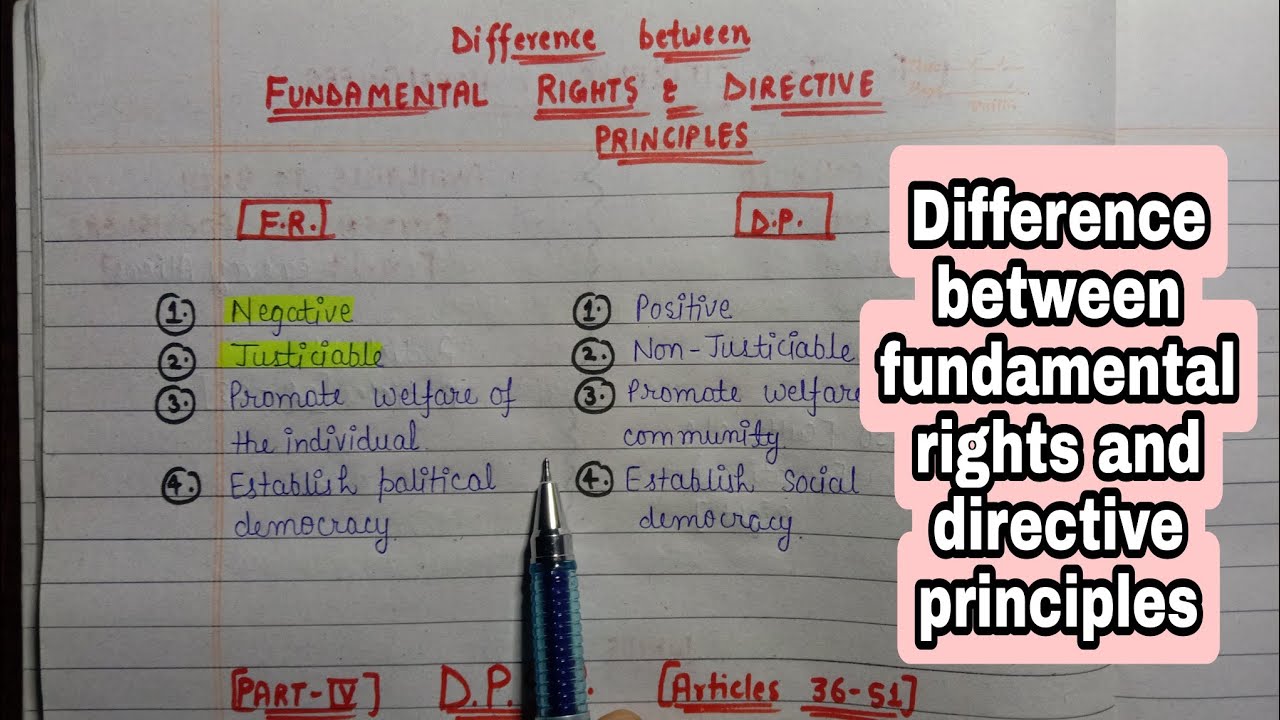
Explore the intricate legal story of the Conflict Between Fundamental Rights and Directive Principles, a key concept in Indian politics where the Constitution of India works to balance individual freedom with the welfare of all people. Understanding this topic is very helpful for students preparing for competitive exams because it explains important decisions made by the Supreme Court and changes called Constitutional Amendments that built our country's legal framework.
🎯 In this chapter, you will understand:
- How Fundamental Rights and Directive Principles differ in purpose and enforcement.
- The historic legal cases that decided which rules take priority.
- How Parliament passed amendments to help make society fairer.
- The modern rule that balances personal liberty with public welfare like two wheels of a cart.
💡 Why this topic matters: It helps us understand how the government works to protect individual freedom while also making laws that help the whole society grow fairly.
🧠 Core Idea: The Constitution of India uses Fundamental Rights to protect personal liberty and Directive Principles to build social and economic fairness.
📌 Conflict Between Fundamental Rights and Directive Principles: A Historical Journey
The story of India's constitutional development shows a continuous effort to balance the freedom of individual citizens with the welfare of the entire community. Ever since our nation adopted its highest law, a special tug-of-war started between the enforceable protections given to citizens in Part III and the social welfare goals set out in Part IV.
To understand why this happens, we must look at how these two sets of rules work in daily legal practice.
- (i) The enforceable nature of Fundamental Rights means citizens can go straight to court if their rights are taken away. In contrast, the non-justiciable nature of Directive Principles means no court can force the government to implement them immediately.
- (ii) This basic difference has created discussions and legal questions ever since the Constitution came into effect in .
- (iii) The situation is made even more interesting by Article 37. Even though Directive Principles cannot be enforced in court, this article places a moral duty on the State to use these principles when making new laws for the nation.
📌 The Judicial Dawn: Champakam Dorairajan Case (1951)
The very first legal discussion between these two parts of the Constitution happened early in our country's history. It established a clear order of priority between individual rights and government guidelines.

The Judiciary's Initial Stance on Individual Rights
In the landmark year , the Supreme Court gave its verdict in the Champakam Dorairajan Case. This decision created the first rule about how to read these constitutional provisions.
- (i) The Court ruled that Fundamental Rights take precedence over Directive Principles whenever there is a disagreement between them.
- (ii) It was clearly explained that Directive Principles must remain subordinate to Fundamental Rights, acting as a supportive helper to citizens' main freedoms.
- (iii) However, judges also noted a way forward: Parliament can amend Fundamental Rights by using official constitutional procedures to help achieve important social goals.
Parliamentary Action: Facilitating Social Reform
Following the guidance of the Court, the law-making body worked to pass specific acts so that important welfare policies could be put into action smoothly.
- (a) The First Amendment Act of was created to remove legal barriers standing in the way of land reforms.
- (b) The Fourth Amendment Act in gave the State more authority to reorganize economic activities for public good.
- (c) The Seventeenth Amendment Act of was passed to protect different land reform measures from being cancelled by courts.
📌 The Shift to Inviolability: The Golaknath Case (1967)
A big change happened in the late sixties when the judges changed their view about how much power Parliament has over individual freedoms.
The Doctrine of Sacrosanct Rights
In the year , the Supreme Court delivered an important ruling in the Golaknath Case that changed the balance of authority.
- (i) The Court decided that Parliament has no authority to amend or curtail Fundamental Rights, describing these rights as "sacrosanct" and basic to human freedom.
- (ii) This decision meant Parliament could not make changes that reduced Part III rights, even if those changes were meant to implement Directive Principles.
📌 The Legislative Fightback: 24th and 25th Amendments (1971)
To address the limits created by the Golaknath ruling, the government passed major updates to the Constitution.
The Birth of Article 31C and Parliamentary Supremacy
In , Parliament passed two key amendments to restore its authority over the Fundamental Rights framework.
(i) The 24th Amendment Act
This law confirmed that Parliament had full power to update, limit, or adjust any of the Fundamental Rights using Article 368.
(ii) The 25th Amendment Act and Article 31C
This update introduced Article 31C, which brought two major rules:
- (a) Laws created to follow Article 39(b) and 39(c)—which deal with sharing resources fairly and stopping money from accumulating in just a few hands—cannot be challenged for violating Articles 14, 19, or 31.
- (b) It added a "non-obstante" clause, which tried to stop courts from questioning any law that stated it was made to fulfill these social goals.
⚡ Quick Revision Capsule: Fundamental Rights vs. Directive Principles
Here is a simple side-by-side view showing how these two essential parts of the Constitution compare with each other.
| Feature | Fundamental Rights (Part III) | Directive Principles (Part IV) |
|---|---|---|
| Nature of Action | Negative restrictions that tell the government what it must not do to people. | Positive guidelines that tell the government what helpful actions it should take. |
| Enforcement | They are justiciable, meaning you can take the government to court to protect them. | They are non-justiciable, meaning courts cannot order the government to carry them out. |
| Main Goal | To build a strong political democracy with personal freedoms. | To create a social and economic democracy where everyone gets fair opportunities. |
| Legal Weight | Backed by legal sanctions enforced by judges. | Backed by moral and political duty owed to voters. |
| Focus Area | Protects individual welfare and personal rights. | Promotes the welfare of the community as a whole. |
📌 Comparative Analysis: Fundamental Rights vs. Directive Principles
To clearly see why differences arise, we can look at how both parts differ in their structure and purpose.
- (i) Nature of Action:Fundamental Rights mostly set limits on government power, while Directive Principles are positive instructions that ask the State to act.
- (ii) Justiciability: Rights are justiciable and protected by courts; principles are non-justiciable and cannot be demanded through court orders.
- (iii) Objectives: Rights work to establish a political democracy; principles work to establish social and economic democracy.
- (iv) Sanctions: Rights have legal sanctions, whereas principles carry moral and political sanctions.
- (v) Scope of Welfare: Rights care for individual welfare, while principles care for the welfare of the community.
- (vi) Execution: Rights apply automatically; principles need supporting laws passed by Parliament to take full effect.
- (vii) Judicial Review: Courts can strike down laws that hurt Fundamental Rights, but cannot cancel laws for missing Directive Principles—though courts can use principles to support a good law.
📌 The Final Arbiter: Kesavananda Bharati Case (1973)
The discussion reached its most famous milestone in Indian legal history, defining the limits of power for both Parliament and the judiciary.
Preserving the Basic Structure of the Constitution
The Kesavananda Bharati Case gave a balanced answer to the debate surrounding the 25th Amendment.
- (i) The Supreme Court decided that the second part of Article 31C was unconstitutional because it tried to eliminate judicial review, which was declared an unchangeable "basic feature" of the Constitution.
- (ii) However, the Court accepted the first part of Article 31C, allowing specific Directive Principles to take priority over certain Fundamental Rights when necessary for public good.
📌 The Pendulum Swings: 42nd Amendment and Minerva Mills
During the mid-1970s, an effort was made to place Directive Principles above all individual rights, which was later rebalanced by the courts.
The 42nd Amendment Act (1976) Expansion
In , during the Emergency, the 42nd Amendment Act tried to widen Article 31C so that it protected laws implementing any Directive Principle.
- (i) This change tried to shield all Directive Principles from being challenged under Articles 14 and 19.
- (ii) Making individual rights completely secondary to all principles was viewed as a big threat to personal liberty.
The Minerva Mills Case (1980) and Reversal
The Supreme Court stepped in during to re-establish proper constitutional equilibrium.
- (a) The Court struck down the extra expansion of Article 31C made by the 42nd Amendment, returning it to its original intention.
- (b) Importantly, Articles 39(b) and (c) kept their protected status over Articles 14 and 19.
- (c) Note that Article 31 (Right to Property) was removed from Fundamental Rights by the 44th Amendment Act ().
📌 The Philosophy of Harmony: Minerva Mills (1980)
The judiciary gave a thoughtful and practical conclusion to this long-running constitutional discussion.
Two Wheels of a Chariot
The Supreme Court explained that the Constitution's strength relies on a healthy balance between Fundamental Rights and Directive Principles.
- (i) Judges described them as two wheels of a chariot, where both wheels are needed equally for the nation to move forward safely.
- (ii) The Court cautioned that making one part completely superior over the other would break the balance designed for our democratic nation.
📌 Conclusion: The Present Position of the Conflict
Understanding where Indian law stands today is very helpful for any student learning about our country's government and legal system.
Current Legal Framework and Basic Structure
Today's legal understanding maintains a smart balance between individual freedoms and societal welfare.
- (i) Fundamental Rights generally maintain their supremacy over Directive Principles across our legal system.
- (ii) Still, Parliament has the power to adjust Fundamental Rights to carry out Directive Principles, as long as the basic structure of the Constitution is not damaged.
- (iii) The protection given to Article 39(b) and 39(c) over Articles 14 and 19 continues to be settled law.
📝 Summary
The journey of the Conflict Between Fundamental Rights and Directive Principles shows how living and adaptable the Indian Constitution truly is. For students, mastering this timeline from the Champakam Case in to the Minerva Mills Case in is essential for doing well in exams and understanding the Basic Structure Doctrine. This careful balance ensures that while the state works toward social and economic democracy, the essential Fundamental Rights of citizens remain respected and protected.
🚀 Quick Revision Points
Essential facts to review before examinations:
- (i) Fundamental Rights (Part III) can be enforced in court, while Directive Principles (Part IV) guide government policy.
- (ii) The Champakam Dorairajan Case () placed Fundamental Rights first, but allowed amendments for social progress.
- (iii) The Golaknath Case () said Fundamental Rights could not be curtailed by Parliament.
- (iv) The Kesavananda Bharati Case () created the Basic Structure Doctrine to protect judicial review.
- (v) The Minerva Mills Case () declared that Rights and Principles are like two wheels of a chariot that must stay in balance.
- 💡 Exam Tip: Remember the phrase "two wheels of a chariot" from the Minerva Mills Case (1980) when answering long questions on the relationship between Fundamental Rights and DPSPs.
❓ Frequently Asked Questions (FAQ)
Q1: What is the main difference between Fundamental Rights and Directive Principles?
A1: Fundamental Rights are justiciable, meaning you can enforce them directly in court, while Directive Principles are non-justiciable guidelines for making government laws.Q2: Which court case introduced the "two wheels of a chariot" comparison?
A2: The Supreme Court used this phrase in the Minerva Mills Case (1980) to explain that rights and welfare goals must be balanced equally.Q3: What is Article 31C?
A3: Introduced by the 25th Amendment in , Article 31C protects laws made to implement welfare goals in Article 39(b) and 39(c) from being challenged under Articles 14 and 19.