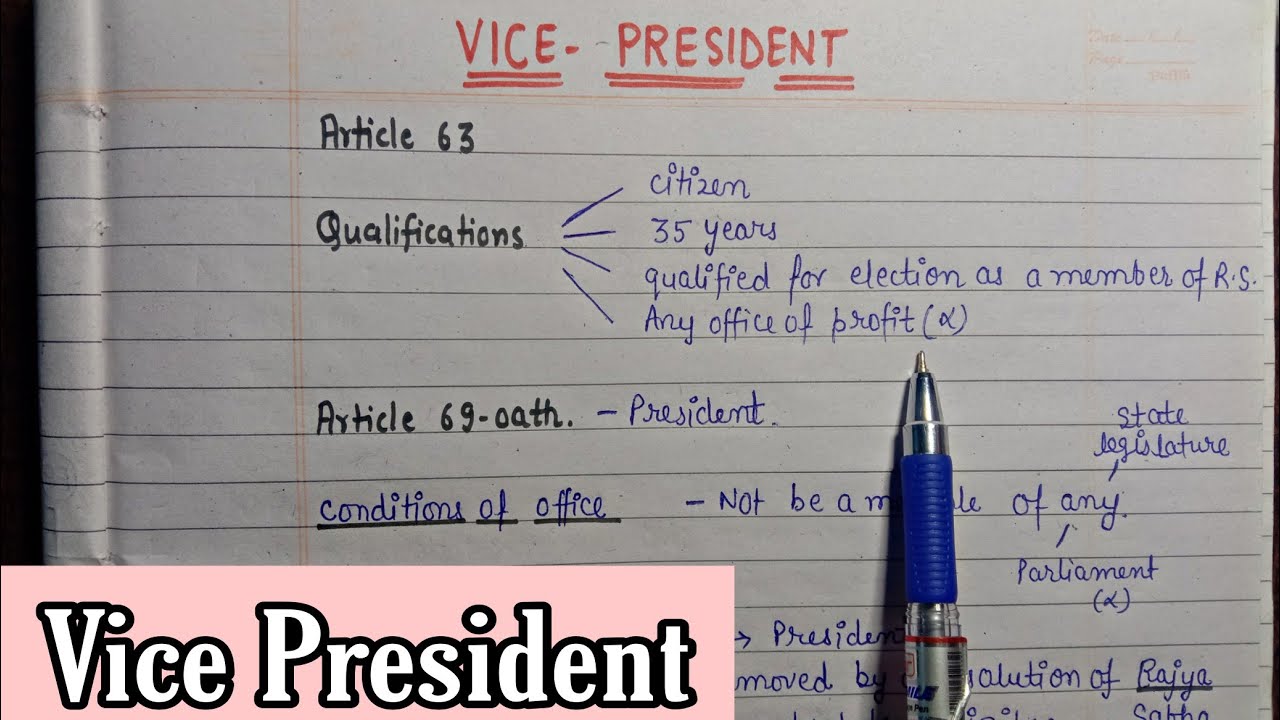
The Vice-President of India holds a very important leadership position created under the Constitution of India. This official plays a key role in maintaining smooth governance and political continuity across the entire nation. Think of the Vice-President as a trusted second-in-command who ensures that the government never stops running, even during unexpected emergencies. They carry out two main duties: acting as the chairperson who guides discussions in the Upper House of Parliament (Rajya Sabha) and stepping in as the temporary Acting President whenever the sitting President is away or unable to work. Learning about the rules written in through helps students preparing for competitive tests like the UPSC clear their concepts about how Indian democracy works.
🎯 In this chapter, you will understand:
- The dual responsibilities of the Vice-President as head of the Rajya Sabha and substitute for the President.
- The major constitutional rules found in Articles 63 to 71 of Part V of the Indian Constitution.
- How the Indian Vice-President differs from the Vice-President of the United States during an executive emergency.
- How the salary, allowance structure, and official perks for this position are decided by Parliament.
💡 Why this topic matters: This topic explains how India keeps its top executive leadership stable and uninterrupted at all times, making sure there is never a single moment without a functioning head of state.
🧠 Core Idea: The Vice-President works every day as the leader of the Rajya Sabha, but remains ready at a moment's notice to take over the President's duties in times of need.
📌 The Dual Role and Functions of the Indian Vice-President in the Constitutional Framework (Articles 63-71)
The office of the Vice-President is carefully designed to make sure that the supreme decision-making authority of India never suffers a break or delay. The individual who takes this office is tasked with keeping everyday lawmaking organized in the Upper House of Parliament, while also standing ready to step into the nation's highest office if an emergency arises. The Constitution of India clearly outlines these duties, borrowing the basic concept from the country structure of the United States, while adding specific rules tailored to fit India's parliamentary system.
Understanding these responsibilities shows how this single role balances both everyday legislative work and national emergency readiness:
- (i) The most visible daily job is serving as the ex-officio Chairman of the Rajya Sabha, leading discussions and keeping order just like the Speaker of the Lok Sabha does in the Lower House.
- (ii) The second function is acting as the Acting President of India whenever the elected President cannot fulfill their duties because of resignation, illness, death, or absence.
- (iii) The foundation of this post is laid out across in the Constitution, which explain the exact methods for election, oath-taking, job tenure, and official powers for this second-highest constitutional post.
📌 Ex-officio Chairman of the Rajya Sabha: A Legislative Leadership Role
The everyday work of the Vice-President centers around guiding the Rajya Sabha (the Council of States). The term ex-officio simply means that whoever gets elected as Vice-President automatically becomes the Chairperson of the Rajya Sabha without needing a separate election for that role. As the head of this legislative chamber, they oversee the debates, uphold parliamentary rules, and manage the daily schedule of business.

Presiding Officer Powers and Alignment with the Speaker of Lok Sabha
As the Chairman of the Rajya Sabha, the Vice-President holds broad authority to keep meetings respectful, orderly, and productive. In almost every practical sense, their powers inside the Upper House match those exercised by the Speaker of the Lok Sabha inside the Lower House, making them the main judge and protector of parliamentary rules during meetings.
- (i) Maintaining Decorum and Order: The Chairman manages debates, gives members permission to speak, accepts official proposals, and maintains discipline. If a vote on a bill ends in a equal draw, the Chairman can cast a special deciding vote called a casting vote to break the tie.
- (ii) Procedural Alignment: The Chairman supervises how laws move through the House, verifies certain financial paperwork, and ensures everyone strictly follows the guidelines laid out in the Rules of Procedure and Conduct of Business.
- (iii) International Precedent: This arrangement is modeled directly after the governance system used in the United States, where the American Vice-President serves as the ex-officio leader of the Senate.
📌 The Critical Role of Acting President: Ensuring Constitutional Continuity
The most crucial emergency task given to the Vice-President is stepping into the President's shoes whenever the presidency unexpectedly becomes vacant or when the sitting President falls temporarily ill. This seamless replacement makes sure that the executive government continues to function smoothly without any dangerous power gaps or delays.
Circumstances and Time Limitations for Assuming the Acting Presidency
The legal rules in the Constitution state exactly when and how long the Vice-President can perform the President's duties. This rule exists purely to protect national safety and preserve political stability across all branches of government.
- (a) Vacancy by Extreme Causes: If the sitting President resigns, passes away, or is removed through legal impeachment, the Vice-President takes over immediately as the Acting President.
- (b) Mandatory Election Period: Taking over the position is strictly temporary. It can last for a maximum duration of , during which time the official election commission must conduct fresh national elections to choose a new President.
- (c) Temporary Incapacity: If the President is simply unable to attend work due to travel, health issues, or short-term personal difficulties, the Vice-President handles the workload until the President recovers and returns.
Suspension of Rajya Sabha Duties While Acting as President
When the Vice-President takes up the duties of the President, their regular day job changes immediately. To prevent any conflict between making executive laws and running the legislature, the law requires them to stop working as the leader of the Upper House during this temporary period.
- (i) While the Vice-President works as Acting President, all presiding duties in the Upper House pass directly to the Deputy Chairman of the Rajya Sabha, who leads the legislative sessions until the Vice-President returns to their original office.
📌 Comparing the Indian and American Vice-Presidency: A Key Constitutional Distinction
Although India adapted its Vice-Presidential role from the system designed in the United States, there is one major structural difference between the two nations regarding how long a Vice-President remains in power when a President leaves office unexpectedly.
Term Completion versus Strictly Acting Capacity
This contrast highlights India's focus on democratic elections. Rather than letting an un-elected substitute finish out a full term, the Indian system insists on holding fresh national elections as soon as reasonably possible.
- (i) American Vice-President: In the United States, if a President passes away or leaves office, the Vice-President officially becomes the new President and serves out the entire remaining term left behind by the predecessor.
- (ii) Indian Vice-President: In India, the Vice-President functions strictly as an Acting President for a short window capped at . They only hold power until a newly chosen President is elected by the representatives of the people.
The "Superfluous Highness" Concept and the Necessity of Political Continuity
Because the Indian Vice-President does not carry independent executive authority on normal days, some political scholars have occasionally referred to the position using the phrase "His Superfluous Highness". This phrase suggests that the office carries little independent power beyond presiding over debates and waiting for emergency events. However, the position is actually indispensable for national safety.
- (a) The primary purpose of this office is to ensure political continuity, acting as an essential legal safety net that guarantees the executive branch never remains headless.
- (b) Having a qualified substitute ready at all times keeps the entire machinery of state working reliably, a feature of utmost importance for maintaining a strong democracy.
📌 Emoluments and Allowances: Remuneration as Chairman of Rajya Sabha
The financial setup for the Vice-President is unique because the Constitution does not fix a specific salary for the title of Vice-President itself. Instead, the earnings given to the official are directly linked to their daily job as the Chairman of the Council of States.
The Salary Structure and Parliamentary Revisions
The exact salary and monthly payments for the position are set by law by the members of Parliament. Over the decades, these amounts have been adjusted multiple times to match modern living costs and uphold the stature of this top leadership office.
- (i) Remuneration Basis: The official receives their monthly paycheck specifically for serving as the Chairman of the Rajya Sabha, not for holding the Vice-Presidential title.
- (ii) Revision of : In the year , Parliament raised the Chairman's monthly base pay from ₹40,000 up to ₹1.25 lakh, reflecting the growing responsibilities of the job.
- (iii) Comprehensive Benefits: Alongside their regular salary, the Vice-President receives benefits like daily work allowances, a free furnished official home, medical care coverage, and travel accommodations for official duties.
- (iv) President's Pay During Acting Tenure: Whenever the Vice-President works as the Acting President, they stop receiving their Rajya Sabha pay and instead receive the full salary and allowances of the President.
📌 Key Constitutional Articles Relating to the Vice-President (A Student's Focus)
For students readying themselves for competitive tests like UPSC or state civil services examinations, memorizing the core articles in Part V of the Indian Constitution provides a clear understanding of the law surrounding this top executive post.
- (i) – The Vice-President of India: Formally creates the official office of the Vice-President.
- (ii) – Ex-officio Chairman: Declares that the Vice-President will automatically serve as the head of the Council of States (Rajya Sabha).
- (iii) – Acting President: Explains how the Vice-President steps in to discharge presidential powers during sudden vacancies or illnesses.
- (iv) – Election: Describes the exact voting process and eligibility criteria used by Parliament to elect the Vice-President.
- (v) – Term of office: States that the normal term of office lasts for five years from the day the official takes charge.
- (vi) – Vacancy Filling: Explains the timeline rules for holding elections to fill an empty seat before or after a term ends.
- (vii) – Oath or affirmation: Sets out the official promise and oath taken in front of the President before entering office.
- (viii) – Other Contingencies: Gives Parliament authority to make rules for unexpected legal situations not covered in other articles.
- (ix) – Election Matters: Explains how doubts, disputes, or legal questions about Vice-Presidential elections are handled by the Supreme Court.
⚡ Quick Revision Capsule: Vice-Presidential Constitutional Framework
Use this convenient summary table to quickly review the essential facts, roles, and legal rules associated with the Indian Vice-President before taking exams.
| Feature / Concept | Constitutional Provision / Details | Key Takeaway for Students |
|---|---|---|
| Primary Role | Ex-officio Chairman of the Rajya Sabha | Leads legislative debates, manages discipline, and casts deciding votes during ties. |
| Secondary Role | Acting President of India () | Steps in as temporary head of state during illness, death, or resignation. |
| Time Limit as President | Maximum of | Must hold fresh national elections for President before six months expire. |
| US vs India Difference | Temporary acting role vs. completing the term | US Vice-President finishes the whole term; Indian counterpart only acts temporarily. |
| Salary Source | Paid as Rajya Sabha Chairman under Parliamentary Acts | Does not receive a salary as Vice-President, but gets President's pay when acting as President. |
📝 Summary
The office of the Vice-President of India functions as a pillar of national political stability. By managing daily parliamentary work as the Chairman of the Council of States and staying ready to assume the role of Acting President for up to , the Vice-President guarantees that the machinery of state never stops working. The rules defined in of the Constitution of India offer a clear blueprint for elections, oaths, tenure, and duties. Mastering these fundamental principles gives students a strong advantage when answering questions about Indian Polity in competitive exams.
🚀 Quick Revision Points
Essential facts to review before examinations:
- (i) establishes the office of the Vice-President of India.
- (ii) The Vice-President acts as the ex-officio leader of the Rajya Sabha, keeping order and breaking tied votes.
- (iii) The maximum time a Vice-President can serve as Acting President is exactly .
- (iv) During their tenure as Acting President, the Vice-President receives the full pay and perks outlined in the Constitution for the President.
- 💡 Exam Tip: Always remember that the Vice-President does NOT get paid for being Vice-President! Their salary comes from their job as Chairman of the Rajya Sabha, unless they are acting as President, in which case they earn the President's salary.
❓ Frequently Asked Questions (FAQ)
Q1: Can the Vice-President cast a regular vote on bills in the Rajya Sabha?
A1: No, the Vice-President does not cast a normal vote during bill discussions. They only cast a deciding vote, called a casting vote, if the voting ends in an exact tie.Q2: What happens to the Rajya Sabha leadership when the Vice-President becomes Acting President?
A2: The Vice-President steps down from legislative duties during that period, and the Deputy Chairman of the Rajya Sabha takes over presiding duties in the Upper House.Q3: How does the Indian Vice-President's emergency role differ from the American system?
A3: In the United States, the Vice-President completes the remaining term of an outgoing President. In India, as governed by of the Constitution, the Vice-President serves only as an temporary Acting President for up to six months while new elections are conducted.