Understanding Non-Tariff Barriers (NTBs) in international trade is essential for students. Unlike tariffs, NTBs create direct or indirect limits on imports, changing how domestic markets work. From simple import quotas to complex rules, these methods impact pricing, production, and public welfare.
🎯 In this chapter, you will understand:
- The definition and types of Non-Tariff Barriers.
- How import quotas affect competitive markets.
- The impact of quotas on domestic monopolies.
- The welfare differences between tariffs and quotas.
💡 Why this topic matters: It explains how countries restrict trade without using traditional taxes, which is vital for understanding modern global economic policies.
🧠 Core Idea: Trade isn't just about tariffs; non-tariff measures like quotas significantly distort market balance and welfare.
Non-Tariff Barriers (NTBs) in International Trade
Non-Tariff Barriers represent trade restrictions beyond traditional taxes. They define how goods enter a country.
The Architecture of Non-Tariff Trade Controls
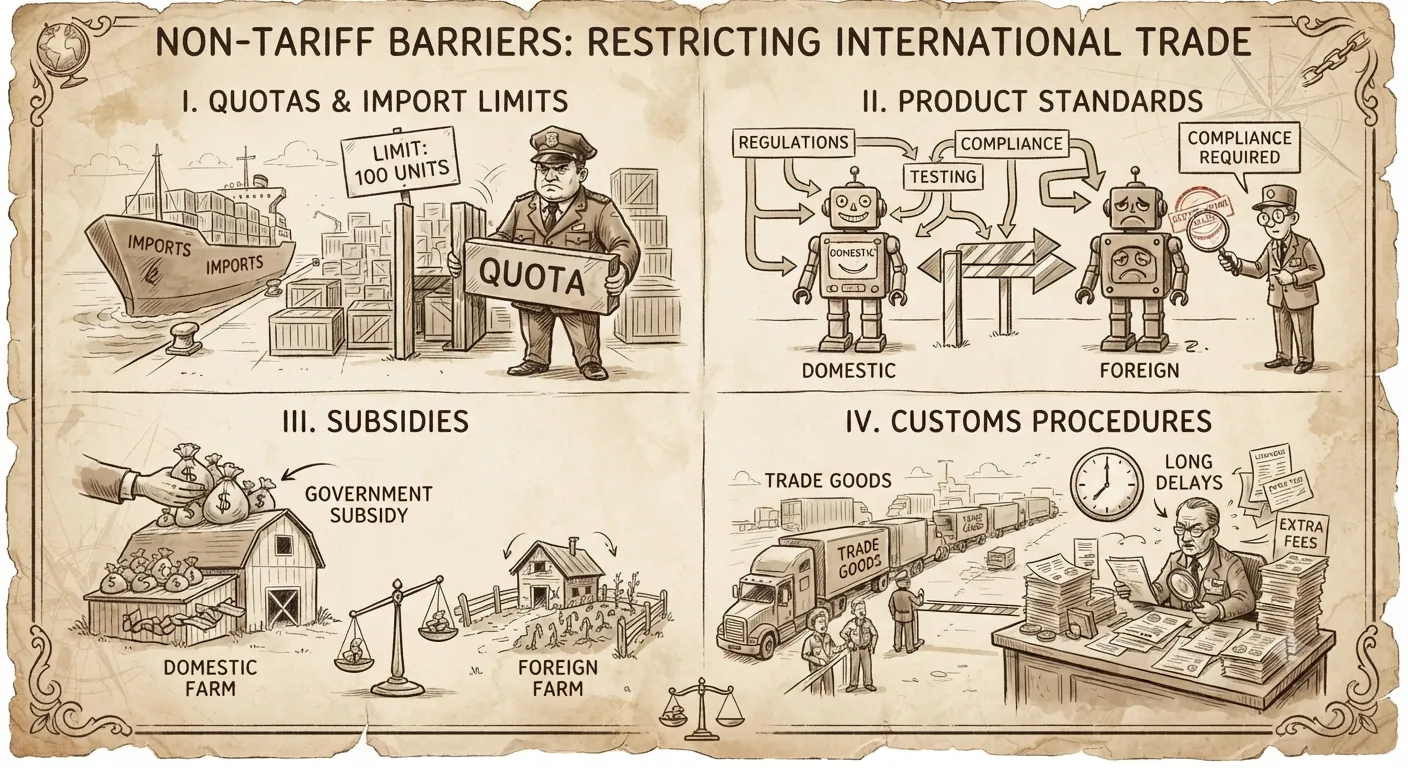
NTBs can directly limit imports through import quotas or use regulations to influence trade indirectly. Many countries use these to follow WTO rules while still protecting local industries.
- (i) Conventional NTBs use set limits on how much of a product can be imported.
- (ii) Other methods work indirectly, affecting trade flow without set quantity limits.
- (iii) Learning these is key to seeing how domestic prices and social welfare change.
Import Quotas: Direct Restrictions
Import quotas are a classic example of direct NTBs. They set a limit on exactly how much of a good can enter the market.
Import Quotas under Perfect Competition
When markets are competitive, an import quota changes the supply and price. These are managed via import licenses.
- (i) Domestic prices rise above world prices (Pw) because supply is now capped.
- (ii) Local production grows as the economy reaches a new balance with limited imports.
- (iii) The quota creates "quota rent," which is profit for the license holder, sometimes leading to social waste through bribery or inefficiency.
Import Quotas with Domestic Monopoly
In a monopoly, quotas make inefficiencies worse because the monopolist keeps control over prices.
- (a) The monopolist produces less at higher prices, causing more welfare loss than in competitive markets.
- (b) Quotas allow the company to keep market dominance by stopping foreign competition.
- (c) Tariffs are often better here because they set a price cap that keeps the monopolist in check.
Social Welfare Implications
Quotas change who wins and who loses in an economy.
Comparison Between Quotas and Tariffs
While both restrict trade, their impact on public funds and market fairness differs.
Feature Tariffs Import Quotas Government Revenue Collects customs duties. No revenue; creates quota rent. Monopoly Conditions Caps prices. Allows price hikes. Global Preference Preferred (GATT/WTO). Discouraged. - (i) Tariffs bring money to the government, while quotas benefit license holders.
- (ii) Global trade rules generally push to replace quotas with tariffs for better transparency.
⚡ Quick Revision Capsule: Trade Barriers
A snapshot of key differences between these two trade tools.
| Tool | Primary Impact | Revenue Status |
|---|---|---|
| Tariffs | Price increases | Government revenue |
| Quotas | Supply limits | Quota rent (Profits) |
📝 Summary
Understanding Non-Tariff Barriers (NTBs) is vital for students. Quotas change domestic markets by limiting supply, which helps producers but often hurts consumers by raising prices. Knowledge of these tools is necessary to evaluate international trade strategies.
🚀 Quick Revision Points
- (i) NTBs use quotas or rules to block trade (Direct/Indirect).
- (ii) Quotas create profit for license holders.
- (iii) Monopoly control is worse under quotas (Inefficiency).
- (iv) Global WTO rules prefer tariffs over quotas.
- 💡 Exam Tip: Always remember that tariffs generate government revenue, while quotas result in quota rent.
❓ Frequently Asked Questions (FAQ)
Q1: Who gets the money from quota rent?
A1: The license holders or exporters who receive the right to trade the goods.Q2: Why are quotas worse for monopolies?
A2: Tariffs set a price ceiling, but quotas just remove foreign competition, letting the monopolist charge even more.Q3: How does lobbying affect quotas?
A3: It causes "rent-seeking," where resources are wasted trying to get licenses instead of improving production.