Many nations frequently rely on protectionist trade policies as a deliberate mechanism to capture global foreign direct investment (FDI) flows. Especially across developing countries, these incoming FDI inflows are highly chased because they deliver critical assets like scarce physical investment capital, deep technological know-how, and completely new product lines. Evaluating the true impact of trade protection on social welfare is absolutely essential for students preparing for exams in international economics, policy development, and trade frameworks.
🎯 In this chapter, you will understand:
- How defensive trade barriers drive foreign companies to invest locally.
- The trade-off between immediate job creation and long-term consumer costs.
- Lessons from real-world examples like Canada's shifting capital flows.
- Sustainable ways host countries can secure lasting technology transfers.
💡 Why this topic matters: It reveals whether using import taxes to attract global investment actually helps or hurts a country's overall economic well-being over time.
🧠 Core Idea: Shielding local markets with tariffs forces foreign businesses to build local factories, but true growth happens only when those companies share knowledge and integrate deeply with local suppliers.
Protectionist Trade Policies and Their Role in Attracting FDI in Developing Countries
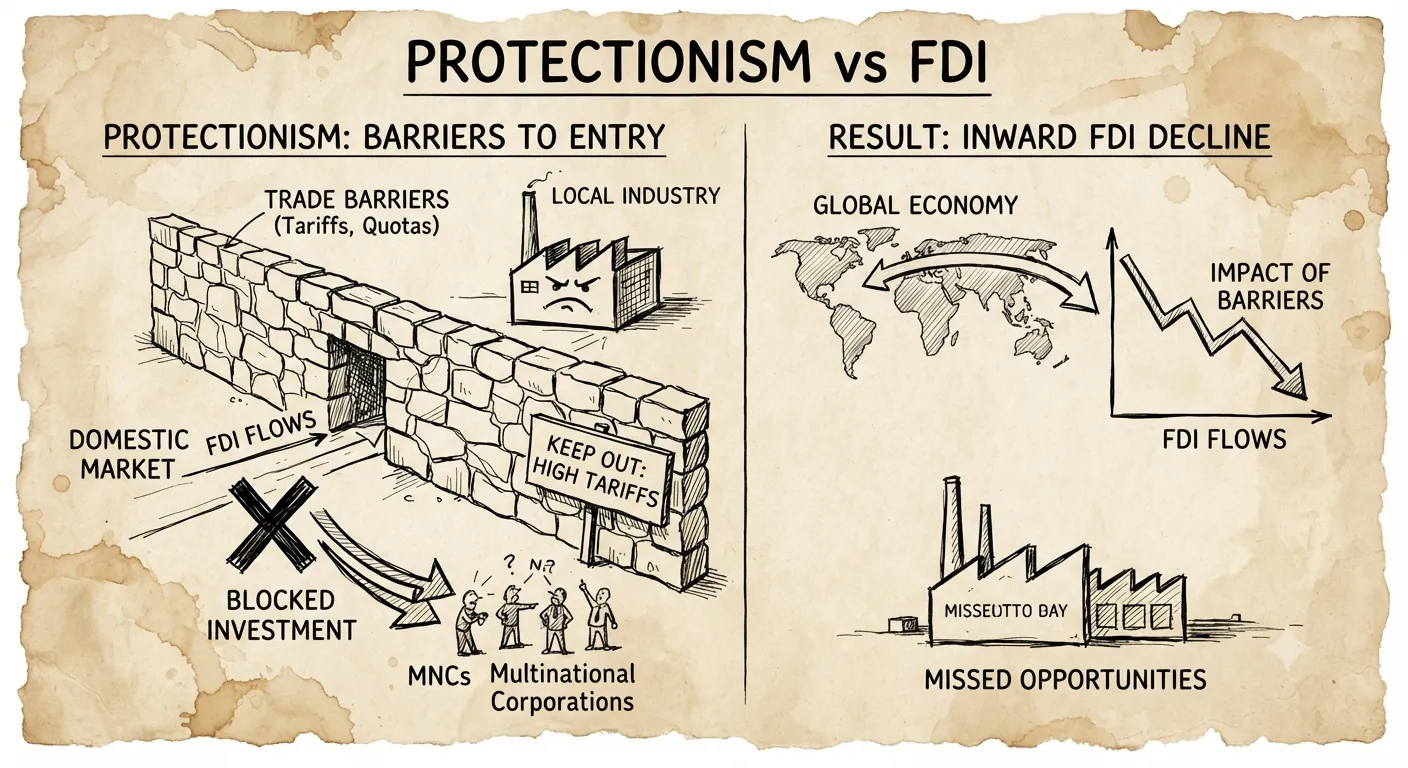
Deploying a defensive trade barrier to pull in international corporate investments is a classic balancing act that serves up clear advantages alongside deep structural hurdles for a host country. When a developing nation shields its internal markets with tariffs, international firms often choose to build local factories to bypass those taxes. This dynamic secures vital capital, advanced technology, and innovative products directly from foreign multinational corporations seeking to capitalize on a protected, high-margin consumer environment.
- Core Dynamics of Tariff-Jumping Investment Practices
The core concept rests on creating a policy wall that forces international brands to invest locally if they want to sell inside the country. While this can rapidly jumpstart domestic manufacturing plants, it creates immediate side effects for local market pricing and long-term business competitiveness.
- (i) Advantages: Defensive trade structures can lift overall social welfare, provided that the incoming investments spark widespread job creation and genuinely upgrade native industrial capabilities.
- (ii) Consumer impact: Because foreign corporations operate with limited competition behind tariff walls, they regularly charge higher prices, which directly extracts economic value and reduces consumer welfare.
- (iii) Knowledge transfer concerns: The strategy risks failing to secure permanent technical skill developments if foreign entities simply extract profits from the protected space without deeply training the local workforce.
Challenges of Using Trade Protection to Attract FDI
Even though high tariffs and restrictive import boundaries can trigger a sudden initial rush of incoming international corporate investment, relying heavily on this approach creates serious long-term economic distortions. When market entry is restricted artificially, it often breeds local production inefficiencies and exposes the host country to sudden corporate flight once trade rules shift open again.
Short-Term Benefits versus Long-Term Losses
While incoming FDI inflows create immediate economic motion and put local citizens to work right away, the trailing economic outcomes can turn highly unfavorable. If foreign corporations choose not to permanently share their proprietary knowledge, operational infrastructure, or core resources, the host country gets left with little sustainable economic foundation once the investment cycle cools.
- (i) Immediate hiring rounds provide a rapid, temporary boost to local employment metrics.
- (ii) Everyday consumer prices frequently climb due to weak market competition and protective import penalties.
- (iii) Growing overly dependent on permanent regulatory shields leaves internal policy decisions fragile and exposed.
Case Study: Canada and FDI Outflows
The economic history of Canada offers an insightful look into the hidden risks of using protectionist trade strategies to anchor foreign capital. Many American manufacturers originally built massive branch plants inside Canada to get past steep import duties. However, the moment the USA-Canada Free Trade Agreement dissolved those trade walls, those same companies closed down operations and moved right back out, proving that temporary protection pulls in transient capital rather than permanent institutional commitment.
- (a) Transnational firms actively harvest protected economic environments to secure elevated profit margins.
- (b) Dismantling local trade tariffs often triggers rapid, large-scale investment outflows.
- (c) Over-reliance on artificial market insulation regularly proves counterproductive over a longer timeline.
Efficient Strategies for Attracting FDI
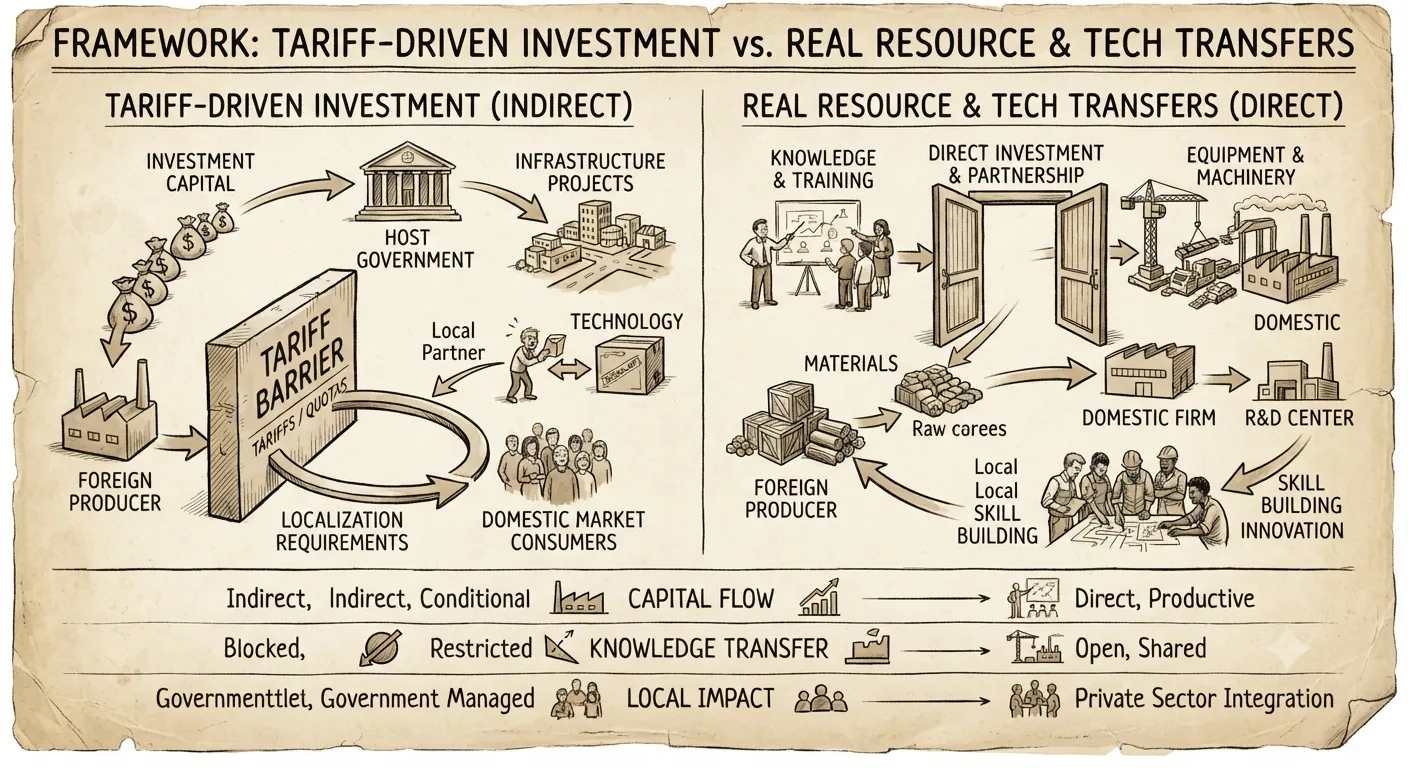
Instead of relying blindly on restrictive trade protection mechanisms, forward-thinking developing economies can structure explicit economic frameworks. These modern setups focus directly on guaranteeing a real transfer of resources and open pathways to local markets, maximizing the true developmental upside of incoming investment while completely neutralizing social welfare losses.
- Strategic corporate agreements: Lock in binding commitments centered on technical knowledge sharing and asset distribution.
- Integrated market entry: Guide incoming global corporations to source materials locally so they integrate deeply into the native supply ecosystem.
- Sustainable gains: Cultivate lasting employment stability, advanced vocational skill training, and rapid industrial technology integration.
⚡ Quick Revision Capsule: Trade Policy & FDI Impact
A structured side-by-side view comparing raw trade protection with sustainable investment strategies:
| Strategy Factor | Tariff-Jumping FDI Model | Sustainable Resource Transfer Model |
|---|---|---|
| Primary Target | Bypass defensive import duties | Deep market integration & skill building |
| Consumer Price Impact | Higher prices due to weak market competition | Competitive pricing from efficient local supply chains |
| Worker & Tech Upside | Risk of limited skill sharing and simple assembly | Mandated technical training & technology transfer |
| Capital Stability | High risk of sudden corporate flight when tariffs fall | Long-term institutional commitment |
| Real World Example | Branch plants under historical Canada trade barriers | Modern strategic integration pacts in emerging markets |
📝 Summary
Grasping exactly how protectionist trade policies interact with incoming FDI inflows is a bedrock requirement for anyone diving into economics, international trade structures, and global development frameworks. While using tariffs can successfully ignite immediate hiring and bring in fresh machinery, securing real long-term economic health depends entirely on drafting smart agreements with incoming firms to guarantee continuous resource and skill transfers, rather than leaning forever on weak market insulation, as demonstrated during documented in international trade history.
🚀 Quick Revision Points
Essential facts to review before examinations:
- (i) Host countries deploy import barriers strategically to attract tariff-jumping investments, though it alters core pricing scales.
- (ii) Initial waves of job creation can mask long-term consumer welfare losses caused by suppressed market competition.
- (iii) The historical retreat of American capital from Canada proves that investments anchored strictly on trade barriers remain volatile.
- (iv) Healthy economic policies swap raw protectionism for deep integration pacts that mandate genuine technical knowledge transfer.
- 💡 Exam Tip: Focus your essay answers on comparing immediate employment gains against long-term consumer price increases, and cite the Canada branch plant example to demonstrate how capital flees when tariff walls disappear.
❓ Frequently Asked Questions (FAQ)
Q1: Why do developing countries use protectionist trade policies to attract FDI?
A1: They build tariff walls so foreign corporations find it cheaper to set up factories inside the country rather than paying import duties to ship goods there. This brings in fresh capital and jobs.Q2: What is the main danger highlighted by the Canada case study?
A2: It shows that when investment relies solely on trade barriers, it vanishes quickly. Once the USA-Canada Free Trade Agreement cut tariffs, those businesses packed up and left.Q3: How can a country ensure that incoming corporate investment provides long-term value?
A3: By moving away from simple trade protection and instead writing smart agreements that require foreign firms to train local workers and share their core technology transfer methods.