The concept of dumping in international trade plays a crucial role in understanding unfair trade practices and how countries respond with anti-dumping measures. At its core, dumping happens when a foreign firm exports its goods at artificially low prices, sparking intense competition issues that can severely harm domestic industries. Gaining a clear grasp of dumping margins, the criteria used to identify dumped products, and how anti-dumping duties function is essential for students preparing for economics and international trade exams.
Dumping in International Trade: Mechanics and Margins
- What Happens When a Firm Dumps Products Abroad?
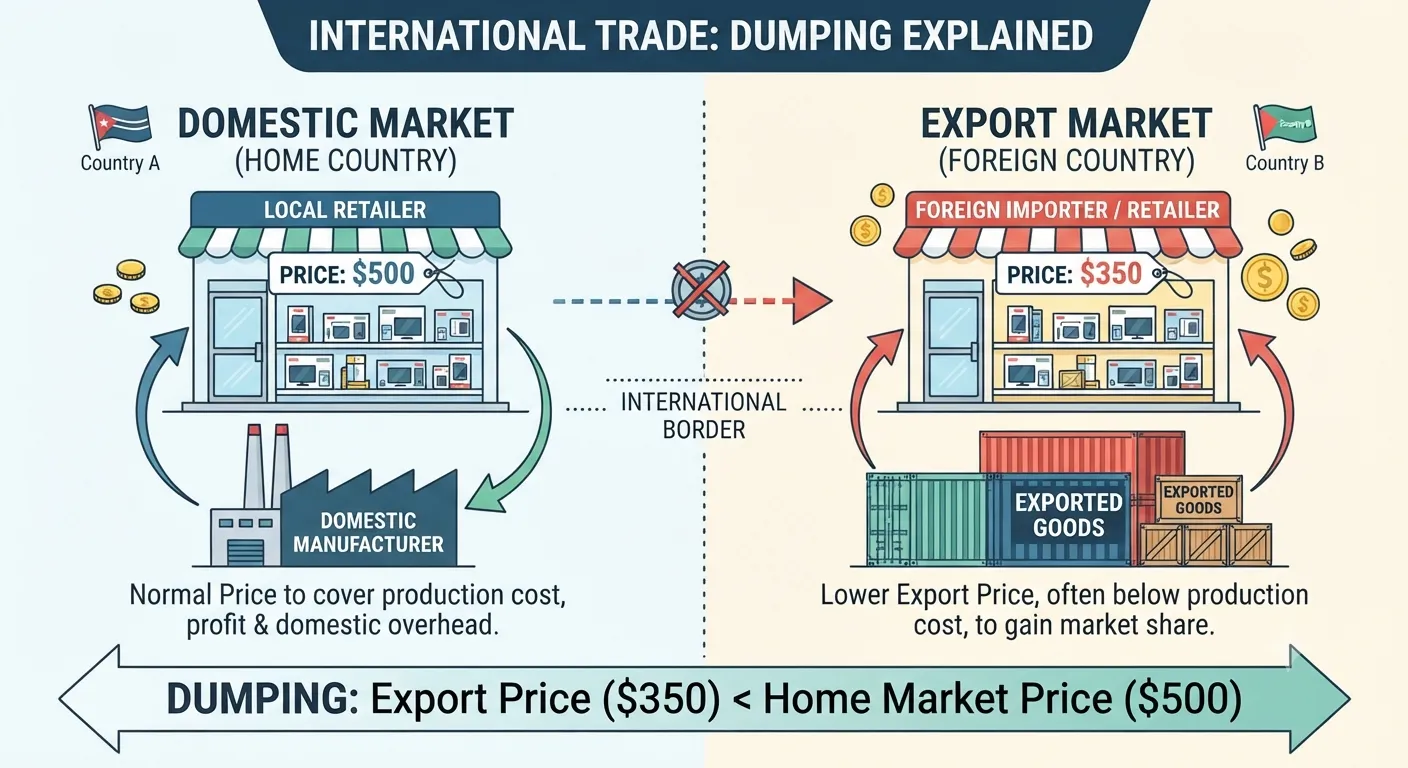
Put simply, dumping occurs when the export price of a product is lower than the price it commands back in its home country. This pricing gap is what experts call the dumping margin, and trade authorities generally view it as an aggressive attempt to undercut local competition unfairly. To prove that dumping is actually taking place, investigators compare the export price with the domestic price. If a direct price comparison isn't possible, they will look at the cost of production plus administrative expenses and a reasonable profit to find a fair baseline.
Anti-Dumping Measures and Government Legal Role
When foreign products flood a market unfairly, the governments of importing countries step in to protect their domestic industries by levying anti-dumping duties. However, these aren't just arbitrary political moves; governments can only implement these measures after a thorough, transparent, and completely objective investigation.
How Governments Investigate Alleged Dumping
Before taking action, authorities must conclusively establish two things: that dumping is actively happening and that it is causing or threatening material injury to domestic industries. This means looking deep into price comparisons, complex cost structures, and the exact financial impact on local competitors to ensure trade fairness remains intact.
- (i) Evaluating material injury means tracking the actual economic harm and lost ground suffered by domestic producers.
- (ii) These investigations follow strict legal protocols, which mirror the exact procedures used in subsidy-related trade inquiries.
- (iii) Transparency and objective data analysis are absolute prerequisites before any protective duties can be rolled out.
Imposition and Application of Anti-Dumping Duties
Once the double burden of proof—dumping and material injury—is verified, the importing country's government officially levies an anti-dumping duty on those specific goods. These special tariffs serve to balance the scales, bring back healthy competition, and insulate the market from sudden trade disruptions.
- (a) Governments scale these duties proportionally to perfectly offset the calculated dumping margin.
- (b) The main goal is to stop foreign firms from undercutting domestic producers who are playing by the rules.
- (c) Ultimately, anti-dumping duties serve as a vital defensive and regulatory tool in global commerce.
WTO Oversight and Challenges for Developing Nations
The World Trade Organization (WTO) builds the overarching rules that govern how nations handle these disputes, ensuring that anti-dumping actions don't turn into hidden protectionism. However, the global landscape isn't always balanced. Developing nations frequently face steep hurdles because wealthy, developed countries sometimes weaponize anti-dumping investigations simply to shield their own markets, creating friction worldwide.
Trade Factor Impact and Real-World Application Impact on Developing Countries Sudden anti-dumping investigations can abruptly stop exports, sparking economic anxiety and long-term uncertainty for growing industries. Active Use by Developing Countries In recent years, nations like India have actively turned the tables, utilizing anti-dumping measures defensively to safeguard their own industrial bases. WTO Oversight Role The WTO monitors cases globally to guarantee that all duties and state-level investigations align strictly with international trade rules.
Why This Matters for Aspiring Trade Professionals and Economics Students
Unpacking how dumping works, understanding how anti-dumping duties correct the market, and tracing the role of the WTO in trade policy gives you a major advantage if you are a student of economics or international trade. Learning these legal frameworks and their global side-effects prepares you to tackle exam questions confidently while grasping how countries, particularly developing nations, fight for a level playing field in the global marketplace.
Summary
The practice of dumping stands out as a highly contentious trade strategy where products are sold abroad below home-market values. To protect local markets, governments calculate the dumping margin and introduce anti-dumping duties, provided they can prove material injury through formal investigations. Under the eyes of the WTO, these mechanisms help maintain global equilibrium, even as developing nations like India increasingly use them to defend their domestic industries against external market distortions.
Quick Revision Points for Students
Reviewing these foundational trade concepts will help you lock in key facts for your upcoming exams.
- (i) Dumping means exporting goods at prices lower than what the firm charges in its own domestic market.
- (ii) The dumping margin is the precise pricing difference between the foreign export price and the normal domestic price.
- (iii) If direct prices are missing, authorities calculate the margin using the production cost plus basic overheads and profit.
- (iv) A government cannot impose anti-dumping duties unless it legally proves that local producers are facing material injury.
- (v) The WTO acts as an international referee, ensuring anti-dumping policies are used fairly and aren't just hidden trade barriers.
Frequently Asked Questions (FAQ)
Q1: What exactly constitutes "dumping" in international commerce?
A1: Dumping happens when a company exports its products to another nation at a price lower than what it normally charges in its own home market, which distorts natural market competition.Q2: How do trade authorities calculate a dumping margin when direct price comparisons fail?
A2: When home-market prices aren't reliable or available, investigators determine the margin by calculating the product's actual cost of production, adding administrative expenses, and factoring in a reasonable profit margin.Q3: What role does "material injury" play in initiating anti-dumping duties?
A3: It is the legal trigger for defense. An importing country cannot just slap a tariff on low-priced goods; it must objectively prove that the dumped imports are causing genuine financial harm or operational collapse to its domestic industries.