The WTO disciplines on agriculture and textiles are a crucial component of the international trading system, especially for developing countries. Following the Uruguay Round negotiations, agriculture was brought under a dedicated legal framework through the Agreement on Agriculture (AoA), while textiles were integrated into the general WTO rules from 2005. A proper understanding of market access, domestic support, and export competition is essential for students, exam aspirants, and anyone studying global trade policy.
WTO Disciplines on Agriculture and Textiles: Evolution and Framework (1995-2005)
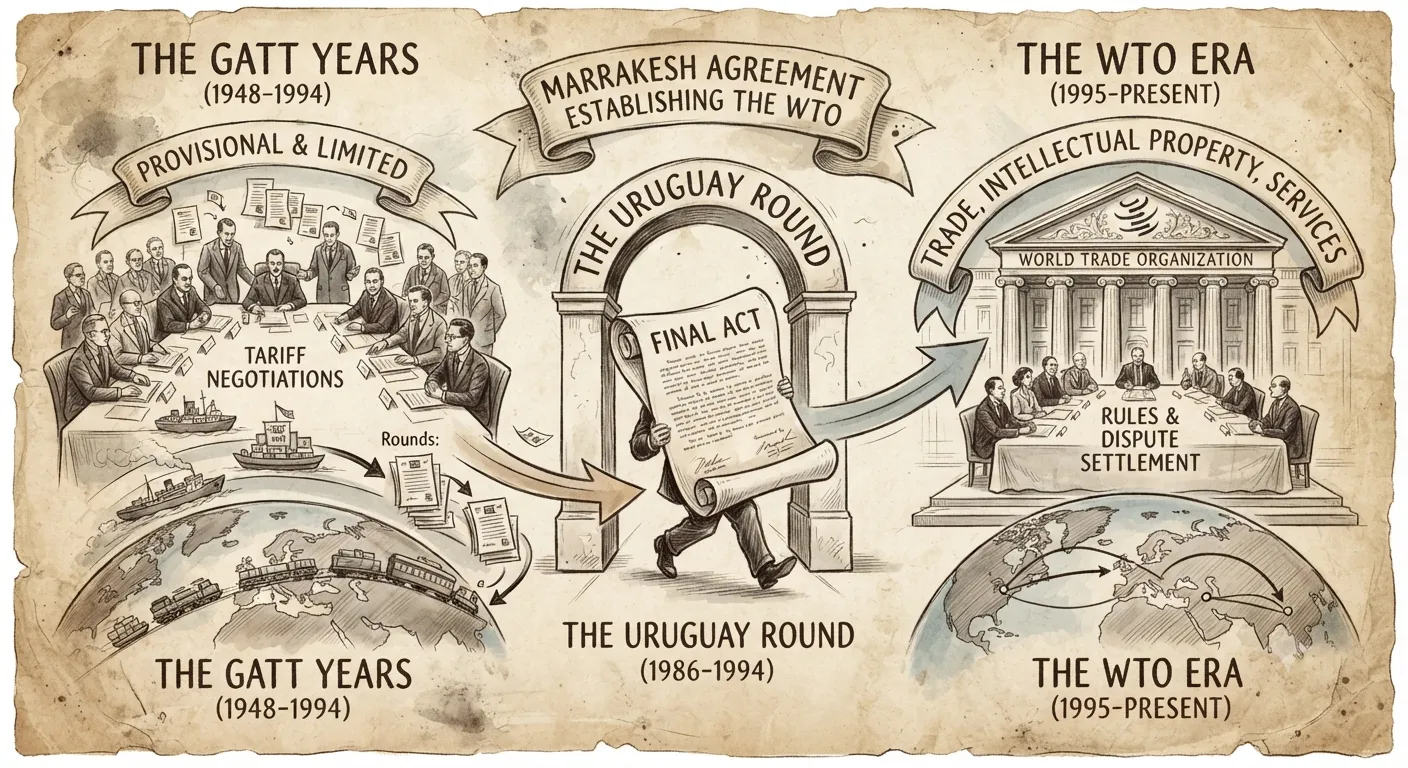
The journey toward a regulated global marketplace began with the transition from the old GATT regime to the modern WTO structure. The modern global trading system evolved from the General Agreement on Tariffs and Trade (GATT) established after the Second World War. The inadequacies of GATT in regulating sensitive sectors like agriculture led to comprehensive negotiations during the Uruguay Round.
- The Transition from GATT to WTO
The transition marked a fundamental shift in global trade governance, moving from a provisional treaty to a permanent international institution.
- (i) The Uruguay Round negotiations served as a marathon of diplomacy, lasting over seven years and finally concluding on 15 December 1993.
- (ii) These landmark agreements were formally ratified in April 1994 at the ministerial meeting in Marrakesh, Morocco.
- (iii) The World Trade Organization (WTO) officially came into force on 1 January 1995, establishing its permanent headquarters in Geneva, Switzerland.
- (iv) In the current era, the WTO has grown to include 164 members, which accounts for nearly 98% of world trade.
Textiles and Agriculture Under the WTO Framework
Specific sectors required specialized handling to move from protectionism to a rules-based multilateral system. Both textiles and agriculture had long histories of heavy state intervention that needed structural dismantling.
The Discipline of the Textiles Sector
For decades, textiles were governed by protectionist arrangements that shielded developed nations from competition. However, a major shift occurred as these products were integrated into the general WTO rules starting in 2005.
- (i) Historically, textiles were managed through restrictive quotas rather than open market principles.
- (ii) The full integration in 2005 marked the end of the Agreement on Textiles and Clothing (ATC).
- (iii) This transition highlights why multilateral rules are essential to prevent powerful protectionist lobbies from dominating global trade.
The Agriculture Discipline and Specialized Agreements
Agriculture remains a unique case due to its vital role in food security and rural livelihoods. This led to the creation of the Agreement on Agriculture (AoA) to manage its complexities.
- (i) Before the Uruguay Round, agriculture operated under extremely weak GATT disciplines.
- (ii) The AoA introduced legally binding commitments that forced nations to reduce trade barriers.
- (iii) Oversight is provided by the WTO Committee on Agriculture, which ensures all member states fulfill their transparency obligations.
Scope, Coverage, and Implementation of the AoA
The Agreement on Agriculture encompasses a wide range of products but maintains specific exclusions and timelines for implementation to ensure a smooth global transition.
Product Coverage and Exclusions
While the majority of farm goods are included, certain industrial-adjacent raw materials are kept outside this specific legal framework.
- (i) Included Products: Most staple foods, livestock, and primary agricultural commodities.
- (ii) Excluded Products: The agreement does not cover fishery, forestry, rubber, jute, sisal, abaca, and coir.
Timelines for Global Implementation
Recognizing the different economic capacities of nations, the AoA set varying deadlines starting from 1 January 1995.
- (a) Developed Countries: Given a 6-year window to complete reductions (completed by 2000).
- (b) Developing Countries: Granted a 10-year period to adjust (completed by 2004).
- (c) Least Developed Countries (LDCs): Exempted from making any reduction commitments to protect their fragile economies.
Country Category Implementation Period Completion Date Reduction Mandate Developed Countries 6 Years 2000 Full commitments apply Developing Countries 10 Years 2004 Lighter reduction commitments Least Developed Countries (LDCs) N/A Exempt No reduction commitments required
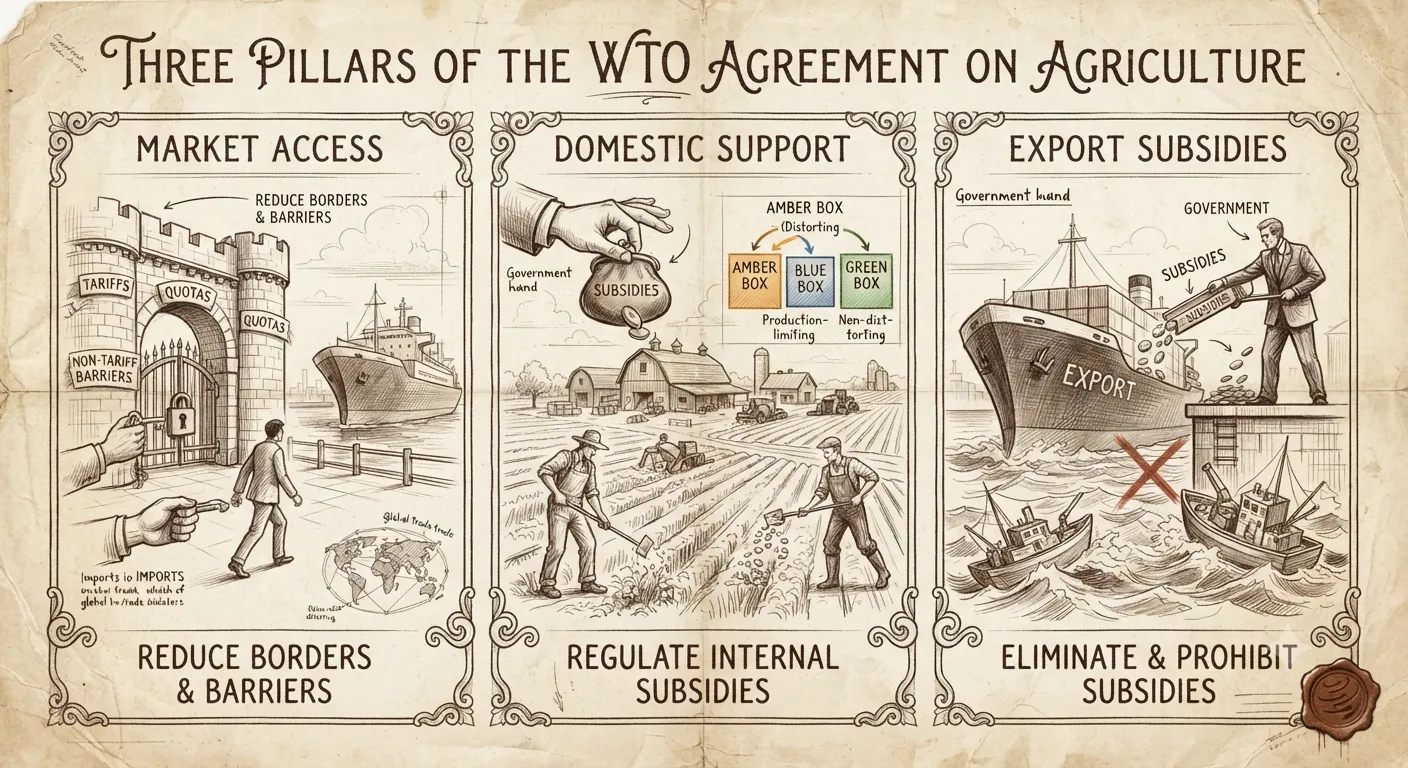
The Three Pillars of the Agreement on Agriculture
The AoA is built upon three fundamental pillars designed to eliminate trade distortions and improve market access across the globe.
Pillar I: Market Access and Tariffication
This pillar focuses on making trade predictable by converting hidden barriers into transparent tariffs.
Tariffication and Reduction Commitments
- (i) Abolition of Non-Tariff Barriers: Quotas, variable levies, and voluntary restraint agreements must be converted to fixed duties.
- (ii) Developed Nations: Required an average reduction of 36% (minimum 15% per item).
- (iii) Developing Nations: Required an average reduction of 24%.
Minimum Access and Special Safeguards
- (i) Minimum Access: Required members to open 3% of domestic consumption in 1995, rising to 5%.
- (ii) Special Safeguard (SSG): Allows temporary duty hikes if imports surge or prices crash, provided the country practiced tariffication.
Pillar II: Domestic Support and Subsidy Boxes
This pillar disciplines internal government subsidies that can artificially boost production and distort the international market.
Aggregate Measurement of Support (AMS)
- (i) Developed Countries: Committed to a 20% reduction in trade-distorting support.
- (ii) Developing Countries: Committed to a 13.3% reduction.
- (iii) De minimis: Support within 5% (developed) or 10% (developing) of production value is exempt.
Categorization of Subsidy Boxes
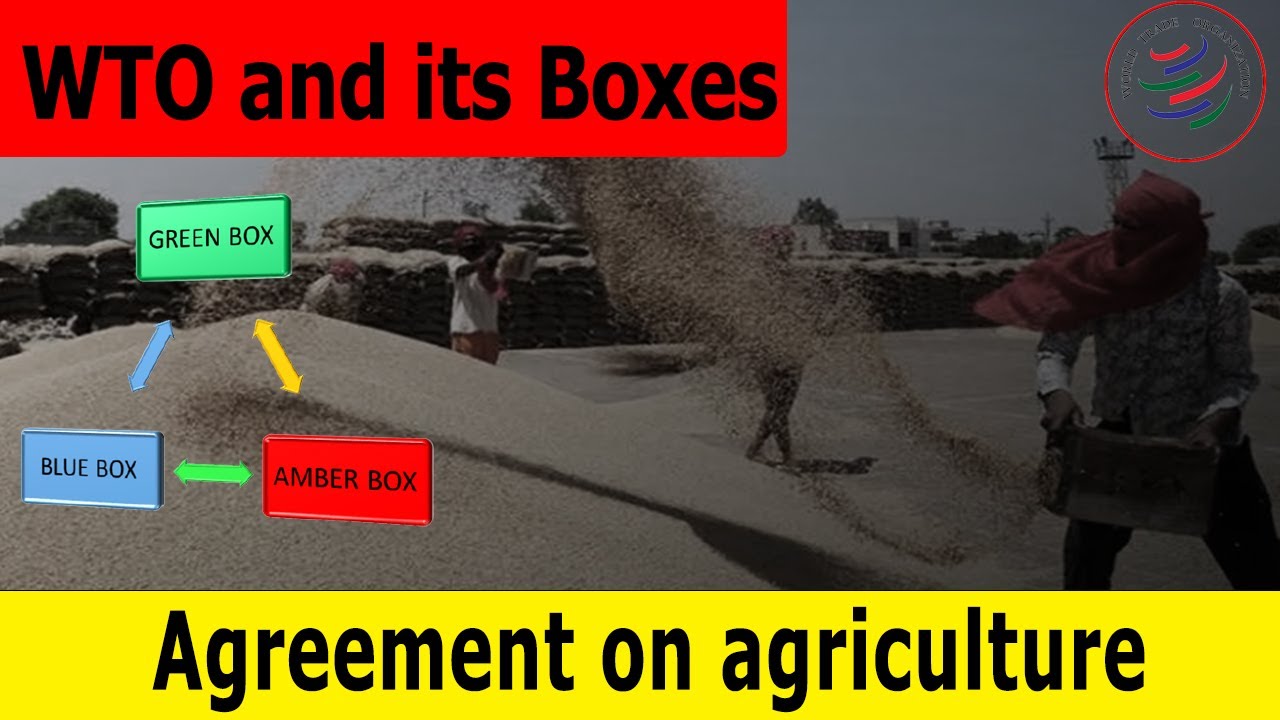
- (i) Green Box: Includes non-distorting support like research, environmental protection, and food security stockholding.
- (ii) Amber Box: Contains trade-distorting measures like price supports; these are subject to reduction.
- (iii) Blue Box: Covers Amber Box subsidies that come with production-limiting constraints.
Pillar III: Export Subsidies and Competition
To prevent dumping, the WTO limits the ability of governments to subsidize goods being sold abroad.
- (i) Developed Countries: Tasked with a 36% cut in spending and 21% cut in volume over 6 years.
- (ii) Developing Countries: Tasked with a 24% cut in spending and 14% cut in volume over 10 years.
- (iii) Under the Nairobi Ministerial Decision (2015), these subsidies are being phased out globally to ensure fair export competition.
India’s Specific Commitments and Positions
India’s participation in the AoA is shaped by its need to protect low-income farmers and maintain food security across its vast agrarian population.
Market Access and Tariff Bindings
India did not undertake tariffication because it maintained quantitative restrictions for balance-of-payments reasons.
- (i) Primary agricultural products were bound at 100%.
- (ii) Processed foods and edible oils were bound at 150% and 300% respectively.
- (iii) Certain rates were renegotiated under GATT Article XXVIII in 1999 to protect domestic interests.
Domestic Support and Negative AMS
India’s support levels during the base period (1986–88) were actually below the allowed thresholds.
- (i) The total Aggregate Measurement of Support (AMS) was calculated at –₹19,869 crore.
- (ii) Because the support was negative (effectively taxing agriculture), India had no reduction commitments.
- (iii) India utilizes Special and Differential Treatment for input subsidies to resource-poor farmers.
Article 20 and the Mandated Negotiations
The AoA was never intended to be a final document; it includes a built-in agenda for continuous reform to address long-term trade imbalances.
- (i) Mandated Start: Official negotiations for further reform began in January 2000.
- (ii) Core Objectives: These sessions evaluate the impact on global trade and address non-trade concerns like rural development and food security.
- (iii) Developing Interests: A major focus remains on strengthening Special and Differential Treatment for developing countries.
Summary
The WTO disciplines on agriculture and textiles aim to balance global trade liberalisation with domestic protection and food security. While textiles have been fully integrated into general WTO rules since 2005, agriculture remains governed by the Agreement on Agriculture with its three pillars—market access, domestic support, and export competition. For students and exam aspirants, understanding these structures is essential for grasping how international trade law promotes fairness, prevents dumping, and protects vulnerable economies through Uruguay Round principles.
Quick Revision Points for Students
Reviewing the core empirical and geographical facts ensures full retention for examinations.
- (i) The WTO came into force on 1 January 1995 following the Marrakesh Agreement, replacing the GATT framework.
- (ii) The Multi-Fibre Arrangement and ATC ended in 2005, fully integrating textiles into normal WTO disciplines.
- (iii) The AoA rests on Three Pillars: Market Access, Domestic Support (Subsidy Boxes), and Export Subsidies.
- (iv) WTO Subsidies are split into boxes: Green (non-distorting), Amber (trade-distorting, subject to cuts), and Blue (production-limiting).
- (v) India's base-period AMS was negative (–₹19,869 crore), exempting it from mandatory domestic support reduction commitments.
Frequently Asked Questions (FAQ)
Q1: What happened to the textile sector disciplines in 2005?
A1: In 2005, the transitional Agreement on Textiles and Clothing (ATC) expired, fully integrating textiles into general WTO rules and ending decades of restrictive quota systems maintained by developed nations.Q2: What are the three core pillars of the WTO Agreement on Agriculture (AoA)?
A2: The three pillars are Market Access (converting non-tariff barriers to tariffs), Domestic Support (disciplining internal subsidies using Green, Amber, and Blue boxes), and Export Subsidies (limiting state-backed export competition and dumping).Q3: Why didn't India have to reduce its domestic support under the AMS guidelines?
A3: During the base implementation period (1986–88), India’s calculated Aggregate Measurement of Support (AMS) stood at a negative figure of –₹19,869 crore. Because it was negative, India was exempt from any reduction commitments.Q4: Which products are specifically excluded from the scope of the AoA?
A4: The AoA does not cover fishery, forestry, rubber, jute, sisal, abaca, and coir products, keeping them separate from this specific agricultural legal framework.