The infant industry argument for trade protection is a heavily debated economic concept that plays a major role in how developing countries shape their growth strategies. At its core, the idea is quite simple: new manufacturing firms in younger or less-wealthy nations often need temporary protective measures to survive their early days and stay afloat against massive, well-established global competitors. If you are a student gearing up for economics exams or analyzing international trade policies, breaking down how this principle works—and where it falters—is essential.
🎯 In this chapter, you will understand:
- Why newborn domestic industries request initial government protection from global competition.
- How market flaws like weak financial systems lead to trade barriers as a second-best policy.
- The economic risks of shielding firms, including inefficiency, rent-seeking, and higher prices.
- Why temporary trade barriers frequently turn into permanent policies known as perpetual infancy.
💡 Why this topic matters: It explains how developing nations balance domestic growth with global market realities.
🧠 Core Idea: Temporary trade shields give young local businesses time to grow, build skills, and eventually compete internationally.
The Infant Industry Argument for Trade Protection in Developing Countries
Think of this concept as giving a young business room to breathe. The argument highlights how newborn industries in developing nations face an uphill battle when forced to compete directly with mature, highly optimized firms from industrialized countries. Without initial help, local businesses might get crushed before they can scale up production, lower costs, or fix local market flaws.
Why Emerging Domestic Industries Look for a Temporary Shield
Young local industries face steep challenges that mature global competitors have already overcome over time.
- (i) Domestic market failure: Young industries rarely operate in a perfect environment. They frequently run into severe roadblocks like labor market rigidities, trouble raising money due to underdeveloped financial markets, and weak property rights systems (such as poor patent protection) that make early growth risky.
- (ii) Second-best policy: Because these protections focus on patching up local market flaws rather than fixing the root institutional issues directly, economists view trade protection here as a second-best solution.
- (iii) Initial protection rationale: By stepping in with tariffs, quotas, or import licenses, a government creates a temporary shield. This safe window allows domestic firms to build technical skills, refine production processes, and eventually build the muscle to compete globally.
Challenges and Limitations of Infant Industry Protection
While wrapping a young industry in protective blankets sounds good in theory, doing so creates massive side effects. If a government mismanages these safeguards, protections can backfire and harm the national economy.
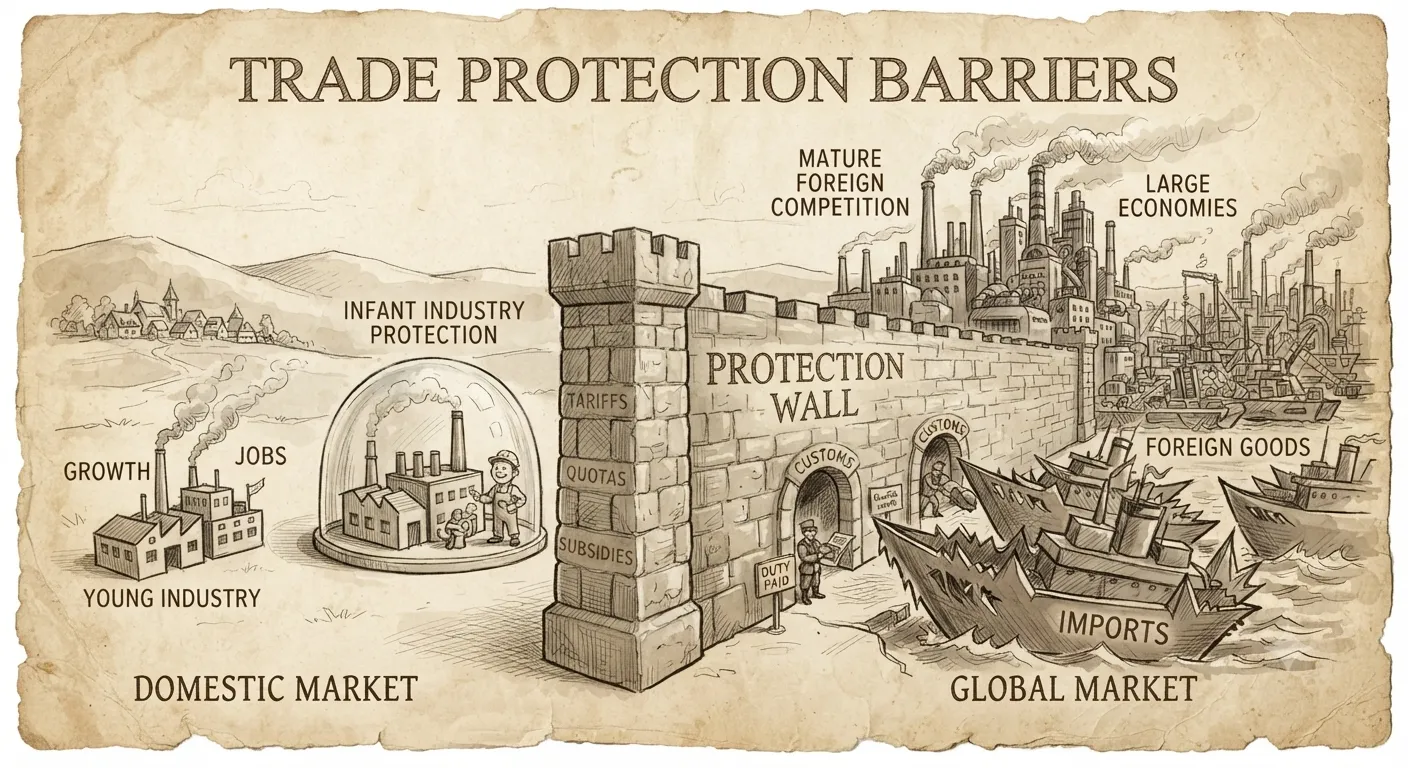
- Core Hurdles of Shielding Domestic Markets: Protecting local companies reduces their natural drive to stay competitive.
Inefficiency and Competition Issues
An absence of competition is a recipe for trouble. When you eliminate foreign rivals, local companies can easily become complacent and inefficient. Without global pressure forcing them to innovate or keep costs low, the entire economy loses out.
- (i) Protected firms lose their drive to boost productivity or upgrade old systems.
- (ii) Everyday domestic consumers bear the brunt, facing higher prices and fewer choices.
- (iii) The country's overall economic efficiency drops as resources get tied up in stagnant operations.
Rent-Seeking and Policy Abuse
When governments hand out discretionary favors, businesses often reallocate resources away from product quality and into political maneuvering.
- Systemic Misallocation of Capital: Government intervention opens opportunities for political gaming.
Rent-Seeking Tactics and Market Failures
When a government hands out discretionary favors like import licenses and quotas, it often triggers wasteful rent-seeking behavior. Instead of focusing on making better products, companies shift attention to gaming the system.
Consequences of Corporate Lobbying
Corporate effort shifts from real production to lobbying officials for financial shelter.
- (a) Businesses spend time, energy, and money lobbying politicians for continued protection rather than improving factories.
- (b) Complicated regulations breed bureaucratic inefficiencies and open doors for corruption.
- (c) The broader economy suffers major welfare losses as resources shift from production to political maneuvering.
- The Intended Goal: Give businesses a brief window to develop deep technical skills and modern technology to tackle global markets head-on.
- The Practical Reality: Intense political pressure and corporate lobbying make it almost impossible for governments to pull back tariffs, resulting in what economists call perpetual infancy syndrome.
- The Long-Term Damage: Industries become permanently dependent on government support, failing to become self-sufficient and completely derailing the policy's original purpose.
⚡ Quick Revision Capsule: Infant Industry Trade Policy
A quick comparative overview of the core mechanisms, trade-offs, and economic risks associated with trade protection in developing nations.
| Policy Aspect | Intended Objective | Real-World Risk / Trade-Off |
|---|---|---|
| Temporary Protection | Shield young domestic firms from mature foreign competitors while scaling up. | Risks creating perpetual infancy syndrome where tariffs are never removed. |
| Market Failure Correction | Provide time to overcome local market flaws like underdeveloped capital systems. | Acts only as a second-best solution instead of fixing root institutional issues. |
| Import Tariffs & Quotas | Allow local producers to build technical expertise and lower production costs. | Fosters complacency, leads to higher consumer prices, and reduces product choices. |
| Resource Allocation | Direct national investment into emerging manufacturing and technological sectors. | Triggers rent-seeking, spending budgets on political lobbying rather than innovation. |
| Policy Phasing & Exit | Gradually dismantle trade barriers as domestic firms reach global competitiveness. | Strong corporate lobbying creates systemic inefficiencies and economic welfare losses. |
📝 Summary
At its core, the infant industry argument is a delicate balancing act. While temporary trade protection can spark early industrial growth in developing countries, prolonged shields breed deep economic inefficiencies. The success of this policy hinges entirely on strict tracking and making sure protections are completely phased out over time. This makes it a foundational case study for any student mapping out international trade policies and real-world economic development.
🚀 Quick Revision Points
Essential facts to review before examinations:
- (i) The main goal is providing short-term relief to young local firms so they can scale up and survive foreign competition.
- (ii) Trade protection is generally labeled a second-best solution because it treats symptoms of domestic market failures rather than fixing them at the source.
- (iii) A lack of outside competition frequently backfires, leading to corporate complacency, higher consumer prices, and structural inefficiency.
- (iv) Policy tools like tariffs and quotas carry a high risk of wasteful rent-seeking, where firms prioritize political lobbying over real productivity.
- (v) The biggest practical danger is perpetual infancy syndrome, where politically powerful industries refuse to let go of their protections.
- 💡 Exam Tip: When answering exam questions on trade protection, clearly differentiate between short-term scale benefits and long-term rent-seeking dangers. Highlight why economists classify tariffs as a second-best policy option.
❓ Frequently Asked Questions (FAQ)
Q1: What exactly is the core idea behind the infant industry argument?
A1: It suggests that new industries in developing countries need temporary protective measures (like tariffs or quotas) to shield them from dominant global competitors until they grow efficient enough to compete on their own.Q2: Why do economists refer to this protection as a "second-best" policy?
A2: Because it uses trade barriers to counteract internal domestic issues—such as labor market rigidities or underdeveloped financial markets—instead of correcting those specific institutional problems directly.Q3: What is "perpetual infancy syndrome" in trade economics?
A3: This happens when industries that were supposed to receive only temporary protection use political and economic leverage to keep those barriers in place forever, meaning they never actually learn to survive without government aid.Q4: How does shielding a young industry cause rent-seeking and policy abuse?
A4: When profits depend heavily on government-issued import licenses or high tariffs, companies shift their budgets away from innovation and spend it on lobbying bureaucrats to maintain their market advantages.