The concept of tariffs in international trade plays a crucial role in shaping domestic market prices and understanding trade policies. A tariff or import duty can significantly affect consumers, producers, and government revenue in a country. By studying the effects of specific and ad valorem tariffs, students preparing for economics exams can grasp the impact of protectionist policies on domestic and global trade scenarios, making it essential for both exam preparation and practical economic understanding.
🎯 In this chapter, you will understand:
- The difference between specific and ad valorem tariffs in trade policy.
- How import taxes alter prices, supply, and demand in a small open economy.
- The welfare distribution among buyers, producers, and state treasuries.
- Why deadweight loss occurs when trade duties disrupt open market efficiency.
💡 Why this topic matters: Tariffs fundamentally rewrite the price relationship between domestic goods and foreign imports, affecting every household, business, and state treasury.
🧠 Core Idea: While tariffs protect local producers and bring in government revenue, they raise prices for consumers and create an overall loss in economic welfare.
Impact of Tariffs on Domestic Market and Economic Agents
When a government steps into the marketplace and applies an import tax, it changes the entire flow of international business. Tariffs do not just sit on custom ledgers; they fundamentally rewrite the price relationship between home-grown products and foreign goods, touching everyone from everyday shoppers to state treasuries.
- Understanding Tariffs: Tariffs fundamentally alter the relative prices of traded and non-traded goods.
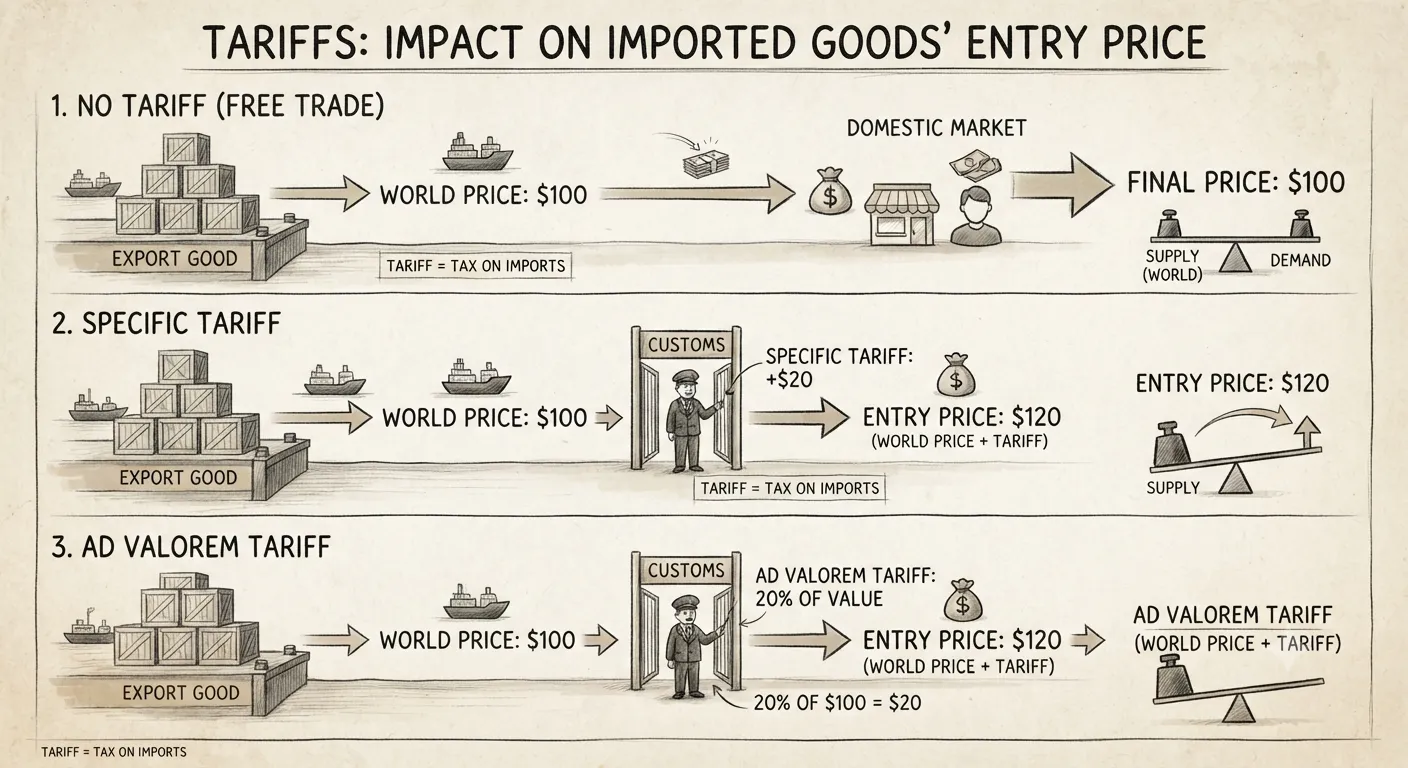
A tariff is an import duty charged by the government. It can be a specific tariff (a fixed money amount per item) or an ad valorem tariff (a percentage of the item's total value). These duties raise the domestic price of imported goods, directly influencing consumption, production, and government revenue.
- (i) Specific Tariffs: Charged as a fixed amount per unit, such as ₹400 per box of imported dates.
- (ii) Ad Valorem Tariffs: Charged as a fixed percentage of the total value of imported goods, such as 30% on computer parts.
- (iii) These tariffs raise local prices above the world price (Pw), shifting supply and demand in the domestic market.
Partial Equilibrium Analysis of Tariff Impact
To see how tariffs work step-by-step, economists use a partial equilibrium model. We look at a single imported product within a small open economy. Because the country is a small player globally, it cannot change world prices. Therefore, our focus stays strictly on how domestic market prices and trade quantities adjust when an import tax is added.
Effects on Domestic Demand and Supply
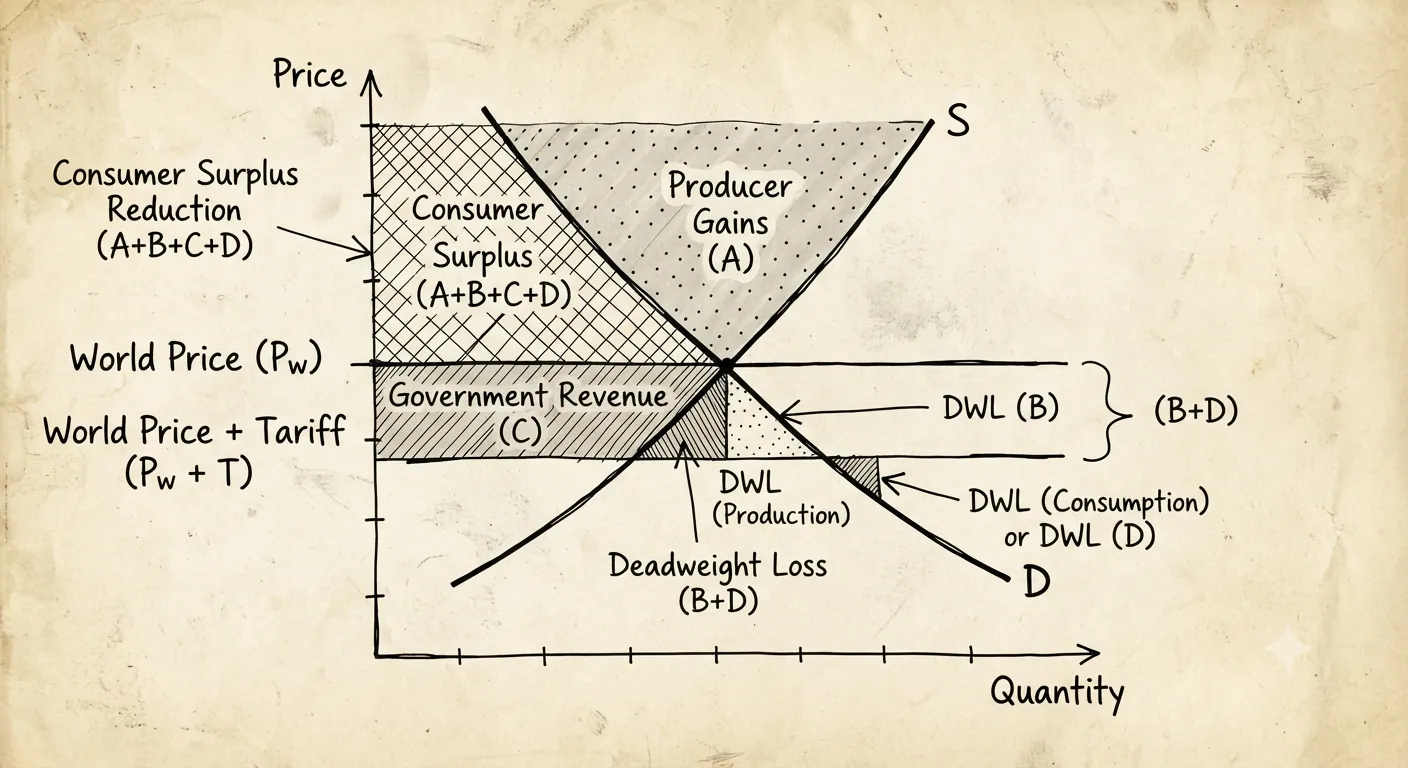
When a tariff is added, local prices rise to (Pw + t). This creates a price gap between world prices and domestic market prices, which changes both local production and buying habits.
- (i) Domestic production goes up because local businesses can sell their goods at higher prices.
- (ii) Domestic buying goes down because shoppers face higher prices.
- (iii) Total import volume falls as the country relies more on local production to meet its needs.
Costs and Benefits of Tariff Imposition
Adding a tariff brings gains for local producers and the state treasury, but it creates financial losses for buyers. A cost-benefit view shows how total social well-being changes.
- (a) Consumer Loss: Buyers pay higher prices and purchase fewer items, leading to a loss in consumer surplus.
- (b) Producer Gain: Local manufacturers profit from higher selling prices, increasing producer surplus.
- (c) Government Revenue: The government collects import duties on foreign goods, bringing in extra tax revenue.
- (d) Net Social Loss: The combined gains of producers and the government are smaller than the loss suffered by consumers, leading to a net economic loss for society.
Welfare Implications of Tariffs
Tariffs distort both production efficiency and buyer choices, creating waste in the economy. This leads to a overall loss of social welfare, which is a key topic for economics examinations.
- Production Distortion: Local resources are used to make goods at home that could have been imported at a lower cost.
- Consumption Distortion: Buyers give up purchasing items even when the personal value of those items is higher than the actual world import cost.
- Exclusion of Broader Impacts: Partial equilibrium analysis looks at only one market at a time. It does not measure broader economic shifts like job trends, wage changes, or national balance of payments.
Conclusion: Importance of Understanding Tariffs
At the end of the day, studying trade barriers lets us see clearly who wins and who loses when international trade is restricted. Balancing these different economic pressures builds a solid foundation for analyzing public policy options and answering key exam questions.
- Final Takeaway on Trade Inefficiencies
Studying tariffs helps students see how protectionist trade policies change domestic prices, production, buying habits, and government revenue. Knowing how gains and losses are split among buyers, sellers, and the government prepares students for exam questions on international trade and economic policies while showing the overall impact on society.
⚡ Quick Revision Capsule: Tariff Impacts on Economic Agents
This breakdown compares how different market groups in a small open economy are affected when an import tax is added.
| Economic Agent / Factor | Market Change under Tariff | Welfare / Financial Impact |
|---|---|---|
| Domestic Consumers | Pay higher price (Pw + t) and buy fewer items | Loss of consumer surplus (Net negative) |
| Domestic Producers | Sell items at higher price and increase production | Gain in producer surplus (Net positive) |
| Government Treasury | Collects tax duty on all imported units | Earns tariff revenue (Net positive) |
| Total Import Volume | Imported quantity decreases as local production rises | Reduced trade volume |
| Overall Society | Production and consumption choices are distorted | Net social deadweight loss |
📝 Summary
Raising import prices in a small open economy moves the market away from world trade values and hurts overall economic efficiency. While local producers gain short-term protection and the government collects tax money, these benefits are smaller than the financial loss to consumers. This creates a lasting net economic loss known as deadweight loss.
🚀 Quick Revision Points
Essential facts to review before examinations:
- (i) Tariffs are government-imposed taxes on imports, levied either as a fixed specific charge per item or a percentage-based ad valorem duty.
- (ii) Under partial equilibrium analysis, domestic prices rise to (Pw + t), causing local buying to fall and domestic output to rise.
- (iii) Overall import volume decreases as domestic prices rise above the world market price.
- (iv) Society suffers an economic deadweight loss because the combined gains of domestic sellers and the government cannot cover the total loss to consumers.
- 💡 Exam Tip: When answering questions on partial equilibrium tariff models, always explicitly point out the two components of net deadweight loss: production distortion loss and consumption distortion loss.
❓ Frequently Asked Questions (FAQ)
Q1: What is the main difference between a specific tariff and an ad valorem tariff?
A1: A specific tariff charges a fixed money amount on every unit imported (such as ₹400 per box). In contrast, an ad valorem tariff is calculated as a percentage of the total value of the imported good (such as a 30% duty on computer parts).Q2: Why does imposing a tariff lead to a net welfare loss for the country?
A2: Although local producers earn more and the government collects tariff revenue, the total financial loss to consumers is greater than these combined gains. This gap creates an economic waste known as deadweight loss.Q3: What important factors are left out of a partial equilibrium tariff analysis?
A3: Because it focuses on only one product market, this model leaves out broader macroeconomic effects like nation-wide employment shifts, changes in factor markets, and long-term balance of payments adjustments.