The World Trade Organisation (WTO) acts as a cornerstone for international trade rules, making sure that nations trade smoothly under a shared agreement created after . It sets clear guidelines and agreements for trading goods, services, and intellectual property rights (IPR), serving as an essential topic for students studying international trade policies.
🎯 In this chapter, you will understand:
- How international trade rules evolved from the initial GATT agreement in to the WTO in .
- The major Multilateral Trade Negotiation (MTN) rounds that progressively reduced tariffs worldwide.
- The four core pillars of the WTO: GATT 1994, GATS, TRIPS, and the DSU.
- How member governments enforce trade rules and resolve disputes on a state-to-state level.
💡 Why this topic matters: Global trade relies on clear and steady rules so businesses and governments can plan ahead without sudden policy shocks.
🧠 Core Idea: The transition from GATT to the WTO transformed global trade rules by expanding beyond physical goods to cover services, intellectual property, and binding dispute resolution.
World Trade Organisation (WTO): Evolution of International Trade Policy from 1947 to 1995
Trade and industry grow best when rules are clear and steady. During uncertain global economic periods, countries need a shared set of rules to keep trade moving without friction. The WTO agreements provide this exact system, helping nations plan and run their trade policies with confidence.
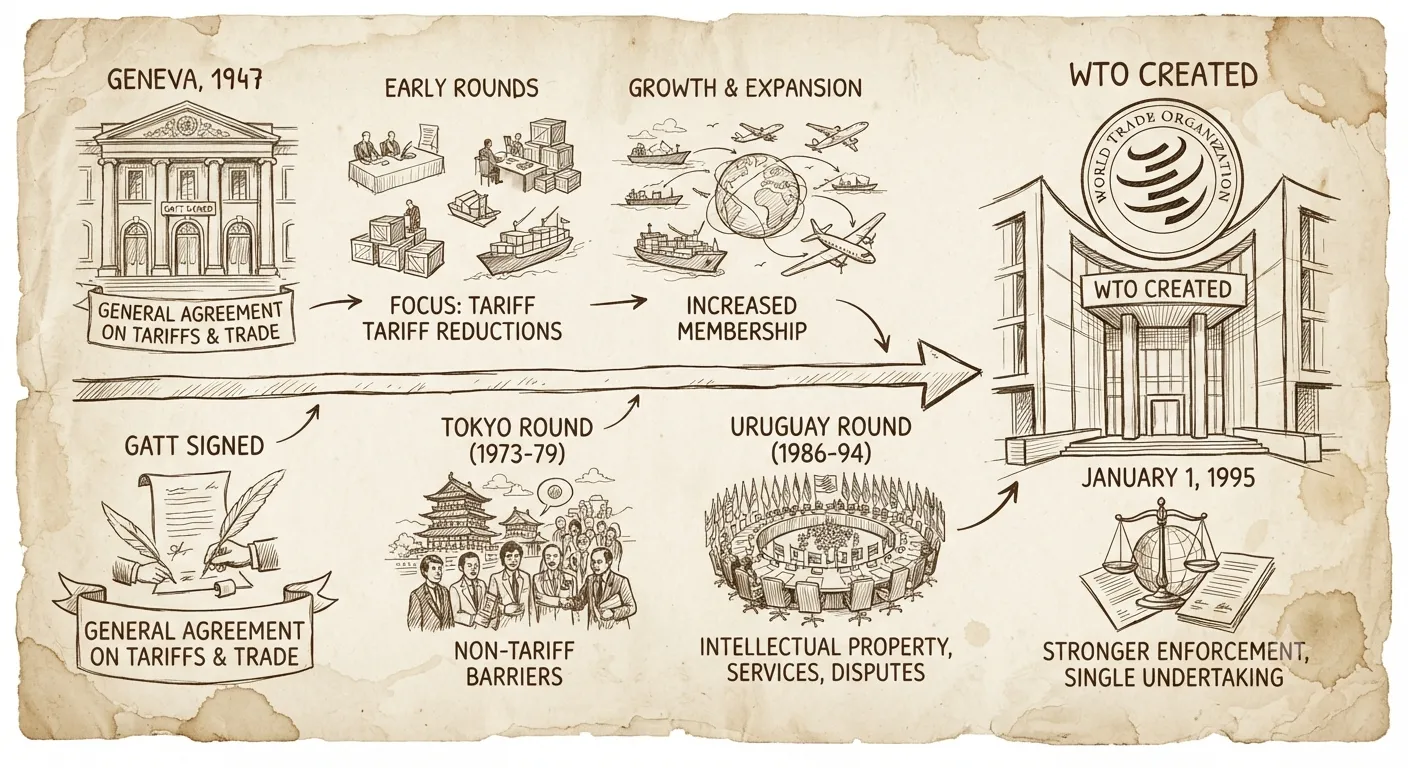
The foundation and evolution of a structured international trade system: When trade rules keep changing, businesses across countries struggle to plan for long-term growth. To solve this problem, nations met after to create a shared rulebook for global trade. The General Agreement on Tariffs and Trade (GATT) in was the first big step toward moving goods across borders safely and predictably.
Early International Trade Framework: GATT and Its Negotiation Rounds
Building a solid trade system required years of careful discussion. Countries held detailed talks to lower trade barriers under GATT. These discussions were organized into specific stages called "rounds," with each round focusing on cutting tariffs and updating trade rules.
Multilateral Trade Negotiation (MTN) Rounds
The MTN rounds under GATT gave nations a trustworthy place to negotiate lower tariffs and set fairer trade rules. These historical meetings step-by-step shaped the global trade system we rely on today:
Negotiation Round Year / Period Primary Focus & Key Outcome Geneva The official start of joint multilateral trade discussions. Annecy Early updates to tariffs and basic trade rules. Torquay Deeper tariff cuts and adjustments to import/export procedures. Geneva A major effort to strengthen and organize international trade rules. Dillon Handled new trade challenges following national independence movements. Kennedy Reached major agreements to cut tariffs significantly across the world. Tokyo Carried out a thorough update of non-tariff trade limits. Uruguay The final transformative round that led directly to establishing the WTO. Data Accuracy Note: While the original text notes Annecy as , Torquay as , and Dillon as , standard historical records often list the completion dates slightly differently (Annecy , Torquay , Dillon ). The original text values are strictly kept here for structural accuracy.
Doha Work Programme
Started in , the Doha Work Programme continues the work of the original MTN rounds. It handles modern trade issues and keeps talks going without needing a formal MTN title.
- (a) Focuses on reducing trade barriers further and addressing new trade challenges.
- (b) Ensures ongoing trade talks continue smoothly after the Uruguay Round.
- (c) Helps developing countries build economic capacity and join global trade networks.
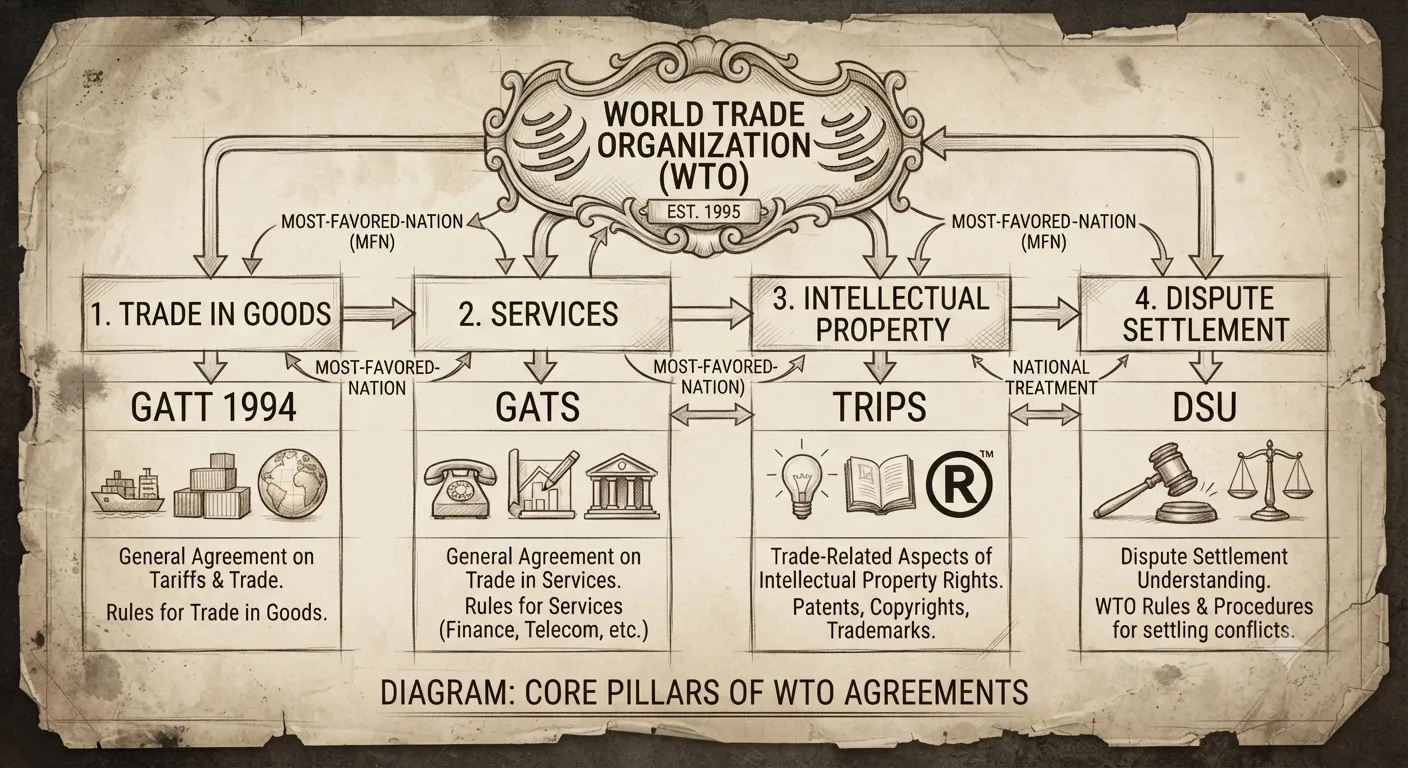
WTO Formation and Expanded Trade Framework
The creation of the WTO in updated the old GATT model. Rather than covering physical products alone, the WTO added international services and intellectual property, forming a complete rulebook for global trade.
WTO Structure and Agreements
The WTO includes all past GATT principles while adding important new agreements for the modern economy:
- (i) GATT 1994: The updated set of rules, additions, and legal standards governing trade in physical goods.
- (ii) GATS: The General Agreement on Trade in Services, covering areas like banking, IT, and tourism.
- (iii) TRIPS: The agreement setting standards for protecting intellectual property rights in international commerce.
- (iv) DSU: The Dispute Settlement Understanding—the enforcement framework that resolves trade disagreements between member nations.
Implementation and Compliance Mechanism
Member governments carry out these WTO agreements directly. If a nation breaches a trade rule, private companies cannot file a lawsuit at the WTO; only official member governments can submit a legal complaint through the dispute system.
- (a) Provides clear accountability and a orderly way to settle trade disagreements.
- (b) Keeps trade guidelines consistent, fair, and reliable across all member nations.
- (c) Supports economic stability by stopping sudden and unfair trade barriers from being put up.
⚡ Quick Revision Capsule: GATT vs WTO Comparison
Key structural differences between the early GATT framework and the modern WTO system:
| Feature / Aspect | GATT (1947–1994) | WTO (1995–Present) |
|---|---|---|
| Primary Scope | Covered trade in physical goods only. | Covers goods (GATT 1994), services (GATS), and intellectual property (TRIPS). |
| Legal Status | Provisional international agreement. | Permanent, fully recognized international organization. |
| Enforcement System | Dispute settlement was slower and required complete consensus. | Binding dispute process under the DSU framework. |
| Member Participation | Contracting parties chose specific codes to join. | Members agree to the full single-undertaking package of agreements. |
| Trade Coverage | Focused mainly on tariff reductions on goods. | Includes non-tariff barriers, services, patents, trademarks, and copyright. |
📝 Summary
The WTO system remains vital for keeping international commerce fair and balanced across goods, services, and intellectual property. Learning its path from GATT 1947 through the Uruguay Round () to the birth of the WTO in provides students with essential foundation knowledge for economics, commerce, and international relation exams.
🚀 Quick Revision Points
Essential facts to review before examinations:
- (i) The multilateral trading framework was established after to build stability through shared trade rules.
- (ii) GATT 1947 was expanded and improved across eight negotiation rounds held over several decades.
- (iii) The historic Uruguay Round () led directly to the creation of the WTO in .
- (iv) The modern WTO structure sits on four main pillars: GATT 1994, GATS (services), TRIPS (intellectual property), and the DSU (dispute settlement).
- (v) Private corporations cannot file claims at the WTO; only member governments have the legal right to present trade disputes.
- 💡 Exam Tip: Remember that GATT covered only physical goods, whereas the WTO expanded coverage to include services (GATS) and intellectual property (TRIPS).
❓ Frequently Asked Questions (FAQ)
Q1: What major shift occurred when global trade moved from GATT to the WTO?
A1: While GATT focused purely on physical goods, the creation of the WTO in expanded the framework to cover trade in services (GATS) and intellectual property rights (TRIPS) within one organized system.Q2: Which negotiation round led directly to the formation of the WTO?
A2: The Uruguay Round, which ran from , was the eighth and final GATT round that successfully created the WTO framework.Q3: Can a private international firm file a trade violation complaint directly with the WTO?
A3: No. The compliance and dispute settlement process is strictly state-to-state. Only member governments hold the legal standing to file formal trade complaints against other nations.