Understanding the principle of open and free competition under WTO rules is crucial for students preparing for exams in international trade and economics. The regulations, as outlined in Article XI of GATT 1994, ensure that governments do not impose unwarranted restrictions on the import and export of goods, maintaining a fair global trade environment. These rules also explain the circumstances under which temporary measures like export restraint or duties can be applied, providing insights into trade policy management and critical economic considerations.
🎯 In this chapter, you will understand:
- The core WTO rules enforcing open and free market competition under GATT 1994.
- The legal boundaries and exceptions surrounding customs tariffs and import controls.
- How governments manage temporary export safeguards and export duties during critical shortages.
- Key strategic takeaways for trade policy management and examination preparation.
💡 Why this topic matters: International trade rules establish a stable global market by preventing nations from setting up unfair or unpredictable trade barriers.
🧠 Core Idea: Open and fair market competition is the default rule under GATT 1994, making tariffs the primary allowed control while banning non-tariff trade blocks.
📌 WTO Principles of Open and Free Competition in Trade Policy under GATT 1994
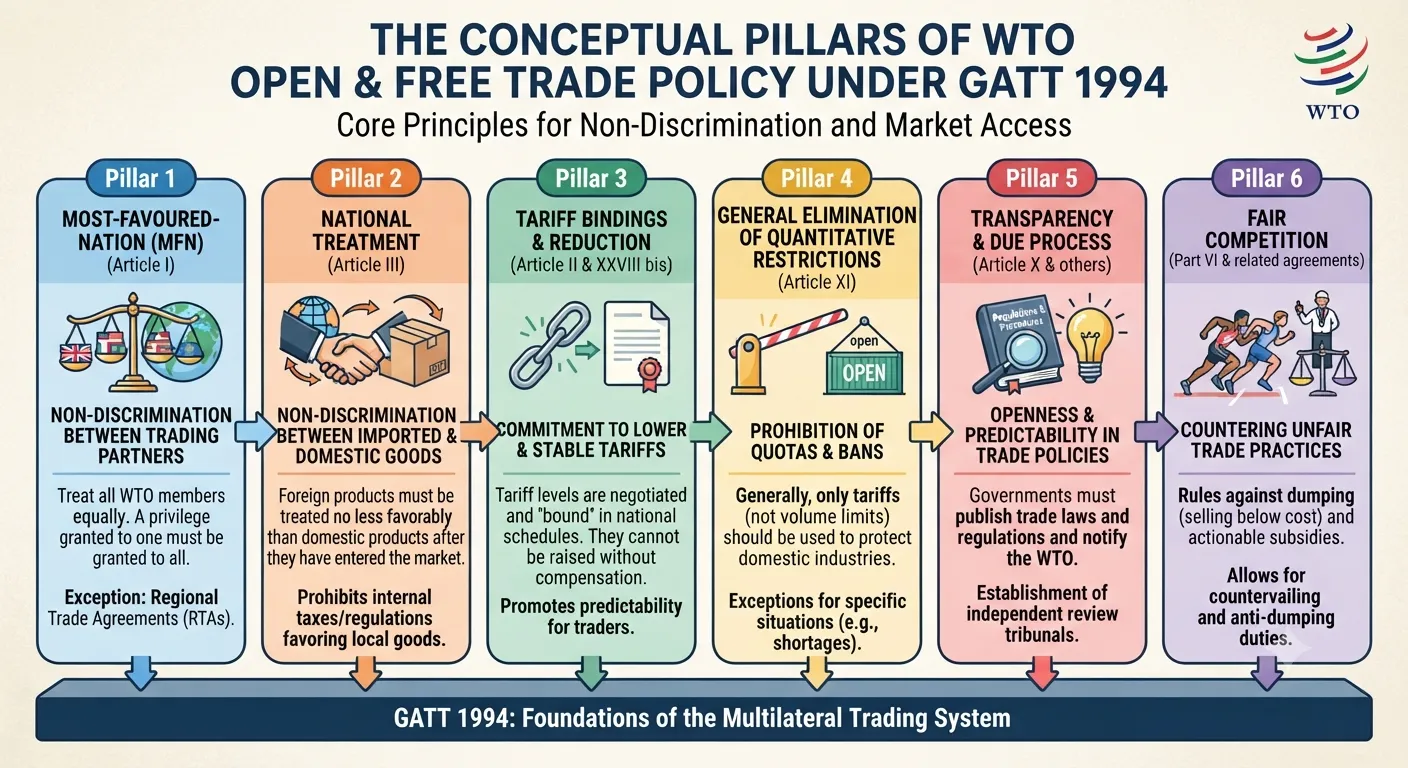
The WTO emphasizes unrestricted trade while allowing limited government intervention to maintain stability. The core idea behind WTO regulations is to encourage open and fair competition among nations by restricting the imposition of arbitrary trade barriers. Governments are generally prohibited from enforcing restrictions on imports and exports, ensuring smooth international trade flows across borders.
- Core Structural Pillars of Trade Openness
The regime built under GATT 1994 establishes a baseline where open markets are the rule and restrictions are the exception. By limiting the tools governments can use to block goods, the framework builds a predictable environment for international businesses.
- (i) Import Restrictions: Only tariffs, i.e., customs duties applied at the time of import, are normally allowed. All other forms, such as stopping imports or imposing quantitative limits, are prohibited except under exceptional circumstances.
- (ii) Export Restrictions: Governments may temporarily restrain exports only to prevent or alleviate critical shortages of essential goods like food or vital products.
- (iii) Export Duties: Authorities can impose export duties to control general export flows, protect essential domestic resources, or capture part of the profit from exported goods, particularly for important industrial raw materials.
📌 Disciplines on Import Tariffs under WTO
The rules governing import tariffs are a cornerstone of trade policy, balancing government revenue needs with the overarching goal of free trade. While market access is protected, countries retain the sovereign right to use structured duties as their primary economic lever.
Application of Tariffs and Exceptions
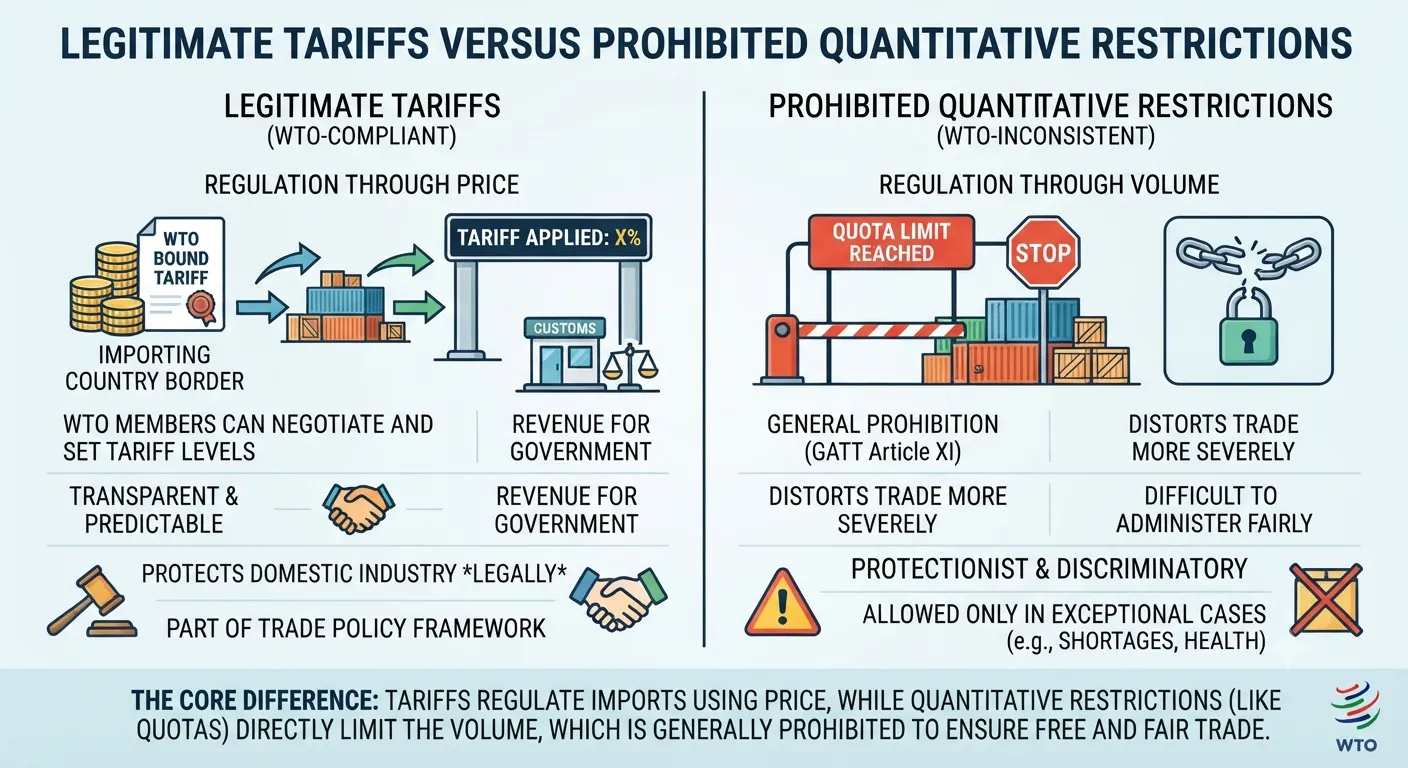
The tariff system allows governments to impose a fixed customs duty on imported goods, which is considered the legitimate form of controlling imports without violating WTO principles. Any attempt to limit import quantity or completely ban a product falls outside the general rules and is permissible only under special contingencies.
- (i) Customs Duty: Legitimate tool applied on imported products to generate revenue and regulate trade fairly.
- (ii) Quantitative Restrictions: Generally banned except under critical circumstances like national emergencies.
- (iii) Special Exceptions: Narrowly allowed where imports might threaten national security or public safety.
📌 Export Restraints and Duties
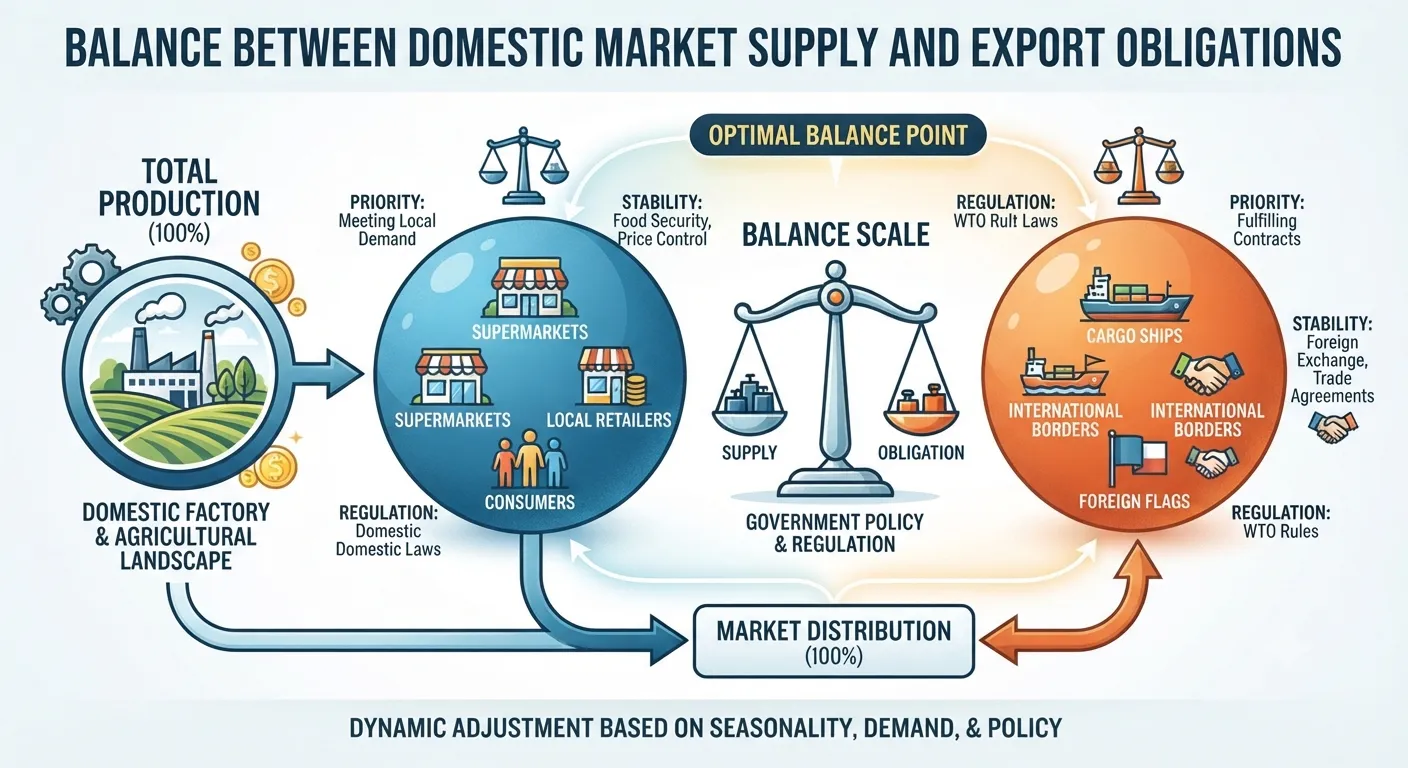
While export restrictions are usually discouraged to protect global consumers, the WTO permits temporary measures to manage essential commodities during crises. Export duties serve as a practical tool to control market supply and prevent excessive domestic price increases, especially for crucial industrial inputs.
Operational Breakdown of Export Safeguards
Governments implement export controls not to disrupt trade permanently, but to handle immediate domestic pressures and protect critical supply chains.
- (a) Temporary Export Measures: Used to address shortages of critical goods like food and essential products.
- (b) General Export Duties: Imposed to regulate the overall export of valuable resources or capture part of the profit from specific exports.
- (c) Policy Consideration: Export duties reflect strategic trade policy decisions aimed at balancing domestic availability with global trade obligations.
Insights into Trade Policy Management
Understanding these rules gives students and policymakers a comprehensive view of how governments can intervene in trade without violating WTO principles. It also highlights the delicate balance between free trade and safeguarding critical domestic resources.
- (i) Trade Balance Considerations: Policies must ensure domestic needs are met while remaining compliant with WTO obligations.
- (ii) Economic Strategy: Export duties and temporary measures help maintain industrial stability and market equilibrium.
- (iii) Educational Relevance: Provides a clear framework for students to understand international trade mechanisms and government interventions.
⚡ Quick Revision Capsule: WTO Trade Disciplines Summary
A structured comparison of trade measures under GATT 1994 regulations:
| Measure Type | WTO Status / General Rule | Primary Function / Exception |
|---|---|---|
| Customs Duty | Permitted Regulatory Tool | Applied on imported products to generate revenue and regulate trade fairly. |
| Quantitative Restrictions | Generally Prohibited | Banned except under critical circumstances like national emergencies. |
| Special Exceptions | Narrowly Allowed | Provides narrow allowances where imports might threaten national security or public safety. |
| Temporary Export Safeguards | Exception Allowed | Used to prevent or relieve severe shortages of food or vital domestic products. |
| Export Duties | Strategic Intervention Tool | Used to regulate valuable local resources, protect local industries, and balance market supply. |
📝 Summary of WTO Free Trade Principles
The WTO rules under GATT 1994 advocate open and free competition by restricting arbitrary import and export controls. Temporary export measures and carefully applied tariffs are the only acceptable interventions, emphasizing the balance between free trade and safeguarding critical domestic interests. Understanding these principles is essential for students studying trade policy and global economics.
🚀 Quick Revision Points
Essential facts to review before examinations:
- (i) The core rule of Article XI of GATT 1994 prohibits general restrictions on imports and exports except under strict criteria.
- (ii) Tariffs and customs duties are the only recognized, legitimate tool for regular import controls under WTO rules.
- (iii) Export restrictions can only be deployed temporarily to prevent or mitigate critical shortages of essential goods like food.
- (iv) Export duties remain a strategic option to safeguard domestic resources and maintain industrial input stability.
- 💡 Exam Tip: When answering exam questions on GATT 1994, remember that non-tariff barriers (like import quotas) are strictly forbidden, while tariffs are accepted as the standard legal method for regulating trade.
❓ Frequently Asked Questions (FAQ)
Q1: What is the primary rule regarding import and export restrictions under GATT 1994?
A1: Under Article XI, the rule mandates open and fair competition by prohibiting quantitative restrictions, bans, or absolute stops on imports and exports, preferring tariffs as the single standard measure.Q2: When can a government legally restrict exports under WTO guidelines?
A2: Governments can temporarily use export restrictions only to address or prevent critical shortages of food or other vital, essential products within their domestic markets.Q3: Why do nations use export duties if the WTO encourages open trade?
A3: Export duties are applied to control the general flow of valuable local assets, shield domestic industries from raw material scarcity, and prevent domestic price spikes.