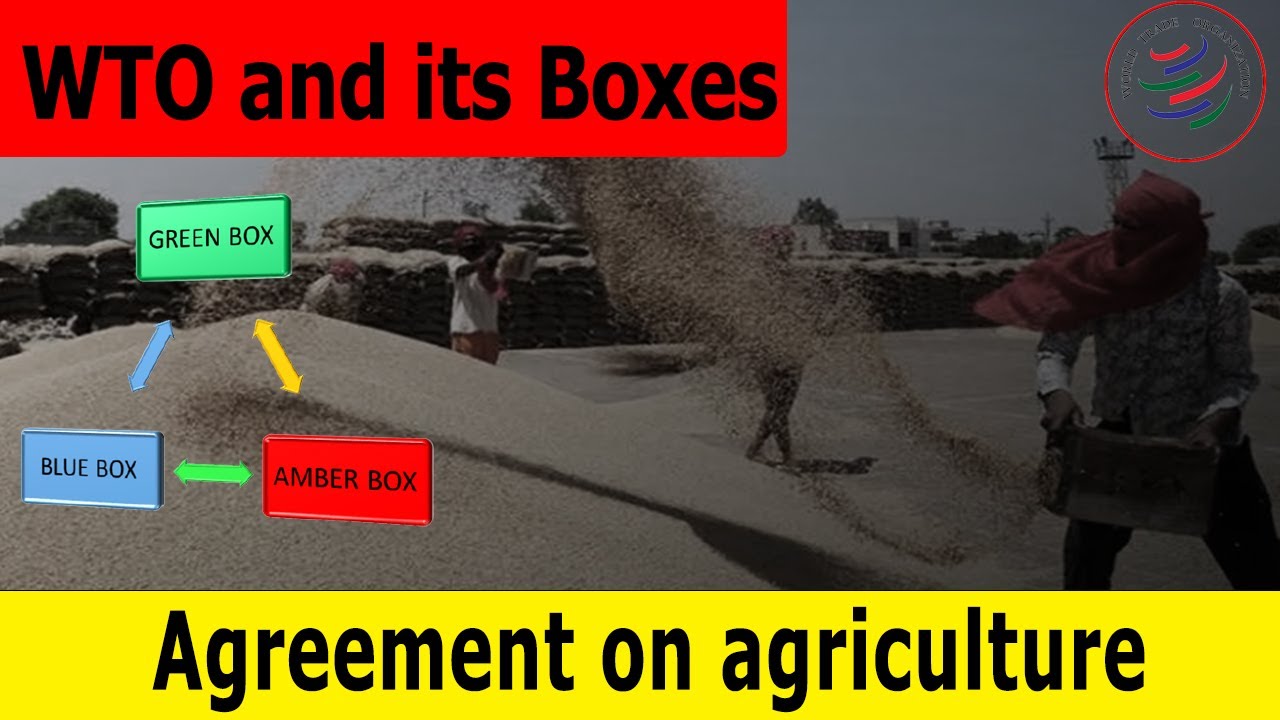
The global trade rules for farming and clothing products are a vital part of the world trading system, especially for developing countries. After the long Uruguay Round talks, farming was given its own binding legal setup through the Agreement on Agriculture (AoA). Meanwhile, textile trade was brought under standard WTO rules starting in . Learning how market access, domestic support, and export competition work is key for students, exam candidates, and trade enthusiasts.
🎯 In this chapter, you will understand:
- How global trade rules moved from the old GATT framework to the modern WTO system.
- How textiles were integrated into main WTO rules and how the Agreement on Agriculture works.
- The three core pillars of agricultural trade rules: market access, domestic support, and export competition.
- India's unique stance, tariff limits, and subsidy calculations under world trade law.
💡 Why this topic matters: It explains how global policies balance fair trade rules with essential needs like rural livelihoods, national food security, and market protections for developing economies.
🧠 Core Idea: The WTO framework sets fair, predictable global rules to curb unfair government subsidies and trade barriers while giving special flexibility to lower-income nations.
WTO Disciplines on Agriculture and Textiles: Evolution and Framework (1995-2005)
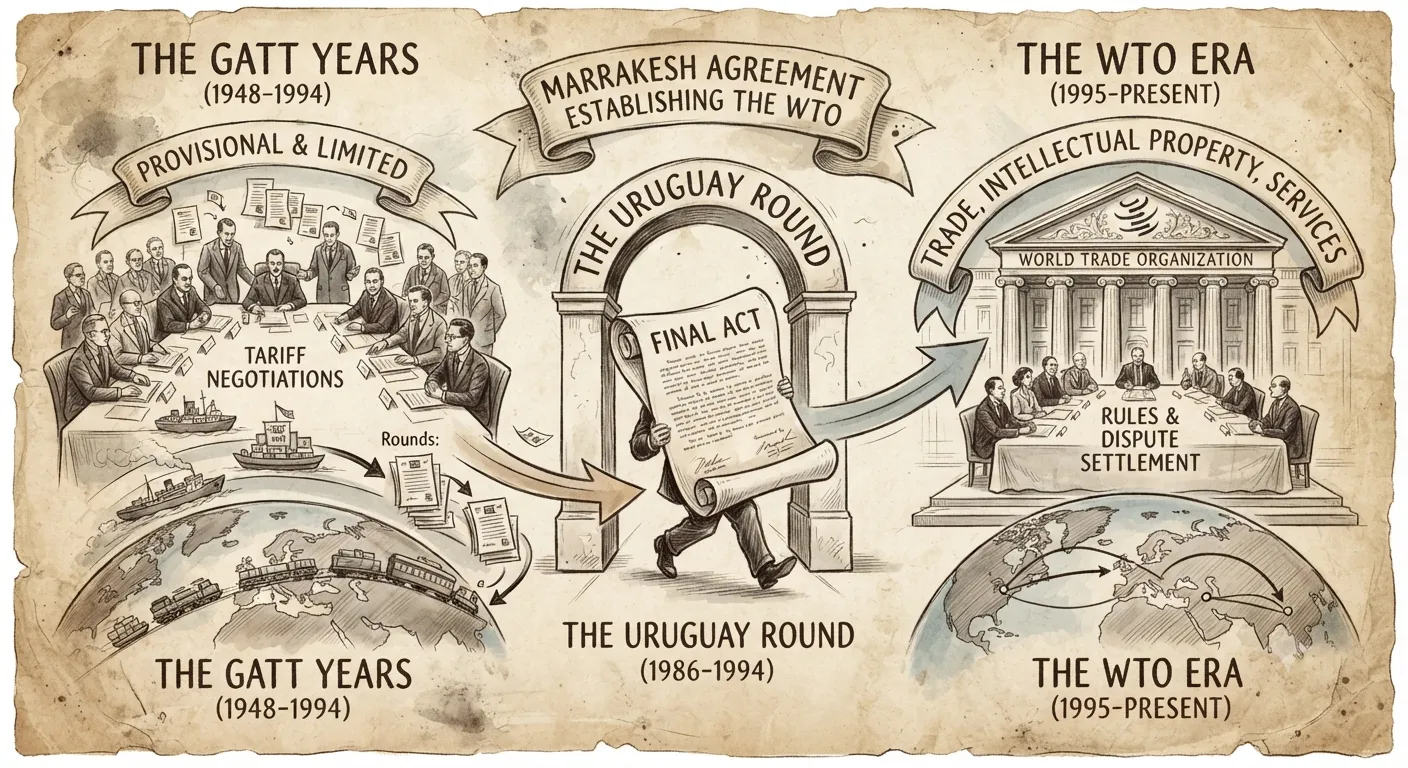
The journey toward a regulated global marketplace began when countries shifted from the older GATT arrangement to the modern WTO structure. The world trading system grew out of the General Agreement on Tariffs and Trade (GATT) formed after World War II. Because GATT was too weak to handle sensitive areas like farming, nations launched comprehensive discussions during the Uruguay Round.
- The Transition from GATT to WTO
This shift changed global trade management forever, turning a temporary agreement into a permanent global institution.
- (i) The Uruguay Round negotiations were a massive diplomatic effort that lasted over seven years before ending on .
- (ii) These historic trade deals were officially signed in at a major meeting in Marrakesh, Morocco.
- (iii) The World Trade Organization (WTO) officially started its work on , placing its main office in Geneva, Switzerland.
- (iv) Today, the WTO includes 164 members, representing nearly 98% of world trade.
Textiles and Agriculture Under the WTO Framework
Certain sensitive sectors needed tailored rules to move away from heavy government protection and join a fair, rules-based system. Both clothing and farming had a long history of government intervention that needed systematic reform.
The Discipline of the Textiles Sector
For decades, textile trade was governed by protective rules that shielded rich nations from foreign competition. However, a major change occurred when these items were brought under general WTO rules starting in .
- (i) Historically, clothing and textiles were managed through strict import limits rather than open market trade.
- (ii) The complete integration in marked the end of the temporary Agreement on Textiles and Clothing (ATC).
- (iii) This transition shows why shared international rules are needed to stop strong industry lobbies from dominating world trade.
The Agriculture Discipline and Specialized Agreements
Farming remains a special case because it is directly tied to national food security and the daily lives of rural communities. This led to the creation of the Agreement on Agriculture (AoA) to handle its unique challenges.
- (i) Before the Uruguay Round, farm trade operated under very weak GATT oversight.
- (ii) The AoA introduced legally binding promises that forced countries to lower trade barriers.
- (iii) The official WTO Committee on Agriculture oversees this work to make sure all member countries share clear trade data.
Scope, Coverage, and Implementation of the AoA
The Agreement on Agriculture covers a wide range of farm goods, but it leaves out specific raw materials and gives countries different amounts of time to adapt smoothly.
Product Coverage and Exclusions
While most basic farm goods are covered, a few industrial-adjacent raw products sit outside this main legal structure.
- (i) Included Products: Most staple food crops, farm animals, and basic agricultural items.
- (ii) Excluded Products: The agreement does not apply to fish products, forest goods, raw rubber, jute, sisal, abaca, or coir.
Timelines for Global Implementation
Knowing that countries have different financial strengths, the AoA set different completion schedules starting from .
- (a) Developed Countries: Received a 6-year window to complete their required cuts (finished by ).
- (b) Developing Countries: Received a 10-year period to adjust their policies (finished by ).
- (c) Least Developed Countries (LDCs): Were completely excused from making subsidy or tariff reduction commitments to safeguard their fragile economies.
⚡ Quick Revision Capsule: Timelines for Global Implementation
This table summarizes how different categories of member countries implemented their commitments under the Agreement on Agriculture:
| Country Category | Implementation Period | Completion Date | Reduction Mandate |
|---|---|---|---|
| Developed Countries | Full commitments apply | ||
| Developing Countries | Lighter reduction commitments | ||
| Least Developed Countries (LDCs) | N/A | Exempt | No reduction commitments required |
The Three Pillars of the Agreement on Agriculture
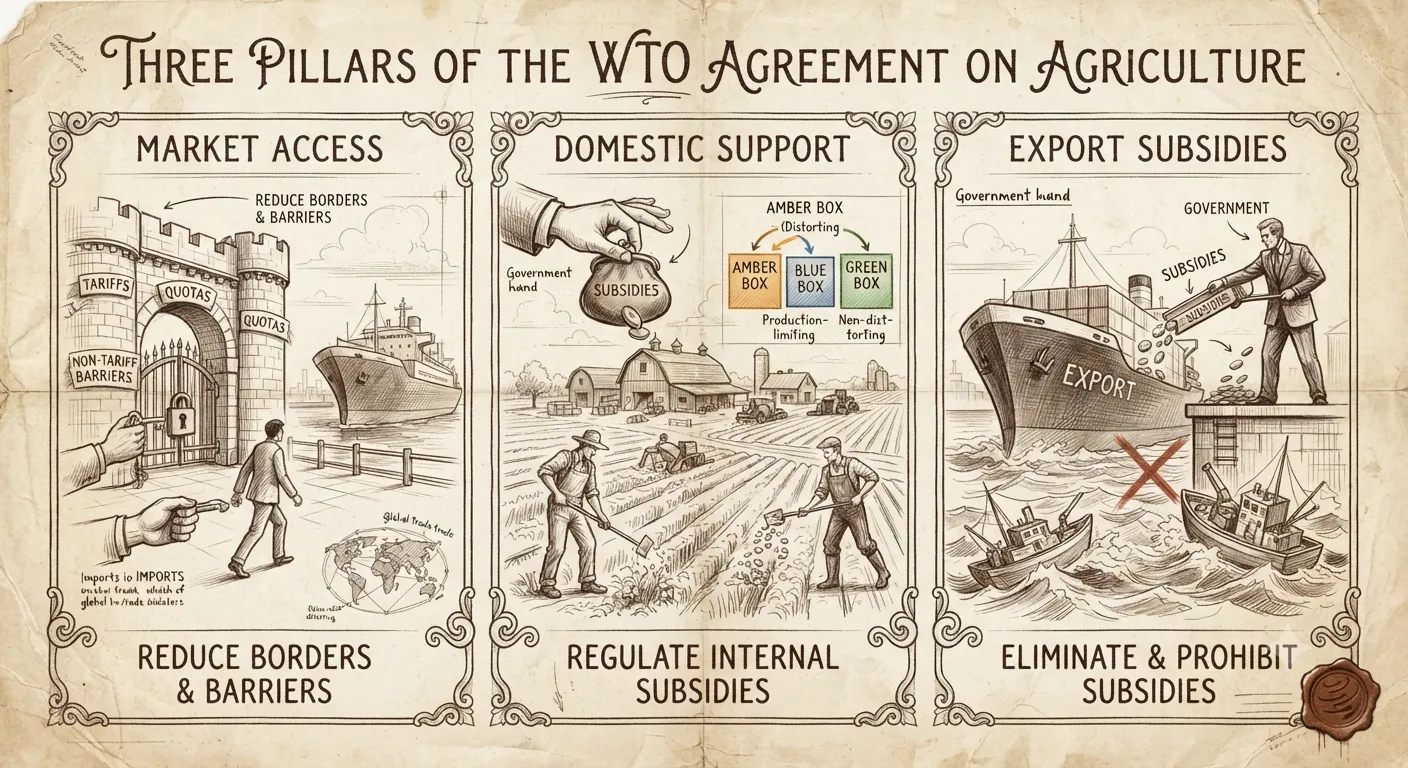
The AoA rests on three core pillars created to remove unfair market distortions and open up international trade for everyone.
Pillar I: Market Access and Tariffication
This pillar makes international buying and selling predictable by changing hidden trade barriers into simple, clear tariffs.
Tariffication and Reduction Commitments
- (i) Abolition of Non-Tariff Barriers: Custom limits, flexible import fees, and private buying limits had to be turned into plain, fixed taxes.
- (ii) Developed Nations: Had to lower their tariffs by an average of 36% (with at least a 15% cut on every item).
- (iii) Developing Nations: Had to lower their tariffs by an average of 24%.
Minimum Access and Special Safeguards
- (i) Minimum Access: Required countries to open up 3% of their domestic market to foreign goods in , eventually raising that share to 5%.
- (ii) Special Safeguard (SSG): Lets a country temporarily raise import taxes if foreign goods suddenly flood in or if import prices fall sharply, provided the country converted its non-tariff barriers to tariffs.
Pillar II: Domestic Support and Subsidy Boxes
This pillar regulates internal state financial aid that can unfairly boost production and distort trade across the world.
Aggregate Measurement of Support (AMS)
- (i) Developed Countries: Agreed to lower their trade-distorting support by 20%.
- (ii) Developing Countries: Agreed to lower their trade-distorting support by 13.3%.
- (iii) De minimis rule: Support that stays within 5% of total crop value for rich countries (or 10% for developing countries) does not need to be cut.
Categorization of Subsidy Boxes
- (i) Green Box: Holds subsidies that do not distort trade, such as government spending on farming research, environmental programs, and holding emergency national food reserves.
- (ii) Amber Box: Holds trade-distorting measures like government price guarantees; these subsidies must be reduced.
- (iii) Blue Box: Covers Amber Box subsidies that require farmers to limit how much they produce.
Pillar III: Export Subsidies and Competition
To stop market dumping (selling cheap subsidized goods overseas), the WTO restricts government payments that help sell products abroad.
- (i) Developed Countries: Had to cut export subsidy spending by 36% and reduce subsidized export volumes by 21% over 6 years.
- (ii) Developing Countries: Had to cut export subsidy spending by 24% and reduce subsidized export volumes by 14% over 10 years.
- (iii) Under the historic Nairobi Ministerial Decision of , these export payments are being eliminated globally to ensure fair market competition.
India’s Specific Commitments and Positions
India's role in the AoA is shaped by its vital need to protect small, low-income farmers and guarantee secure food supplies for its large population.
Market Access and Tariff Bindings
India did not convert non-tariff measures into tariffs because it already used import restrictions to manage its foreign exchange balances.
- (i) Maximum allowed import tax limits (tariff bindings) for basic farm crops were set at 100%.
- (ii) Maximum limits for processed foods and cooking oils were set at 150% and 300% respectively.
- (iii) Some of these rates were updated under GATT Article XXVIII in to safeguard local farming interests.
Domestic Support and Negative AMS
India’s government support levels during the base reference years () were well below the allowed limits.
- (i) India's total Aggregate Measurement of Support (AMS) was calculated at a negative number of –₹19,869 crore.
- (ii) Because this total support was negative (meaning farm production was effectively taxed overall), India was not required to cut its domestic support.
- (iii) India uses special flexibility rules (Special and Differential Treatment) to provide key farm input subsidies to poor farmers.
Article 20 and the Mandated Negotiations
The AoA was never meant to be a static document; it includes built-in rules for ongoing talks to address continuing global trade issues.
- (i) Mandated Start: Official follow-up talks for further reform started in .
- (ii) Core Objectives: These talks examine how trade rules affect world markets while protecting crucial non-trade goals like rural growth and national food supplies.
- (iii) Developing Interests: A central focus is expanding Special and Differential Treatment so developing nations receive fair terms.
📝 Summary
The rules of the WTO for farming and textiles aim to bring open global trade while allowing countries to protect local farmers and food supplies. While clothing trade was completely merged into standard WTO rules in , farming continues to follow the Agreement on Agriculture through its three core areas: market access, domestic support, and export competition. For students and exam candidates, understanding these rules reveals how international agreements keep global trade fair while protecting vulnerable economies through Uruguay Round principles.
🚀 Quick Revision Points
Essential facts to review before examinations:
- (i) The WTO began its operations on following the signing of the Marrakesh Agreement, replacing GATT.
- (ii) The old quota system for textiles ended in , fully integrating clothing trade into general WTO rules.
- (iii) The Agreement on Agriculture rests on three main pillars: Market Access, Domestic Support, and Export Subsidies.
- (iv) WTO subsidy rules use three main boxes: Green Box (non-distorting), Amber Box (distorting, needs cuts), and Blue Box (production-limiting).
- (v) India's base support level was negative (–₹19,869 crore), exempting it from mandatory domestic support reduction cuts.
- 💡 Exam Tip: Remember the distinction between subsidy boxes: Green Box is permitted (non-distorting), Amber Box is trade-distorting and subject to reduction cuts, and Blue Box contains Amber Box support conditioned on production limits.
❓ Frequently Asked Questions (FAQ)
Q1: What happened to the textile sector disciplines in 2005?
A1: In , the transitional Agreement on Textiles and Clothing (ATC) ended. This integrated textiles fully into general WTO rules and stopped the restrictive quota systems previously used by rich countries.Q2: What are the three core pillars of the WTO Agreement on Agriculture (AoA)?
A2: The three pillars are Market Access (turning non-tariff barriers into clear tariffs), Domestic Support (regulating internal subsidies using Green, Amber, and Blue boxes), and Export Subsidies (limiting government aid for goods sold abroad).Q3: Why didn't India have to reduce its domestic support under the AMS guidelines?
A3: During the base reference period (), India's calculated Aggregate Measurement of Support was a negative figure of –₹19,869 crore. Because the total was negative, India was exempted from subsidy cut requirements.Q4: Which products are specifically excluded from the scope of the AoA?
A4: The AoA does not cover fish products, forest goods, raw rubber, jute, sisal, abaca, or coir items, keeping them outside the main agricultural legal setup.