The National Treatment Principle under GATT 1994 ensures fair and non-discriminatory trade between imported and domestic products. If you are a student preparing for international trade and economics exams, mastering this concept is vital. At its heart, the rule is designed to maintain an equitable treatment of products across global markets, preventing hidden domestic advantages and promoting smooth, unhindered competition.
🎯 In this chapter, you will understand:
- How the National Treatment Principle prevents internal market discrimination against foreign goods.
- The relationship between National Treatment and the Most Favoured Nation (MFN) rule.
- Practical examples of non-discriminatory regulations in everyday trade practices.
- Key exceptions allowed under WTO guidelines, including domestic production subsidies.
💡 Why this topic matters: Understanding this principle clarifies how global economic rules stop countries from using domestic regulations as hidden trade barriers.
🧠 Core Idea: Once an imported good clears customs at the border, it must receive equal treatment with local domestic products inside the national market.
📌 National Treatment Principle in International Trade: GATT 1994 Context
The core framework of non-discrimination acts as a shield against internal economic bias across WTO member countries.
The Core Framework of Non-Discrimination
The National Treatment principle explicitly prohibits members of the WTO from giving less favorable treatment to imported products than they extend to their own domestic equivalents. This structural rule ensures everyone plays on a level field once goods clear customs.
- (i) Imported goods cannot be subjected to stricter quality control guidelines than domestic items.
- (ii) Member states cannot mandate special packaging requirements for imports if local goods do not face the same rules.
Internal Barrier Prevention
The overarching law ensures imported products compete fairly right alongside local options without facing sneaky internal barriers.
- (a) Internal taxes must apply equally to foreign and local goods.
- (b) Local safety rules cannot single out imports for additional compliance fees.
- (c) Distribution networks inside the country must remain open to all items.
- (d) Domestic laws cannot favor local producers over foreign competitors.
📌 Examples and Exceptions of National Treatment
Looking at how this plays out in the real world makes the principle much easier to understand. Here is how the rules apply to daily trade practices and where the boundaries blur.
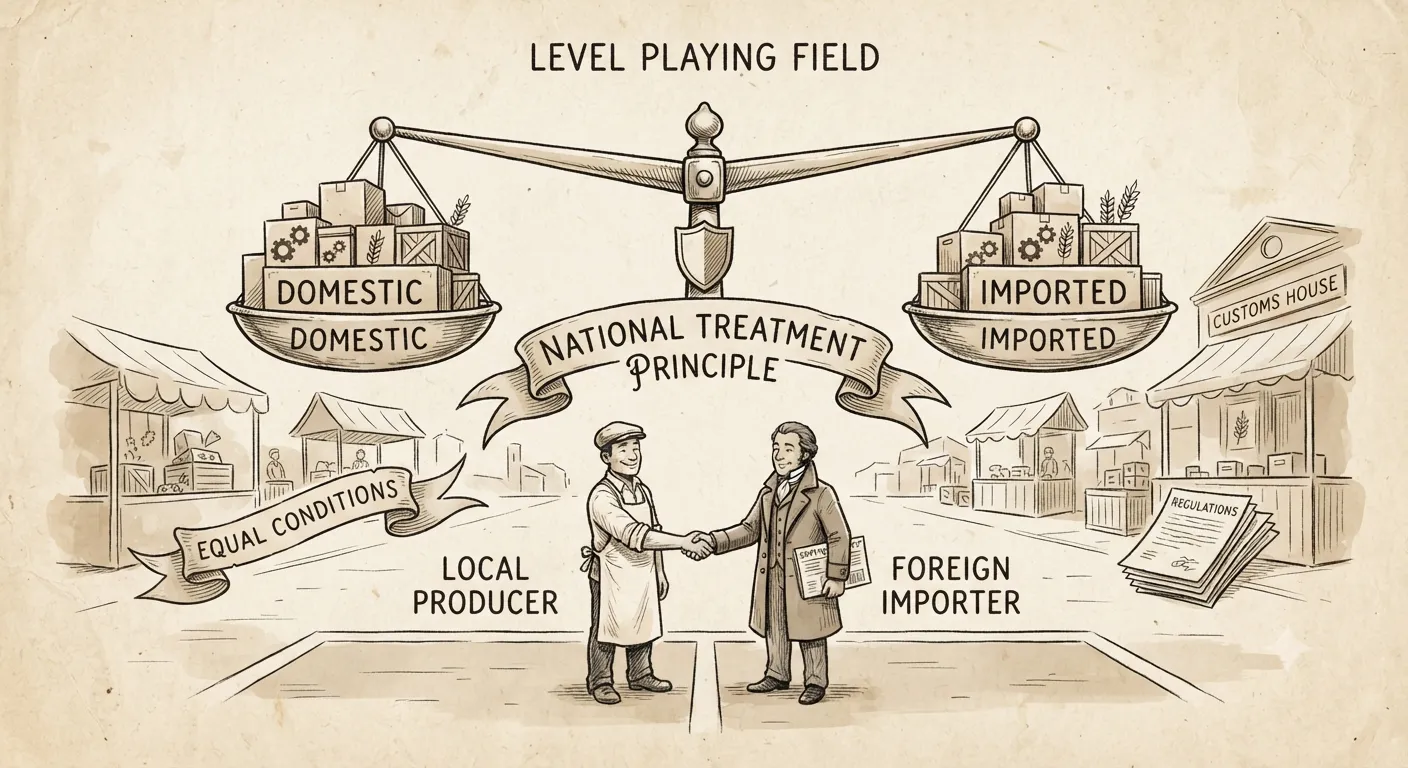
- The World Trade Organization monitors regulations to ensure countries do not abuse domestic policies to restrict international trade.
Role of the WTO in Trade Policy
The WTO actively monitors and enforces the National Treatment Principle. By ensuring that members comply with these standards, the organization keeps global trade flowing smoothly and prevents countries from shifting to protectionist habits through internal regulations.
- (i) A member country cannot enforce rigid domestic quality inspections solely on foreign goods while leaving local factories unchecked.
- (ii) Packaging and labeling standards must remain uniform, meaning foreign brands follow the exact same rulebook as local producers.
- (iii) However, governments can still provide subsidies for domestic production under specific WTO guidelines without being forced to pay out those same subsidies to foreign competitors.
- (iv) Regulatory standards must be transparent and clearly documented for all market participants.
📌 Importance of National Treatment for Trade Competition
The National Treatment Principle works hand in hand with the Most Favoured Nation (MFN) principle to keep global market competition free and open. Think of them as a two-step defense: while MFN ensures equal treatment between all foreign trading partners at the border, national treatment guarantees fair play between those imported goods and local products inside the country.
- This combination creates a secure foundation for international contracts and long-term economic planning.
Exceptions to National Treatment
Even though equality is the main goal, WTO frameworks deliberately include certain exceptions to let nations support their local economies responsibly.

Balancing trade equality with national policy exceptions - Subsidy Provision: Governments are permitted to grant subsidies for domestic production to boost local industries. As long as these incentives align with broader WTO disciplines, nations do not have to stretch these financial benefits to imported goods.
- Government Procurement: Direct government purchasing for state use can favor domestic suppliers under specific conditions.
- Public Morals & Safety: Nations may restrict goods to protect public health or national security under GATT Article XX.
- General Exceptions: Specific rules allow temporary measures during environmental or health emergencies.
⚡ Quick Revision Capsule: Non-Discrimination Principles
Comparison of key non-discrimination standards under international trade law:
| Trade Principle | Primary Focus | Key Application |
|---|---|---|
| National Treatment | Internal market equality | Protects imported goods from discriminatory domestic laws after customs clearance. |
| Most Favoured Nation (MFN) | Border trade equality | Ensures equal tariff rates and border treatment among all WTO members. |
| Domestic Subsidies | Recognized policy exception | Allows governments to assist local producers without extending payments to imports. |
| General Exceptions | Public policy safeguards | Permits trade restrictions under GATT Article XX for public health or morals. |
| Government Procurement | State purchasing rules | Allows preference for local goods in direct government purchases under defined limits. |
📝 Summary
The National Treatment Principle under GATT 1994 forms the bedrock of fair international commerce by strictly outlawing discrimination between imported and domestic products. Operating alongside the MFN principle, it keeps market competition clean and regulatory habits honest, making it an indispensable pillar for students studying international trade and global economics.
🚀 Quick Revision Points
Essential facts to review before examinations:
- (i) The principle focuses entirely on internal measures after a product crosses the border, treating foreign and local goods equally using National Treatment.
- (ii) It prohibits discriminatory internal taxes, specialized packaging mandates, or lopsided quality controls on imports.
- (iii) It pairs up with the Most Favoured Nation rule to form the dual core of the WTO's non-discrimination philosophy.
- (iv) Governments retain the right to issue domestic production subsidies as a valid exception under GATT 1994.
- 💡 Exam Tip: Remember that National Treatment applies inside the country after customs clearance, whereas MFN applies at the border. Do not confuse tariff commitments with internal regulation rules!
❓ Frequently Asked Questions (FAQ)
Q1: When exactly does the National Treatment Principle kick in during trade?
A1: It applies only after a foreign product has cleared customs and entered the domestic market. Border tariffs themselves are handled under different market access commitments, not national treatment.Q2: How do National Treatment and the Most Favoured Nation (MFN) principle differ?
A2: MFN prevents discrimination between different foreign trading partners at the border. National Treatment prevents discrimination between an imported product and a local product inside the domestic market.Q3: Can a country give its domestic industries subsidies under this rule?
A3: Yes. Direct government subsidies to domestic producers are a recognized exception under WTO rules in GATT 1994, meaning governments do not have to give identical subsidies to foreign importers.