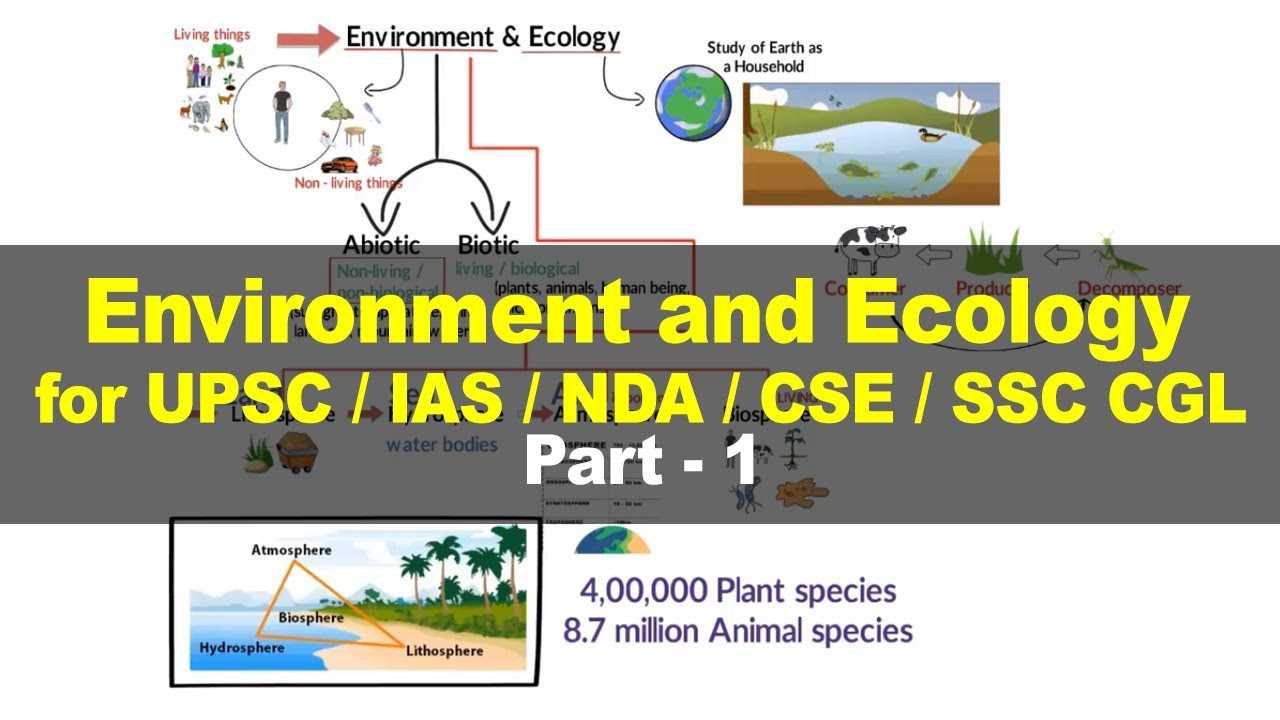
The study of environment and ecology helps us understand how living beings and non-living elements coexist on Earth to sustain life across time.
🎯 In this chapter, you will understand:
- The primary components and spheres that form our planet's natural environment.
- The fundamental scientific definition of ecology and its six organizational levels.
- Core ecological mechanisms including energy flow, nutrient cycles, and succession.
- How human activities impact ecosystems and why conservation efforts are critical.
💡 Why this topic matters: Learning ecological principles provides the foundation for sustainable living and tackling global environmental challenges.
🧠 Core Idea: All life forms and physical elements on Earth interact through interconnected systems to maintain environmental stability.
📌 Environment and Ecology: Core Principles and Key Concepts
The study of ecological principles covers natural components, living interactions, dynamic systems, human impacts, and protective measures.
Understanding the Environment
The environment includes every natural element surrounding us and forming life-supporting conditions on Earth.
- (i) The environment refers to all living and non-living elements naturally existing on Earth, forming the conditions necessary for life.
- (ii) It comprises the atmosphere, hydrosphere, lithosphere, and biosphere, which together maintain ecological stability.
- (iii) Broadly divided into two categories: natural environment and human-made (built) environment.
📌 Major Components of the Environment
Earth's natural systems operate through four main physical spheres that work together continuously.

- The physical components provide structural support, climate regulation, water supply, and biological habitats.
Detailed Environmental Spheres
Each component plays a specific functional role in planet dynamics:
- (i) Atmosphere: A gaseous shield around Earth vital for climate regulation and weather patterns.
- (ii) Hydrosphere: Encompasses all water systems such as oceans, rivers, lakes, and groundwater.
- (iii) Lithosphere: The outer crust and upper mantle of Earth, containing minerals and soil.
- (iv) Biosphere: The collective sum of all living organisms interacting with the environment.
📌 Ecology – The Science of Interactions
Ecology studies the relationships between living beings and their physical habitats.
- Ecology focuses on connection networks that keep ecosystems functioning properly.
Levels of Ecological Organization
Ecological study ranges from individual organisms up to the entire biosphere:
Hierarchical structure of ecological organization. - (i) Organism: A single living being.
- (ii) Population: A collection of organisms of the same species in a defined area.
- (iii) Community: Assemblage of different species populations in one location.
- (iv) Ecosystem: Biological community plus its physical environment functioning together.
- (v) Biome: Large geographic regions with distinct climate and characteristic flora and fauna.
- (vi) Biosphere: The largest level – the global network of life and environmental systems.
📌 Key Ecological Concepts
Five vital concepts describe how natural communities survive, adapt, and process energy.
- Energy Flow: Movement of energy through an ecosystem from producers to decomposers.
- Nutrient Cycling: Continuous recycling of essential elements between organisms and the environment.
- Habitat and Niche:Habitat – the physical home; niche – the organism’s functional role.
- Biodiversity: Variation in species, genes, and ecosystems.
- Ecological Succession: Gradual change in species composition over time.
📌 Human Influence on the Environment
Human growth and modern industrial activities alter natural environments significantly.
- Activities such as industrialization, urban expansion, and intensive farming have caused widespread pollution, deforestation, and climate disruption.
- These impacts have triggered loss of biodiversity and deterioration of ecosystem health.
📌 Conservation – Safeguarding the Future
Conservation aims to protect biodiversity and repair environmental damage caused by human use.
- Seeks to maintain natural resources and preserve ecological balance.
- Includes creation of protected zones, restoration of damaged habitats, and promotion of sustainable lifestyles.
📌 Conclusion
Understanding environmental science provides the tools necessary to protect global life-support systems.
- Understanding environment and ecology is essential for sustainable development.
- By recognizing human impacts and fostering eco-friendly practices, we can secure a balanced planet for future generations.
⚡ Quick Revision Capsule: Environment & Ecology
This quick revision table summarizes key terms, environmental spheres, and organizational levels for fast review.
| Concept / Level | Definition & Core Features | Key Significance |
|---|---|---|
| Environment | All living and non-living elements naturally existing on Earth. | Provides vital conditions necessary for life. |
| Four Spheres | Includes atmosphere, hydrosphere, lithosphere, and biosphere. | Maintains global climate, water, soil, and ecological stability. |
| Ecology | The scientific study of interactions between organisms and surroundings. | Sustains networks supporting planetary life systems. |
| Habitat vs Niche | Habitat is the physical home; niche is the functional role. | Defines species position and operational duties in ecosystems. |
| Conservation | Protection, habitat restoration, and eco-friendly practice adoption. | Protects biodiversity and natural resources for future generations. |
📝 Summary
The environment and its ecological networks sustain life on Earth through delicate balances across the atmosphere, hydrosphere, lithosphere, and biosphere. Modern human activities have stressed these systems, making active conservation and sustainable practices vital for protecting biodiversity for future generations.
🚀 Quick Revision Points
Essential facts to review before examinations:
- (i) The natural environment consists of living (biotic) and non-living (abiotic) components working together.
- (ii) The six ecological levels range from individual organisms up to the overall global biosphere.
- (iii) Energy flows through ecosystems while essential mineral nutrients cycle continuously.
- (iv) Human growth causes pollution and deforestation, making eco-friendly conservation essential.
- 💡 Exam Tip: Always distinguish clearly between an organism's physical home (habitat) and its functional role (niche) in exam questions.
❓ Frequently Asked Questions (FAQ)
Q1: What is the main difference between environment and ecology?
A1: The environment refers to the surrounding physical and biological conditions, whereas ecology is the scientific study of how living organisms interact with those surroundings and each other.Q2: What are the four main components of Earth's environment?
A2: The four components are the atmosphere (gaseous envelope), hydrosphere (water bodies), lithosphere (outer land crust), and biosphere (living zone).Q3: What are the primary levels of ecological organization?
A3: The levels expand from organism to population, community, ecosystem, biome, and ultimately the global biosphere.