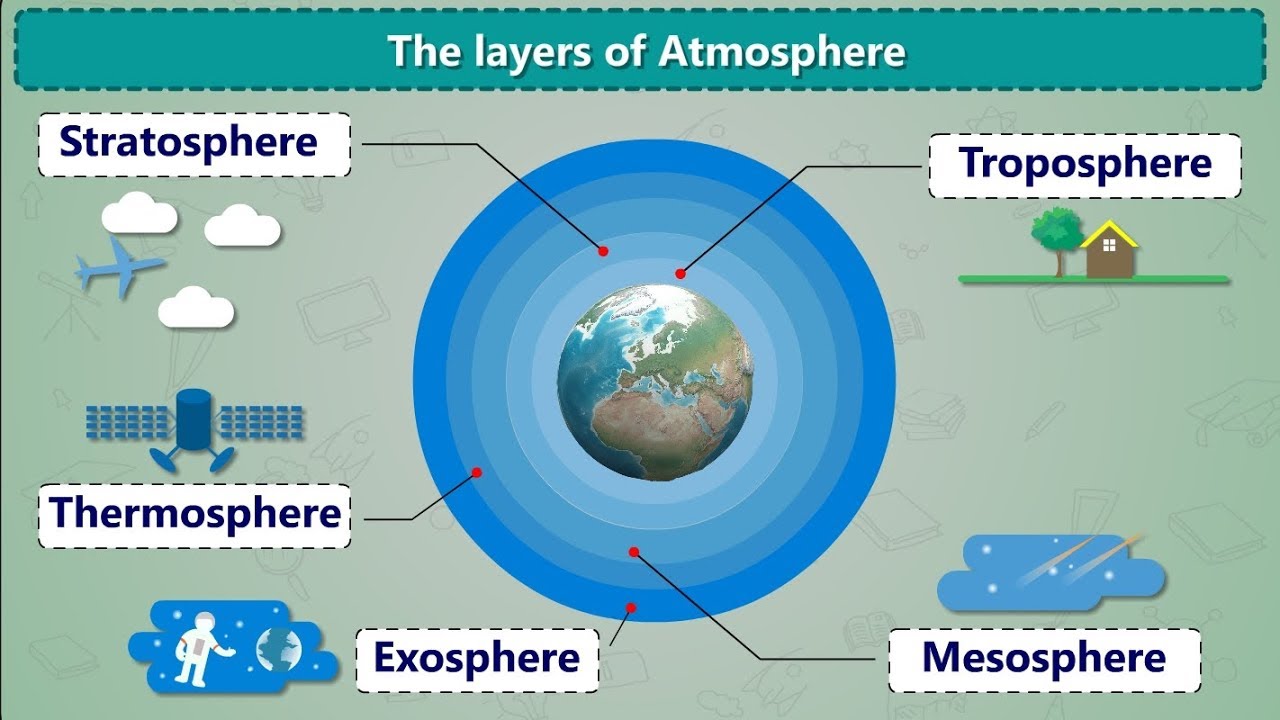
Take a fun trip into science to learn about the Earth's atmosphere, the giant blanket of gas that protects all life on our planet. This guide explains what the air is made of, how it is stacked in layers, and how the elements of weather and climate work every day. It is a great study helper for students getting ready for geography tests. We will see how basic gases like Nitrogen and Oxygen, together with the protective ozone layer, keep our world warm and safe.
🎯 In this chapter, you will understand:
- Why air is essential for human, animal, and plant survival.
- The main gases in our air, like Nitrogen, Oxygen, Carbon Dioxide, and Ozone.
- The five unique layers of the atmosphere from the ground up to outer space.
- How temperature, air pressure, wind, and humidity create everyday weather.
💡 Why this topic matters: Without this air blanket, Earth would be a freezing, lifeless rock in space. Understanding air helps us care for our environment!
🧠 Core Idea: The atmosphere is an invisible shield held by gravity that gives us breathable air, keeps us warm, and shapes all weather.
📌 The Earth’s Atmosphere: Composition, Structure, and the Dynamics of Weather and Climate
Air is around us all the time, even when we cannot see it. It is the most important natural shield for our everyday survival.
- A Story of Survival: The Indispensable Role of Air and the Atmosphere
Air is mandatory for life. While we can go without food or water for a short time, we must breathe continuously every single second. Without this thin layer of air around Earth, living things would not survive past a few moments.
- (i) Breathing is an instant need; people and animals cannot live without air for more than a few minutes.
- (ii) The air carries vital gases: Oxygen is needed by humans and animals to live, while Carbon Dioxide helps plants make food through photosynthesis.

The Invisible Blanket: Defining the Atmosphere and its Key Features
The atmosphere is a dynamic, multi-part mix of invisible gases, tiny water drops, and dust particles wrapped around Earth. Earth's gravity pulls on this air layer so it stays attached to our planet.
Physical Attributes of Earth's Atmospheric Envelope
This big air shield usually has no color or smell. We only feel it when it moves and turns into wind. The air gets thinner as you go higher up into the sky. In fact, most of the air mass—about 99% of it—is packed close to the ground in the first 32 km.
- (i) The atmosphere is a mixture of various gases, water vapor, and tiny floating dust bits.
- (ii) Gravity keeps most of the air weight down low, placing 99% of the air within 32 km from the ground.
Composition of the Atmosphere: Understanding Key Gases, Water Vapour, and Dust
The air is made of a carefully balanced recipe of standard gases, changing amounts of water vapor, and tiny solid particles that keep our planet comfortable.
Major Gaseous Constituents: The Power Trio of Nitrogen, Oxygen, and Carbon Dioxide
Most of the atmosphere is made of two main gases: Nitrogen and Oxygen. Nitrogen (78%) makes up most of the air and keeps things calm, while Oxygen (21%) allows animals and humans to breathe. Other small trace gases help control temperature on Earth.
- (i) Nitrogen (78%) and Oxygen (21%) are the main parts of air, while Argon (0.93%) is the next biggest gas.
- (ii) Carbon Dioxide (0.03%): This gas lets sunlight pass through to warm the ground, but traps the heat coming back up. This process is called the greenhouse effect. Burning too many fuels adds extra carbon dioxide, causing global warming.
- (iii) Ozone: Mostly found between 10 and 50 km above us, this gas works like Earth's natural sunscreen by absorbing harmful UV radiation from the sun.

Variable Elements: The Critical Roles of Water Vapor and Dust Particles
Some things in the air change from place to place. Water vapor (invisible water gas) helps control Earth's temperature so our world does not become too hot or too cold.
- (a) Water Vapor Distribution: Warm, wet rainforest air can have up to 4% water vapor, but dry deserts and freezing polar zones usually have less than 1%.
- (b) Dust Particles and Condensation: Tiny bits of sea salt, dirt, smoke, and space dust act as condensation nuclei. They give water vapor a surface to hold onto so clouds and rain droplets can form.

Structure of the Atmosphere: A Vertical Journey Through Five Distinct Layers
The air is not identical all the way up. It is divided into five main stacked layers based on changes in temperature and air thickness.
Troposphere: The Weather Factory Closest to Earth (0–13 km)
The Troposphere is the bottom layer where we live, walk, and play. It holds 75% of the air's total weight. Air moves around constantly here, creating nearly all weather phenomena like rain, clouds, and storms. As you climb higher in this layer, the air gets colder.
- (i) It reaches from ground level up to 0–13 km high and holds three-quarters of all air mass.
- (ii) The temperature drops by about 1°C for every 165 meters you go up.
- (iii) The top border is called the Tropopause, where temperature stops dropping and gets as cold as -80°C over the equator.
Stratosphere and Mesosphere: The Middle Layers and the Ozone Shield
Right above the tropopause is the Stratosphere. It is calm and clear, making it a safe path for airplanes to fly. It also holds the life-saving ozone layer. Above that lies the Mesosphere, which is the coldest region in the entire sky.
- (a) Stratosphere (13–50 km): Contains the famous ozone layer that shields us from dangerous solar ultraviolet (UV) radiation.
- (b) Mesosphere (50–80 km): Here, temperature drops fast, reaching nearly -100°C at its upper boundary called the Mesopause.

Thermosphere and Exosphere: The Outer Reaches and Radio Wave Reflection
The highest layers get extremely thin as they reach toward outer space. The Thermosphere carries charged particles that help bounce radio signals back to Earth, while the Exosphere is the final thin edge before outer space.
- (i) Thermosphere (80–400 km): Filled with tiny electric particles called ions that reflect radio signals back down for wireless communication.
- (ii) Exosphere (>400 km): The top outer layer where sparse gases slowly float away into deep space.
Elements of Weather and Climate: Defining Atmospheric Dynamics
Weather is what happens in the air day by day, while climate is the pattern over many years. Both are created by basic measurable parts called elements of weather.
Key Elements: Temperature, Pressure, Humidity, and Precipitation
Changes in these elements make air move, create clouds, and bring rain to different regions of the world.
- Temperature: How hot or cold the air is, which changes air weight and starts air movements.
- Pressure: The weight of air pushing down; differences in air pressure create wind patterns.
- Winds: Air moving sideways across Earth, carrying heat and clouds from place to place.
- Humidity: The amount of water vapor in the air, determining if we will get clouds or precipitation.
- Clouds and Precipitation: Visible water drops or ice in the sky that fall down as rain, snow, or hail when cooled.

⚡ Quick Revision Capsule: Atmospheric Layers Overview
Use this table for a fast look at how the five air layers compare in height and key features.
| Layer Name | Height Range | Key Unique Features |
|---|---|---|
| Troposphere | Contains 75% of air mass; home to all weather phenomena. | |
| Stratosphere | Smooth air for jets; contains the life-protecting ozone layer. | |
| Mesosphere | Coldest atmospheric layer, dropping down to -100°C. | |
| Thermosphere | Filled with charged ions that bounce radio waves back to Earth. | |
| Exosphere | Above | Outer edge of air that slowly fades away into space. |
📝 Summary
Learning about the composition and structure of the atmosphere shows us how Earth stays safe and habitable. Studying these layers, from the lower Troposphere where all daily weather occurs to the ozone layer in the higher Stratosphere, helps explain planetary science. For all young students, mastering how gases like Carbon Dioxide drive the greenhouse effect and how elements of weather and climate interact is vital for school examinations.
🚀 Quick Revision Points
Essential facts to review before examinations:
- (i) Nitrogen (78%) and Oxygen (21%) make up 99% of our dry atmosphere.
- (ii) Most atmosphere mass (99%) sits in the lowest 32 km due to gravity.
- (iii) The Troposphere cools with height and manufactures our daily weather.
- (iv) The Ozone layer in the Stratosphere blocks harmful solar radiation.
- 💡 Exam Tip: Remember that temperature decreases as you go up in the Troposphere (lapse rate), but increases with altitude in the Stratosphere because of the ozone absorbing heat!
❓ Frequently Asked Questions (FAQ)
Q1: What is the main job of the atmosphere?
A1: It gives us oxygen to breathe, keeps temperatures balanced, and shields us from space cold and solar rays.Q2: Which layer of the atmosphere contains the ozone layer?
A2: The Stratosphere contains the protective ozone layer.Q3: Why does weather only happen in the Troposphere?
A3: Because the Troposphere contains almost all of the atmosphere's water vapor and dust particles needed to form clouds and rain.