Indo-Greeks, Sakas, Parthians, and Kushans (2nd BCE – 3rd CE)
The era of Central Asian Contacts with India, spanning from the 2nd century BCE to the 3rd century CE, stands as a transformative period that dramatically reshaped the subcontinent's political map, cultural landscape, and economic vitality. Through successive waves of migrations and invasions by powerful groups like the Indo-Greeks, Sakas, Parthians, and Kushans, ancient India absorbed profound new influences, notably visible in coinage, the flourishing of Gandhara art, the widespread propagation of Mahayana Buddhism, and advancements in polity and international trade networks. For students preparing for competitive exams, this detailed study of external contacts provides crucial insights into the historical synthesis that defines this classical age.
Central Asian Influences Shaping Indian History: Contacts, Invasions, and Cultural Synthesis (2nd Century BCE – 3rd Century CE)
Central Asian groups profoundly influenced India's administration, artistic traditions, religious development, and commercial activity through a long, dynamic period of interaction.
The establishment of powerful foreign dynasties through invasions and subsequent settlements by Central Asian tribes not only brought about significant upheaval in India's political structures but also ushered in an era of unprecedented cultural and economic enrichment, making this a pivotal topic for serious historical examination and success in competitive examinations.
(i) Four major groups—the Indo-Greeks, Sakas (Indo-Scythians), Parthians, and Kushans—successively established vast kingdoms, primarily dominating the north-western and parts of central India.
(ii) These new rulers acted as catalysts, introducing a range of administrative, numismatic, artistic, and religious innovations into the existing Indian framework.
(iii) The ultimate assimilation and naturalization of these foreign elements within the greater Indian society led to a robust and long-lasting synthesis of Indo-Central Asian cultures.
The Enduring Legacy of the Indo-Greeks in Ancient Indian History: Coinage, Art, and Philosophy
The Indo-Greeks, flourishing in the 2nd century BCE, left an indelible mark on India, particularly through their pioneering use of standardized coinage, the philosophical discourse of their most celebrated king, and their foundational role in the development of Gandhara art.
The Great Invasion and Territorial Expansion of the Indo-Greeks (Yavanas)
Under the leadership of figures like Demetrius I, these Hellenistic successors crossed the formidable Hindu Kush mountains, successfully establishing powerful Greek rule across modern Afghanistan, Pakistan, and significant portions of north-west India, fundamentally altering the existing political balance.
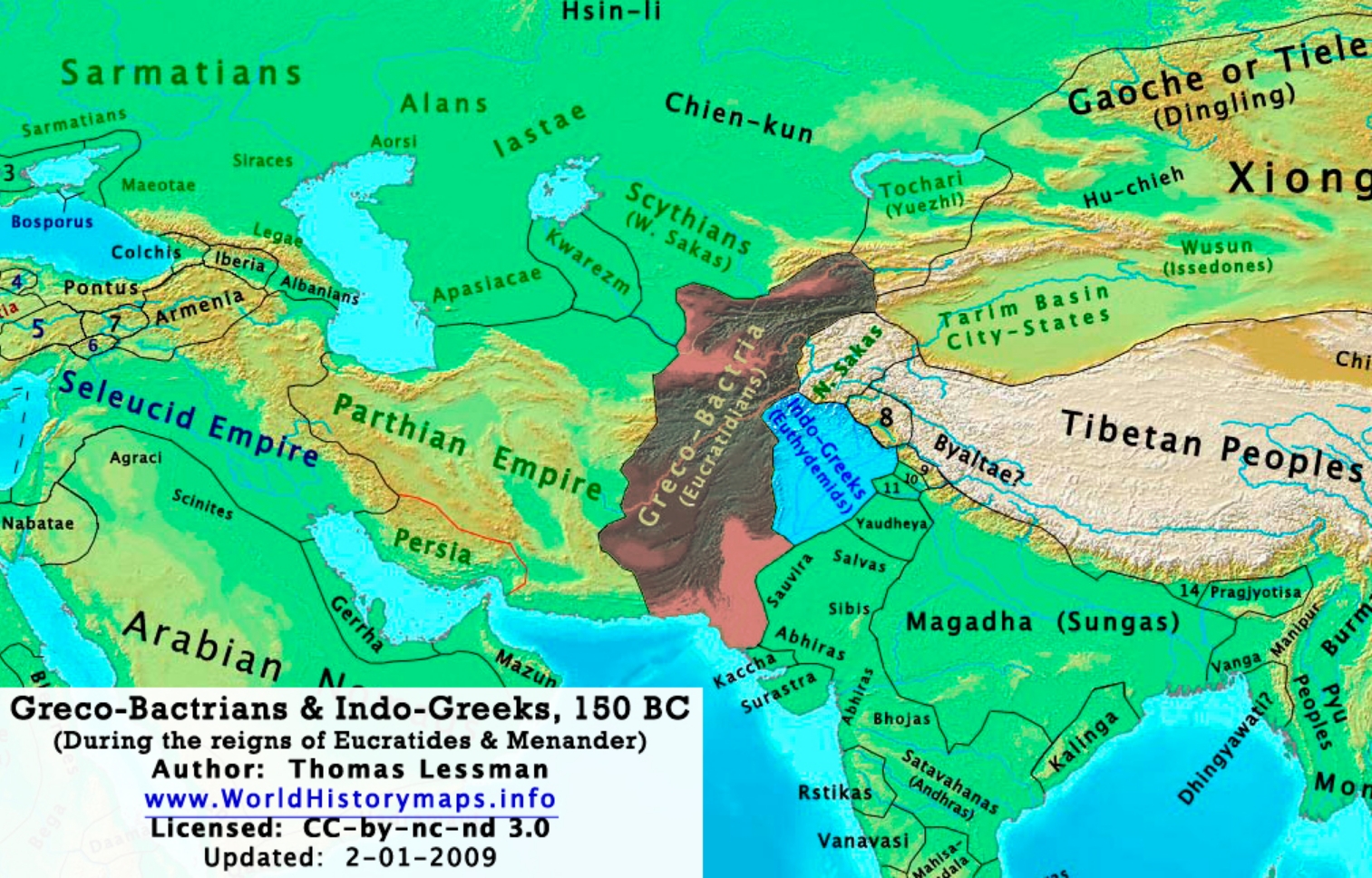
Indo Greeks Invasion in Indian Sub-continent: Mapping the Spread of Hellenistic Influence
(i) Their sphere of political control was vast, stretching from the regions of Bactria and Gandhara deep into the subcontinent, reaching as far as Mathura and the fertile Ganges basin.
(ii) The most renowned ruler was Menander I (Milinda), whose insightful philosophical debates with the Buddhist sage Nagasena were meticulously recorded and preserved for posterity in the vital Buddhist canonical text known as the Milindapanha (Questions of Milinda).
(iii) The stability provided by their consolidated rule proved instrumental in facilitating robust international trade and intensifying cultural exchanges across diverse geographical and ethnic regions.
Pioneering Contributions of the Indo-Greeks: Numismatics and Artistic Innovations
The Indo-Greeks are credited with introducing specific artistic and economic innovations that significantly enriched and ultimately impacted the evolving cultural matrix of ancient India.
(a) Coinage Revolution: They were the first to issue meticulously standardized, aesthetically pleasing coins featuring precise portraits of the reigning king, often accompanied by depictions of Greek deities. This professionalism in minting provided a substantial boost to inter-regional commerce.
Indo Greeks Coin: Illustrating Greek Deities and Royal Portraits
(b) Gandhara Art Patronage: They actively supported the nascent phase of the Gandhara school of art, a syncretic style characterized by the fusion of Greek realistic anatomical representation (Hellenistic techniques) with traditional Indian religious themes and symbolism, most notably in the depiction of the Buddha.
The Sakas (Indo-Scythians): Successors, Multiple Branches, and Cultural Assimilation
The formidable Sakas (Indo-Scythians) successfully displaced the Indo-Greeks, establishing widespread dominance across key regions like Punjab, Mathura, and the Deccan, leaving a powerful and lasting political, administrative, and cultural impression on India.
(i) Originating from Central Asia, these nomadic tribes successfully displaced the fragmented Indo-Greek rulers, consolidating a powerful new form of dominance across the north-western territories of the Indian subcontinent.
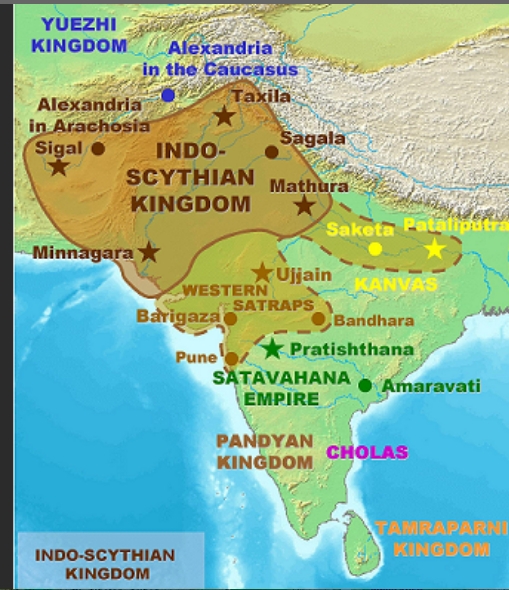
(ii) Their influence was highly decentralized, characterized by multiple ruling branches that successfully controlled vast areas including Punjab, the important political and religious center of Mathura, and the strategic parts of the Deccan region.
Kingdom of Indo Scythians: Mapping the Territorial Reach of the Sakas
(iii) Despite their foreign origins, the Sakas rapidly assimilated into the local culture; notable rulers like Rudradaman demonstrated this integration by famously issuing important official inscriptions entirely in chaste Sanskrit, marking a key cultural shift.
The Parthians in Indian History: Strategic Control and the St. Thomas Connection
The Parthians (Indo-Parthians), originating from ancient Iran, succeeded in expanding their dominion into north-western India, serving as crucial intermediaries for cultural and early religious exchanges between the Persianate world and India.
(i) They rapidly rose to prominence in the power vacuum following the decline of the Indo-Greeks, establishing control over highly strategic trade and military regions crucial for regional dominance.
(ii) Their most distinguished ruler, Gondophernes, is historically significant because tradition holds he provided patronage and hospitality to St. Thomas, one of the original Christian apostles, during his legendary missionary journey to the Indian subcontinent.
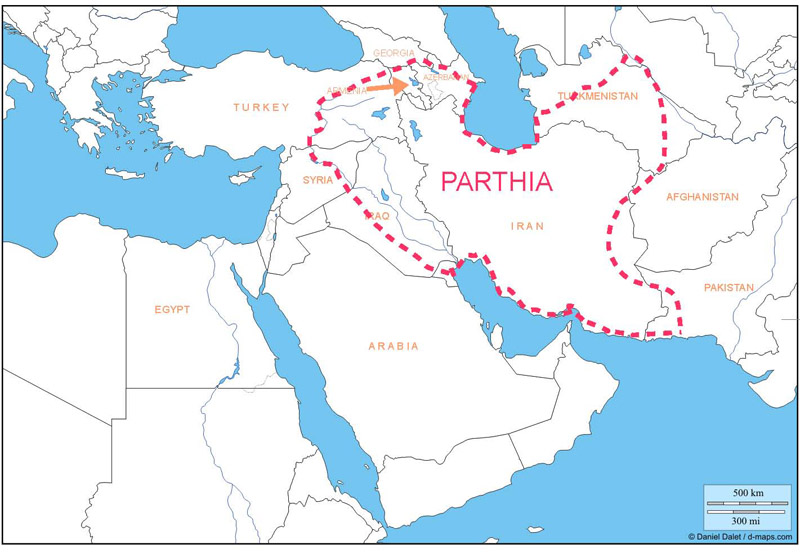
Parthian Kingdom Map: Representing Their Strategic Foothold in the Northwest
(iii) Like their predecessors, the Parthians gradually adopted local Indian administrative customs and practices, significantly enriching the regional trade routes and contributing to the formation of a distinct hybrid culture.
The Kushans: The Most Influential Central Asian Rulers in India (1st–3rd Century CE)
The powerful Kushans, who emerged from the Yuezhi confederation, established the most expansive and culturally consequential Central Asian empire in India, dominating the subcontinent from the 1st to the 3rd century CE.
The Grand Expansion of the Kushan Empire and Silk Road Control
The Kushans skillfully expanded their territorial control from their Bactrian base deep into India, governing a vast domain that included the cultural hubs of Gandhara, Mathura, and Kashmir, and extending beyond, making them a true imperial power.
Kushan Kingdom Map: Highlighting the Extent of Their Great Imperial Rule
(i) The initial consolidation of power was undertaken by early dynasts such as Kujula Kadphises, who laid the stable groundwork for future expansion and prosperity.
(ii) The most illustrious of the Kushan rulers, Kanishka I, is celebrated in history as an ardent and generous patron of both Buddhism and the sophisticated arts.
(iii) The empire's immense wealth and enduring power were intrinsically linked to its strategic control and effective policing of the lucrative trans-continental Silk Road trade routes.
The Profound Achievements of Emperor Kanishka: Era, Religion, and Economy
The reign of Emperor Kanishka (generally dated around c. 127 CE) resulted in a far-reaching and profound impact across the domains of religion, political administration, and the monetary economy.
(a) Saka Era Institution: Kanishka is traditionally credited with initiating the widely used and historically important Saka Era calendar system, which remains in contemporary use for various purposes.
(b) Mahayana Buddhism Patronage: He was instrumental in supporting the development and widespread dissemination of Mahayana Buddhism and notably convened the significant Fourth Buddhist Council, traditionally held in Kashmir (or Jalandhar), which formalized many Mahayana doctrines.
(c) Gold Coins Minting: Kanishka’s administration issued an impressive variety of highly pure gold coins, a crucial step that signaled massive prosperity, facilitated large-scale transactions, and significantly boosted long-distance trade.
The Cultural Impact of Kushans: Synthesis of Traditions and Artistic Flourishing
The period of Kushan dominance witnessed an exceptional cultural synthesis, effectively merging Greek and Indian artistic traditions, strongly supported by the powerful patronage extended towards the newly formalized Buddhist sects.
(i) The Gandhara art school reached its zenith during this era, becoming the primary vehicle for blending Hellenistic realistic detail with essential Indian motifs, creating iconic images of the Buddha and Bodhisattvas.
(ii) Due directly to the imperial patronage of the Kushans, the doctrines of Mahayana Buddhism successfully transitioned from a regional faith to a global religious system, spreading rapidly across Central Asia and East Asia.
Central Asian Influence on Indian Architecture, Technology, and Global Trade
The Central Asian rulers served as powerful conduits of cultural exchange, leading to the enrichment of Indian material culture, particularly in architecture and the sophistication of its trade networks.
(i) They were responsible for constructing numerous monumental stupas, viharas, and monasteries, which rapidly developed into major religious, educational, and cultural centers across the empire.
(ii) By strategically controlling the Silk Road, they significantly enhanced India's access to new trade goods and technology, facilitating the spread of advanced knowledge in areas like metallurgy, textiles, and fine pottery.
Reforms in Polity, Governance, and Society under Central Asian Rulers
The consistent Central Asian contacts permanently altered India’s political administrative system, introducing new models of governance, bureaucracy, and societal structure.
(i) They introduced the administrative model of the Satrap system (provincial governorship) and formalized the concept of divine kingship (e.g., the use of titles like 'Devaputra'), which deeply influenced subsequent indigenous Indian polities.
(ii) Over generations, the gradual and widespread social integration of these foreign groups into the Varna system led to the creation of distinct hybrid cultural practices, successfully blending Central Asian martial traditions with established Indian religious and social customs.
Summary: The Enduring Legacy of Central Asian Contacts (2nd BCE–3rd CE) for Students
The defining historical period of Central Asian contacts with India (2nd BCE–3rd CE), driven by the successive rules of the Indo-Greeks, Sakas, Parthians, and Kushans, fundamentally transformed politics, art, the evolution of Buddhism, coinage, and transcontinental trade. For students and exam preparation, these interactions demonstrate a critical historical process of cultural fusion, highlighting significant innovations in statecraft (like the Satrap system), the profound spread of religions (Mahayana Buddhism), and the emergence of global art forms (Gandhara art) that collectively shaped the trajectory of ancient Indian history.
We are Committed to deliver a hassle free digital experience for all our learners and we will be grateful if you could take a moment to provide a “Google Review“ about your experience with us. it will help us to futher enhance our services for you in the future. Your support helps us grow!
We use cookies that are necessary to make our site work. We may also use additional cookies to analyze, improve, and personalize your digital experience. Browser notifications can help you receive schedule updates, reminders, and timed research session alerts. You can manage your cookie preferences using the Cookie settings link. For more information, see our Cookie Policy.
Cookie Preferences
Essential configurations secure your dashboard workspace sessions. System notification authorization is required to enforce schedule routines.
Essential & Alerts
Required for secure log ins, session timing counters, and scheduled study alerts.
Necessary
Analytics
Helps us analyze metrics to measure and optimize educational material delivery speeds.
Marketing / Ads
Used to display non-intrusive structural updates or relevant educational announcements.
New Updates
No new updates in last 48 hours.
Reading Preferences
Choose your preferred language:
Choose your preferred reading fonts:
Disclaimer | We aim for the highest fidelity to the original content, though some linguistic nuances may differ. Thank you for your understanding.
Disclaimer
Learning Directive: You are about to enter in Adaptive Learning Mode setup. Here you will get :
• Daily: 4-5 curated topics per subject, per day. • Gated Progression: Next-day access remains locked until all current topics are marked finished. • 24 hours rule: Unlock cycle gets triggered on your first visit to a subject.
If you disagree you will be redirected to UPSC digital library to learn as a freelancers