The Paleolithic Age, also known as the Old Stone Age, marks the initial chapter of human culture across the Indian subcontinent. Extending from roughly to , this formative period documents how early humans adapted to changing environments using unpolished stone implements. Primitive populations lived as nomadic hunter-gatherers, relying on wild plants and game for survival. Key archaeological sites in South India and the Soan Valley offer critical evidence of these early settlements. Studying this era helps us understand the roots of human technological development and social evolution.
In this chapter, you will understand:
- The primary phases and timeline of the Paleolithic Age in India
- Technological shifts from heavy core tools to fine stone flakes and blades
- Environmental adaptations during the Pleistocene glaciations
- The transition into the Mesolithic era and early domestic practices
Why this topic matters: Understanding early stone tool industries and prehistoric human migration provides the groundwork for studying ancient Indian history, civilization origins, and archaeology modules in competitive examinations.
Core Idea: Early human existence in India progressed through three main Paleolithic phases shaped by climate changes. Toolmaking shifted over time from crude, heavy choppers to refined flakes, blades, and burins. This technological evolution paved the way for permanent settlements, rock art, and early agriculture in the Mesolithic era.
Evolution of Human Life: Paleolithic Age in India, Tools, and Cultural Phases (500,000–8000 B.C.)
The Old Stone Age represents the longest phase of human history in India, defined by simple life patterns and a complete reliance on stone tools for daily survival tasks.
Archaeological surveys reveal that prehistoric communities moved across river valleys and forest edges in search of water, game, and seasonal wild plant fruits.
- (i) The entire timeline spans from approximately down to the end of the Pleistocene epoch near
- (ii) Core survival strategies relied entirely on making simple stone tools alongside nomadic hunting and gathering.
- (iii) Typical early implements recovered from river terraces include heavy core tools such as hand-axes, cleavers, and choppers.
Early Paleolithic Phase: The Era of Crude Stone Industries and the Ice Age Context
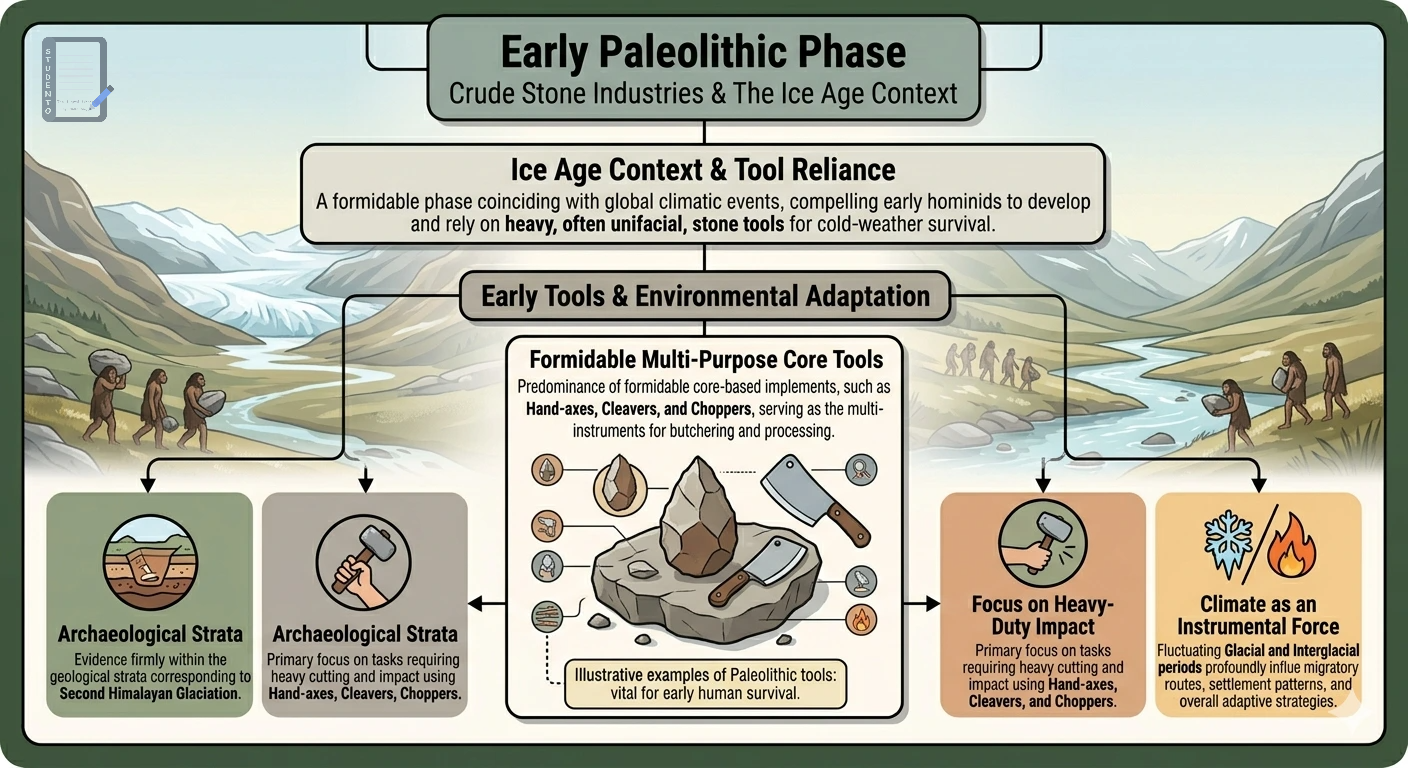
The Early or Lower Paleolithic phase unfolded during the cold epochs of the Pleistocene Ice Age, forcing early humans to invent sturdy tools capable of heavy butchering and wood chopping.
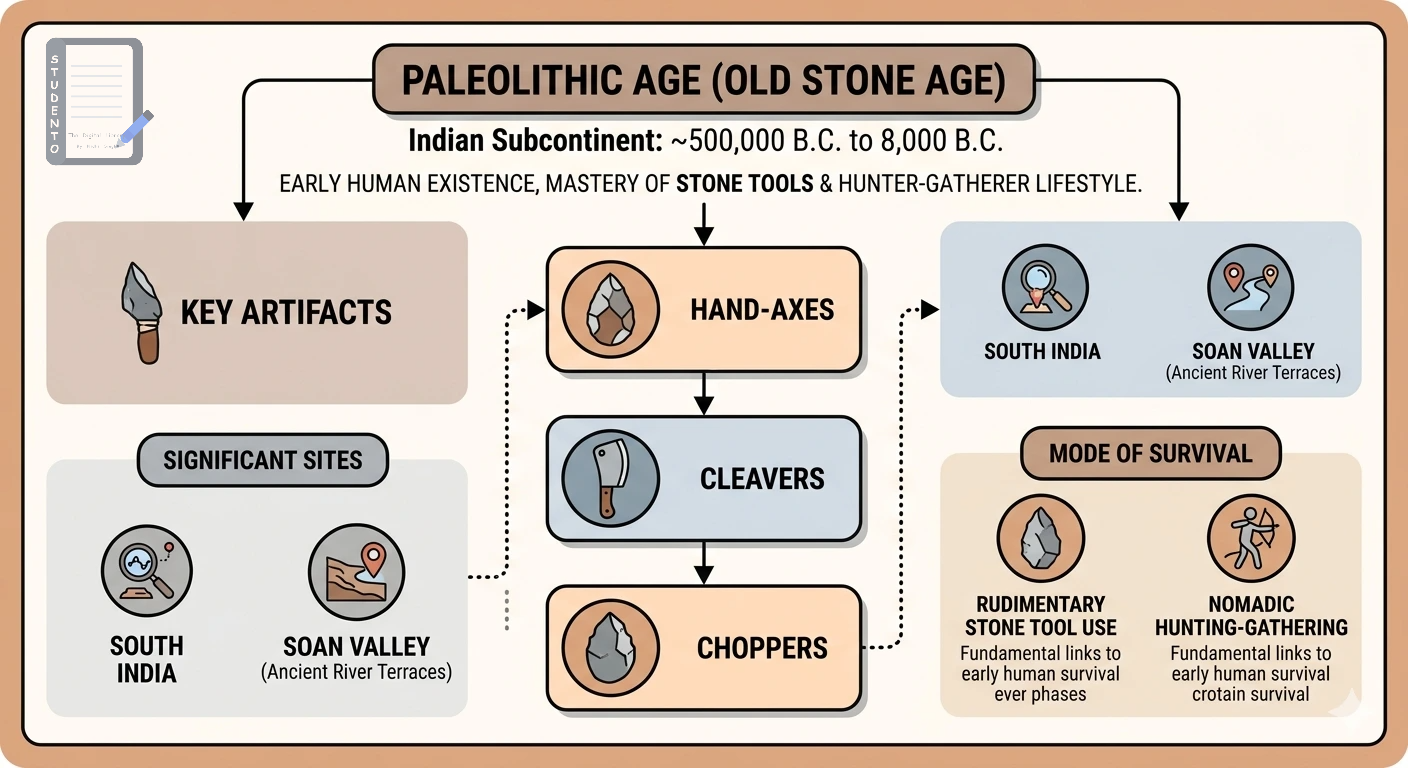
- Lower Paleolithic sites are widely distributed near river terraces across the subcontinent, including the Soan Valley in the north and various sites across South India.
Early Tools and Environmental Adaptation: Surviving the Glaciations
To survive during severe glacial periods, early humans developed heavy-duty core tools that provided high impact for splitting bones and processing thick hides.
- (i) Geological evidence places these early cultures within the strata of the second Himalayan glaciation period.
- (ii) The core toolkit was dominated by large hand-axes, heavy cleavers, and rough choppers made from quartzite or river pebbles.
- (iii) Major climate shifts during glacial and interglacial cycles dictated human migration paths, shelter choices, and foraging areas.
Middle Paleolithic Phase: The Transition to Flake Tool Technology
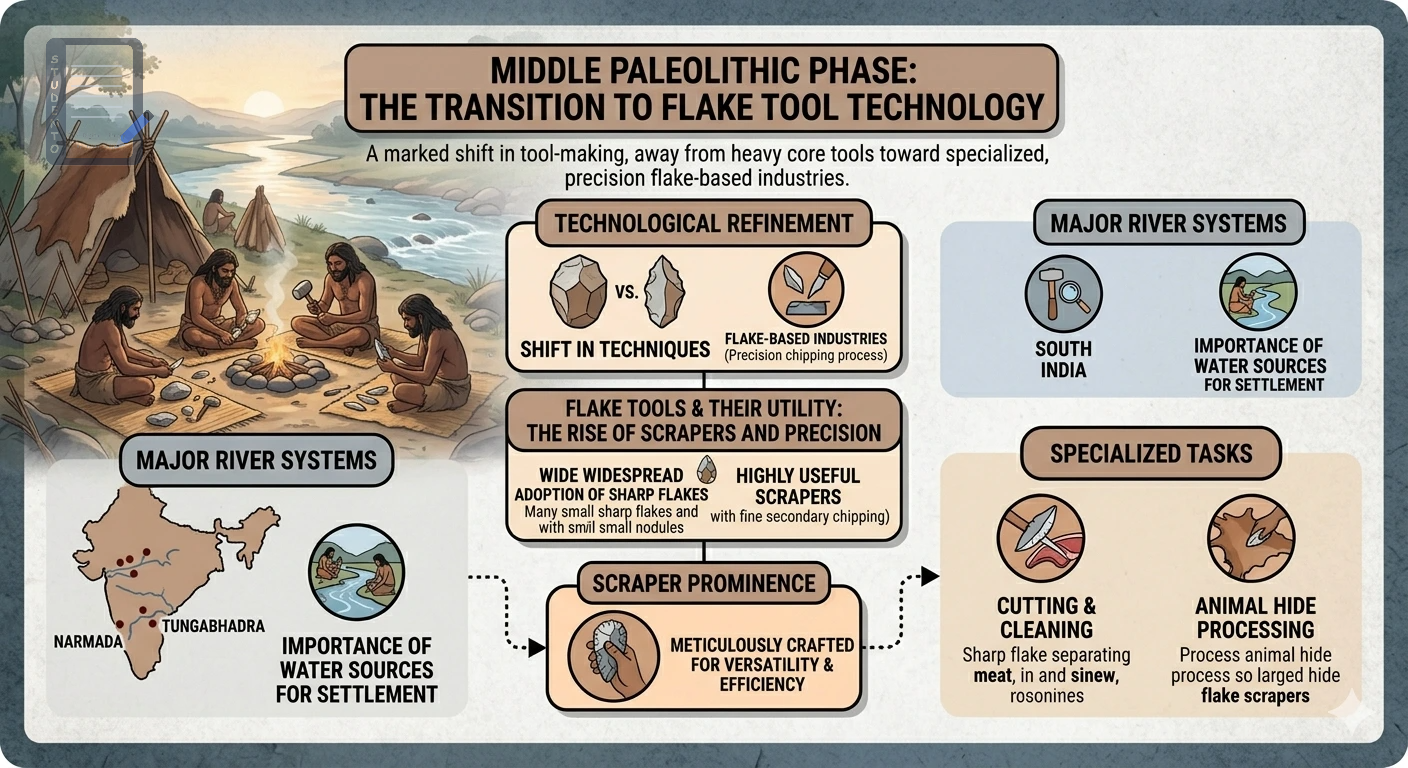
During the Middle Paleolithic era, toolmakers altered their production techniques by striking smaller, sharper flakes off larger core stones to create specialized implements.
- This technological shift allowed early humans to craft lighter, sharper instruments that required less raw material and offered greater working precision.
Flake Tools and Their Utility: The Rise of Scrapers and Precision
Flake-based tools transformed everyday tasks, enabling finer woodcarving, hide trimming, and meat slicing.
Early Paleolithic Phase illustration depicting prehistoric human civilization during the Old Stone Age, featuring early stone tool usage, hunting practices, survival techniques, and the development of primitive human societies in ancient history. - (i) The Middle Paleolithic toolkit featured various functional forms of scrapers, points, and borers crafted from thin stone flakes.
- (ii) These specialized flake tools were primarily used for cutting, cleaning, and processing animal skins into basic garments or covers.
- (iii) Major artifact concentrations line prominent river basins, notably along the banks of the Narmada and the Tungabhadra rivers.
Paleolithic Cultural Phases Quick Revision Capsule
A structured comparison of chronological periods, tool innovations, and prominent features across prehistoric India:
| Paleolithic Phase | Tool Technology & Artifacts | Key Features & Key Sites |
|---|---|---|
| Early (Lower) Paleolithic | Core tools: hand-axes, cleavers, heavy choppers | Coincided with the Ice Age; prominent in the Soan Valley and South India. |
| Middle Paleolithic | Flake tools: scrapers, points, borers | Shift to specialized processing; concentrated near the Narmada and Tungabhadra rivers. |
| Upper Paleolithic | Slender blades, chisel-like burins, bone tools | Warm climate transition, rock shelter habitation, and early symbolic art. |
| Mesolithic Transition | Tiny, geometric microliths | Semi-settled living, hunt refinements, and early animal domestication groundwork. |
Upper Paleolithic Phase: Blades, Burins, and the Dawn of Rock Shelter Habitation
The Upper Paleolithic phase marks the final period of the Old Stone Age, coinciding with warmer climatic shifts at the end of the last glaciation and rapid human cultural advancement.
Middle Paleolithic Phase illustration depicting prehistoric human civilization during the Middle Stone Age, featuring advanced stone tool technology, hunting activities, social development, shelter creation, and the gradual evolution of early human societies in ancient history. Advanced Tools, Organized Habitation, and Early Artistic Expression
Innovations in tool production flourished alongside the regular use of natural caves, establishing stable base camps and sparking early creative expression.
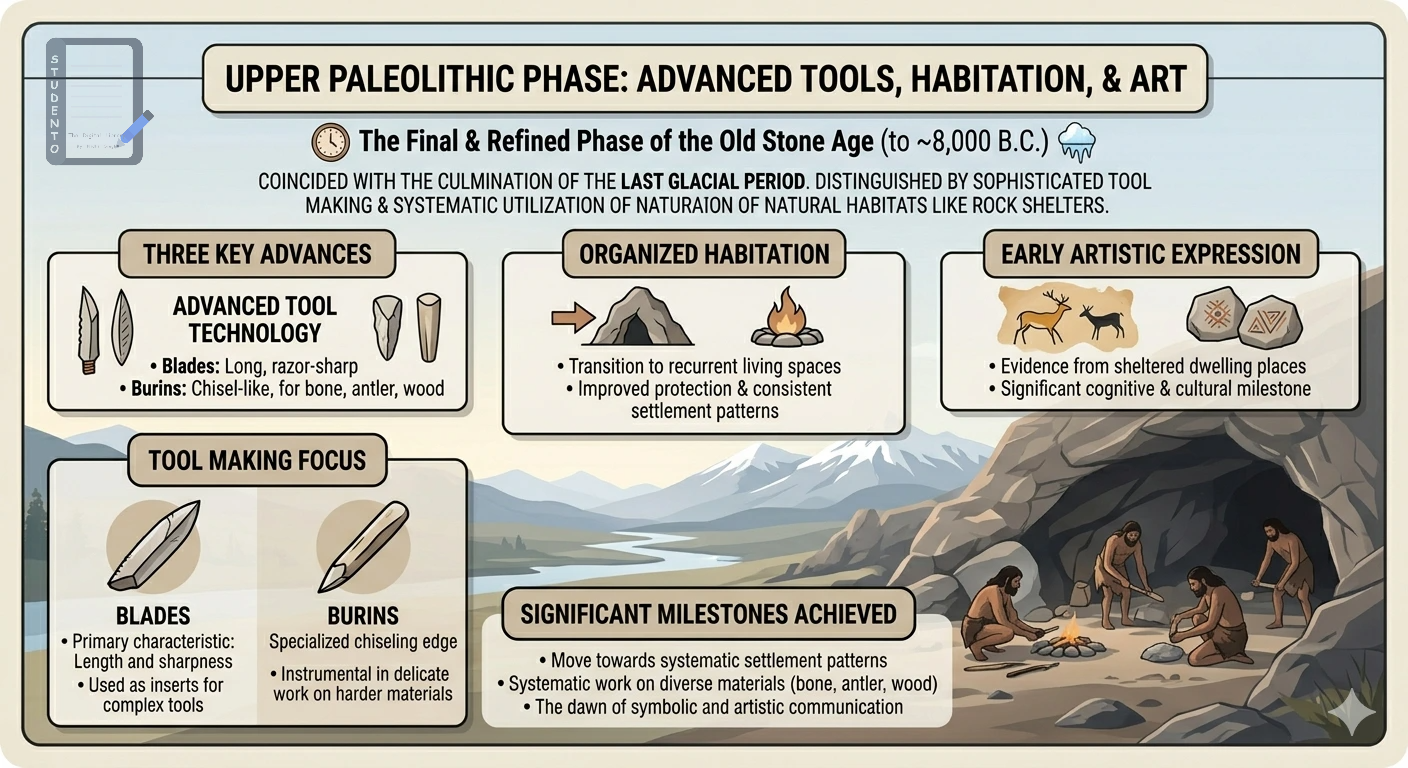
Upper Paleolithic Phase tools illustration showcasing advanced prehistoric stone tools used by early humans during the Late Stone Age, highlighting human innovation, hunting equipment, blade technology, bone tools, survival methods, and the cultural development of ancient civilizations in prehistoric history. - (i) Core artifacts include long parallel-sided blades and specialized chisel-like burins used to carve bone and wood.
- (ii) Natural rock shelters and limestone caves served as long-term dwelling hubs, protecting groups from predators and weather.
- (iii) Cave walls and rock surfaces show early evidence of artistic expression, indicating cognitive growth and social bonding.
Mesolithic Transition: Bridging the Gap to Agriculture and Domestication
The Mesolithic Age (spanning roughly to ), often called the Late Stone Age, served as an intermediate bridge between nomadic hunting and farming communities.
- (i) Toolmaking reached high efficiency through tiny, geometrically shaped stone flakes known as microlithic tools mounted on wooden or bone handles.
- (ii) Human bands gradually adopted semi-permanent camp structures near lakes and rivers, moving toward settled communities and early plant management.
- (iii) This transitional phase built the cultural and economic footing for the Neolithic Age, which brought full-scale crop cultivation and animal domestication.
Summary
The Paleolithic Age covers nearly the entirety of human prehistory in the Indian subcontinent, running from down to Early populations depended entirely on simple stone tools and foraging to survive across varied terrain. As climate conditions shifted from cold glacial cycles to warmer interglacial phases, toolmaking techniques transformed. Heavy core choppers gave way to refined flake scrapers, sharp blades, and specialized burins. Inhabiting natural rock shelters fostered stronger social ties, early artistic expression, and long-term residency patterns. The subsequent Mesolithic era built upon these milestones, introducing microliths and initial domestication practices that ultimately led to the agricultural revolution of the Neolithic Age.
Quick Revision Points for Students
Key facts to remember for competitive examination review:
- (i) Timeline spans from to , divided into Lower, Middle, and Upper Paleolithic phases.
- (ii) Early Paleolithic relied on core tools (hand-axes, cleavers) during Pleistocene glaciations.
- (iii) Middle Paleolithic produced flake tools (scrapers) near major rivers like the Narmada.
- (iv) Upper Paleolithic introduced blades, burins, and cave living, leading into the Mesolithic microlith era.
- Exam Tip: Pay close attention to tool classifications associated with each phase—hand-axes for Lower, scrapers for Middle, and blades/burins for Upper Paleolithic—as examiners frequently test these specific associations in history papers.
Frequently Asked Questions (FAQ)
Q1: What are the main dates associated with the Paleolithic Age in India?
A1: The Paleolithic Age in India spans from approximately to , divided into Early, Middle, and Upper phases based on stone tool developments.Q2: How do Middle Paleolithic tools differ from Early Paleolithic tools?
A2: Early Paleolithic tools were heavy core implements like hand-axes and cleavers, whereas Middle Paleolithic tools were made from smaller stone flakes, producing precise tools like scrapers.Q3: What role did the Mesolithic Age play in human development?
A3: The Mesolithic Age () introduced microlithic tools and semi-settled living, bridging the gap between Old Stone Age foraging and Neolithic agricultural societies.