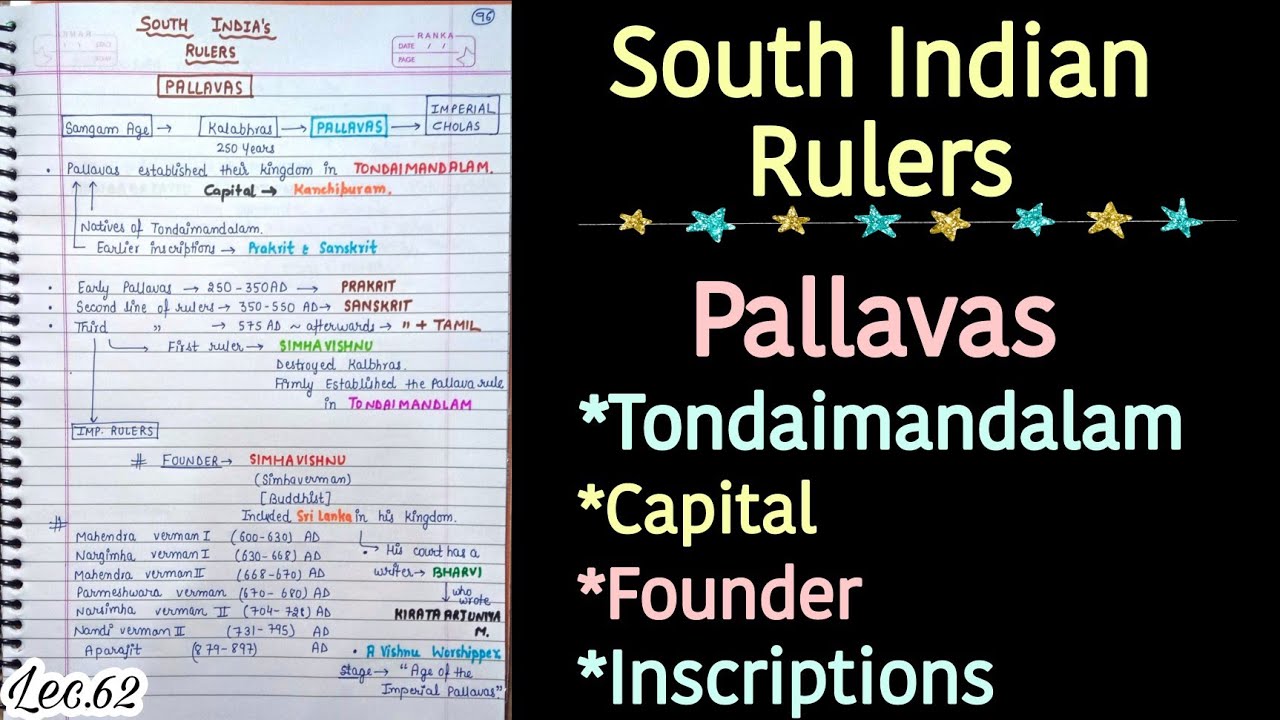
The political history of the early Pallava dynasty marks a pivotal phase in South Indian history, bridging the decline of the Satavahanas and the emergence of major regional empires. Studying this era gives clear insight into how early local chieftains consolidated control, issued Prakrit and Sanskrit royal grants, and established their capital at Kanchipuram. Through copper plate records and stone inscriptions, historians trace this steady political and cultural shift leading up to the great imperial expansion around .
In this chapter, you will understand:
- The transition from Prakrit to Sanskrit copper plate charters in early Pallava administration.
- Key early rulers including Sivaskandavarman and the impact of Samudragupta's southern campaign.
- The administrative legacy inherited from the Satavahanas and religious patronage under Vedic traditions.
- The shift toward imperial dominance under Simhavarman and Simhavishnu before AD 600.
Why this topic matters: It explains the foundation of monarchical power, epigraphic language shifts, and architectural beginnings in medieval South India, making it essential for competitive exams and archaeological studies.
Core Idea: Before becoming a dominant southern power around , the early Pallavas ruled through two distinct phases marked by Prakrit and Sanskrit charters. Their foundational administration and strategic alliances culminated in the defeat of the Kalabhras and the dawn of the Imperial Pallava era under Simhavishnu.
Political History of the Early Pallava Dynasty and Rulers Before AD 600
Understanding early Pallava rule requires dividing their timeline into two distinct stages: the foundational early period prior to and the dominant imperial era that followed.
Historians separate Pallava rule into the Early Pallavas (who governed before ) and the later Imperial Pallavas, who expanded their territorial authority across vast parts of southern India.
The label Imperial highlights the greater political reach, military power, and territorial control held by later kings compared to the foundational work of their predecessors.
- (i) The Early Pallavas are sub-divided based on the language of their official grants, transitioning from early Prakrit charters to subsequent Sanskrit charters.
- (ii) Language shifts in these grants help scholars trace the administrative development and chronological timeline of the royal family.
The Pioneering Rulers Mentioned in Early Prakrit Charters
The initial era of Pallava administration is documented through Prakrit charters, which explicitly name three key figures, with Sivaskandavarman standing out as the most prominent ruler of this group.
The Reign of Sivaskandavarman and Early Lineage Clues
Sivaskandavarman played a major role in organizing early Pallava authority. Historical records label him as Yuvaraja (crown prince), which confirms that his unnamed father was already an established king, proving early dynastic continuity.
- (i) Possible Predecessor: Inscriptions found in the Guntur district mention a ruler named Simhavaraman, who may have been the father of Sivaskandavarman.
- (ii) Successive Generations: Royal lineage records show that Sivaskandavarman was succeeded by his son Buddhavarman, whose own son Buddhyankura was born to Queen Charudevi.
- (iii) The Charudevi Grant: A surviving Prakrit copper grant issued by Queen Charudevi mentions an ancestor named Bappa, though the term simply means father and does not conclusively confirm him as the absolute founder.
Geographical and Religious Assertions of Early Pallavas
Copper plate charters establish an early link between the Pallavas and the city of Kanchipuram, while also documenting their performance of sacred rituals and adoption of high royal titles.
- (a) Kanchi's Relevance: Both the Mayidavolu copper plate grant and the Hirahadagalli copper plate grant issued by Sivaskandavarman confirm that Kanchipuram served as the central hub of early administrative power.
- (b) Royal and Religious Titles: Historical records show Sivaskandavarman taking the title Dharma Maharaja while celebrating major ritual sacrifices, including the Asvamedha (horse sacrifice).
- (c) The Vishnugopa Interlude: During the mid-4th century , a king named Vishnugopa appears in the famous Allahabad pillar inscription, which records his defeat by the Gupta emperor Samudragupta during his southern expedition.
Comprehensive List of Early Pallava Rulers in Prakrit Records
Combining records from early copper plates and northern campaign inscriptions gives us six documented leaders from this initial historical phase.
- (i) The Prakrit charters name five specific royal figures: Simhavarman, Sivaskandavarman, Bappa, Buddhavarman, and Buddhyankura.
- (ii) Adding Vishnugopa from the Gupta court records brings the total count of early Prakrit-era rulers to six.
The Later Early Pallavas and Their Sanskrit Charter Sources
During the second phase of the early period, official charters transitioned from Prakrit to Sanskrit, offering valuable legal and territorial details despite focusing heavily on religious land grants.

Reliable Inscriptional Sources for the Later Early Pallava Period
Several copper plate sets provide solid evidence for reconstructing the family trees and administrative land grants of the middle Pallava period.
- Key Grants:
- (i) The Ongodu I grant issued under King Skandavarman.
- (ii) The Uruvapalle and Singarayakonda plates credited to Yuva MaharajaVishnugopa.
- (iii) The Ongodu II, Pikira, Mangaduru, and Vilavatti plates associated with Simhavarman.
- (iv) The Chura grant and Udayendiram plates of Nandivarman I, alongside the Chendalur and Pallangoil plates.
- External Corroboration: Inscriptions from neighboring kingdoms, such as the Penugonda plates of the Western Gangas, confirm that Pallava kings like Simhavarman and Skandavarman personally crowned Ganga rulers.
- Key Grants:
Dating, Chronology, and the Transition of Administrative Tradition
Fixing precise dates for early kings requires cross-referencing inscriptions with contemporary Jain literature and external royal records.
- (a) Chronological Anchors: The Jain text Lokavibhaga, precisely dated to , provides a firm baseline when studied alongside the Penugonda plates.
- (b) Historical Lineage Listing: The later Velurpalayam plates of Nandivarman III list earlier ancestors, including Asokavarman, who should not be confused with the Mauryan Emperor Ashoka.
- (c) Satavahana Legacy: The Pallavas kept many administrative practices inherited from the Satavahanas, supporting traditional Hindu governance through royal patronage of Siva and Vishnu worship.
Simhavarman and Simhavishnu: The Dawn of Imperial Expansion (c. 550-600 AD)
The final decades of the 6th century witnessed a dramatic expansion in Pallava power led by Simhavarman and his ambitious son Simhavishnu.
Simhavarman (c. 550-600 AD): Devotion and Transition of Power
Simhavarman is widely identified as the royal saint Ayiadigal Kadavarkon, whose deep religious devotion is recorded in the devotional text Periyapuranam.
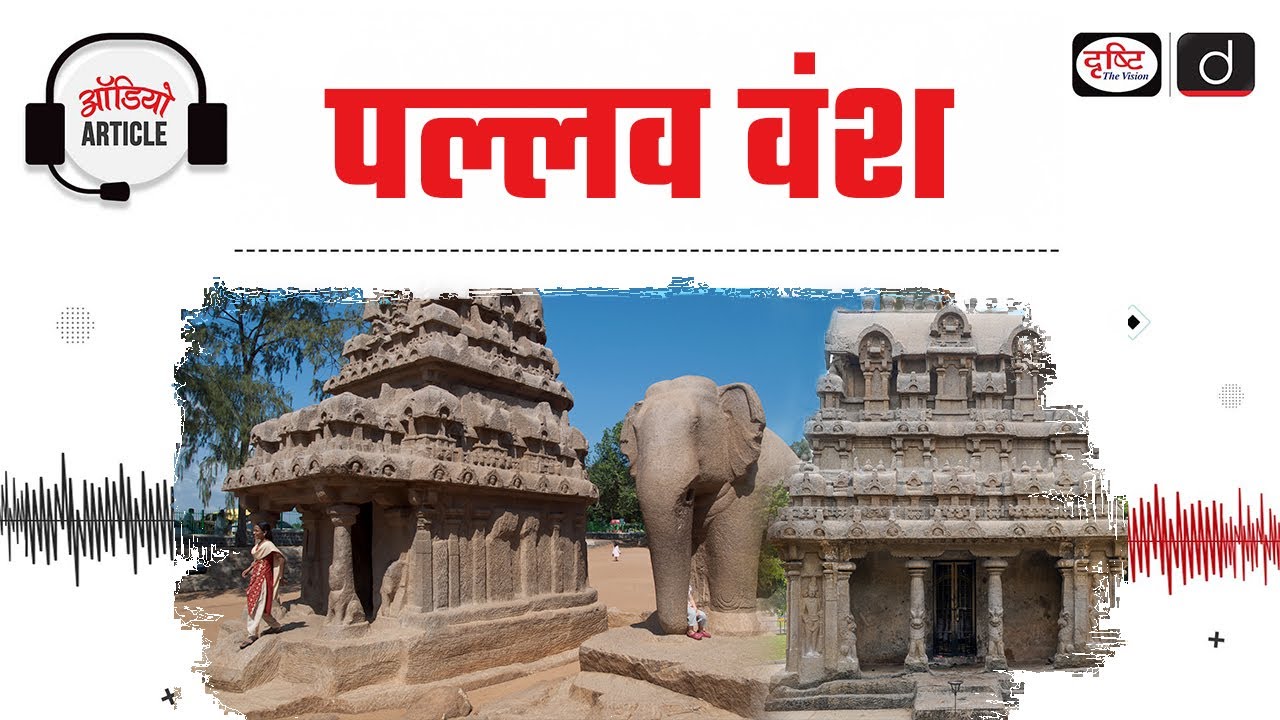
Monolithic cave architecture pioneered during the reign of Simhavishnu at Mahabalipuram. - (i) Literary Contribution: He authored 24 Tamil verses honoring Siva, collected as the Kshetra Tiruvenba in the sacred Eleventh Tirumurai canon.
- (ii) Expansion and Abdication: As territorial expansion gained speed, Simhavarman eventually stepped down from the throne, handing full governance over to his energetic son, Simhavishnu.
Simhavishnu (Avanisimha): The Destroyer of Kalabhras and Architectural Patron
Simhavishnu, also styled Avanisimha (Lion of the Earth), transformed the kingdom into a true southern empire through major military victories.
- (a) Military Conquests: According to the Velurpalayam plates, Simhavishnu defeated the formidable Kalabhras and pushed his borders south by defeating the Cholas, Pandyas, and Malavarayas.
- (b) Architectural Beginnings: His reign pioneered rock-cut cave temples, including the Siyyamangalam Cave Temple and the famous Adivaraha Temple at Mahabalipuram.
- (c) Cultural Legacy: These early rock-cut structures laid the foundation for the magnificent monuments and shore temples built by later Imperial Pallava kings.
Quick Revision Capsule: Early Pallava Dynastic Phases
A structured comparison of the main evolutionary stages, charter languages, and key historical achievements of the Early Pallava dynasty:
| Historical Phase | Primary Language & Source | Key Rulers & Major Milestones |
|---|---|---|
| Early Phase I | Prakrit Charters (Mayidavolu, Hirahadagalli) | Sivaskandavarman established Kanchipuram as capital and performed Vedic sacrifices. |
| Early Phase II | Sanskrit Charters (Ongodu, Pikira, Vilavatti) | Simhavarman and Skandavarman expanded kingdom boundaries and crowned Ganga rulers. |
| Gupta Interlude | Allahabad Pillar Inscription | Vishnugopa was defeated during Samudragupta's southern campaign. |
| Transitional Phase | Periyapuranam & Tirumurai Canon | Simhavarman (Ayiadigal Kadavarkon) authored devotional poetry before abdicating. |
| Imperial Dawn | Velurpalayam Plates & Cave Temples | Simhavishnu defeated the Kalabhras and commissioned rock-cut temples at Mahabalipuram. |
Summary
The early history of the Pallava dynasty documents an important evolution from regional chieftains into a central imperial power in South India. By analyzing their transition from Prakrit to Sanskrit charters, historians trace how administrative systems matured around their capital at Kanchipuram. With the military triumphs of Simhavishnu over the Kalabhras and the launch of rock-cut architecture at Mahabalipuram, the early phase smoothly set the stage for the classical Imperial Pallava era starting around .
Quick Revision Points
Essential facts to review before examinations:
- (i) Early Pallava grants transitioned from Prakrit to Sanskrit over time.
- (ii) Sivaskandavarman was the most prominent ruler associated with early Prakrit copper plates.
- (iii) The Jain text Lokavibhaga () serves as a crucial chronological anchor.
- (iv) Simhavishnu ended Kalabhra dominance and started the rock-cut temple movement.
- Exam Tip: Remember to distinguish between Mauryan Emperor Ashoka and Pallava King Asokavarman when analyzing the lineage listed in the Velurpalayam plates.
Frequently Asked Questions (FAQ)
Q1: What is the main difference between early and imperial Pallavas?
A1: Early Pallavas ruled before using Prakrit and early Sanskrit charters over smaller territories, while Imperial Pallavas ruled larger territories with expanded military influence and monumental stone architecture after .Q2: Which city served as the capital for the early Pallava dynasty?
A2: Kanchipuram served as the royal capital and administrative hub, as recorded in the early copper plate grants of Sivaskandavarman.Q3: Who was the founder of the Imperial Pallava line?
A3: Simhavishnu is regarded as the true architect of imperial Pallava power after defeating the Kalabhras and expanding his domain across South India.