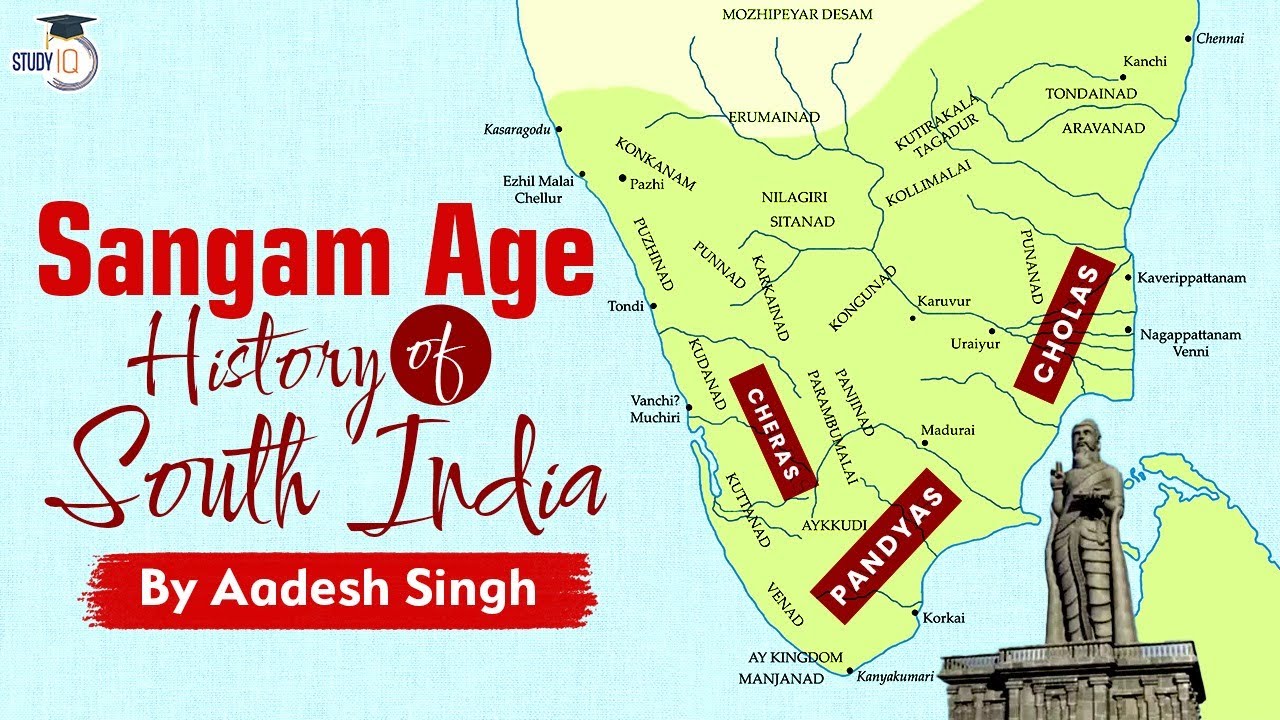
The historical reality of the Sangam Age stands as a cornerstone of ancient South Indian history. Spanning roughly from to , this vibrant era was once viewed purely through the lens of poetic tradition. However, modern historical research, backed by a massive array of stone inscriptions, imperial edicts, Roman coins, and Greco-Roman travelogues, has firmly proven that the Sangam poems reflect real rulers, genuine battles, and booming commercial trade networks across Early Historic Tamilakam. Understanding how these varied sources fit together gives students a clear, rock-solid framework for analyzing early South Indian society, state formation, and international trade.
In this chapter, you will understand:
- How epigraphic edicts and northern Indian literature confirm the existence of early Tamil dynasties.
- The transition of Sangam poetry from long-standing oral traditions to written literary academies.
- How Red Sea archaeological discoveries and Greco-Roman texts validate Indo-Roman maritime trade.
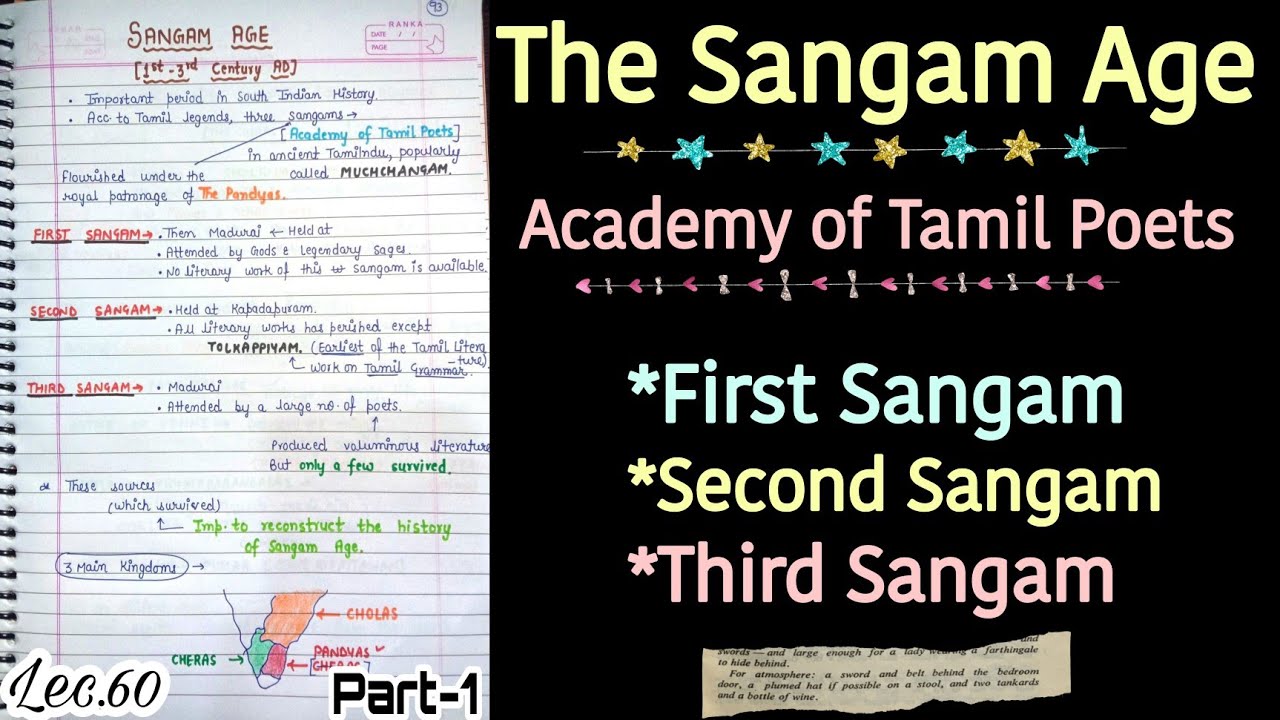
- The political structure, capitals, and commercial hubs of the three major powers—Cheras, Cholas, and Pandyas.
Why this topic matters: Establishing the historicity of the Sangam Age converts ancient Tamil poetry from romantic literature into verifiable historical fact, forming an essential core subject for competitive examination syllabus and deep historiographical understanding.
Core Idea: The Sangam literature is supported by independent evidence from Mauryan rock edicts, Kalingan inscriptions, Red Sea potsherds, and Greco-Roman texts. Together, these sources prove the existence of the three royal houses—the Cheras, Cholas, and Pandyas—along with their thriving trade with the Mediterranean world.
Validating the Early Tamil Past: Historicity of the Sangam Age Through Diverse Sources (c. 3rd Century BCE – 3rd Century CE)
The historical reality of the Sangam Age is authenticated by cross-references found in contemporary regional, imperial, and international records, supporting the narratives of the ancient Tamil poetic tradition.
The existence of the powerful ruling families and the key events detailed within the Sangam literature is firmly corroborated by a combination of literary mentions, stone inscriptions, and foreign traveler accounts.
- (i) The verification process involves matching the details found in the poems with independent evidence from inscriptions, confirming the names of rulers, locations, and political structures.
- (ii) The economic and maritime vibrancy described in the poems, particularly the profitable pepper and pearl trade, is verified through archaeological finds and Greco-Roman texts.
- (iii) This meticulous authentication process converts the poetic accounts from mere tradition into reliable historical data, vital for reconstructing the history of South India.
Inscriptions and References in Major Indian Literature: Authenticating Tamilakam
Ancient texts from across India, including key imperial edicts and classical Sanskrit literature, provide direct supporting evidence for the existence and influence of the Sangam kingdoms.

Pan-Indian Literary Corroboration: Arthashastra and Ramayana
The prestige and wealth of the Sangam kingdoms were recognized across the subcontinent, featuring in seminal works of Indian classical literature and political science.
- (i) The epic Ramayana mentions the renowned city of Kavata, a center famous for its pearls and administered by the Pandya rulers, highlighting their sovereign status.
- (ii) Similarly, Kautilya’s Arthashastra, a foundational text on statecraft, includes direct references to the precious Pandya pearls, underscoring the regional importance of the Pandya kingdom's maritime wealth.
Ashokan Rock Edicts and the Satyaputras Dynasty
The vast empire of Emperor Ashoka recognized the southern kingdoms as established neighbors, a fact etched into stone for posterity.
- (a) The Ashokan Major Rock Edict XIII explicitly names the major Dravidian powers—the Cholas, Cheras, Pandyas, and the Satyaputras—as independent neighbors on the southern borders of the Mauryan Empire.
- (b) The identity of the Satyaputras is conclusively linked to the Athiyaman dynasty, who governed the Tagadur region (known today as Dharmapuri, Tamil Nadu).
- (c) This identification is further confirmed by the Tamil Brahmi inscription discovered at Jambai, dating back to . This inscription reads: "Satiyaputho Adhiya Nedumananji eetha paali," denoting a Jain stone bed donation made by the ruler Athiyaman Neduman Anji, thus authenticating a Sangam-era chieftain.
Hathigumpha Inscription: Kharavela and the Pandya Tribute
A significant epigraphic record from eastern India details a major military campaign against the southern confederacy, verifying the political alliances of the Sangam period.
- (i) The Hathigumpha inscription, commissioned by the Kalinga ruler King Kharavela, documents his military triumph over the formidable Dramira confederacy, a coalition that had reportedly endured for .
- (ii) Critically, the inscription records that the Pandya king subsequently paid a rich tribute to Kharavela, including valuable items such as pearls, precious gems, horses, and war elephants, thereby independently confirming the Pandya's wealth and political existence.
Pugalur Inscription: Cheras and Patitrupathu Verification
This inscription provides a precise link between the royal lineages mentioned in Sangam poetry and archaeological evidence, reinforcing the historicity of the Chera rulers.
- (i) The Pugalur inscription, an inscription in Tamil Brahmi from , explicitly names three generations of the Chera royal line.
- (ii) The rulers listed are Ko Aadhan Sellirumporai, his son Perunkadunko, and his grandson Ilankadunko, all of whom donated a Jain monastic bed.
- (iii) The names of these specific Chera kings are also meticulously recorded in the Sangam text Patitrupathu, establishing a direct, undeniable link between the literary source and epigraphic proof.
Velvikudi Copper Plates: Kalabhras and Pandya Land Grants
Though dated much later, these plates validate the memory and existence of an early Pandya king and the political disruption caused by the Kalabhras.
- (i) The Velvikudi copper plates, issued by the later Pandya KingNeduncadayan in , document the restoration of a land grant.
- (ii) The original grant was made to a Brahmana named Narkorran by Neduncadayan's ancient ancestor, the Sangam-era Pandya KingPalyaga Mudukudumi Peruvazhuthi.
- (iii) The plates narrate that the grant was temporarily revoked during the period of the Kalabhras interregnum, but was finally reinstated by Nedunjadayan in his third regnal year, providing a continuity of royal memory and historical context for early Pandya rule.
Oral Transmission and Epigraphic Support for Sangam Academies
The perpetuation of Sangam poetry was initially dependent on oral traditions, and the institutional framework of literary evaluation is attested in later inscriptions.
Nakkiran's Commentary on Iraiyanar Akapporul: Literary Transmission
The transmission of the ancient poems was a significant feat, relying on a dedicated system of oral preservation across generations.
- (i) According to the scholarly commentary by Nakkiran on the text Iraiyanar Akapporul, the vast collection of Sangam songs was faithfully transmitted orally for an estimated ten generations.
- (ii) This remarkable feat of memory and recitation continued until the time of Nilakantan of Muciri, a figure generally dated to .
Epigraphic Evidence for the Sangam Academies: Tamil Evaluation
Inscriptions confirm that the institution of a literary academy, or Sangam, was a recognized and patronized entity in the Pandya heartland.
Tamil Brahmi rock-cut inscription verifying royal grants and literary assemblies in ancient Tamilakam. - (a) The Erukkankuti inscription () makes a crucial mention of a Sangam academy bench where Tamil literary compositions and works were formally evaluated and judged for merit.
- (b) Later inscriptions, including those from Cinnamanur and Talavaypuram (), also clearly reference the historic Sangam academy located at Madurai, confirming its enduring patronage by successive Pandya kings.
Foreign Sources and Archaeological Confirmation of Indo-Roman Trade
The Sangam Age was characterized by a lucrative and extensive trade relationship with the Greco-Roman world, a fact richly detailed in both Tamil poetry and foreign historical records.
Sangam Poetry and Archaeology of Maritime Commerce
The poetic descriptions of trade voyages find solid validation in archaeological discoveries made along the Red Sea coast.
- (i) The Sangam poems, such as Akananuru 149, vividly describe how the ships of the Yavanas (Greeks and Romans) sailed to the Tamil coast, bringing gold and departing with highly prized commodities like pepper.
- (ii) The discovery of Tamil pepper in Berenice, Egypt, aligns perfectly with these poetic accounts, confirming the long-distance trade route for this valuable spice.
- (iii) A Tamil Brahmi inscription on a potsherd found in Berenice, bearing the name Kotrapooman, further indicates the active presence and participation of Tamil merchants within the thriving Indo-Roman trade network.
Quseir al-Qadhim Inscriptions: Tamil Merchants in Roman Ports
Further archaeological excavation at Roman port sites provides physical evidence of Tamil presence and language in Egypt.
- (a) At the ancient Roman port site of Quseir al-Qadhim, which has been identified as Myos Hormos by the Romans, crucial evidence was unearthed.
- (b) Tamil Brahmi inscriptions were discovered here, containing distinct Tamil names like Saathan and Kanan, which robustly substantiates literary accounts of extensive Tamil maritime trade and engagement with the Roman Empire.
Greco-Roman Literature and Tamil Coastal Towns Identification
The maritime activities and geography of Tamilakam were well-documented by influential Greco-Roman writers, providing external validation for locations mentioned in Sangam texts.
- Veerai Munthurai (Arikamedu-Virampattinam): This port city, a major center for Indo-Roman exchange, was referred to as Poduke in Greco-Roman records.
- Korkai: The ancient capital and port city of the Pandyas was identified as Colchi or Kolkhai by foreign geographers.
- Uraiyur: The prominent early Chola capital was referred to as Argaru in external accounts.
- Writings of Scholars: Classical texts like Strabo’s Geography, Periplus of the Erythraean Sea, Pliny’s Natural History, Ptolemy’s Geography, and the Peutinger Table all provide independent references to these flourishing Tamil coastal towns.
The Legacy of Historical Consciousness in Early Tamilakam
The Sangam poets were not mere creators of art; they were preservers of collective memory, a consciousness that actively served to legitimize the power and identity of their patrons.
Purpose and Power in Historical Narratives
The recording of historical events within the poems was driven by a deep-seated need for identity and authority, ensuring that the past served the needs of the present ruling class.
- (i) The historical consciousness of Tamil poets is evident in their careful preservation of significant past events within communal memory.
- (ii) This continuity of memory—tracing one’s past and maintaining legacy—was crucial in shaping the political and social identity of the time.
- (iii) Historical traditions were intentionally employed by Sangam poets to cater to the needs of their patrons, the chieftains and rulers, who sought validation and authority for their rule.
Questions of Selection and Glorification
The selective nature of historical preservation raises important questions about the interplay between memory, power, and resources.
- (a) Selection Bias: Why were certain aspects of the past chosen for preservation in narratives while others were intentionally excluded or forgotten?
- (b) Patron Motivation: Were these poems purely emotional outpourings, or did they serve a political function, specifically designed to please and glorify powerful chieftains?
- (c) Myth and History: The interweaving of mythical stories with verifiable historical accounts suggests a deliberate strategy to establish a more magnificent and enduring version of Tamil history.
Early Historic Tamilakam: The Muventar (Major Powers - Cheras, Cholas, Pandyas)
The political landscape of the Early Historic period (circa ) in Tamilakam was dominated by three great royal dynasties collectively known as the Muventar, each controlling a specific and prosperous region.
The Cheras Dynasty: Centers and Maritime Influence
The Cheras commanded the western region of Tamilakam, leveraging their control over the rich spice trade to build their influence.
- (i) The Chera rule is documented approximately between and .
- (ii) Their primary centers of power included Karur in present-day Tamil Nadu, along with crucial port cities of Muziris and Thondi in present-day Kerala, which were key hubs for the profitable pepper trade with the Roman world.
The Chola Dynasty: Capitals and Karikala Chola
The Cholas held sway over the fertile Kaveri delta region, boasting a long history that predates and follows the core Sangam Age.
- (a) The Chola rule spanned both pre- and post-Sangam periods, roughly from around .
- (b) Their early capitals included Urayur (also known as Uraiyur in modern Tiruchirapalli) and the economically vital port city of Kaveripattinam.
- (c) The edicts of Ashoka (the 2nd and 13th rock edicts) confirm their status as a major southern power. The most renowned ruler from this early period was Karikala Chola, whose heroic deeds are extensively chronicled in Sangam poetic compositions.
The Pandya Dynasty: Pearl Fishery and Foreign Recognition
The Pandyas ruled the southern-most tip of the peninsula, their wealth largely derived from the famed pearl fishery centered on their maritime domains.
- (i) The original capital of the Pandyas was Korkai (in modern Thoothukudi), which was later shifted to Koodal (present-day Madurai) during the reign of Nedunjelian.
- (ii) Their extensive influence stretched across Travancore in the west and the Vellaru River in the north, covering the entire southeastern coast.
- (iii) Foreign accounts by Greek and Roman writers such as Pliny the Elder, Strabo, and Ptolemy repeatedly mention the Pandyas and their principal port of Korkai, often highlighting the region's universally recognized reputation for its rich pearl fishery.
Quick Revision Capsule: Corroborating Sangam Historicity
A quick summary matrix cross-referencing key archaeological, literary, and epigraphic evidence for Early Historic Tamilakam:
| Dynasty / Topic | Key Historical Evidence & Inscriptions | Primary Capitals & Ports Identified |
|---|---|---|
| The Cheras | Pugalur Tamil-Brahmi inscription () naming three royal generations; verified by Patitrupathu. | Karur (Inland Capital), Muziris and Thondi (Major West Coast Ports). |
| The Cholas | Ashokan Rock Edicts II & XIII; Greco-Roman records of Argaru; Sangam poems praising ruler Karikala Chola. | Uraiyur (Inland Capital), Kaveripattinam / Puhar (East Coast Port). |
| The Pandyas | Hathigumpha Inscription of Kharavela; Velvikudi Copper Plates; referenced in Arthashastra and Ramayana for pearls. | Korkai (Early Port Capital), Madurai (Inland Capital and Sangam Academy seat). |
| Satyaputras | Jambai Tamil Brahmi Inscription referring to ruler Athiyaman Neduman Anji; Ashokan Edict XIII. | Tagadur (Modern Dharmapuri region, Tamil Nadu). |
| Indo-Roman Trade | Tamil Brahmi potsherds at Berenice and Quseir al-Qadhim (Myos Hormos); accounts in Periplus and Ptolemy. | Arikamedu (Poduke), Muziris, Korkai (Colchi). |
Summary
The Sangam poems constitute an invaluable historical record, seamlessly merging oral tradition with verifiable facts, which is paramount for students of history. While later additions like commentaries by medieval scholars such as Nakkiran or colophons were introduced, the core historical data regarding the Cholas, Cheras, Pandyas, the flourishing Indo-Roman trade, and specific events remain authenticated by Ashokan edicts and inscriptions like Hathigumpha. The dedicated preservation and codification of these texts by scholars like U.V. Swaminatha Iyer (from ) ensures that this resource remains the cornerstone for studying Early Historic Tamilakam and its deep cultural legacy.
Quick Revision Points for Students
Essential takeaways for quick examination recall:
- (i) Ashokan Rock Edicts II and XIII provide the earliest imperial epigraphic confirmation of the Cholas, Cheras, Pandyas, and Satyaputras.
- (ii) The Jambai inscription conclusively identifies the Satyaputras with the Athiyaman chieftains of Tagadur.
- (iii) Tamil Brahmi inscriptions discovered at Berenice and Quseir al-Qadhim in Egypt verify active Tamil merchant presence in Roman Red Sea ports.
- (iv) The Pugalur inscription corroborates the Chera lineage explicitly described in the Sangam text Patitrupathu.
- Exam Tip: When answering questions on the historicity of the Sangam Age, always balance literary evidence with epigraphic proofs (Ashokan Edicts, Jambai, Pugalur) and foreign archaeological evidence (Berenice potsherds, Periplus, Pliny). Re-stating this cross-verifiable triangulation will maximize marks in history examinations.
Frequently Asked Questions (FAQ)
Q1: What are the primary sources that prove the Sangam Age actually existed?
A1: The historicity is established through a combination of indigenous Sangam poems, Tamil Brahmi inscriptions (Jambai, Pugalur), imperial Indian inscriptions (Ashokan Edicts, Hathigumpha Inscription), Red Sea archaeological finds (Berenice, Quseir al-Qadhim), and classical Greco-Roman texts (Periplus, Pliny, Ptolemy).Q2: How do foreign archaeological excavations validate Sangam poetry?
A2: Excavations at ancient Roman port sites like Berenice and Quseir al-Qadhim in Egypt uncovered potsherds inscribed with Tamil Brahmi names such as Kotrapooman, Saathan, and Kanan, directly matching Tamil poetic accounts of overseas trade with the Yavanas.Q3: Who were the Muventar in Early Historic Tamilakam?
A3: The Muventar refers to the three crowned kings of ancient Tamilakam—the Cheras, the Cholas, and the Pandyas—who ruled over distinct regions and dominated inland trade and maritime commerce between the 3rd century BCE and 3rd century CE.