The Company School of Painting represents a fascinating blend of Eastern and Western artistic traditions that emerged in India during the colonial period. This unique artistic movement, driven by British patronage, is crucial for students of art history and colonial studies as it illustrates the cultural exchange and adaptation of traditional Indian art under external influence, providing valuable insights for exam preparation.
🎯 In this chapter, you will understand:
- How British East India Company officers reshaped traditional Indian artistic patronage.
- The migration of royal court painters and their transition to observational realism.
- Core visual characteristics, mediums, and themes of Company School paintings.
- The historical significance of colonial souvenirs and commissioned art albums.
💡 Why this topic matters: It highlights how indigenous Indian artists adapted to foreign European demands during a major political transition, creating a hybrid style that documented 18th-century Indian life.
🧠 Core Idea: Combining European observational realism with intricate Indian painting techniques to produce detailed documentation and artistic souvenirs for British patrons.
The Evolution of Company School Painting: Blending Indian Art and British Patronage (Eighteenth Century Period)
Before the establishment of British colonial rule, the purpose and placement of art in India were deeply rooted in indigenous cultural, spiritual, and social life. Art served a variety of functions, far removed from purely secular or documentation purposes.
A New Artistic Purpose: Documenting Colonial India Through the Lens of Traditional Indian Artists
- (i) Art was intrinsically tied to religious and community life, often serving as elaborate decoration for sacred spaces like temple walls or as vibrant illustrations within invaluable manuscripts detailing religious texts and stories.
- (ii) Furthermore, even at a grassroots level, art provided aesthetic and ritualistic adornment to the humble walls of mud houses in villages, indicating its widespread, socio-cultural relevance across the subcontinent.
- (iii) However, with the arrival of the British starting in the , a significant shift in artistic patronage and demand occurred, setting the stage for the Company School's emergence.
British Fascination and the Commissioning of Local Indian Artists
The new colonial masters, particularly the officers of the British East India Company, were deeply intrigued by the exotic landscape and the unfamiliar customs of India, which led them to actively commission local artists for documentation.
Colonial Curiosity: Capturing Indian Life, Flora, and Fauna for British Records
A wave of genuine curiosity and academic interest swept through the British community in India. They were captivated by the diverse customs and manners of the people, the unique tropical flora and fauna, and the varied locales of India that were unlike anything back home.
- (i) This profound fascination spurred many British officers to issue direct commissions to local artists, instructing them to paint various scenes from their immediate surroundings.
- (ii) These artistic endeavors fulfilled a dual purpose: they served both as detailed documentation of the new colonial territories and as appealing artistic souvenirs to be sent back to Britain.
- (iii) The work of artists like Ghulam Ali Khan exemplifies this period, showcasing a sophisticated merging of styles to depict both traditional and contemporary colonial life.
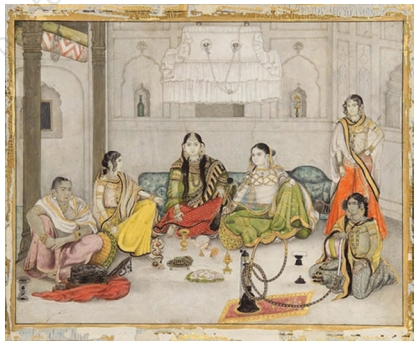
Company Paintings by Ghulam Ali Khan - Ghulam Ali Khan’s Company paintings offer a glimpse into colonial India, blending European and Indian artistic techniques to depict both traditional and contemporary scenes.
Adaptation of Traditional Art: Indian Artists Meet European Demands
To successfully cater to the distinct aesthetic preferences and documentary requirements of their new British clientele, Indian artists had to strategically modify their established, age-old painting techniques and methodologies.
Court Artists' Migration and the Necessity of Stylistic Compromise
Many of the artists who took up these new commissions were skilled professionals who had previously worked in prestigious regional courts that were now declining, such as those in Murshidabad, Lucknow, or Delhi. The shift in patronage necessitated a major change in their artistic focus.
- (a) The primary driver for this adaptation was the acute need to accurately document the world around them—a requirement that superseded the traditional artistic goals.
- (b) They were forced to incorporate close observation of reality, a fundamental characteristic and hallmark of European art, into their practice.
- (c) This was a radical departure from the established traditional Indian art practices, where artists often relied predominantly on structured rule books and deep memory rather than direct, real-time visual observation to execute their compositions.
Defining Characteristics and the Rise of the Company School of Painting
The successful fusion of detailed traditional Indian art techniques, often delicate in execution, with the European emphasis on realism and close observation culminated in the birth of the distinct Company School of Painting.
The Fusion Style: Realism, Detail, and Subjective Focus
This emerging style was immediately identifiable by its unique set of features that catered directly to British interests. It was a new visual language capturing India through a lens appreciated by the West.
- (i) The paintings were characterized by a meticulous, detailed depiction of various scenes, with a particular emphasis on landscapes, regional local customs, detailed representations of flora and fauna, and portraits of local people.
- (ii) The overriding stylistic principle guiding the work was an adherence to realism and observational accuracy, which set it apart from preceding Indian miniature traditions.
- (iii) The preferred medium was predominantly paper, making the works easily transportable and suitable for collecting in sets or albums.
Popularity: The Art Market Among British Officers and in Britain
The Company School paintings quickly became a highly desirable commodity, first among those stationed in India and later across the vast British Empire.
- (a) They achieved widespread popularity among the vast contingent of British officers in India who sought tangible, artistic records of their time and experiences in the subcontinent.
- (b) The appeal of these works was not confined to India; they gained significant popularity in Britain itself, serving as exotic and informative windows into the colony.
- (c) The fashion for collecting these paintings led to the creation of specially curated albums containing sets of these images, which became highly sought after collectibles among the elite and curious in the home country.
Significance of Company Painting for Colonial Studies Students
The Company School of Painting remains a vital topic for study, perfectly illustrating the complex artistic and cultural interactions during the British colonial rule period. These paintings provide an invaluable primary source for understanding how traditional Indian artists adapted their techniques to meet the demands of a new European patronage, focusing on realism and documentation. For students, studying this art form is essential as it reveals the mechanics of cultural exchange and the socioeconomic impact of colonialism on indigenous artistic traditions.
⚡ Quick Revision Capsule: Company School of Painting
Key summary details comparing traditional Indian art methods with Company School innovations:
| Aspect | Traditional Indian Art | Company School Adaptation |
|---|---|---|
| Primary Patronage | Indian Royal Courts, Temples, & Rural Communities | British East India Company Officers & European Elite |
| Core Purpose | Religious, Ritualistic, & Idealized Storytelling | Secular Documentation, Natural History, & Souvenirs |
| Key Technique | Rule Books, Memory, & Stylized Expressions | Direct Observation, European Realism, & Linear Perspective |
| Common Medium | Palm Leaves, Cloth Manuscripts, & Temple Walls | Watercolors on European Paper |
| Key Centers | Murshidabad, Lucknow, & Delhi Courts | Patna, Calcutta, Tanjore, & Delhi Colonial Hubs |
📝 Summary
During the , the decline of native royal patrons and the rise of British colonial rule transformed Indian art. Traditional court painters from centers like Murshidabad, Lucknow, and Delhi adapted their techniques to cater to British East India Company personnel. Combining European observational realism with Indian precision, artists like Ghulam Ali Khan recorded local trades, landscapes, flora, and fauna on paper, giving birth to the Company School of Painting.
🚀 Quick Revision Points
Essential facts to review before examinations:
- (i) Emerging in the , Company Painting fused European realism with Indian miniature skill.
- (ii) It replaced memory-driven iconographic art with direct real-time visual observation.
- (iii) Major themes included natural history (flora/fauna), local occupations, and everyday Indian life.
- (iv) Artworks were executed primarily on paper to be bound into collectible souvenirs and albums.
- 💡 Exam Tip: Focus on how shifting socioeconomic patronage directly influenced artistic style—specifically moving from courtly idealization to scientific documentation and realism.
❓ Frequently Asked Questions (FAQ)
Q1: Why is it called the "Company School" of painting?
A1: It is named after the British East India Company, as its officers were the main patrons commissioning these works.Q2: What is the main stylistic difference between Company Paintings and Traditional Indian Miniatures?
A2: Company Paintings adopted European observational realism, shadow shading, and linear perspective, whereas traditional miniatures relied on stylized, memory-based compositions and canonical rulebooks.Q3: Which famous artists are associated with this movement?
A3: Master painters such as Ghulam Ali Khan and Zain al-Din are primary examples of court painters who adapted to European patrons.