Explore the Modern Indian Art Masters and their Iconic Paintings, a critical study for students preparing for exams on Indian Art and Culture. These masterpieces, created between the and , reflect a powerful synthesis of traditional Indian, Mughal, Folk, and Western artistic techniques, playing a vital role in India's cultural renaissance and nationalist movement.
🎯 In this chapter, you will understand:
- The transition from colonial influences to an indigenous artistic language.
- Technical innovations including oil on canvas, wash, tempera, and folk style.
- The role of myth, rural life, and spirituality in building national identity.
- Key contributions of pioneers like Bose, Majumdar, Chughtai, G. Tagore, Varma, Roy, and A. Tagore.
💡 Why this topic matters: Modern Indian art reflects how national identity and cultural pride were reclaimed during the freedom movement through creative expression.
🧠 Core Idea: Indian masters combined traditional heritage with modern techniques to replace colonial styles with a vibrant local narrative.
Masterpieces of Modern Indian Art: Style, Technique, and Nationalist Context (Late 19th–Mid 20th Century)
A journey through India's modern art movement highlighting folk revival, mythology, and political consciousness. The transition into modern Indian art saw artists move away from purely colonial influences, seeking inspiration in India's rich heritage and contemporary nationalistic aspirations. The works below are pivotal examples that showcase this artistic and cultural reclamation.
- (i) These paintings represent a deliberate effort to establish an indigenous artistic language, often drawing from traditional Indian sources like Ajanta and Mughal manuscripts.
- (ii) The artists utilized diverse media, from oil on canvas (Raja Ravi Varma) to wash and tempera (Abanindranath Tagore, Abdul Rehman Chughtai), reflecting technical innovation and revival.
- (iii) The thematic focus often centered on Indian mythology, rural life, and spiritual concepts, consciously steering away from Western academic realism or Orientalist fantasy.
Nandalal Bose: The Tiller of the Soil Panel and the Folk Art Revival
Nandalal Bose (–), a key figure in the Bengal School, utilized his art to celebrate the dignity of the common man and align with Mahatma Gandhi's vision of rural empowerment, as powerfully demonstrated in his Haripura Congress panels.
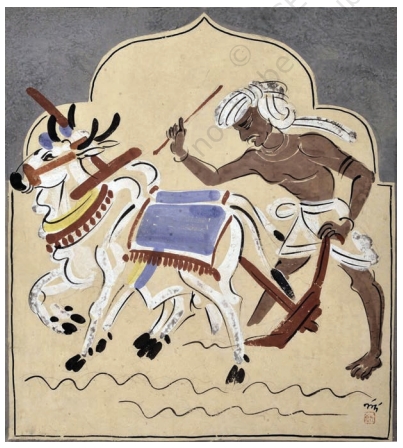
Tiller of the Soil (1938) for the Haripura Congress
The "Tiller of the Soil" panel, created by Nandalal Bose in for the Haripura Congress, stands as a profound tribute to the backbone of the nation—the Indian farmer. This artwork deliberately shifts focus from the elite to the daily, laborious reality of the common man in rural India. It is a visual narrative of simplicity, strength, and an unwavering connection to the land, an essential theme in the context of the freedom struggle.
- (i) Representation of Village Life:Bose sought to capture the unadorned essence of village life, focusing on the simplicity and inherent dignity of the rural existence, making the work instantly relatable to the masses.
- (ii) Artistic Technique and Folk Influence: The use of thick tempera paint in a bold, cursory style with broad brushstrokes intentionally evokes the patuas (scroll painters) or folk art tradition, chosen specifically to represent the simplicity and tradition of rural India.
- (iii) Political and Cultural Significance: The panel conveys a strong political statement, echoing Gandhi’s philosophy that rural India is the true heart of the nation. The background arch symbolically represents strength and continuity, highlighting the message of rural empowerment and national unity.
The Role of Art in Nation Building: Bose’s Vision
Beyond this single panel, Nandalal Bose's extensive work during this period, often produced at Kala Bhavana, established art as a critical tool for shaping national identity. Under his supervision, over 400 posters were created, placing the common people at the core of the nation-building process.
- (a) Drawing Inspiration:Bose drew profound inspiration from traditional Indian art, notably the majestic Ajanta wall paintings and classical sculptures, influencing the artwork's strong formal design and bold color scheme.
- (b) Art as a Moral Tool: His artistic endeavors were not mere visual expression but a deliberate attempt to shape the nation’s moral and cultural character, underscoring the vital importance of the common man in the struggle for independence and self-identity.
Kshitindranath Majumdar: Rasa-Lila and the Sublime Bhakti Mood
Kshitindranath Majumdar (–), a disciple of Abanindranath Tagore, extended the delicate Wash Technique to portray profound mythological and religious subjects, particularly those inspired by the devotional fervor of Bhakti Marga.
Rasa-Lila: The Divine Dance in Watercolour
The "Rasa-Lila" painting portrays the enchanting and divine life of Sri Krishna, rendered in the classic wash technique with Majumdar's unique, delicate variations. The artwork embodies a serene and profound spirituality, capturing the joy and devotion inherent in the Bhagavata Purana narrative.
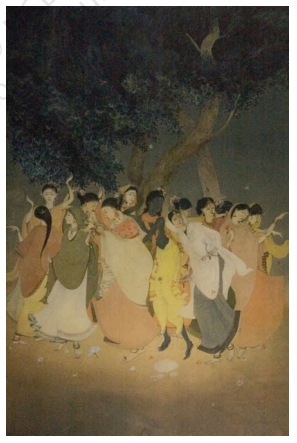
Raslila by Majumdar - A vibrant portrayal of the divine dance of Krishna with the Gopis, highlighting themes of devotion and joy in Indian mythology. - (i) Stylistic Features:Majumdar’s signature style features rustic, slender figures, modest gestures, and idyllic settings, all executed using delicate watercolours, emphasizing spiritual grace over dramatic realism.
- (ii) Depiction of Divine Play: The scene captures Krishna dancing with Radha and the sakhis (female companions), set against a backdrop of trees, evoking the simple, natural atmosphere referenced in texts like the Bhagavata Purana and the Gita Govinda.
- (iii) Sublime Mood and Unity: The figures are drawn with simple, flowing, and delicate lines, successfully conveying the sublime and serene moods of the characters. By depicting Krishna and the gopis in equal proportion, the painting visually bridges the human and divine realms, reflecting the core tenet of spiritual connection in Bhakti.
Abdul Rehman Chughtai: Radhika and the Poetic Calligraphy
Abdul Rehman Chughtai (–) introduced a unique sensuous depth to the wash technique, blending Abanindranath Tagore’s influence with the delicate, lyrical lines found in Mughal and Persian manuscripts.
Radhika: Emotional Depth in Wash and Tempera
The painting "Radhika," executed in wash and tempera, presents Radhika in a moment of profound emotional contemplation—walking away from a lighted lamp against a dramatically gloomy background. The artwork, rooted in Hindu mythology, expertly captures a state of trance or deep remorse through its atmospheric use of light and shade.
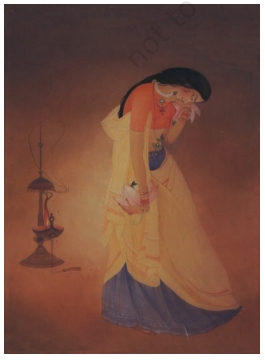
Radhika by Abdul Rehman Chughtai - This artwork reflects the romantic and spiritual aura of Radha, rendered in Chughtai’s unique and expressive style. - (a) Style and Influence:Chughtai's distinct style is marked by a lyrical quality, with every line reflecting the elegance and grace of calligraphy, reminiscent of Mughal manuscripts. He was influenced by the Tagores and Bose but innovated the wash technique with his distinct lines.
- (b) Use of Light and Shade: The background's use of light and shade is profoundly simplified, effectively contributing to the mood and emotional depth of Radhika's poignant state.
- (c) Subject and Poetic Quality:Chughtai frequently painted subjects from Indo-Islamic, Rajput, and Mughal legends, but his treatment is consistently poetic. His work is often described as a visual poem, capturing grace and emotion through refined strokes.
Gaganendranath Tagore: City in the Night and Indian Cubism
Gaganendranath Tagore (–) stands as one of India's earliest modernists, adopting the syntax of Cubism not merely for abstraction but as an expressive apparatus to convey his inner experiences and the turbulent complexity of the urban and mythical world.
City in the Night (1922): Expressionistic Cubism
The watercolour painting "City in the Night," created in , is a striking portrayal of the painter's introspection, where he transforms the formal geometry of Analytical Cubism into a highly expressive medium. He softened the strict lines of Cubism, blending them with seductive profiles and dramatic shadows to create a truly Indian interpretation of the European movement.
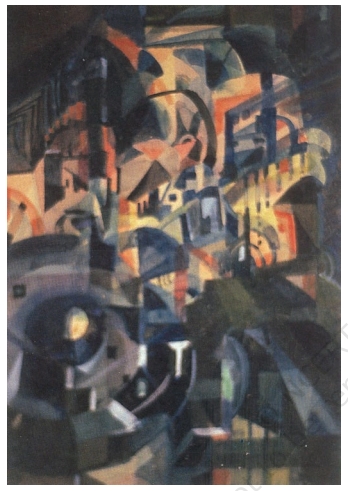
City in the Night by Gaganendranath Tagore - A dramatic depiction of a cityscape at night, highlighting Tagore's innovative approach to light and shadow. - (i) Imaginary Cities: The artwork depicts a mysterious, fragmented world of imaginary cities, potentially referencing mythical places like Dwarka (Lord Krishna’s abode) or Swarnapuri (The Golden City), visualized through multiple viewpoints and multi-faceted shapes typical of Cubism.
- (ii) Cubist Forms and Luminosity: The painting is characterized by an interplay of diamond-shaped planes and prismatic colors, creating a fragmented luminosity that suggests both architectural forms and mountain ranges. The zigzag planes are meticulously composed to form a tight, structured composition.
- (iii) Theatrical Influence: The scene is mysteriously illuminated by artificial light, a feature directly influenced by the theatre. Tagore’s close involvement with his uncle Rabindranath Tagore’s plays profoundly informed his use of stage elements like overlapping planes, partition screens, and the dramatic effects of lighting to create a magical, otherworldly atmosphere.
Raja Ravi Varma: Rama Vanquishing the Pride of the Ocean (Academic Realism)
Raja Ravi Varma (–) pioneered the use of oil paint and lithographic reproduction in India, famously bringing Puranic (mythological) stories to life with a dramatic, academic realism inspired by Western techniques, thereby making classical narratives accessible to the masses.
Rama Vanquishing the Pride of the Ocean (Valmiki Ramayana)
This painting is a powerful depiction from the Valmiki Ramayana, capturing the intensely dramatic moment where Lord Rama, frustrated by Varuna, the God of the Ocean, prepares to shoot a fiery arrow to command passage for his army to Lanka. The style is intended to be noble, momentous, and highly emotional, characteristic of Varma's large-scale mythological narratives.
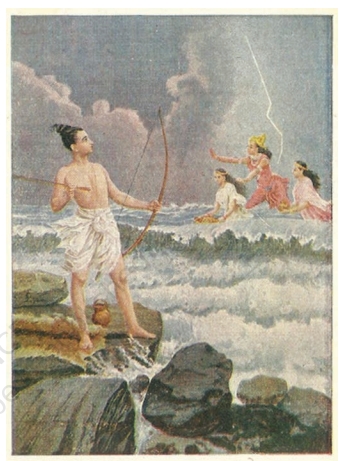
Rama Pride of Ocean by Raja Ravi Verma - Depicting Lord Rama’s steadfast resolve, this painting is a testament to Verma's ability to bring mythological stories to life with intricate detail. - (a) Style and Subject:Varma's style, a blend of European academic realism and Indian sensibility, made his mythological subjects widely popular. He was one of the first Indian painters to master oil paint, giving his works an unprecedented grand scale.
- (b) Sequential Narrative: The scene, where Varuna appears just as Rama readies the arrow, serves as a springboard for the next event—the building of the Setu (bridge). Varma's works often unfolded in a series, narrating the entire epic of the Ramayana.
- (c) Mass Accessibility: Through lithographic reproduction, Varma's mythological paintings were printed as oleographs, making Hindu gods and goddesses accessible in homes across India, significantly shaping popular imagination.
Jamini Roy: Woman with Child and the Father of Folk Renaissance
Jamini Roy (–), often called the father of the folk renaissance in India, consciously rejected Western influences to cultivate a uniquely modern Indian identity based on the expressive simplicity and power of indigenous Bengal folk art (Pats).
Woman with Child (1940): Bold Lines and Earthy Tones
The gouache painting "Woman with Child," created in , exemplifies Roy's mature style. It is characterized by bold simplifications, sweeping brush strokes that create thick outlines, and a two-dimensional, stylized form that directly references the folk pat paintings of Bengal, reflecting his search for purity and simplicity in art.
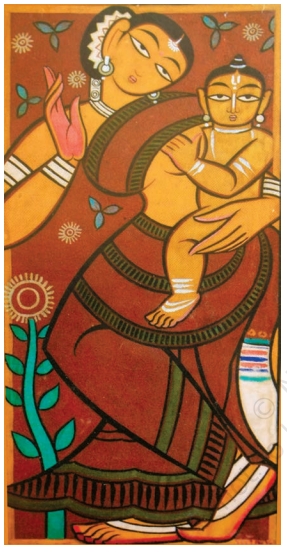
Women with Child by Jamini Roy - This painting exemplifies Jamini Roy's bold lines and earthy tones, celebrating the simplicity and beauty of rural Indian life. - (i) Artistic Journey and Folk Influence: In the , Roy traveled extensively in the Bengal countryside, meticulously studying folk paintings (pats) to incorporate their expressive power of line, volume, and decorative clarity into his own works.
- (ii) Style and Materials: The figures are rendered in dull yellow tones against a brick-red background, intentionally emulating the color palette of terracotta reliefs from his home village in Bankura. He used only seven basic colors, made from organic materials like rock dust and alluvial mud.
- (iii) Innovative Technique:Roy used lamp black for outlining and began making his own canvas using home-spun fabric, moving away from traditional paper. His emphasis on village communities and folk art became a form of cultural and political resistance, asserting local identity as national identity.
Abanindranath Tagore: Journey’s End and the Wash Technique
Abanindranath Tagore (–), regarded as a father figure of nationalist and modern art in India, is credited with inventing the Wash Painting Technique, which sought to revive Indian and Oriental painting traditions, focusing on subtle emotional depth and symbolic aesthetics.
Journey’s End (1913): Symbolism and Poignancy
The watercolour painting "Journey’s End," created in , is a poignant, symbolic masterpiece. It depicts a collapsed camel, exhausted from its journey, set against a backdrop of red dusk. The painting uses the hallmark wash technique to create hazy, misty, and impressionistic atmospheric effects, perfectly symbolizing the end of a long journey, akin to the end of a life or a day.
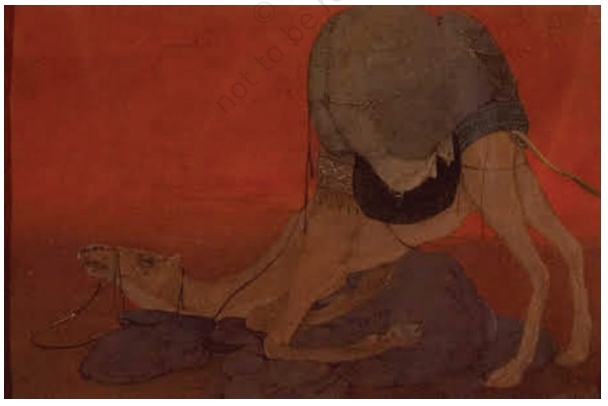
Journey Ends by Abanindranath Tagore - A poignant artwork capturing the culmination of a journey, showcasing Tagore's mastery of emotional depth and subtle storytelling. - (a) Wash Technique: This technique, invented by Abanindranath, involves repeatedly dipping the artwork in water and reapplying color, creating the characteristic soft, atmospheric effects that enhance the painting's emotional and symbolic resonance.
- (b) Revival of Oriental Traditions: His work was instrumental in reviving themes, styles, and techniques from Indian and Oriental painting traditions, serving as a powerful counter-movement to colonial artistic dominance.
- (c) Symbolism:Abanindranath employed symbolic aesthetics and literary allusions to convey deeper meaning. The fine lines and delicate tones describing the camel's physical features enhance the painting's powerful symbolism of exhaustion, finality, and rest.
⚡ Quick Revision Capsule: Modern Indian Art Masters Comparison
A consolidated reference guide comparing key modern Indian artists, their iconic works, techniques, and national themes.
| Artist & Period | Key Painting | Technique & Style |
|---|---|---|
| Nandalal Bose (–) | Tiller of the Soil () | Tempera on paper; bold folk-inspired brushwork like patua scrolls. |
| Kshitindranath Majumdar (–) | Rasa-Lila | Watercolour wash technique; slender figures with serene spiritual devotion. |
| Abdul Rehman Chughtai (–) | Radhika | Wash and tempera; lyrical calligraphic lines with Mughal-Persian depth. |
| Gaganendranath Tagore (–) | City in the Night () | Watercolour; Analytical Cubism combined with theatrical light and shadow. |
| Raja Ravi Varma (–) | Rama Vanquishing the Pride of the Ocean | Oil on canvas; Western academic realism with Indian mythological themes. |
| Jamini Roy (–) | Woman with Child () | Gouache; mineral pigments, thick lamp-black lines, and patua folk style. |
| Abanindranath Tagore (–) | Journey’s End () | Watercolour wash technique; soft, hazy atmosphere with symbolic emotional depth. |
📝 Summary
These masterpieces of modern Indian art created between the and are crucial for understanding the nation's cultural and political awakening. Artists like Nandalal Bose, Raja Ravi Varma, Jamini Roy, and the Tagore brothers synthesized diverse traditions—from academic realism to Cubism and Bengal folk art—to establish a truly indigenous artistic identity. The focus on the Tiller of the Soil, mythological narratives, and the wash technique provides students with essential insights into the period, demonstrating how art became a powerful vehicle for national pride and the reclamation of cultural heritage, which is highly relevant for Art and Culture exam preparation.
🚀 Quick Revision Points
Essential facts to review before examinations:
- (i) Nandalal Bose used tempera and folk patua styles in to highlight rural workers at the Haripura Congress.
- (ii) Abanindranath Tagore invented the watercolour wash technique to introduce soft, emotional mist and spiritual symbolism.
- (iii) Raja Ravi Varma popularized Indian mythology by using oil paint and mass-producing prints as oleographs.
- (iv) Jamini Roy used natural mineral paints and bold black outlines inspired by Bengal's rural pats to lead the Folk Renaissance.
- 💡 Exam Tip: Pay special attention to the medium used by each artist (e.g., Varma = Oil, A. Tagore = Wash, Roy = Gouache/Natural Pigments, Bose = Tempera) as examiners frequently test the link between technique and artistic ideology.
❓ Frequently Asked Questions (FAQ)
Q1: What was the main goal of the Bengal School of Art during the early 20th century?
A1: Its main goal was to reject Western academic realism and build an indigenous artistic identity by drawing inspiration from classical Indian murals, Mughal miniatures, and local folk traditions.Q2: How did Raja Ravi Varma change how people experienced Indian artwork?
A2: By using European oil painting methods and setting up lithographic printing presses, Varma made mass-produced oleographs of Hindu deities accessible to everyday households.Q3: What makes Jamini Roy's technique distinct from other artists of his era?
A3: Jamini Roy turned away from Western academic methods and Bengal School wash techniques to adopt flat two-dimensional forms, bold lamp-black outlines, and organic pigments on home-spun fabric inspired by patua scroll painters.