The story of Indian painting underwent a dramatic transformation during the , influenced by both technological advancements and colonial art pedagogy. This shift, culminating in the masterful works of Raja Ravi Varma, is a critical topic for students preparing for competitive exams, as it details the transition from traditional styles to the European academic realism that briefly dominated the Indian art scene.
🎯 In this chapter, you will understand:
- How technology and British art schools introduced European academic styles to India.
- The life and techniques of Raja Ravi Varma in painting Indian mythological themes.
- How oleographs democratized art for ordinary Indian households.
- The nationalist backlash against Western aesthetics that birthed the Bengal School of Art.
💡 Why this topic matters: It marks the historical bridge between classical Indian traditional painting and modern nationalist art movements.
🧠 Core Idea: Blending Western realism techniques with indigenous Indian folklore revolutionized how sacred art was created, distributed, and viewed across India.
Raja Ravi Varma: European Academic Realism and the Evolution of Indian Painting in the 19th Century
The artistic landscape of India experienced a profound shift with the introduction of new technologies and the establishment of British art schools. This period marked a significant divergence from centuries-old indigenous painting traditions, setting the stage for modern Indian art movements.
- (i) The proliferation of photography in the served as a major catalyst for the decline of traditional Indian painting styles, as the camera offered a faster and more precise method for visual documentation and replication.
- (ii) Simultaneously, British-established art schools actively promoted the use of European academic oil painting techniques, encouraging artists to utilize these foreign methods while applying them to familiar Indian subject matter.
- (iii) This new academic style quickly gained prominence, particularly within the formal structures of the colonial-era art education system, influencing a new generation of painters.
Raja Ravi Varma: Pioneering European Techniques on Indian Themes
The most compelling embodiment of this fusion between Western technique and Indian context was found in the extraordinary oeuvre of Raja Ravi Varma, an artist who achieved unparalleled success in the late 19th century.
Academic Realism and Self-Taught Mastery
Raja Ravi Varma, originating from the Travancore Court in Kerala, was a self-taught visionary who perfected the demanding techniques of academic realism. His method involved meticulously studying and replicating popular European masterpieces, subsequently adapting this proficiency to breathe life into Indian narrative themes.
- (i) Varma’s distinct talent lay in his ability to imbue mythological and historical figures with a sense of three-dimensional realism that was entirely new to the Indian audience, a style strongly influenced by European chiaroscuro and perspective.
- (ii) His success stemmed from his skill in bridging two disparate artistic worlds, making mythological subjects accessible and relatable through a universally accepted European representational style.
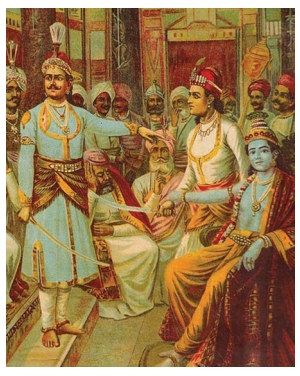
Painting by Raja Ravi Verma - Known for his mastery in depicting Indian mythology, this painting by Raja Ravi Verma showcases his skill in portraying divine figures with realism and grace. - (iii) This fusion created a body of work that was both technically dazzling and deeply resonant with cultural narratives.
Widespread Popularity and the Democratization of Indian Mythology via Oleographs
The work of Raja Ravi Varma reached an unprecedented level of mass appeal and cultural penetration, unlike any other Indian artist before him. His depictions of scenes from Ramayana and Mahabharata resonated deeply, transforming high art into popular culture.
- (a) The immense demand for Varma's art led to the mechanized reproduction of his masterpieces as oleographs, a type of chromolithography that allowed for the mass production of colour prints.
- (b) These oleographs were affordably priced and widely circulated, successfully penetrating local markets and becoming ubiquitous as decorative elements in ordinary Indian homes, often seen as calendar images.
- (c) This process effectively democratized Indian art, making visual representations of gods and epic stories accessible to all segments of society, a factor contributing significantly to his lasting legacy.
Nationalist Critique and the Rise of the Bengal School of Art
Despite his popularity, the Westernized style of Raja Ravi Varma eventually faced strong opposition, becoming a central point of contention for Indian nationalist sentiment towards the turn of the century.
Backlash Against Western Aesthetic in Indian Depictions
As the nationalist movement gained momentum, a critique emerged that deemed Raja Ravi Varma'sacademic style to be excessively Western and alien. Critics argued that the European aesthetic was inherently incapable of capturing the true spiritual and historical essence of Indian myths and narratives.
- (i) The opposition was rooted in a growing desire to rediscover and promote a truly indigenous Indian artistic identity, free from colonial influence.
- (ii) This increasing disillusionment with foreign-influenced art became a powerful cultural expression of the broader Nationalist Movement in India.
The Emergence of Indigenous Art: Setting the Stage for the Bengal School
The cultural backlash against academic realism provided the intellectual and artistic foundation necessary for the emergence of a distinctive, indigenous art movement. This movement was deliberately conceived as a counterpoint to the Western style championed by Varma.
- (a) This shift culminated in the genesis of the Bengal School of Art during the .
- (b) The Bengal School actively championed a revival of Indian traditional painting styles and aesthetics, moving away from oil painting and Western realism towards models inspired by Mughal and Ajanta frescoes.
⚡ Quick Revision Capsule: Evolution of 19th Century Indian Art
A quick comparison of key artistic movements and milestones discussed in this module.
| Movement / Phase | Key Features & Techniques | Impact & Legacy |
|---|---|---|
| Pre-19th Century Traditional Art | Indigenous techniques, miniatures, wall paintings | Gradually declined with the arrival of photography and colonial art schools |
| European Academic Realism | Oil painting, perspective, chiaroscuro, camera-like precision | Adopted by British art schools; changed visual depiction in India |
| Raja Ravi Varma Era | 3D realism applied to Ramayana and Mahabharata themes | Mass production via oleographs; democratized art across Indian households |
| Nationalist Backlash | Rejection of Western aesthetics as spiritually inadequate | Fueled the cultural arm of the Indian freedom movement |
| Bengal School of Art | Revival of indigenous styles, inspired by Mughal and Ajanta frescoes | Emerged in the as an authentic Indian artistic identity |
📝 Summary
The evolution of Indian painting during the and reflects a dynamic interaction between foreign influence and cultural resurgence. Introduced by colonial institutions, Western academic realism found its ultimate exponent in Raja Ravi Varma, who synthesized Western oil painting techniques with classical epics like Ramayana and Mahabharata. His creation of low-cost oleographs brought divine imagery directly into everyday public life. However, as anti-colonial nationalist sentiment grew, artists sought an authentic indigenous expression, leading directly to the establishment of the Bengal School of Art.
🚀 Quick Revision Points
Essential facts to review before examinations:
- (i) Photography and colonial art academies catalyzed the shift away from traditional miniatures in the .
- (ii) Raja Ravi Varma pioneered the use of European chiaroscuro and perspective on Indian mythological narratives.
- (iii) Mass-printed oleographs democratized fine art, turning sacred iconography into household calendar art.
- (iv) Nationalist criticism of Western realism led to the birth of the Bengal School of Art in the , reviving styles from Ajanta and Mughal traditions.
- 💡 Exam Tip: Focus on the cause-and-effect loop for art history questions: Colonial Art Schools/Technology -> European Realism (Raja Ravi Varma) -> Oleographs/Mass Appeal -> Nationalist Rejection -> Bengal School (Indigenous Revival).
❓ Frequently Asked Questions (FAQ)
Q1: What made Raja Ravi Varma's painting style unique in 19th-century India?
A1: He was a self-taught artist from Travancore who successfully combined European academic oil painting techniques, such as 3D perspective and chiaroscuro, with traditional Indian mythological stories.Q2: What are oleographs and how did they affect Indian society?
A2: Oleographs are color lithographic prints. Raja Ravi Varma used them to mass-produce his artwork, making images of gods and epic tales affordable for ordinary homes across India.Q3: Why did nationalist thinkers criticize Raja Ravi Varma's art?
A3: Critics felt that his European academic style was too Western and unable to express the true spiritual depth of Indian stories, which motivated artists to start the indigenous Bengal School of Art.