The Bengal School of Art emerged as a pivotal force in the early , deeply intertwined with the Swadeshi movement and the quest for a distinct Indian identity in art. Led by Abanindranath Tagore and supported by E. B. Havell, this movement challenged colonial art policies by rejecting European academic realism and drawing inspiration from traditional Indian forms like Mughal miniatures and Pahari miniatures. This historical and artistic shift is crucial for students preparing for exams focused on Modern Indian Art History and cultural nationalism.
🎯 In this chapter, you will understand:
- How the Bengal School sparked a nationalist resurgence in early 20th-century Indian art.
- The institutional reforms led by Abanindranath Tagore, E. B. Havell, and Nandalal Bose.
- The integration of folk art, Pan-Asian wash techniques, and European modernism.
- The debate between Anglicist and Orientalist perspectives on authentic modernism.
💡 Why this topic matters: It marks the transition from colonial European academic standards to a self-determined, nationalist identity in Indian visual culture.
🧠 Core Idea: Reclaiming indigenous traditions and fusing them with folk and international elements to build a modern Indian artistic expression.
The Bengal School of Art: The Rise of Cultural Nationalism in Indian Painting (Early 20th Century)
A revolutionary movement, the Bengal School of Art, despite its localized name, extended its nationalist vision far beyond Calcutta, serving as the foundational pillar for a new, authentically Indian artistic expression.
- The genesis of this significant cultural revival began in Calcutta, then the nucleus of British authority in India, but its influence quickly spread across the subcontinent, notably establishing the environment for India’s first national art school at Shantiniketan.
- (i) The movement was intrinsically linked to the powerful Swadeshi nationalist movement, aiming to reclaim and redefine Indian culture in direct opposition to colonial impositions.
- (ii) The principal driving force was Abanindranath Tagore, who found an unlikely but crucial ally in E. B. Havell, a British administrator and Principal of the Calcutta School of Art.
- (iii) Both pioneers fundamentally rejected the prevailing European influence and academic realism championed by colonial art schools, turning instead to classical Indian sources like Mughal and Pahari miniatures to create a genuine national style.
Abanindranath Tagore and E. B. Havell: Reforming the Art Education Curriculum
The collaboration between Abanindranath Tagore and E. B. Havell in marked the start of deep educational reform, transforming the Government Art School in Calcutta into a center for indigenous art techniques and nationalist themes.
Initiating the Shift to Indian Art Traditions
The reformers began their work at the institution that later became the Government College of Art and Craft, Kolkata. Their vision extended to other regional centers like Lahore, Bombay, and Madras, though Calcutta maintained a pronounced focus on developing fine arts rooted in Indian aesthetics.
- (i) They meticulously crafted a curriculum that actively incorporated Indian art traditions, techniques, and narrative themes as central elements of study, moving away from a Eurocentric model.
- (ii) Abanindranath's iconic painting, Journey's End, serves as a powerful demonstration of this artistic synthesis, effectively utilizing elements from Mughal and Pahari miniatures to establish a distinctly Indian painting style.
- (iii) Furthermore, Abanindranath was instrumental in creating the Journal of the Indian Society of Oriental Art, a critical platform used to widely promote Swadeshi values and showcase sophisticated Indian art to the emerging class of modern Indians, setting the stage for modern Indian painting.
Shantiniketan and Kala Bhavana: The Cradle of Early Indian Modernism
The mantle of the Bengal School was carried forward powerfully at Shantiniketan by Nandalal Bose, where Rabindranath Tagore established Kala Bhavana, India’s first national art school, fostering a dynamic environment for Indian-style art development.
Nandalal Bose and the Integration of Folk Art
Nandalal Bose, a student of Abanindranath, was invited to lead the painting department at Kala Bhavana, a constituent unit of Visva-Bharati University. He played a pivotal role in creating an intellectual and artistic space that wholeheartedly encouraged and nurtured an authentic Indian style of art.
- (i) Bose's profound interest lay in folk art, which connected art directly to the lives and experiences of ordinary people, emphasizing social inclusion over elitist academic art.
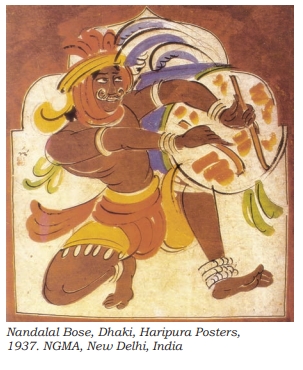
Painting by Nandalal Bose - This artwork embodies the spirit of Indian traditions through modern interpretations of folk art and Indian themes. - (ii) His famous Haripura Posters, created for the Indian National Congress session, vividly depicted rural folk engaged in daily chores, visually reinforcing Mahatma Gandhi's vision of social upliftment and accessibility through artistic expression.
- (iii) Kala Bhavana became a crucial hub for training a new generation of nationalist artists, including figures like K. Venkatappa in South India, all dedicated to making sophisticated art understandable and accessible to the general public, rather than solely the anglicized elite.
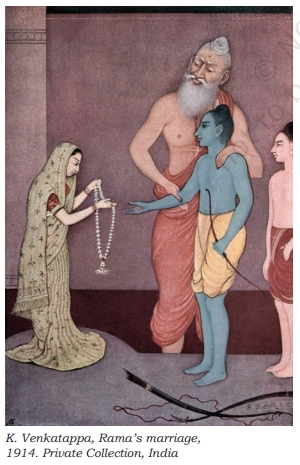
Painting of Lord Rama's Marriage by K. Venkatappa - Capturing the divine atmosphere surrounding the marriage of Lord Rama and Sita from the Ramayana.
- (i) Bose's profound interest lay in folk art, which connected art directly to the lives and experiences of ordinary people, emphasizing social inclusion over elitist academic art.
Jamini Roy: Embracing the Simplicity of Rural Folk Art
The distinguished artist Jamini Roy, despite receiving initial academic training in colonial art schools, consciously made the decision to abandon European influences, choosing instead to champion the bold, simple aesthetic of rural folk art styles.
Characterizing Jamini Roy's Unique Style
Roy's mature body of work is characterized by remarkable simplicity, the dramatic use of bold colors, and themes centered on the everyday lives of women, children, and rural communities. This deliberate choice gave his art a widespread appeal and made it easy for his distinctive style to be replicated, connecting art with the masses.
- (i) His work represented a powerful rejection of the sophisticated and often inaccessible nature of Western realism.
- (ii) The bold, clean lines and flat color application created a new visual language that was immediately identifiable as authentically Indian folk modernism.
The Continued Artistic Struggle: Indian vs. European Art Tastes
The debate and struggle over artistic patronage and aesthetic preference between Indian national styles and European tastes persisted throughout the British Raj, reflecting the broader conflict between nationalism and colonialism.
Conflicting Commissions and Patronage
The British government often favored artists trained in European realistic techniques from institutions like the Bombay School of Art for high-profile commissions, such as the decoration of important government buildings in Lutyens' Delhi.
- (a) Simultaneously, artists aligned with the Bengal School were granted the opportunity to decorate the India House in London.
- (b) However, this concession was made under stringent British supervision, indicating the lingering control and selective acceptance of Indian art by colonial authorities.
Colonial Art Policy, The Artistic Divide, and Pan-Asian Influences
Colonial art policy fundamentally polarized the Indian art world, creating a distinct division between those who championed European academic style and those who advocated for an authentic Indian style—a divide intensified by the Swadeshi movement.
The Swadeshi Movement and The Call for Cultural Unity
The Partition of Bengal in and the subsequent escalation of the Swadeshi movement profoundly shaped artistic ideology, leading to a search for broader cultural alliances.
- (i) The influential art historian Ananda Coomaraswamy collaborated with the Japanese thinker Kakuzo Okakura during the latter's visit to Rabindranath Tagore in Calcutta.
- (ii) Okakura introduced the concept of Pan-Asianism, a unifying cultural ideology designed to link India with other Eastern nations in a collective resistance against Western imperialism.
- (iii) Two Japanese artists who accompanied him subsequently traveled to Shantiniketan, where they taught the Japanese wash technique of painting, presenting a non-Western alternative to European oil painting.
The Arrival of Modern European Abstract Art
In stark contrast to Pan-Asianism, ideas about modern European art began to enter the Indian artistic consciousness, particularly during a landmark year: .
- (a) A significant exhibition featuring works by avant-garde artists like Paul Klee, Wassily Kandinsky, and other Bauhaus artists traveled to Calcutta, giving Indian artists their first substantial exposure to modern European abstract art.
- (b) This radical form of art, which deliberately rejected academic realism, profoundly impacted intellectual discourse among the Indian artistic community.
Gaganendranath Tagore: Experimentation with Cubism and Caricature
Gaganendranath Tagore, the elder brother of Abanindranath Tagore, was among those deeply influenced by modern Western styles, leading to unique experiments in his artistic work.
- (i) He famously experimented with Cubism, utilizing geometric patterns and fractured planes to depict complex architectural spaces and building interiors.
- (ii) Furthermore, he developed a keen interest in creating caricatures, using this medium to satirize the wealthy Bengali elite for their blind imitation of European habits.
The Divide Between Anglicists and Orientalists: Differing Views on Modernism
The ideological divide in Indian art was not merely racial, but centered on fundamentally opposing perspectives regarding what constituted authentic modernism, pitting Orientalist and Anglicist viewpoints against each other.
Benoy Sarkar's Critique and the 'Futurism of Young Asia'
The Bengali intellectual Benoy Sarkar aligned himself with the Anglicist view, believing that the growing modernism originating in Europe represented the authentic and necessary artistic path forward for India.
- (i) In his influential essay, The Futurism of Young Asia, Sarkar argued that the Oriental Bengal School of Art, despite its nationalist intent, was aesthetically regressive and anti-modern.
E. B. Havell's Defense of Native Art for Modernity
Contrasting sharply with Sarkar's view, E. B. Havell passionately advocated for a conscious return to native Indian art traditions as the only means to achieve a truly unique and meaningful modern Indian art.
- (a) Havell strongly believed in the core importance of the Bengal School, viewing tradition as a springboard for, rather than a hindrance to, modernity.
Amrita Sher-Gil: The Fusion of Western Modernism and Indian Themes
The artistic trajectory of Amrita Sher-Gil perfectly encapsulates the successful synthesis of Western and Indian art styles, bridging the divide between these philosophies.
- (i) She skillfully adopted a modernist style, similar to the forms seen in the Bauhaus exhibition, but applied it to depict deeply Indian scenes and subjects.
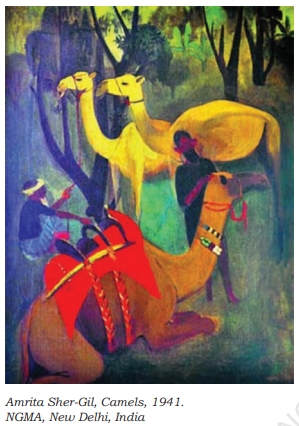
Camel Paintings by Amrita Sher-Gil - Reflecting a deep artistic connection with the cultural elements and life of rural India.
- (i) She skillfully adopted a modernist style, similar to the forms seen in the Bauhaus exhibition, but applied it to depict deeply Indian scenes and subjects.
Modern Art in India: Product of Colonialism and Nationalism
Ultimately, the complex development of modern art in India is best understood as a dynamic outcome of the interaction between colonialism and nationalism.
- (a) Colonialism introduced vital institutions—such as art schools, galleries, journals, and societies—that provided the infrastructure for a modern art ecosystem.
- (b) Nationalist artists, while utilizing these new institutional frameworks, vigorously asserted a preference for Indian artistic tastes and temporarily embraced a broader Asian identity to counter Western cultural dominance.
⚡ Quick Revision Capsule: Key Figures of the Bengal School & Modern Indian Art
A structured comparative guide to the central pioneers, movements, and stylistic contributions of modern Indian art history.
| Artist / Pioneer | Movement / Institution | Key Stylistic Contribution |
|---|---|---|
| Abanindranath Tagore | Bengal School of Art / Calcutta | Rejected academic realism; adapted Mughal and Pahari miniature styles; painted Journey's End. |
| E. B. Havell | Government Art School, Calcutta | Reformed curriculum to center native art traditions over European copyist methods. |
| Nandalal Bose | Kala Bhavana, Shantiniketan | Incorporated folk art and rural themes; designed the iconic Haripura Posters for Gandhi. |
| Jamini Roy | Independent Folk Modernism | Embraced flat colors, simple bold lines, and popular folk motifs accessible to the public. |
| Gaganendranath Tagore | Independent Modernist | Experimented with Cubism and published satirical caricatures mocking anglicized elites. |
| Amrita Sher-Gil | Indo-European Modernist | Fused post-impressionist Western techniques with rich, poignant scenes of rural Indian life. |
📝 Summary
The early witnessed a dramatic evolution in Indian art. Starting as a nationalist rebellion against British academic realism, the Bengal School of Art led by Abanindranath Tagore and E. B. Havell redefined aesthetics through Mughal, Pahari, and Japanese wash traditions. As institutions like Kala Bhavana in Shantiniketan emerged, pioneers like Nandalal Bose and Jamini Roy embraced folk art and rural themes. Concurrently, exposure to Bauhaus abstraction and Cubism inspired artists like Gaganendranath Tagore and Amrita Sher-Gil, resulting in a rich synthesis of indigenous heritage and global modernism.
🚀 Quick Revision Points
Essential facts to review before examinations:
- (i) The Bengal School emerged alongside the Swadeshi movement to reject British academic art principles.
- (ii) E. B. Havell and Abanindranath Tagore reformed the Calcutta Art School curriculum in .
- (iii) Kakuzo Okakura and Japanese artists introduced Pan-Asianism and wash techniques to Shantiniketan.
- (iv) The Bauhaus exhibition in Calcutta introduced European abstract art to Indian practitioners.
- (v) Amrita Sher-Gil bridged Western modernism and Indian rural motifs seamlessly.
- 💡 Exam Tip: Focus on distinguishing between the artistic philosophies of Abanindranath Tagore (Miniature-inspired nationalist revival), Jamini Roy (Folk art simplification), and Amrita Sher-Gil (Western technique applied to Indian life).
❓ Frequently Asked Questions (FAQ)
Q1: What was the primary objective of the Bengal School of Art?
A1: Its primary goal was to resist colonial artistic dominance and European academic realism by reviving indigenous techniques, themes, and classical Indian aesthetics during the Swadeshi era.Q2: How did Japanese artists influence early modern Indian painting?
A2: Through Okakura's concept of Pan-Asianism, Japanese painters visited Shantiniketan and taught the wash technique, providing an Asian alternative to Western oil painting.Q3: What was Benoy Sarkar's critique of the Bengal School?
A3: In The Futurism of Young Asia, Sarkar argued that the Orientalist focus of the Bengal School was backward-looking and that true Indian modernism lay in adopting Western stylistic developments.