The Ahmadnagar School of Painting represents one of the earliest and most vibrant traditions of Deccani miniature art, flourishing under the Nizam Shahi dynasty during the mid-sixteenth century. This unique school blended indigenous Indian styles with strong Persianate influences, particularly visible in its rich colour palette and specific costume details, making it a crucial study for students preparing for exams on Indian Art History. Key examples, such as the illustrated volume celebrating Hussain Nizam Shah I, showcase a distinctive artistic expression between and .
🎯 In this chapter, you will understand:
- The origins and historical context of the Ahmadnagar School under the Nizam Shahi dynasty.
- Distinctive feminine and masculine costume styles blending Northern, Southern, and Persian fashions.
- Key compositional features, rich color palettes, and artistic influence from Central Asia and Persia.
- Important surviving manuscripts like Tarif-i-Hussain Shahi and royal portraiture.
💡 Why this topic matters: The Ahmadnagar School marks the birth of Deccani miniature painting before Mughal styles dominated regional traditions.
🧠 Core Idea: A unique fusion of Northern Indian pre-Mughal forms, Southern Vijayanagara/Lepakshi sartorial details, and Central Asian/Persianate landscape treatments.
Ahmadnagar School of Deccani Painting Style: Origins, Features, and Influence (1553–1569)
The Ahmadnagar School of Painting emerged as a pioneer of the Deccani artistic tradition, offering a captivating synthesis of prevailing Northern Indian and profound Persianate aesthetic sensibilities. The foundational works of the Ahmadnagar style are preserved in an illuminated volume of poems, specially commissioned to commemorate the prosperous rule of Sultan Hussain Nizam Shah I (who reigned from to ).
- (i) The earliest recorded examples of this unique Deccani painting style are found within a series of twelve miniatures illustrating the celebration of Hussain Nizam Shah I's reign.
- (ii) While the battle scenes depicted in the miniatures hold limited artistic value, the representations focusing on the queen and the royal marriage ceremonies are highly celebrated for their use of gorgeous, brilliant colours and strikingly sensuous lines.
- (iii) The representation of women in these initial works strongly indicates an indebtedness to the Northern tradition of pre-Mughal painting, which was particularly prominent in regions like Malwa and Ahmedabad during this specific period.
Stylistic Elements and Distinctive Costume Details in Ahmadnagar Painting
The miniatures of this school are renowned for their distinctive blend of Northern and Southern Indian fashion elements, providing key visual cues for identifying the Ahmadnagar style.
Feminine Attire: Blending Northern Tradition with Deccani Fashion
The depiction of women's clothing in the Ahmadnagar School miniatures showcases a fascinating amalgamation of regional styles, distinguishing the school from contemporary North Indian centres and demonstrating the assimilation of different artistic currents.
- (i) The women in these early Ahmadnagar paintings are observed wearing a modified Northern Indian costume, typically featuring the choli (bodice) paired with long, meticulously braided pigtails that elegantly conclude in a delicate tassel.
- (ii) The only noticeable element that distinctly reflects a Southern Indian fashion influence is the manner in which a long scarf is draped, passing around the body positioned just below the hips, a detail also mirrored in the famous Lepakshi frescoes.
- (iii) The feminine dress further elaborated in a later series of Ragamala paintings stands out as one of the most compelling and emotive expressions of the Deccan Schools of Painting.
- (iv) In contrast to the long braided pigtails, the women's hair in the Ragamala series is styled and rolled up into a neat bun positioned on the nape of the neck, a feature noted to be similar to the style seen in the Lepakshi murals.
Male Costume: Echoes of Early Akbari Miniatures
The attire of male figures in the Ahmadnagar paintings bears a striking resemblance to fashions prevalent in Northern India, particularly those documented in the earliest Mughal works, indicating parallel developments or shared sources of inspiration.
- (a) The male costume is decidedly Northern, particularly the style of the jama (a long coat), which is characterized by its pointed tails, a detail frequently observed in the early Akbari miniatures.
- (b) The small, compact pagri (turban) worn by the male figures closely mirrors the specific form of headgear found in the earliest known examples of Akbari miniatures, confirming the strong Northern visual language incorporated into the Ahmadnagar style.
Palette, Composition, and The Influence of Persia and Bukhara Artists
The Ahmadnagar School distinguished itself through its use of luxurious materials and its compositional techniques, which reveal deep artistic links to the Persianate world, particularly in landscape treatment and sky representation.
Colour Richness and Distinctive Sky Composition
The aesthetic choices of the Ahmadnagar artists, particularly regarding colour, resulted in visually dynamic and opulent works that set them apart from their northern contemporaries who were increasingly influenced by the Mughal court style.
- (i) The palette employed in Ahmadnagar paintings is notably richer and far more brilliant compared to contemporary Northern Indian manuscripts, which at the time were falling under the strong influence of the burgeoning Mughal atelier.
- (ii) A shared characteristic across Deccani paintings, including those from Ahmadnagar, is the depiction of a high, circular horizon paired with a striking gold sky, a stylistic choice that directly reflects pronounced Persian artistic influence in composition.
- (iii) This strong connection signifies that the Deccani Sultanates, including Ahmadnagar, derived a significant portion of their landscape idiom and background treatment directly from Persia.
- (iv) In some later paintings, particularly the Ragamala series, the traditional horizon line disappears entirely, replaced instead by a neutrally coloured ground that is often patterned with small, highly stylised plants or occupied by symmetrical architectural domes constructed over arcades.
- (v) The only feature within the Ragamala compositions that deviates from these Northern or Persian traces is the distinctive women's hairstyle.
Key Manuscript: Tarif-i-Hussain Shahi and the Bukhara Connection
Specific manuscripts serve as cornerstone examples of the style, and art historical analysis points to the potential involvement of artists trained in Central Asian traditions, bringing external artistic vocabularies into the Deccan.
- (a) The iconic portrait titled "King sitting on the Throne, Ahmadnagar", dated between and , is a crucial piece, currently housed at the Bharata Itihasa Samshodaka Mandala, Poona, demonstrating the grandeur of the court.
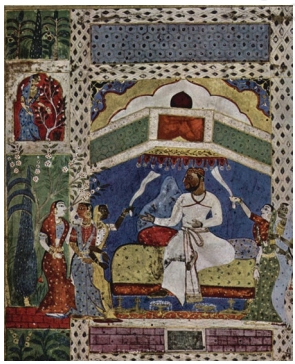
King Sitting on the Throne Ahmadnagar - A regal portrait of a king seated on the throne, symbolizing the power and grandeur of the Ahmadnagar Sultanate and its artistic patronage. - (b) Art historians have suggested that the original illustrations contained within the Gulistan manuscript of are attributable to Bukhara artists, indicating a flow of Central Asian talent.
- (c) Further evidence supporting the presence of these external artists in the Deccan is found in a manuscript now located in the Bankipore Library, Patna. This work, signed by the scribe Yusuf and dedicated to Ibrahim Adil (), features seven miniatures that adhere closely to the distinct Bukhara idiom of that specific period.
⚡ Quick Revision Capsule: Ahmadnagar School Key Features
A quick summary of key parameters defining the Ahmadnagar style of Deccani miniature painting:
| Feature Category | Ahmadnagar Style Characteristics | Cultural Roots / Influence |
|---|---|---|
| Primary Patronage | Sultan Hussain Nizam Shah I () | Nizam Shahi Dynasty of Ahmadnagar |
| Female Costumes | Choli with long braided pigtails; hip scarf draping | Northern Pre-Mughal & Southern Lepakshi Frescoes |
| Male Attire | Pointed jama coat and compact pagri turban | Early Northern Akbari Miniatures |
| Color & Landscape | Brilliant, rich palette with high circular horizon & gold skies | Persianate Landscape Idiom |
| Manuscript Links | Tarif-i-Hussain Shahi (), Gulistan () | Central Asian Bukhara Idiom |
📝 Summary
The Ahmadnagar School of Painting holds significant importance as the earliest documented style of Deccani miniature art, showcasing a remarkable capacity for cultural synthesis. Its bold colour choices, distinctive clothing elements—blending Northern choli with Southern scarf—and the adoption of the Persianate gold sky and Bukhara idiom make it a fascinating study. For students of Indian Art History, understanding the Ahmadnagar style, exemplified by the Tarif–i–Hussain Shahi, is crucial for tracing the development of Deccani painting between and before the widespread influence of the Mughal atelier.
🚀 Quick Revision Points
Essential facts to review before examinations:
- (i) Developed during under Nizam Shahi ruler Sultan Hussain Nizam Shah I.
- (ii) Earliest works survive as twelve miniatures celebrating royal marriage and court life in Tarif-i-Hussain Shahi.
- (iii) Synthesizes female attire from North India (choli and braided hair) and South India (scarf draped at hips like Lepakshi).
- (iv) Features Persian elements including high circular horizons, gold skies, and Central Asian influences from Bukhara artists.
- 💡 Exam Tip: Note the double influence in women's attire in Ahmadnagar art: long braided pigtails come from Northern pre-Mughal traditions (Malwa/Ahmedabad), whereas the hip scarf and rolled bun (Ragamala series) mirror the Southern Vijayanagara/Lepakshi style!
❓ Frequently Asked Questions (FAQ)
Q1: What is the earliest documented manuscript of the Ahmadnagar School?
A1: The earliest documented works are the twelve miniatures found in the manuscript celebrating the reign of Sultan Hussain Nizam Shah I (Tarif-i-Hussain Shahi), produced between and .Q2: How does Persian influence manifest in Ahmadnagar painting?
A2: Persian influence is clearly seen in the landscape treatment, featuring a high circular horizon line, a brilliant gold sky, and stylistic contributions from Bukhara artists.Q3: Where is the portrait "King sitting on the Throne, Ahmadnagar" preserved?
A3: It is preserved at the Bharata Itihasa Samshodaka Mandala in Poona, created between and .