Explore the captivating Bijapur School of Painting, a prominent style within the Deccan Sultanate art tradition, renowned for its fusion of indigenous and external influences. This content is crucial for students preparing for art history and competitive examinations, highlighting the importance of manuscripts like the Nujum al-Ulum (dated ) and the influential patronage of rulers like Ibrahim Adil Shah II during the . Discover the unique characteristics, from the slender figures in Ragamala paintings to the symbolic depth of the Throne of Prosperity miniature.
🎯 In this chapter, you will understand:
- The origins and aesthetic foundations of the Bijapur School of Painting under Adil Shahi rulers.
- Key artistic manuscripts including Nujum al-Ulum () and the Ragamala series.
- The symbolic structure of the Throne of Prosperity and the spiritual depth of The Yogini.
- Cross-cultural influences from South Indian Lepakshi murals, Gujarati woodwork, and Ottoman Turkey.
💡 Why this topic matters: The Bijapur School represents a masterclass in synthesis, bridging regional South Indian techniques with Ottoman and Persian artistic elements to create a distinctive Deccani visual identity.
🧠 Core Idea: Guided by aesthetic rulers like Ali Adil Shah I and Ibrahim Adil Shah II, sixteenth-century Bijapur produced vibrant manuscripts, rich astronomical illustrations, and expressive spiritual portraiture.
Bijapur School of Painting: Exploring Deccan Art Patronage and Style (Sixteenth Century)
The Bijapur School represents a vibrant chapter in Deccan art, flourishing under the generous patronage of the Adil Shahi rulers and demonstrating a distinct aesthetic synthesis. The artistic output of Bijapur in the is best documented in key illustrated works, offering a deep insight into the court's intellectual and creative inclinations.
Early Documented Masterpieces:
- (i) The most significant early evidence is found in the richly illustrated encyclopaedia, the Nujum al-Ulum (Stars of Sciences), which is reliably dated to .
- (ii) This monumental manuscript contains an impressive collection of 876 miniatures, meticulously illustrating diverse subjects such as weaponry, household utensils, and celestial constellations.

Najam al Ulum - A detailed depiction of a scholarly figure, illustrating the intellectual pursuits and comprehensive knowledge documented within the Bijapur court'sNujum al-Ulum encyclopaedia. - (iii) Notably, the depiction of female figures in these paintings is distinctly regional, showing them as tall and slender, adorned in traditional south Indian attire, a feature mirrored in the subsequent Ragamala series.
Influential Patrons of Bijapur Art: The Legacy of the Adil Shahi Rulers
The high artistic standard of the Bijapur School was directly attributable to the enthusiasm and scholarly interest of its principal rulers, who fostered a culture of literary and musical appreciation alongside painting.
Ali Adil Shah I: The Foundation of Bijapur Artistic Heritage
The tradition of art sponsorship in Bijapur gained significant momentum under Ali Adil Shah I (who reigned from ), setting the stage for the school’s distinctive style and development. His court encouraged intellectual and artistic pursuits, laying the groundwork for the future creative peak.
- (i) Ali Adil Shah I was a known patron of the arts and literature, gathering scholars and artists who contributed to the early distinctive style of the region.
- (ii) His reign coincided with the period leading up to the creation of the Nujum al-Ulum manuscript, signifying a strong institutional commitment to illustrated texts.
Ibrahim Adil Shah II: The Pinnacle of Aestheticism and the Nauras-nama
The successor, Ibrahim Adil Shah II (reigning from ), is considered the greatest patron of the Bijapur School, whose personal interests profoundly shaped the court's aesthetic output. He was deeply devoted to Indian culture, music, and art, embodying a rare synthesis of scholarly and artistic talent.
- (a) Ibrahim II was not merely a patron but also an accomplished expert in Indian music, earning renown as the author of the celebrated literary work, Nauras-nama.
- (b) He was the esteemed owner of the critical Nujum al-Ulum manuscript, suggesting its continued importance in the royal library.
- (c) Historical evidence strongly indicates that Ibrahim Adil Shah II may have been the one to commission the exquisite Ragamala series, generally dated to the , reflecting his profound appreciation for musical themes in painting.
International Connections: The Influence of Ottoman Turkey on Bijapur Painting
The cosmopolitan nature of the Bijapur court allowed for the absorption of international artistic influences, specifically through its established diplomatic and cultural ties with the Ottoman Empire.
- Turkish Connection:Bijapur maintained a noticeable and close political and cultural connection with Turkey, facilitating the exchange of artistic ideas and styles.
- Astronomical Illustrations: The complex astronomical illustrations found within the Nujum al-Ulum manuscript may have stylistic origins or been directly influenced by Ottoman Turkish manuscripts, showcasing a fascinating artistic lineage.
Defining Characteristics of Bijapur Ragamala Paintings and Aestheticism
The Ragamala paintings produced in Bijapur exemplify the school’s maturity, standing out for their vibrant palette, compositional simplicity, and deep connection to indigenous Indian styles.
Artistic Synthesis: Indian Echoes and Daring Colouring
The Bijapur School's aesthetic is a powerful blend, retaining strong roots in Indian art traditions while pushing boundaries with its use of colour and composition. This is a vital point for students studying the development of regional painting styles.
- (i) The Ragamala paintings maintain strong connections to traditional Indian styles, bearing visible echoes of the dynamic and ornate aesthetics of the Lepakshi style of South Indian mural painting.
- (ii) These paintings are a brilliant manifestation of the luxuriant aestheticism of the Adil Shah court, utilizing strikingly daring and brilliantly successful colouring.
- (iii) They are noted for their simplified compositions, where essential forms and figures are emphasized, contributing to their visual impact and clarity.
⚡ Quick Revision Capsule: Bijapur School of Painting Highlights
A quick-reference comparative table summarizing key manuscripts, works, and artistic attributes of the Bijapur School.
| Artwork / Manuscript | Period / Patron | Key Stylistic Features & Symbolism |
|---|---|---|
| Nujum al-Ulum | (Ali Adil Shah I / Ibrahim II) | 876 miniatures covering astronomy, weapons, and household tools; tall, slender female figures in South Indian dress. |
| Ragamala Series | (Ibrahim Adil Shah II) | Musical themes, daring colouring, simplified compositions, and echoes of the Lepakshi style. |
| Throne of Prosperity | (Chester Beatty Library) | Symbolic diagram with 7 stages, animal/tribal figures, Gujarati architectural framework, and Persian-style palette. |
| The Yogini Miniature | (Deccan Sultanate) | Vertical layout, female seeker holding a myna bird, elaborate jewelry, flowing scarves, and lush surrounding flora. |
The Throne of Prosperity: Symbolism and Style in the Nujum al-Ulum
Among the key miniatures in the Nujum al-Ulum is the Throne of Prosperity, a complex symbolic diagram that perfectly illustrates the fusion of artistic traditions at the Bijapur court.
Symbolic Structure and Compositional Details
The Throne of Prosperity (dated , Bijapur), currently preserved in the Chester Beatty Library, Dublin, Ireland, is a visual treatise on auspiciousness, constructed with meticulous, layered detail.
- (i) The miniature conceptually represents an auspicious throne through a complex symbolic diagram.
- (ii) The throne’s structure is supported by seven distinct stages, each one populated by a varied set of figures, ranging from powerful animals like elephants and tigers to elements of nature such as palm trees and peacocks, and even depictions of primitive tribes, symbolizing a cosmic hierarchy.
- (iii) The underlying basic structures within the miniature strikingly recall the intricate patterns and forms found in wood-carved doorways and facades of Gujarati homes or the traditional architecture of Deccan temples.
Colouring and Stylistic Fusion: Persian and Deccani Elements
The painting’s use of colour and decorative motifs highlights the seamless integration of foreign and indigenous artistic vocabularies in Bijapur art, showcasing an early form of Deccani stylistic blending.
- (a) The application of colour adheres closely to the vibrant and detailed palette characteristic of the Islamic Persian tradition.
- (b) Decorative elements include complex arabesques adorning the top section of the throne, juxtaposed with distinct Deccani foliage set against a deep, vibrant blue sky.
- (c) The highly stylised plants flanking the throne on either side have a clear visual reference to the delicate margin decoration style prevalent in early sixteenth-century Gujarati manuscripts.
The Yogini Painting: A Mystical Portrait of Spiritual Pursuit in Deccan Art
The depiction of the Yogini is another masterwork from the Deccani School, capturing the spiritual depth and individual focus characteristic of the era's mystical traditions.
The Concept of the Yogini and Vertical Composition
A Yogini is defined as a woman dedicated to the practice of Yoga, committing to a disciplined life in pursuit of profound spiritual and intellectual knowledge, making her an ideal subject for profound portraiture.
- (i) The painting utilizes a powerful vertical composition, dominated by the long, standing figure of the Yogini, whose height is visually accentuated.
- (ii) This commanding figure is elegantly complemented by a cluster of decorative white structures situated near the top of the composition, adding visual balance.
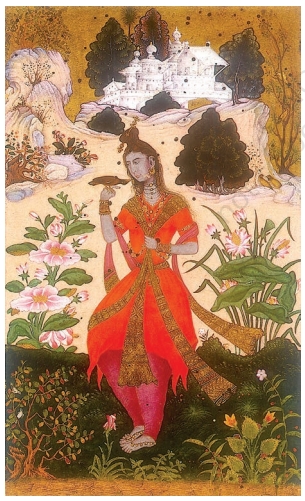
The Yogini of Bijapur - A fascinating depiction of a mystical yogini figure from Bijapur, embodying the spiritual and artistic traditions of the Deccan Sultanates and the pursuit of spiritual exploration. - (iii) The central action is an intriguing moment where the Yogini is shown preoccupied with a myna bird, giving the impression of an intimate, spiritual conversation or exchange.
Adornment, Hairstyle, and Exquisite Flora
The figure’s elaborate presentation, from her rich jewellery to her flowing attire and the lush surrounding landscape, contributes to the overall exquisite aesthetic of this Deccani painting.
- (a) The Yogini is richly adorned with jewellery, suggesting her high spiritual or social status.
- (b) Her distinctive hair bun is styled to visually elongate her physical presence and enhance the verticality of the composition.
- (c) Long, dramatically flowing scarves swirl around her body, adding a sense of movement and grace to the static figure.
- (d) The figure is enveloped by a setting of exquisite flora, which contributes significantly to the detailed and rich overall landscape.
📝 Summary
The Bijapur School of Painting stands as a paramount example of artistic synthesis in Deccan, blending Persianate traditions with indigenous Indian styles like the Lepakshi tradition. The influential patronage of Ibrahim Adil Shah II led to masterpieces like the Ragamala paintings and the symbolic illustrations of the Nujum al-Ulum, such as the Throne of Prosperity and the compelling Yogini painting. The school's characteristic daring colouring and aesthetic refinement are vital topics for students preparing for examinations on Indian Art and Culture, showcasing the dynamic cultural exchange in the Deccan Sultanates.
🚀 Quick Revision Points
Essential facts to review before examinations:
- (i) Nujum al-Ulum () contains 876 miniatures and reflects early Bijapur patronage under Ali Adil Shah I.
- (ii) Ibrahim Adil Shah II authored the musical treatise Nauras-nama and commissioned the Ragamala series ().
- (iii) The Throne of Prosperity combines 7 symbolic tiers, Gujarati woodwork structures, and Persian-influenced colors.
- (iv) The Yogini miniature emphasizes vertical balance, flowing scarves, interaction with a myna bird, and rich Deccani flora.
- 💡 Exam Tip: Note the distinction between southern indigenous roots (such as Lepakshi murals and Gujarati wood carvings) and foreign influences (such as Ottoman Turkish star charts and Persian color palettes) when answering descriptive questions on Deccani art.
❓ Frequently Asked Questions (FAQ)
Q1: What is the most famous illustrated manuscript from the Bijapur School?
A1: The most famous manuscript is the Nujum al-Ulum (Stars of Sciences), dated to , containing 876 miniatures.Q2: Who was the most influential patron of Bijapur painting?
A2: Ibrahim Adil Shah II (), an expert in Indian music and author of Nauras-nama, was the principal patron.Q3: What makes the Throne of Prosperity miniature unique?
A3: It features a 7-stage symbolic throne mixing Gujarati temple woodcarving structures with Persian colors and Ottoman astronomical elements.