The Golconda School of Painting represents a captivating and opulent style that flourished in the independent Deccan kingdom from onwards. This art form, celebrated for its lavish use of gold jewellery, distinct Deccani elements, and sophisticated compositions, offers invaluable insight into the culture and enormous wealth of one of the richest South Indian states. Understanding the nuances of Golconda art is crucial for students preparing for history and art and culture exams, as it details the confluence of trade, diamond wealth, and unique artistic expression in the seventeenth century.
🎯 In this chapter, you will understand:
- The economic foundations and trade routes that fueled Golconda's artistic patronage.
- Key visual characteristics of early Golconda miniatures, including the Diwan of Hafiz.
- Seventeenth-century style shifts, large-format hangings, and stylized landscape depictions.
- The global reach of Golconda art and its value for competitive examinations.
💡 Why this topic matters: It highlights how maritime trade and diamond resources enabled a unique South Indian kingdom to develop an internationally recognized artistic style independent of early Mughal influence.
🧠 Core Idea: Golconda miniature painting blends opulent gold detailing, vibrant pigments, and distinct Deccani landscapes to record courtly wealth and royal lifestyle.
Golconda School of Painting: Opulence, Trade, and Artistic Legacy of the Deccan in the Seventeenth Century
The kingdom of Golconda emerged as a powerful, independent state and rapidly became the most prosperous of the Deccan kingdoms, fostering a unique artistic tradition. The foundation of this artistic wealth lay in the kingdom's strong economic base, which allowed for significant patronage of the arts.
- (i) Golconda achieved its independent status in , setting the stage for its subsequent political and cultural dominance in the region.
- (ii) By the close of the sixteenth century, the kingdom had ascended to become the wealthiest of all the Deccan kingdoms, primarily due to robust commercial activities.
- (iii) The brisk trade conducted via the east coast ports, which involved exporting materials like iron and cotton goods to Southeast Asia and establishing high-value trade routes with Persia, significantly contributed to its revenue.
- (iv) The discovery of diamonds early in the seventeenth century further solidified and dramatically expanded the kingdom's immense financial resources and influence.
Early Golconda Artistic Style and Distinguishing Features
The earliest documented examples of Golconda painting reveal a sophisticated style that stood independent of Mughal influence, characterised by unique colour palettes and lavish material use.
Artistic Visuals and Lavish Use of Gold Jewellery in Golconda Miniatures
A striking characteristic of the artistic output from Golconda is the prominent depiction of ornate gold jewellery, which reflects the kingdom's status as a hub of wealth and diamond trade.
- (i) The visuals meticulously captured in Golconda paintings frequently drew attention to the elaborate gold ornaments worn by both the female and male figures of the court.
- (ii) The engaging and novel themes found in these paintings garnered substantial international recognition, particularly after Dutch merchants transported portraits of sultans to Europe in the late seventeenth century.
The Earliest Documented Golconda Miniatures: The Diwan of Hafiz
The earliest authenticated examples of Golconda painting, dating back to , are preserved within the manuscript of the Diwan of Hafiz, offering a foundational view of the nascent style.
- (a) These seminal paintings vividly portray intricate court scenes featuring a young ruler, majestically seated upon a throne and holding a distinctly Deccani sword.
- (b) The works are distinguished by the lavish use of gold for enrichment and figures set against a deep, vibrant azure sky.
- (c) The royal assemblage is often shown being entertained by dancing girls, while the architectural elements are shown with several registers of flat screens.
- (d) Critically, this early artwork exhibits no discernible Mughal influence, featuring the distinctive local practice of employing purple hues and depicting animals, such as foxes, rendered in a striking blue colour.
Style Evolution and Characteristic Features in the Seventeenth Century
As the seventeenth century unfolded, Golconda painting evolved, moving toward greater sophistication while maintaining unique local artistic marks, including distinctive landscapes and figure rendering.
Large-Format Wall Hangings and Complex Pictorial Designs
Paintings from the late sixteenth and early seventeenth century often took on a grand scale, intended as impressive decorative elements for courtly spaces.
- (i) Many of the paintings created during this period were notably large, reaching heights of up to eight feet, and were created specifically to function as wall hangings.
- (ii) These compositions are recognized for their complex pictorial designs, which frequently incorporate figures placed within architectural settings drawn from diverse origins, showcasing a synthesis of influences.
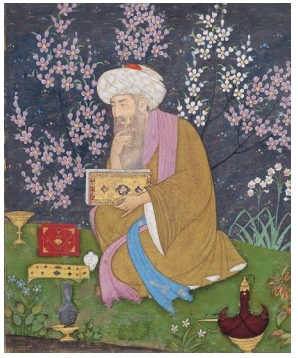
Poet in a Garden by Muhammed Ali - A serene depiction of a poet lost in thought in a lush garden, capturing the tranquility and beauty of classical Mughal art, demonstrating the pictorial design complexity. Portrait of Muhammad Qutb Shah: Sophistication and Preserved Symmetry
The portraiture of rulers, such as Muhammad Qutb Shah, demonstrates the increasing skill of Golconda artists while consciously retaining the balanced compositional structures of earlier works.
- (a) A notable portrait of Muhammad Qutb Shah (ruling from ), captured during his early reign, shows him seated on a diwan in the characteristic Golconda dress, complete with a tight-fitting cap.
- (b) Although the painting exhibits increased sophistication and skill in its execution, it deliberately maintains the symmetry prevalent in the earlier paintings of .
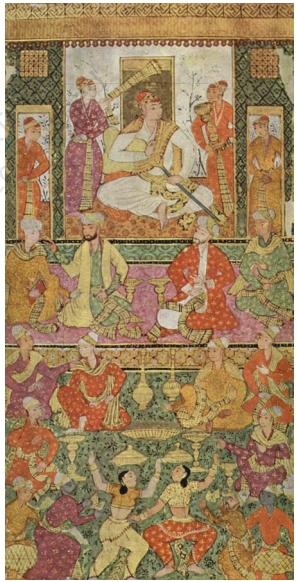
Dancing Before Muhammed Quli Qutub Shah - A lively and cultural depiction of a dance performance before the Sultan of Golconda, illustrating the artistic patronage and sophisticated court life of the Deccan. Unique Rendering, Manuscript Illustration, and Landscape Details
The distinctiveness of Golconda painting is further defined by its marked rendering of figures and a unique approach to depicting the local Deccani landscape.
- Plastic Rendering and Drapery: Golconda artworks display a pronounced plastic rendering, especially evident in the way the drapery of court figures and the costumes of courtesans and grooms are depicted, giving them a three-dimensional quality.
- Illustrated Sufi Manuscript: A manuscript of a Sufi poem, featuring over twenty richly illuminated miniatures, also utilizes the characteristic gold and blue skies seen in other works, with the men’s and women’s attire notably reflecting the fashion trends associated with Ibrahim II of Bijapur.
- Deccani Landscape Features: The landscapes are highly stylized, featuring indigenous Deccani trees and plants rendered with rich colour and distinctively tinted edges, often silhouetted dramatically against dark foliage—a universally prominent feature in Deccani painting.
Popularity and Enduring Legacy of Golconda Painting
The Golconda School of Painting remains an important historical marker, celebrated for its opulent themes, intricate gold work, and unique blend of local artistic features that captured the attention of both local patrons and international merchants.
Popular Art Themes and International Fame
The subject matter preferred by Golconda artists revolved primarily around the life and opulence of the court, giving these works immediate local and later international appeal.
- (i) Recurring themes in Golconda art encompassed formal portraits of rulers, lively court scenes, and various depictions of royalty and court life, invariably emphasized by the inclusion of intricate gold jewellery.
- (ii) These paintings achieved significant popularity both within the Deccan and globally, cementing their place in art history after being introduced to Europe by Dutch merchants toward the end of the seventeenth century.
Conclusion: Importance of Golconda Art for History and Culture Students
The Golconda School of Painting is a testament to the cultural richness of the Qutb Shahi dynasty and the immense economic power derived from its diamond trade. Its unique characteristics—including the marked plastic rendering, independent early style (pre-Mughal influence), and the lavish use of gold and azure colours—make it a distinctive chapter in Indian miniature painting. This subject is essential for students, providing a crucial case study for art and culture exams on how indigenous Deccani styles, fueled by seventeenth century trade and wealth, created an influential and enduring artistic legacy.
⚡ Quick Revision Capsule: Golconda Miniature Painting Key Elements
A quick summary table detailing the essential technical and historical dimensions of the Golconda School of Painting:
| Feature Domain | Artistic Realization | Historical Significance |
|---|---|---|
| Economic Drivers | Port trade with Persia & Southeast Asia; diamond discoveries. | Allowed lavish funding for pigments, gold leaf, and court artist commissions. |
| Early Manuscript Styles | Diwan of Hafiz () with azure skies and purple hues. | Proves complete independence from early Mughal miniature style. |
| Scale & Formats | Canvas hangings up to eight feet tall; detailed court portraits. | Decorated royal palaces and served as trade items for Dutch merchants. |
| Figure & Drapery Style | Pronounced plastic rendering on clothing, robes, and turbans. | Created a distinct 3D visual depth in Deccani figurative depictions. |
| Landscape Motifs | Stylized flora with tinted edges set against dark foliage background. | Universal hallmark of authentic 17th-century Deccani art. |
📝 Summary
From its independence in through the peak of its wealth in the seventeenth century, Golconda built an artistic legacy defined by trade-derived wealth, diamond mining, and distinct regional aesthetics. Documented in early manuscripts like the Diwan of Hafiz and perfected in full-length portraits of rulers like Muhammad Qutb Shah, Golconda artists combined gold ornamentation with deep azure and purple tones. Their grand wall hangings, three-dimensional drapery, and stylized Deccani landscapes traveled to Europe via Dutch traders, cementing the school's global prominence.
🚀 Quick Revision Points
Essential facts to review before examinations:
- (i) Independence achieved in ; economy grew via maritime exports and diamond mining.
- (ii) Key early work: Diwan of Hafiz (), featuring zero Mughal influence and blue-tinted animals.
- (iii) Visual signature: Heavy use of gold ornaments, plastic rendering of drapery, and dark foliage with tinted edges.
- (iv) Exported to Europe in the late 17th century by Dutch merchants.
- 💡 Exam Tip: Pay special attention to the pre-Mughal features of Golconda art (e.g., blue foxes, purple tones) and the term "plastic rendering" when answering descriptive art and culture questions on Deccani miniature schools.
❓ Frequently Asked Questions (FAQ)
Q1: What distinguished early Golconda painting from Mughal painting?
A1: Early Golconda art displayed no Mughal influence. It utilized distinct purple tones, blue animals (like foxes), gold-enriched courtly scenes, and deep azure skies.Q2: How did Golconda's economy influence its art?
A2: Wealth from diamond mining and trade in cotton and iron via east coast ports enabled rulers to patronize lavish miniatures featuring extensive gold jewellery and large 8-foot wall hangings.Q3: How was Golconda art introduced to Europe?
A3: Toward the end of the seventeenth century, Dutch merchants acquired portraits of Golconda sultans and courtly hangings, transporting them to Europe where they gained international fame.