The Deccani School of Miniature Painting represents a captivating fusion of indigenous Indian artistic traditions with Persian and Mughal influences, yielding a unique visual narrative crucial for UPSC and state public service commission students. These artworks, spanning various kingdoms like Bijapur, Golconda, and Ahmednagar, highlight themes from Composite Animal Imagery to Royal Portraits and Ragamala Series, offering deep insights into the to socio-cultural landscape and artistic innovation of the Deccan region.
🎯 In this chapter, you will understand:
- The distinct artistic fusion and unique features of the Deccani School of Miniature Painting.
- Surreal compositions, including the famous Composite Horse Painting.
- Royal patronage, portraiture, and courtly life under the Deccan Sultans.
- Cultural, musical, and devotional themes like Ragamala paintings and Sufi traditions.
💡 Why this topic matters: Deccani paintings offer vital historical evidence of cross-cultural dialogue, blending Persian, Islamic, and indigenous Indian elements into a rich visual heritage highly relevant for art history examinations.
🧠 Core Idea: Supported by rulers in Bijapur, Golconda, and Ahmednagar, Deccani miniature painting developed a unique aesthetic defined by rich color choices, imaginative symbolism, and emotional depth.
Deccani Miniature Paintings: Story of Artistic Fusion and Royal Patronage (16th to 18th Century)
A collection of exquisite Deccani miniature paintings reveals a rich tapestry of cultural synthesis, demonstrating exceptional artistry under the patronage of powerful Deccan Sultans.
These remarkable works serve as primary evidence of a distinct artistic idiom that flourished in the Deccan, blending the refined aesthetics of Persia and the emerging Mughal style with the local, vibrant Indian sensibilities.
- (i) The Deccani schools, notably in centers like Bijapur, Golconda, and Ahmednagar, developed unique characteristics, including rich color palettes and emotional depth, differentiating them from their northern counterparts.
- (ii) The subject matter ranges broadly, encompassing symbolic compositions, intimate royal portraits, musical iconography, and narrative historical scenes, reflecting the diverse interests of the ruling elite.
- (iii) The preservation of these paintings in global and national institutions underscores their immense historical and cultural value for art history students and researchers.
Symbolic Composition and Imaginative Artistry in Deccani Painting
The Deccani artists frequently explored themes of surrealism and symbolism, often creating unique compositions that merged human, animal, and mythological elements, resulting in deeply philosophical or playful works.
The Composite Horse Painting: Deccani Surrealism and Hybrid Imagery
This mesmerizing artwork, known as the Composite Horse Painting, stands as a prime example of the Deccani School's imaginative genius. It is a curious and masterful blend of various artistic devices, culminating in the form of a Composite Horse, which appears to be mid-gallop. The striking artwork is composed entirely of intricately intertwined human figures, lending the powerful animal shape a strangely delicate and profound metaphorical layer.
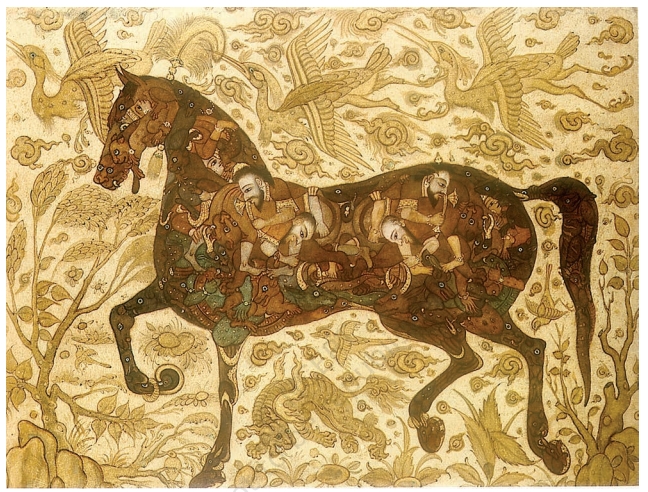
Composite Horse Painting - A striking artwork of a composite horse, depicting the hybrid nature of animals in medieval Indian art, highlighting intricate details and symbolism. - (i) The surreal narrative is significantly enriched by the incorporation of elements such as flying cranes, fierce lions, distinct Chinese clouds, and plants with exaggeratedly large leaves, all designed to enhance the fantastical atmosphere.
- (ii) Despite the overall impression of an airy and flying scene, the artist deliberately included realistic rocky formations in the painting's two lower corners, an anchoring technique that purposefully creates a dislocation of the sense of space.
- (iii) The painting's color scheme is generally restrained, maintaining authenticity with shades predominantly in brown, offset by controlled applications of blue to achieve a subtle yet impactful visual harmony.
Royal Patronage and Portraits of Deccan Sultans
The ruling Sultans of the Deccan were great connoisseurs of art, commissioning portraits and narrative scenes that immortalized their power, piety, and personal tastes, showcasing both Persian and indigenous influences.
Sultan Ibrahim Adil Shah II: A Portrait of Regal Energy from Bijapur
The painting depicting Sultan Ibrahim Adil Shah II, the celebrated ruler of Bijapur, is an evocative study in energy and sophisticated sensibility. The artwork dynamically captures the Sultan's movement and regal presence through the use of vibrant, intense colours, particularly the brilliant red employed on the horse’s limbs and tail, and the gracefully flowing garment of the Sultan himself, visually activating the entire composition.
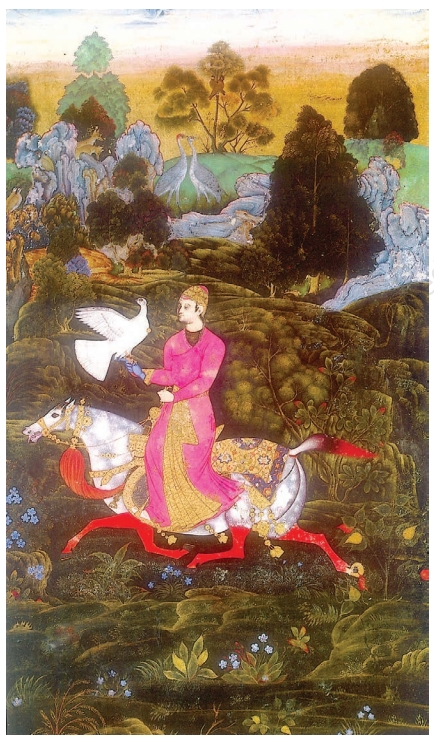
Sultan Ibrahim Adil Shah II - A royal portrait of the Sultan of Bijapur, showcasing his regal stature and the artistic influence during his reign in the Deccan. - (a) The background scenery, featuring dark dense forest foliage alongside flying cranes, all set against a stunning sunlit golden blue sky, significantly enhances the overall visual experience and drama of the painting.
- (b) Despite the overall panoramic energy, the central focus is drawn to the Sultan's delicately portrayed face, subtly highlighted by the placement of a white hawk near the center of the canvas.
- (c) A distinct cultural synthesis is evident: strong Persian influence is noticeable in the stylized treatment of the majestic horse and rocks, while the detailed depiction of the local plants and the dense landscape draws clear inspiration from native Indian sources.
- (d) The visual force of the galloping horse successfully generates a palpable energy that works to visually activate the entire panoramic landscape; this masterpiece currently resides in the collection of the Institute of the Peoples of Asia, Academy of Sciences, Leningrad, Russia.
Portrait of Sultan Abdullah Qutb Shah: Symbolism of Sovereignty
The reserved yet authoritative Portrait of Sultan Abdullah Qutb Shah, held in the collection of the National Museum, New Delhi, India, provides a crucial glimpse into the royal iconography of the Golconda Sultanate. This painting meticulously portrays the Sultan in a position of ultimate authority and regality.
- (i) The Sultan is depicted enthroned, a clear visual representation of his political and royal status, and holds a sword in one hand, specifically symbolizing his political sovereignty and military power.
- (ii) Furthermore, the presence of a luminous halo encircling his head is a powerful artistic device used to metaphorically depict his divinity or divinely sanctioned right to rule, a common motif in royal portraits of the era.
Ragamala and Devotional Themes: Capturing Deccan Cultural Life
Deccani painting beautifully documented not only royal life but also spiritual and musical traditions, contributing significantly to the cultural mapping of the era.
Ragini Pathamsika of Raga Hindola: Musical and Architectural Splendour
This vibrant painting, titled Ragini Pathamsika of Raga Hindola, is a valuable piece of art associated with the elaborate Ragamala family of the Indian classical musical mode, demonstrating the deep connection between art and music in the Deccan. Dating back to the crucial period of , this work is proudly housed in the collection of the National Museum, New Delhi.
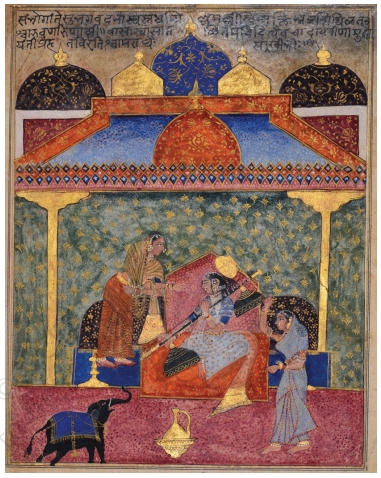
Ragini Pathamsika of Raga Hindola - An evocative painting representing the Ragini Pathamsika, illustrating the classical musical raga Hindola, associated with the emotional mood of monsoon. - (i) The upper section of the artwork clearly exhibits a strong Persian influence, specifically visible in the intricate arabesque decoration adorning the surface of the two prominent domes of the pavilion.
- (ii) The scene unfolds within a beautifully detailed pavilion, showing two beautifully dressed and heavily bejewelled women, accompanied by a third female figure positioned outside, and a dedicated female musician playing the veena, capturing the essence of the musical moment.
- (iii) The composition is dominated by vibrant colours, with intense red and green particularly prominent, though the human figures are rendered in a slightly stylized and formulaic manner characteristic of the period's conventions.
- (iv) A notable feature that intentionally disrupts the painting's structural symmetry is the inclusion of a dark elephant in the left-hand corner, an element that creates a significant visual interest and intentionally breaks the architectonic structuring of the scene.
Hazrat Nizamuddin Auliya Listening to Amir Khusrau: A Devotional Theme
This captivating provincial painting, originating from Hyderabad, Deccan, narrates a highly popular Indian theme of spiritual devotion and musical communion. It depicts the venerated Sufi saint of the , Hazrat Nizamuddin Auliya, deeply engrossed as he listens to the soulful music performed by his devoted and brilliant disciple, Amir Khusrau.
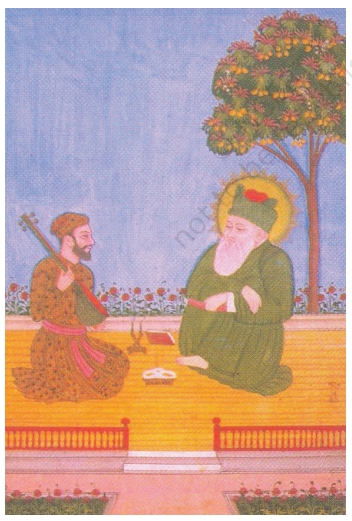
Amir Khusrau and Hazrat Nizamuddin Auliya - A revered depiction of the poet Amir Khusrau and his spiritual mentor Hazrat Nizamuddin Auliya, capturing their bond of love, spirituality, and poetry. - (a) Although the artwork may be classified as naive in style, it possesses an undeniable charm and successfully captures the profound emotional and spiritual bond between the spiritual mentor and his devoted poet-disciple.
- (b) The painting remains an important document, vividly narrating a significant cultural and religious theme rooted in the Indian mystical tradition.
Chand Bibi Playing Chaugan: The Queen and the Royal Sport
The painting showcasing Chand Bibi Playing Chaugan (equine polo) is a remarkable testament to the strength and regal independence of women in the Deccan aristocracy. Chand Bibi, the renowned Queen of Bijapur, is depicted engaging in chaugan, a popular and strenuous royal sport of the time.
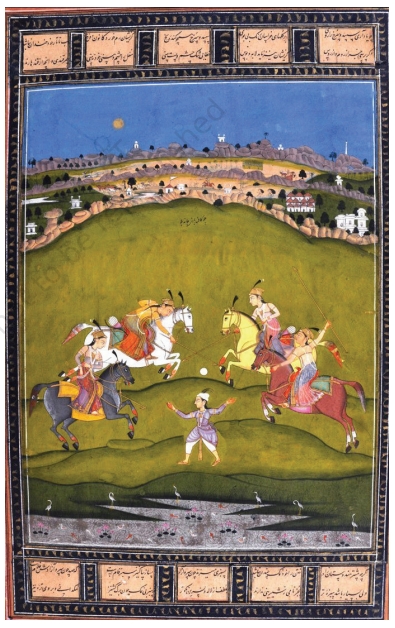
Chand Bibi Playing Polo - A dynamic scene of Chand Bibi, the warrior queen, playing polo, showcasing her strength and royal elegance in the courtly sports of the Deccan. - (i) Chand Bibi is historically revered as a powerful ruler who bravely and successfully resisted Mughal attempts to conquer Bijapur during the reign of Emperor Akbar, solidifying her status as a warrior queen.
- (ii) This specific artwork, while appearing to be more provincial and potentially dating from a later period of Deccani art, remains an important artifact and is held in the collection of the National Museum, New Delhi, India.
Significance of Deccani Miniature Paintings for Art History and Exams
In summary, the study of Deccani Miniature Paintings is absolutely critical for understanding the pluralistic nature of Indian art history, especially for students preparing for competitive exams. These artworks, like the Composite Horse Painting and portraits of Sultan Ibrahim Adil Shah II and Chand Bibi, distinctively showcase a powerful artistic synthesis of Persian, Mughal, and native Indian styles. They provide valuable, authentic insights into the rich cultural life, religious syncretism, and royal patronage that flourished across the Deccan Sultanates from the , making them an essential topic for scoring well in art and culture segments.
⚡ Quick Revision Capsule: Deccani School of Miniature Painting
The following table summarizes key artworks, their locations, key stylistic elements, and historical significance within the Deccani Miniature tradition.
| Artwork Title | Center / Location | Key Stylistic Features |
|---|---|---|
| Composite Horse Painting | Deccan Region | Intertwined human figures forming a horse, flying cranes, Chinese clouds, and rocky spatial dislocation. |
| Sultan Ibrahim Adil Shah II | Bijapur / Institute of Peoples of Asia, Russia | Vibrant red accents, golden blue sky, white hawk focus, and blend of Persian and local foliage styles. |
| Sultan Abdullah Qutb Shah | Golconda / National Museum, New Delhi | Enthroned ruler holding a sword, with a halo denoting divine right and royal sovereignty. |
| Ragini Pathamsika of Raga Hindola | Deccan / National Museum, New Delhi | Persian arabesque dome decorations, vibrant red and green colors, and a dark elephant breaking symmetry. |
| Hazrat Nizamuddin Auliya & Amir Khusrau | Hyderabad | Provincial style capturing a devotional Sufi musical gathering between master and disciple. |
| Chand Bibi Playing Chaugan | Bijapur / National Museum, New Delhi | Depicts the warrior queen playing equestrian polo (chaugan), signifying female royal empowerment. |
📝 Summary
The Deccani School of Miniature Painting flourished between the across prominent centers such as Bijapur, Golconda, and Ahmednagar. These artworks integrated Persian elegance, Mughal precision, and indigenous South Indian artistic expressions. Key themes include complex animal surrealism, royal portraiture reflecting divine sanction, classical Ragamala musical visualizations, Sufi devotional bonds, and active courtly sports performed by legendary figures such as Chand Bibi.
🚀 Quick Revision Points
Essential facts to review before examinations:
- (i) The Deccani School is renowned for intense color palettes, rich emotional tone, and a seamless blend of Persian and local Indian aesthetics.
- (ii) The Composite Horse Painting highlights surrealist animal compositions made of intertwined human forms.
- (iii) Royal portraits used symbols such as halos, swords, and central hawks to represent royal authority and spiritual legitimacy.
- (iv) Ragini Pathamsika of Raga Hindola exemplifies musical iconography coupled with Persian architectural arabesque details.
- 💡 Exam Tip: Focus on identifying the key artistic influences (Persian vs. Native Indian) in specific artworks like Composite Horse Painting and royal portraits of Ibrahim Adil Shah II to answer analytical questions in civil service exams.
❓ Frequently Asked Questions (FAQ)
Q1: What are the main centers of the Deccani School of Miniature Painting?
A1: The primary centers were Bijapur, Golconda, and Ahmednagar, with later influence expanding to centers like Hyderabad.Q2: What is unique about the Composite Horse Painting?
A2: It depicts a horse composed entirely of intertwined human figures, set against surreal elements like Chinese clouds, flying cranes, and spatial rocky formations.Q3: How do Deccani portraits symbolize political authority?
A3: Portraits like that of Sultan Abdullah Qutb Shah use an enthroned posture, a sword, and a radiating halo to express sovereignty and divine sanction.