Embark on a captivating journey through the evolution of Indian Mural Art, a vibrant tradition spanning from the to the . This movement showcases artistic mastery across diverse ruling lines like the Chalukyas, Pallavas, Cholas, and the Vijayanagara Empire. This comprehensive exploration of cave paintings and temple murals provides crucial insights for students preparing for history and culture examinations, highlighting the rich cultural heritage and stylistic changes in South Indian mural art.
🎯 In this chapter, you will understand:
- The historic evolution of South Indian mural art from ancient cave sites to complex temple walls.
- How royal patronage from the Chalukya, Pallava, Chola, Vijayanagara, and Nayaka dynasties shaped visual artistic conventions.
- The technical methods used by traditional artisans, including natural pigments and the blending of relief sculpture with paint.
- Distinctive regional idioms, such as the vibrant Kerala mural style and modern living wall painting traditions across India.
💡 Why this topic matters: Indian mural painting is a primary visual record of historical religious beliefs, royal history, court fashions, and technical expertise across two millennia.
🧠 Core Idea: South Indian mural traditions evolved seamlessly over centuries—adapting from early Buddhist and rock-cut precedents into elaborate Hindu temple art marked by expressive linework, regional symbolism, and natural colors.
Evolution of South Indian Mural Painting Traditions Across Dynasties: 2nd Century BC to 18th Century AD
Mural painting, an enduring tradition in India, represents three-dimensional artistic expressions meticulously applied to the walls of ancient caves, temples, and palaces, documenting centuries of socio-cultural and religious life.
The history of monumental wall paintings, or murals, in India is extensive, with its traceable origins lying between the and the . These artworks serve as invaluable primary sources for understanding ancient artistic techniques and thematic focus.
- (i) Ancient Indian muralists utilized pigments derived exclusively from natural resources, such as terracotta, chalk, red ochre, and yellow ochre, which were carefully mixed with a binding agent like animal fat to create lasting colors.
- (ii) The thematic scope of these paintings was vast, encompassing detailed depictions of human and animal figures, compelling hunting scenes, intimate moments of family life, and grand courtly affairs.
- (iii) Significantly, many murals, particularly those from the early periods, narrate the profound Buddhist ‘Jataka’ stories, providing spiritual and moral narratives for the populace.
Preservation of Ancient Painting Tradition and Sculptural Integration
Following the golden age exemplified by the Ajanta caves, the continuous tradition of Indian painting is reconstructed primarily through surviving fragments found at a few isolated sites, alongside the dual practice of sculpting and painting in rock-cut architecture.
Reconstructing the Ancient Painting Legacy in India
The sheer scarcity of preserved ancient paintings after Ajanta underscores the fragility and importance of the few sites that have managed to survive the passage of time. These remaining fragments are critical for art historians to piece together the narrative of India’s early artistic tradition.
- (i) These preserved sites offer tangible evidence to reconstruct the tradition of ancient paintings, which is a vital component of India’s rich cultural heritage.
- (ii) The symbolic and technical insights gleaned from these early artworks help us understand the sophisticated artistic techniques and symbolism prevalent during those periods.
Holistic Approach: Integration of Sculpture and Painting in Cave Art
Ancient artisans often viewed sculpting and painting as complementary arts. It was a common practice for sculptures in caves to be finished with a layer of plaster and then intricately painted, thereby highlighting the comprehensive, holistic artistic practices of the ancient world.
- (a) The process of cave excavations was frequently accompanied by the simultaneous execution of sculpting and painting, reflecting the continuous evolution of Indian art.
- (b) This integration of artistic practices was fundamental to the expression of religious and cultural themes in ancient India, serving as a powerful visual medium.
Chalukya Dynasty Mural Art: Badami Caves (6th Century CE)
The tradition of mural painting gracefully extended into South India under the patronage of the Early Chalukyan dynasty, finding a significant expression in the famous Badami caves, marking a critical evolutionary step from the Ajanta style.
Badami: Chalukya Capital and Vaishnavism Patronage
The site of Badami, located in modern Karnataka, holds profound historical significance as the capital of the Early Chalukyan dynasty, which rose to prominence in the Deccan region following the collapse of Vakataka rule, asserting their authority from .
- (i) Mangalesha, the younger son of Pulakesi I and brother of Kirtivarman I, was the crucial patron behind the excavation of the celebrated Badami caves.
- (ii) A critical inscription in Cave No.4, dated to , formally dedicates the cave to an image of Vishnu, unequivocally linking the site to Vaishnavism.
- (iii) The Vishnu Cave is particularly renowned for its paintings, especially a surviving, fragmented mural on the vaulted ceiling of the front mandapa.
Artistic Style of Badami Murals and Ajanta Influence
The murals found within the Badami caves represent a vital continuation and adaptation of the mural painting conventions established at Ajanta, effectively serving as a bridge to the broader South Indian mural art tradition. These sixth-century masterpieces showcase a remarkable level of technical sophistication.
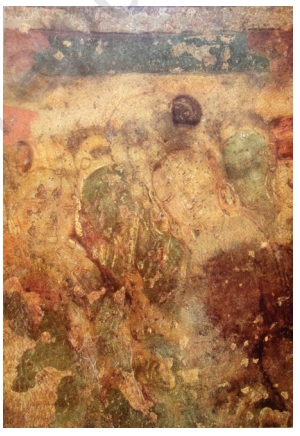
Queen and Attendants Badami Murals - A magnificent depiction of a queen with her attendants in the Badami caves, representing the grandeur of Chalukyan art. - (a) The artistic style is characterized by sinuous lines and fluid forms, arranged in compact compositions, demonstrating the high artistic proficiency attained by the artists.
- (b) Fragments within the cave depict intricate palace life, featuring key figures like Kirtivarman, his wife, and their feudatories, alongside divine figures such as Indra and his retinue.
- (c) Physiognomically, the faces of the royal figures share distinct features with the Ajanta style, marked by large eye sockets, half-closed eyes, and slightly protruding lips, with volume subtly suggested through simple line work.
Pallava, Pandya, and Chola Dynasties: Mural Art in Tamil Nadu
The baton of mural painting was successively carried forward in Tamil Nadu by the powerful Pallava, Pandya, and Chola dynasties, each contributing unique regional and stylistic modifications to the established artistic traditions, primarily centering around temple art.
Pallava Dynasty: From Mahendravarman I to Rajsimha
The Pallava kings, who emerged as successors to the Chalukya kings in certain regions of South India, were renowned as influential patrons of both arts and architecture. Their earliest known artistic endeavors date back to the .
- (i) Ruler Mahendravarman I was a key figure, responsible for constructing temples at Panamalai, Mandagapattu, and Kanchipuram; he was affectionately known by epithets like Vichitrachitta (curious-minded) and Chitrakarapuli (tiger among artists), signaling his deep commitment to art.
- (ii) Although initiated by Mahendravarman I, only remnants of paintings survive today in these temples, hinting at their original grandeur.
- (iii) Later, under King Rajsimha, the Kanchipuram temple received patronage, where fragmented murals depicting Somaskanda can still be discerned, showing an evolution in the painting style.
- (iv) This phase saw faces become round and large, lines grow more rhythmic, and ornamentation significantly increased, though the depiction of the torso remained similar to earlier sculptural traditions but became more elongated.
Pandya Mural Masterpieces at Sittanavasal
The Pandya dynasty also actively supported art, with invaluable surviving examples found in the Tirumalaipuram caves and, most notably, in the Sittanavasal cave complex, renowned for its exquisite cave paintings.
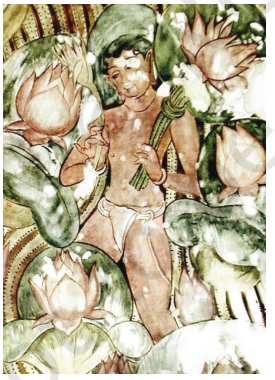
Sittanavasal Pandya Murals - These exquisite murals from the Sittanavasal cave in Tamil Nadu are known for their vibrant depiction of Jain Tirthankaras and their intricate use of colors and details. - (a) Paintings at Sittanavasal adorn the ceilings of the shrines, verandas, and pillars, vividly portraying scenes such as celestial nymphs and dynamic dancers.
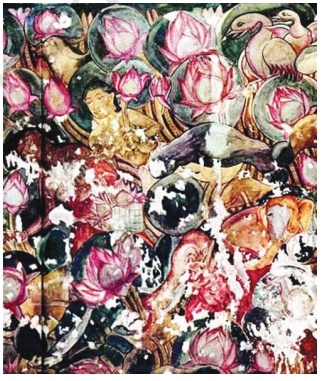
Sittanavasal Early Pandya Murals - Early Pandya murals found in the Sittanavasal caves are celebrated for their artistic brilliance, showcasing scenes from religious and cultural life. - (b) The artistic technique involves figures outlined in firm contours and painted primarily in vermilion red, with the body rendering often done in yellow, utilizing subtle modelling techniques.
- (c) The highly expressive faces and rhythmic movements of the depicted dancers showcase the artists' remarkable skill in visualizing forms harmoniously within the architectural context.
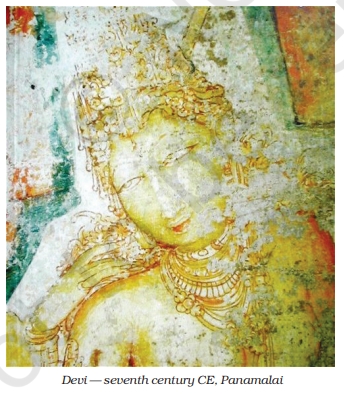
Murals Under Pandyas Devi - These murals under the Pandyas dynasty depict Hindu gods and goddesses, showcasing the richness of Pandya artwork and culture.
- (a) Paintings at Sittanavasal adorn the ceilings of the shrines, verandas, and pillars, vividly portraying scenes such as celestial nymphs and dynamic dancers.
Chola Empire: Brihadeswara Temple Murals at Thanjavur
The zenith of South Indian art and architecture coincided with the height of Chola power in the . The Chola kings not only continued the tradition of temple building but profoundly enriched them with both intricate carvings and exceptional paintings, most famously at the Brihadeswara temple in Thanjavur.
- (i) The murals in the Brihadeswara temple predominantly depict various forms of Lord Shiva, including Shiva as Nataraja and Tripurantaka, alongside realistic portraits of the royal patron Rajaraja Chola and his mentor Kuruvar.
- (ii) A significant discovery revealed two distinct layers of paintings—the older Chola period layer beneath a later layer from the Nayak period—attesting to the depth and longevity of the Chola art tradition.
- (iii) The Chola style achieved a stylistic maturity marked by a sinuous pre-determined flow of lines, supple modelling of figures, and a noticeable elongation of the human physiognomic features, signifying a crucial transition phase in mural art.
Vijayanagara and Nayaka Mural Traditions (14th–18th Century)
Following the decline of the Chola empire, the magnificent Vijayanagara Dynasty sustained and innovated the mural tradition, which was later extended and regionally modified by the Nayaka rulers, ensuring the art form's survival well into the .
Vijayanagara Murals at Hampi and Lepakshi
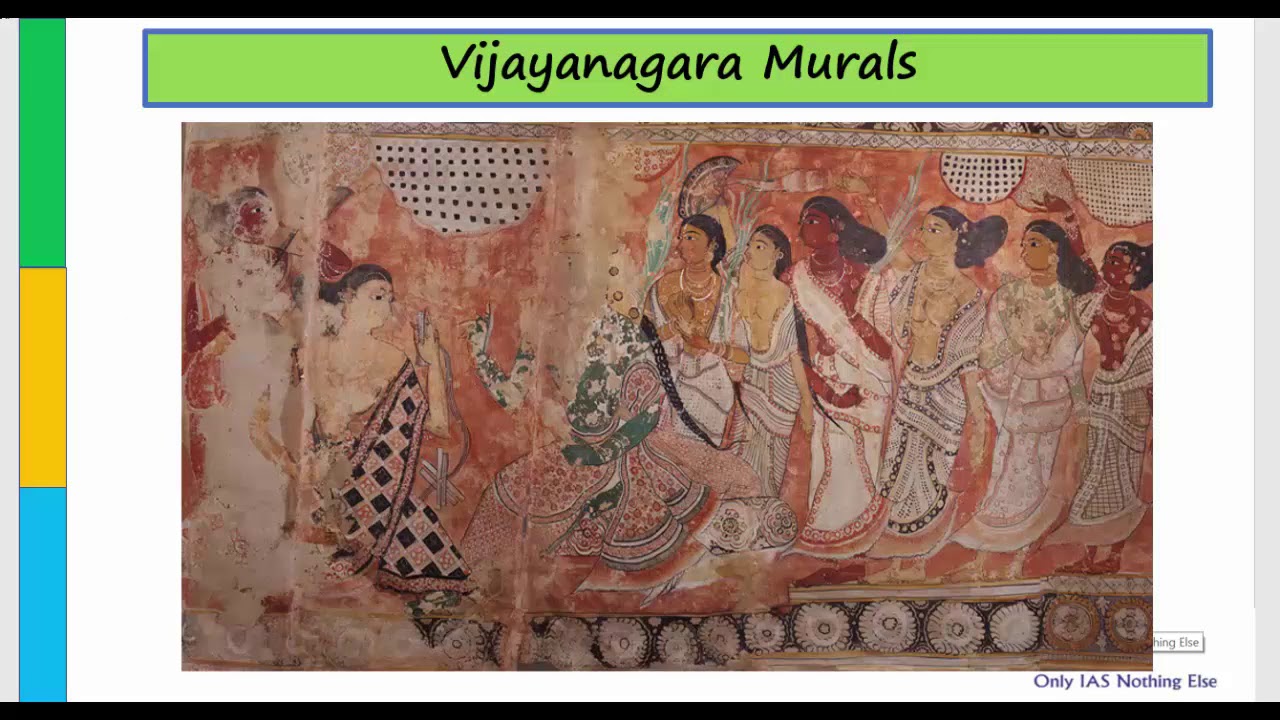
The Vijayanagara Dynasty (spanning the ) consolidated power over a large territory, establishing its capital at Hampi. This period saw the proliferation of paintings in numerous temples, marking the early phase of the Vijayanagara style in sites like Thiruparakunram and the Virupaksha temple at Hampi.
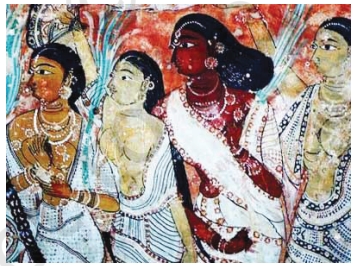
Ladies Attending Parvati Murals Vijayanagara - A beautiful depiction of ladies attending Goddess Parvati in the murals of the Vijayanagara Empire, showing the artistic finesse of the period. - (i) Murals on the ceiling of the mandapa in the Virupaksha temple vividly narrate dynastic history and episodes from the epic Ramayana and Mahabharata.
- (ii) Important panels include depictions of Vidyaranya, the spiritual teacher of Bukkaraya Harsha, and various incarnations of Vishnu.
- (iii) The distinctive pictorial language evolved by Vijayanagara painters includes showing faces in profile, utilizing large frontal eyes, depicting figures with narrow waists, and representing objects primarily in a two-dimensional space.
- (iv) The Shiva temple in Lepakshi, near Hindupur (Andhra Pradesh), offers particularly glorious examples of Vijayanagara paintings, showcasing fluid yet still lines and compositions arranged in rectilinear compartments.
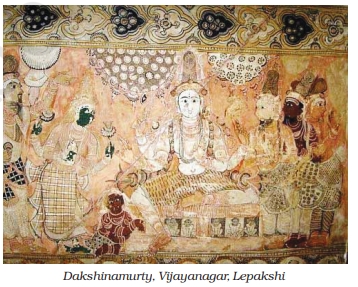
Dakshinamurthy Vijayanagara Murals - These murals from the Vijayanagara period depict Dakshinamurthy, the divine teacher, embodying wisdom and enlightenment in Indian culture.
Nayaka Paintings: Extension with Regional Modifications
The mural tradition continued under the Nayaka dynasty (), primarily found in sites across Tamil Nadu like Thiruparakunram, Srirangam, Tiruvarur, and Chidambaram, essentially serving as an extension of the Vijayanagara style but with subtle regional nuances.
- (a) In Thiruparakunram, paintings from the and co-exist, with early works focusing on the life of Vardhaman Mahavira.
- (b) Nayaka paintings predominantly depict episodes from the Mahabharata, the Ramayana, and scenes related to Krishna-leela, alongside stories of Shiva as Bhikshatana Murti and Vishnu as Mohini.
- (c) Stylistically, the figures, mostly shown in profile against a flat background, feature slimmer waists and less heavy abdomens than their Vijayanagara counterparts, while the artist continued to masterfully infuse movement and dynamic space, such as in the painting of Nataraja at Tiruvalanjuli.
Unique Pictorial Language of Kerala Murals (16th–18th Century)
The artists of Kerala developed a highly distinctive and sophisticated pictorial language between the , drawing selective stylistic elements from the Nayaka and Vijayanagara schools but crucially integrating local influences like Kathakali and Kalam Ezhuthu.
Stylistic and Thematic Characteristics of Kerala Murals
Kerala murals are immediately recognizable for their stunning use of vibrant and luminous colors. The human figures are often rendered with a sense of three-dimensionality, distinguishing them from other contemporary styles. These masterpieces primarily grace the walls of shrines, temple cloister walls, and select palaces.
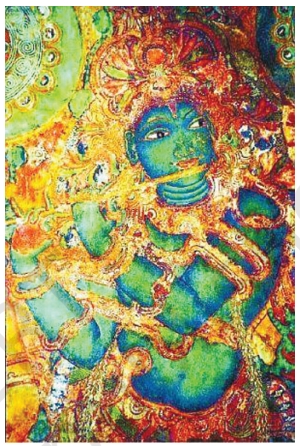
Krishna Playing Flute Kerala Murals - These Kerala murals beautifully portray Lord Krishna playing the flute, a moment of divine music and tranquility in Indian art. - (i) Thematically, they stand apart by focusing almost exclusively on episodes from Hindu mythology that were particularly popular and unique to Kerala, often inspired by local oral traditions and regional versions of the Ramayana and Mahabharata.
- (ii) Over sixty sites are recorded to possess these murals, including three key palaces: the Mattancherry Dutch Palace in Kochi, the Krishnapuram Palace in Kayamkulam, and the Padmanabhapuram Palace.
- (iii) Examples of the mature Kerala mural phase can be observed at prominent sites such as the Pundareekapuram Krishna Temple, Panayanarkavu, Thirukodithanam, and the Vadakkunnathan Temple in Thrissur.
- (iv) The ritual floor paintings, or Kalam Ezhuthu, of Kerala also influence the mural style, as seen in the depiction of Krishna playing the flute accompanied by Gopikas at the Pundareekapuram Krishna Temple.
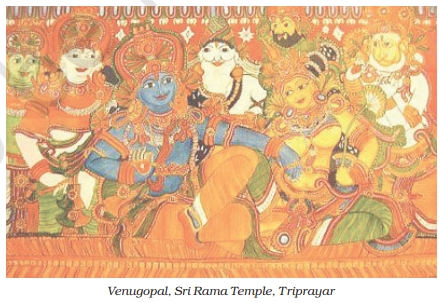
Murals from Venugopal Shri Ram Temple - Murals from the Venugopal Shri Ram Temple illustrate mythological scenes from the Ramayana, a testament to the devotional art of the region.
Contemporary Regional Mural Traditions of India
The practice of mural painting remains a living tradition in India even today, continuing in various vibrant regional forms that connect back to the ancient impulse of decorating walls with art.
- (a) This continuity is seen in traditions like Pithoro in Rajasthan and Gujarat, Mithila painting in Bihar, Warli paintings in Maharashtra, and other regional wall paintings found in Odisha, Bengal, Madhya Pradesh, and Chhattisgarh.
- (b) In Kerala, the practice persists in villages, where women often decorate the interior and exterior walls of houses during ceremonies and festivals, maintaining the art form as part of routine cultural and decorative practices.
Significance of Indian Mural Art for Historical and Cultural Study
The vast history of Indian mural art, spanning from the to the under dynasties like the Pallavas, Cholas, and Vijayanagara, offers an unparalleled visual record of India’s religious, social, and aesthetic evolution. The study of these intricate temple and cave paintings, from the anatomical details of the Badami murals to the vibrant colors of the Kerala murals, is exceptionally important for students, providing a direct connection to the artistic and cultural heritage documented across centuries of rule in the Indian subcontinent.
⚡ Quick Revision Capsule: Dynastic Indian Mural Traditions
Use this summary table to quickly review key historical locations, dynastic patrons, and artistic features of South Indian mural traditions.
| Dynasty & Region | Key Locations | Major Artistic Characteristics |
|---|---|---|
| Early Chalukya | Badami Caves (Karnataka) | Sinuous lines, fluid forms, compact framing, continuity with Ajanta conventions. |
| Pallava Dynasty | Kanchipuram, Panamalai, Mandagapattu | Increased ornamentation, rounder faces, rhythmic linework, royal patron Mahendravarman I. |
| Pandya Dynasty | Sittanavasal, Tirumalaipuram | Vibrant depiction of Jain themes, vermilion and yellow pigments, expressive dancing figures. |
| Chola Empire | Brihadeswara Temple (Thanjavur) | Shaivite iconography, grand scale, sinuous flow, elongated anatomical features. |
| Vijayanagara & Nayaka | Hampi, Lepakshi, Chidambaram | Profile faces with large eyes, narrow waists, dynamic narrative panels from the Ramayana. |
| Kerala School | Mattancherry, Padmanabhapuram, Thrissur | Luminous natural colors, three-dimensional volume, heavily influenced by Kathakali. |
📝 Summary
Indian mural painting represents an uninterrupted tradition extending from early rock-cut sanctuaries to late medieval palace complexes between and . Influenced by both classical texts and regional performance traditions, these murals remain essential historical sources for understanding dynastic culture and devotional life.
🚀 Quick Revision Points
Essential facts to review before examinations:
- (i) Early pigments were derived from natural minerals like red and yellow ochre bound with organic animal fat.
- (ii) King Mahendravarman I of the Pallava dynasty held titles like Chitrakarapuli due to his artistic patronage.
- (iii) The Brihadeswara temple in Thanjavur contains two distinct mural layers: an inner Chola layer and an outer Nayak layer.
- (iv) Kerala murals integrate elements from local performance traditions such as Kathakali and ritual floor drawings (Kalam Ezhuthu).
- 💡 Exam Tip: Pay close attention to dynastic artistic transitions (e.g., from Ajanta's classical volume to Vijayanagara's two-dimensional profiles) when answering descriptive questions on Indian art history.
❓ Frequently Asked Questions (FAQ)
Q1: What materials were used to create pigments in ancient Indian murals?
A1: Painters used natural earth minerals such as red ochre, yellow ochre, chalk, and terracotta, which were mixed with animal fat or vegetable gum as a binder.Q2: What makes the Sittanavasal cave murals historically significant?
A2: Located in Tamil Nadu, the Sittanavasal murals are prime examples of Pandya dynasty painting depicting Jain Tirthankaras, celestial dancers, and rich flora with expressive contours.Q3: How do Vijayanagara murals differ stylistically from earlier Chola paintings?
A3: Vijayanagara murals present figures mostly in profile with large frontal eyes, narrow waists, and flat two-dimensional narrative panels, contrasting with the fluid, elongated forms of Chola art.