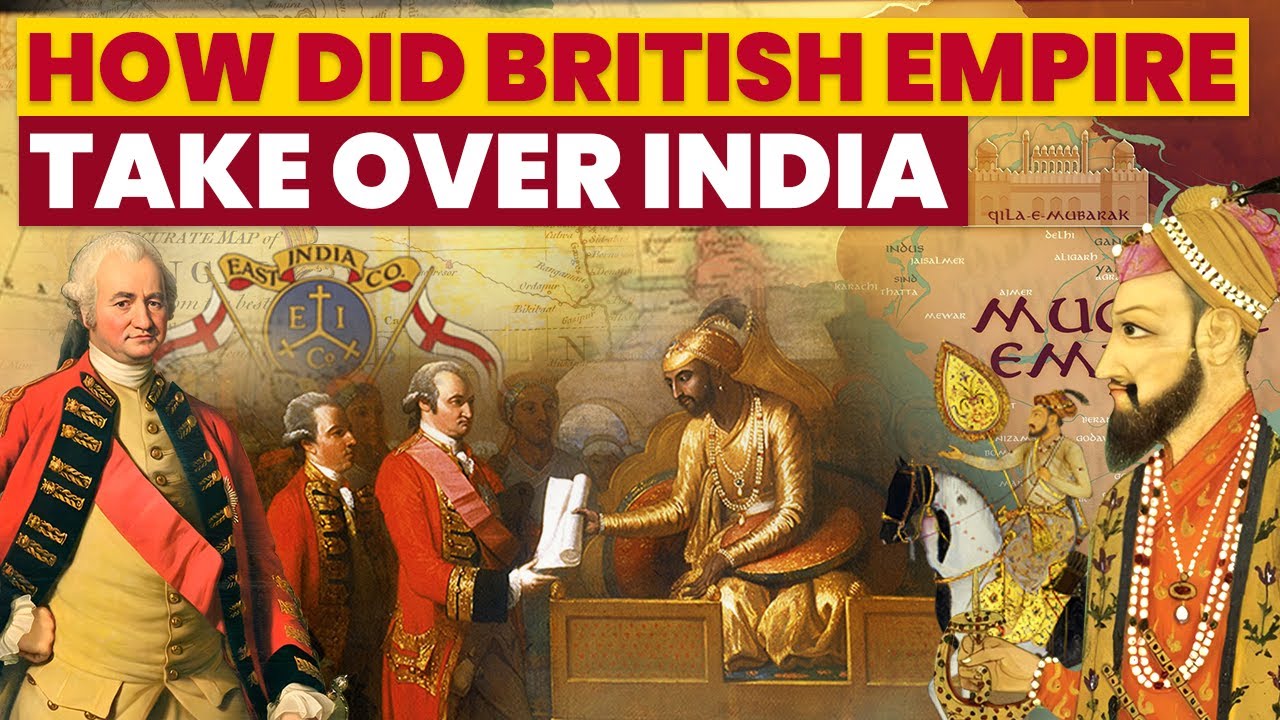
The in India was a decisive phase that paved the way for the rise of British dominance. Through a powerful combination of superior military strength, astute diplomatic maneuvering, massive economic resources, and ruthless exploitation of pre-existing Indian disunity, the formidable British East India Company systematically expanded its territorial and political control. For students preparing for competitive exams, this historical juncture is crucial to deeply understand the complex political, military, economic, and social factors that directly led to the establishment and foundation of colonial rule in India.
🎯 In this chapter, you will understand:
- The key events between and that created a political power vacuum in India.
- The military, financial, and diplomatic strategies used by the British East India Company.
- How discipline, regular salaries, and merit-based leadership gave British forces a clear edge.
- The internal divisions among Indian rulers that made unified resistance impossible.
💡 Why this topic matters: This period explains how a foreign trading company transformed into the dominant ruler of the Indian subcontinent.
🧠 Core Idea: British expansion succeeded because of organizational discipline, financial strength, modern technology, and taking advantage of divided Indian states.
1. Mid-18th Century India and the Multi-Factorial Expansion of British Power (1740–1761)
The eventual road to British supremacy in the Indian subcontinent was strategically paved by a chain of decisive military victories, unparalleled financial strength, exceptional leadership, and the calculated exploitation of divisions among various Indian rulers.
Historians often debate the precise turning point, with some citing the beginning of the Anglo-French rivalry in , others pointing to the major political shift following the Battle of Plassey in , and still others emphasizing the vacuum created after the Third Battle of Panipat in . However, the transformation was undeniably a gradual and multi-dimensional process, marking the collapse of indigenous powers and the rise of a European trading company.
- (i) Early rivalries, especially the fierce conflict with the French for trade and territorial control (the Carnatic Wars), effectively defined the initial phase of the British consolidation of power.
- (ii) The pivotal Battle of Plassey () was a game-changer that granted the British effective political and financial control over the wealthy province of Bengal, providing an indispensable revenue base.
- (iii) The devastating Third Battle of Panipat () significantly fractured the already weakened power of the Marathas, removing a major indigenous barrier and inadvertently aiding the non-Indian British expansion.
2. The Political Vacuum and Strategic Considerations in British Expansion After 1761
The period immediately following marked a crucial phase where the British sought to consolidate their significant territorial gains amidst the lingering challenges posed by both formidable Indian kingdoms and rival European entities.

Navigating Conflicts with Indian and European Forces Post-Panipat
The British East India Company consistently built upon its victories, which effectively marginalized the Nawab of Bengal and decisively eliminated the military threat posed by their European rival, the French, thereby opening up unprecedented new opportunities for political dominance.
- (i) Following the initial success, key Indian powers, notably the powerful Marathas and the dynamic state led by Haidar Ali of Mysore, continued to pose significant and protracted military challenges to the Company's burgeoning authority.
- (ii) Despite experiencing occasional military and logistical setbacks—which were minor in the grand scheme—the sheer scale of the British territorial and financial gains far outweighed any temporary losses they incurred during this expansionist phase.
3. Warfare, Diplomacy, and Administrative Policies: Expansion and Consolidation of British Power
The British East India Company strategically employed a multi-pronged approach, relying alternately on direct warfare, shrewd diplomacy, and innovative administrative policies to systematically dominate and dismantle key Indian kingdoms.
The Three Pillars of Company Dominance: Strategy, Alliance, and Administration
The core methodology of British expansion was designed to systematically weaken and absorb the fractured political landscape of India through a combination of coercive and persuasive means, ensuring their long-term administrative control.
- (i) The extensive use of opportunistic diplomatic alliances, coupled with the exploitation of pre-existing rivalries among Indian rulers, allowed the British to divide and conquer without committing full military resources in every instance.
- (ii) Calculated military campaigns, particularly against powerful resistant rulers like the Nawabs of Bengal and the Sultans of Mysore, were essential for breaking the backbone of indigenous resistance and seizing key strategic territories.
- (iii) The introduction of new administrative policies, such as the Subsidiary Alliance and later the Doctrine of Lapse, was crucial for consolidating newly acquired territories and ensuring their financial and political subordination to the Company's authority.
4. The Decisive Edge: Superior Arms, Military Technology, and Strategic Advantage
The British military forces consistently held profound technological and tactical advantages, particularly in the realm of firearms and cohesive strategic planning, which proved superior to the fragmented armies of most Indian rulers.
Firearms Technology and Tactical Military Superiority
The technological sophistication of the British weaponry played a non-negotiable role; their standard-issue muskets and artillery cannons were often technologically advanced, boasting faster firing rates and considerably greater accuracy compared to most indigenous equipment.
- (i) While some forward-thinking Indian rulers did attempt to import arms or employ European officers for training, they largely failed to successfully integrate these technologies or innovate upon them, remaining dependent on external supplies.
- (ii) Consequently, many Indian armies were reduced to being mere imitators of European military style, crucially lacking the originality in tactics, standardization of equipment, and cohesive coordination required for sustained, successful warfare against the British Company forces.
Maintaining Loyalty: Better Military Discipline and Consistent Regular Salaries
The British Company was highly effective in fostering unprecedented levels of loyalty and maintaining stringent discipline among its soldiers through the key mechanism of stable, on-time payments, a concept often foreign to Indian armies.
A major reason for the unwavering success of the Company's forces was the professionalization of its ranks, where soldiers were provided with a reliable income, kept under exceptionally strict discipline, and were thus less prone to mutiny or desertion during challenging campaigns.
- (i) In stark contrast, Indian rulers frequently struggled with the monumental task of consistently financing their vast, often feudal, armies, leading to chronic arrears in pay and subsequent morale problems.
- (ii) The reliance on mercenaries and the common practice of irregular or deferred payments severely weakened the overall morale, loyalty, and fighting effectiveness of many indigenous Indian forces, making them susceptible to the Company's more stable recruitment and retention strategies.
Efficiency in Administration: Civil Discipline and Merit-Based Selection
The Company administration pioneered a system where officers were largely recruited based on merit and professional skill, and strict disciplinary codes were universally enforced, a practice that contrasted sharply with the often hereditary or caste-based appointments prevalent among many Indian rulers.
The British were able to ensure a high level of operational efficiency and ethical conduct because officers were chosen primarily for their proven reliability and specific skill sets, rather than relying on caste affiliations, family connections, or inherited status.
- (i) The clear delineation of military and political objectives ensured that the campaigns were executed with remarkable efficiency and a focused approach toward achieving the Company's ultimate goals.
- (ii) Conversely, the officer corps of many Indian states was often plagued by internal rivalries and instances where officers prioritized personal enrichment or political gain, which ultimately bred pervasive disloyalty and undermined cohesive military efforts.
Visionary Generals: Brilliant Leadership and the Strength of Second-Line Leaders
The success of the British expansion can be directly attributed to the rare presence of both visionary and pragmatic generals at the highest level, complemented by a highly skilled and supportive network of second-tier commanders who could effectively execute complex plans.
Key figures such as Robert Clive, Warren Hastings, and later, Lord Dalhousie, demonstrated exceptional and rare qualities of strategic thinking, administrative acumen, and decisive action, which were critical for navigating the volatile political landscape.
- (i) The effective utilization of high-quality second-line leaders, including figures like Sir Arthur Wellesley and Sir Eyre Coote, was instrumental in consistently supporting the main campaigns and rapidly consolidating victories across diverse geographical regions.
- (ii) The major drawback for Indian leaders was the general lack of an organized system for developing and supporting a high-quality, professional second-line command structure, leading to frequent infighting and a breakdown in command continuity when the primary leader fell or failed.
The Financial Engine: Strong Financial Backup and Vast Global Resources
The British East India Company possessed and expertly leveraged immense financial resources, which were constantly replenished by the colossal profits generated from its expansive global trade network, ensuring a stable foundation for relentless warfare and expansion.
The core of the Company's sustainability rested on its financial stability, where the vast revenues extracted from India were efficiently recycled to fund shareholder dividends and continually finance costly wars and political maneuvering within the subcontinent.
- (i) The profits generated from England’s rapidly expanding global trade network provided an additional, critical cushion of wealth, ensuring that financial shortages never fundamentally crippled the Company's operations in India.
- (ii) Stable and rapid access to money, crucial war materials, and a constant flow of manpower was secured and maintained by the unquestioned dominance of sea power, which gave the British an unparalleled logistical and strategic advantage over landlocked Indian powers.
Internal Divisions: Absence of Nationalist Pride and Exploitation of Indian Disunity
The British benefited enormously from their own sense of unified purpose and nationalist drive, which stood in stark contrast to the deep political fragmentation and localized interests that characterized most Indian rulers of the period.
A fatal flaw in the defense of the subcontinent was the general absence of a collective, overarching sense of pan-Indian nationalism or unified territorial defense against an external threat.
- (i) Tragically, many Indian rulers prioritized settling old scores or achieving short-term political gains, which often led them to actively seek alliances with the British against their more immediate indigenous rivals, thereby inadvertently legitimizing and strengthening the foreign power.
- (ii) This pervasive disunity, coupled with a focus on immediate, short-term interests rather than long-term strategic defense, fundamentally undermined any chances of a coordinated, cohesive resistance against the relentless and systematic encroachment of the British East India Company.
⚡ Quick Revision Capsule: Factors in the Rise of British Power
This table summarizes the core advantages that enabled the British East India Company to establish dominance over Indian kingdoms:
| Factor | British Company Approach | Indian Kingdoms Approach |
|---|---|---|
| Military & Technology | Modern muskets, fast artillery, and unified battlefield tactics. | Imported weapons without tactical integration; heavy reliance on mercenaries. |
| Finances & Salaries | Regular, on-time wages funded by trade and Bengal land revenue. | Irregular pay leading to low morale, frequent mutinies, and desertion. |
| Leadership & Merit | Promotions based on skill and merit; strong second-line command officers like Sir Eyre Coote. | Positions based on family, caste, or inheritance; command collapsed if top leader fell. |
| Administrative Policy | Strategic tools like Subsidiary Alliance and Doctrine of Lapse. | Fragmented local laws; focused on short-term regional survival. |
| Unity & Vision | Strong national purpose backed by global wealth and British sea power. | No common sense of nationalism; local rulers fought each other and made fatal side deals. |
📝 Summary
The rapid and irreversible rise of British dominance in India during the critical mid-18th century was a historical confluence of several decisive factors: primarily superior arms technology, highly disciplined and professionally paid armies, brilliant strategic leadership, stable and immense financial resources, and the calculated exploitation of debilitating Indian disunity. Key military and political victories, particularly the strategically vital Battle of Plassey () and the subsequent weakening of major Indian powers after Panipat (), conclusively consolidated the Company's territorial and political hold. For students preparing for historical examinations, this period is the quintessential case study that demonstrably illustrates how colonial expansion effectively utilized a powerful blend of military superiority, political maneuvering, and economic leverage to successfully establish British supremacy.
🚀 Quick Revision Points
Essential facts to review before examinations:
- (i) The Battle of Plassey () secured Bengal's vast revenues, providing the financial fuel for further conquest.
- (ii) The Third Battle of Panipat () broke Maratha unity and created a massive political vacuum across northern India.
- (iii) Key policies like the Subsidiary Alliance allowed the British to control Indian state militaries without direct annexation costs.
- (iv) British officers like Robert Clive, Warren Hastings, and Sir Arthur Wellesley provided unbroken command continuity.
- 💡 Exam Tip: When answering questions about British expansion, group your points into four main categories: Military Technology, Financial Sustainability, Administrative Merit, and Indian Disunity.
❓ Frequently Asked Questions (FAQ)
Q1: Why was the Battle of Plassey (1757) so important for the British?
A1: It gave the British control over Bengal, the richest province in India, offering huge revenues to fund their armies and future conquests.Q2: How did regular salaries help the British East India Company army?
A2: Paying soldiers regularly kept morale high and created strict military discipline, whereas Indian rulers suffered from pay delays and army desertions.Q3: What was the primary reason Indian kingdoms failed to unite against the British?
A3: Indian rulers lacked a concept of shared national identity; they viewed rival neighboring states as greater threats than the foreign trading company.