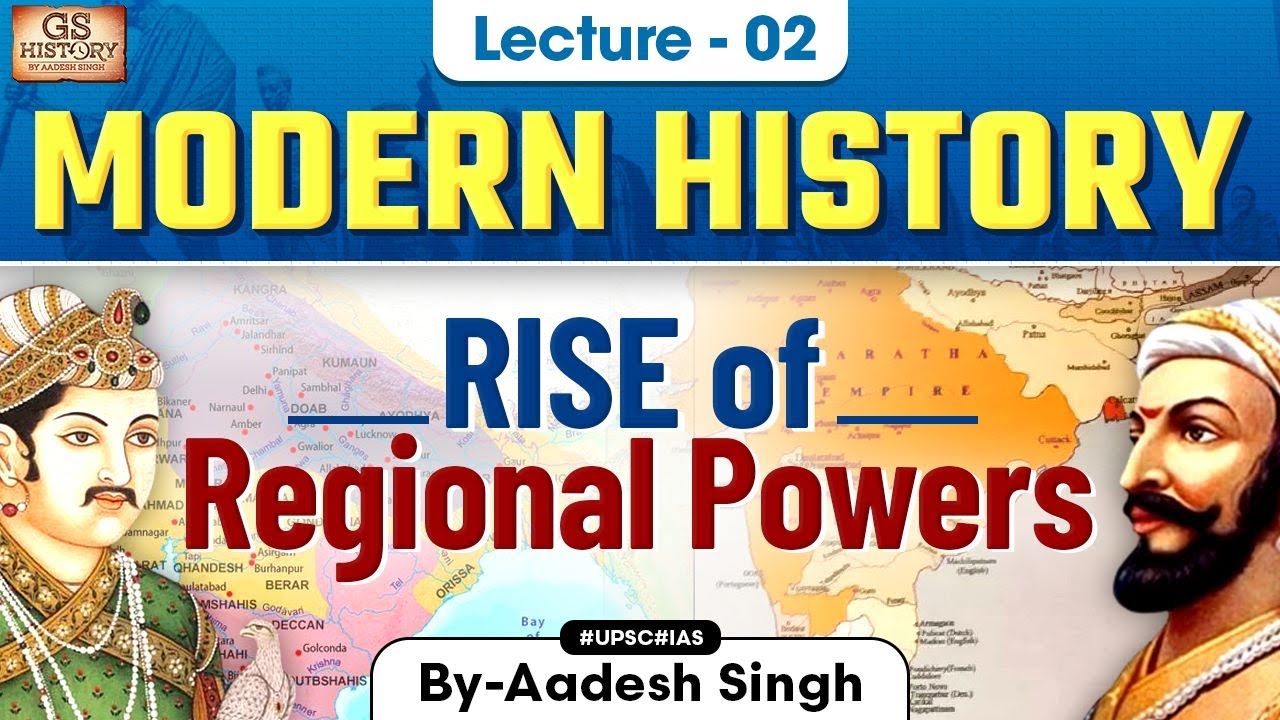
During the , many new regional states came up across India. This completely changed the political landscape that was once ruled by Mughal India. As central power broke down, three main types of powers grew: successor states, independent kingdoms, and rising new powers like the Marathas and Sikhs. Understanding these key kingdoms, the leaders who built them, and their internal weaknesses is very important for students and aspirants studying Mughal India history for competitive exams.
🎯 In this chapter, you will understand:
- How regional states were categorized into Successor, Independent, and New States.
- The founding and growth of major kingdoms like Hyderabad, Awadh, and Bengal.
- The rise of regional sovereignty among Rajputs, Kerala, Marathas, Sikhs, Jats, and Afghans.
- The structural limitations and financial issues that prevented these states from replacing the Mughal Empire.
💡 Why this topic matters: It explains how political power decentralized in India before the rise of British rule.
🧠 Core Idea: The decline of Mughal central authority led to regional state building, but local rivalries and administrative flaws kept them fragmented.
Classification and Survey of Regional States in Mughal India: The Story of Decentralization ()
The was marked by the natural rise of several autonomous regional states as central Mughal political and military power collapsed.
This quick growth of local powers was not the same everywhere. It was a complex and spread-out process where local leaders created their own political systems across the breaking empire.
- (i) The first group consisted of the Successor States, such as Awadh, Bengal, and Hyderabad. Their founders were high-ranking Mughal officers. They kept a formal link and sent yearly payments to the weak Mughal emperor in Delhi, treating him as a symbolic head.
- (ii) The second group included the Independent Kingdoms, like Mysore and the Rajput states. They took advantage of the administrative breakdown in the empire to reclaim full control over their lands and cut political ties with Delhi.
- (iii) The third group contained the New States set up by communities that openly fought and defeated Mughal forces. Prominent examples include the Maratha Confederacy, the resilient SikhMisls, and the Jat territories.
Survey of Key Regional Kingdoms: Founders, Expansion, and Consolidation
The political map of the was shaped by ambitious strongmen who built new states, creating the regional setting that European trading companies would later face.

The State of Hyderabad: Rise of Nizam-ul-Mulk Asaf-Jah
Hyderabad was one of the most stable successor states. It turned the Mughal viceroyalty of the Deccan into an independent domain under its capable founder.
- (i) The founder was Mir Qamar-ud-din Siddiqi, better known as Kilich Khan or Nizam-ul-Mulk. He was a senior nobleman appointed as Governor of the Deccan by the Mughal emperor.
- (ii) He won complete independence after defeating Mubariz Khan, the governor sent by Delhi, at the Battle of Shakr-Kheda in . This victory gave him full control over the Deccan.
- (iii) By , he ruled as an independent leader and took the hereditary title of Asaf-Jah, founding the Nizam dynasty of Hyderabad.
The State of Awadh: Under Burhan-ul-Mulk and Safdar Jang
Awadh was a rich province in the Gangetic plain that quickly grew into an independent state with major influence in North Indian politics.
- (i) The founder was Saadat Khan, popularly known as Burhan-ul-Mulk, who had served as the Mughal governor of the region.
- (ii) After Nadir Shah's invasion, his nephew Safdar Jang took over, strengthening Awadh's administrative network and political power.
The State of Bengal: From Murshid Kuli Khan to Alivardi Khan
Bengal was the richest province of the Mughal Empire. It gained practical autonomy under capable Nawabs and enjoyed economic growth, though this also drew European traders.
- (i) Independent administration began under Murshid Kuli Khan, who served first as Diwan (revenue chief) and then as Subahdar (governor).
- (ii) His successor Sarfaraz Khan was killed in by Alivardi Khan, who seized the throne.
- (iii) Alivardi Khan ruled Bengal independently in practice, though he kept sending annual payments to Delhi to preserve formal legitimacy.
The Independent and New States: Assertions of Regional Sovereignty
Unlike successor states, other regional powers developed as fully independent entities or through armed revolts against Mughal rule.
Rajputs and Kerala: Reasserting Ancient Sovereignty
The Rajput states and Kerala used the weakening of imperial rule to rebuild local dynastic power.
- Rajput States:
- (i) Rajput chieftains, who had served as senior military leaders in the Mughal court, re-established independent rule in the .
- (ii) Their territory stretched from south of Delhi to parts of the western coast, giving them control over major trade routes.
- Kerala (Travancore):
- (i) The kingdom of Kerala was unified under Martanda Varma, who made Travancore his center of power.
- (ii) He modernized his army along Western lines, helping Travancore successfully defend against external forces like the Dutch.
- Rajput States:
The New Political Forces: Marathas, Sikhs, and Jats
These groups built power through military conflicts and became major challengers to all surrounding powers, including European traders.
- Marathas: The strongest challenge to Mughal authority came from the Marathas. Under the leadership of the Peshwas, they expanded rapidly.
- (i) The Peshwas turned the kingdom into a vast confederacy that challenged Mughal authority across India.
- (ii) They took control over key areas like Malwa and Gujarat, becoming the leading native power of the century.
- Sikhs: The Sikhs developed from a religious community into a strong political and military force due to ongoing persecution.
- (i) Key leaders included Guru Gobind Singh (who established the military order of the Khalsa), Banda Bahadur (who led early uprisings), and later Ranjit Singh (who united the Misls).
- (ii) Maharaja Ranjit Singh created a unified kingdom in Punjab that successfully protected the region from outside invasions.
Jats and the Afghan States (Rohilkhand and Farukhabad)
- (i) Jats: Under chiefs like Churaman, Badan Singh, and Suraj Mal, the Jats built the state of Bharatpur and expanded south of Delhi.
- (ii) Rohilkhand and Farukhabad: These smaller Afghan kingdoms arose following tribal migration and the decline of Mughal authority after Nadir Shah's invasion.
- Marathas: The strongest challenge to Mughal authority came from the Marathas. Under the leadership of the Peshwas, they expanded rapidly.
⚡ Quick Revision Capsule: 18th-Century Regional States
A quick summary of key regional powers, their founders, and their nature of origin.
| State Category | Key Regions | Prominent Founders / Leaders |
|---|---|---|
| Successor States | Hyderabad, Awadh, Bengal | Nizam-ul-Mulk, Saadat Khan, Murshid Kuli Khan |
| Independent Kingdoms | Mysore, Rajputs, Travancore (Kerala) | Martanda Varma, Rajput Chieftains |
| New Rebel States | Maratha Confederacy, Punjab, Bharatpur | Peshwas, Maharaja Ranjit Singh, Suraj Mal |
| Afghan Enclaves | Rohilkhand, Farukhabad | Afghan Tribal Chiefs |
Nature and Limitations of Regional States: Why They Could Not Replace the Empire
Though these regional states asserted their independence, they shared common administrative and political flaws that prevented any single power from building a stable, united empire.
- (i) Symbolic Allegiance: Most successor states maintained formal links with the Mughal court to legitimize their own local rule.
- (ii) Reliance on Local Elites: They failed to create strong centralized administrations and relied heavily on local elites, such as zamindars, merchants, and nobles, which kept power decentralized.
- (iii) Structural Weaknesses: Their financial, military, and administrative systems were often temporary and lacked the strength needed for large-scale rule.
- (iv) Constant Internal Warfare: Frequent wars among neighboring regional states drained resources and prevented any single ruler from organizing unified resistance against European forces.
- (v) Economic Strain: Problems in the Jagirdari system and declining farm productivity created financial stress that weakened these states.
📝 Summary
The was a key transition period in Indian history marked by the growth of autonomous regional powers. While states like Hyderabad, Awadh, Bengal, the Marathas, and the Sikhs created strong local governments, their internal rivalries and structural flaws left them vulnerable to British expansion.
🚀 Quick Revision Points
Essential facts to review before examinations:
- (i) Successor States maintained formal allegiance to Delhi while acting independently.
- (ii) Nizam-ul-Mulk founded Hyderabad after the Battle of Shakr-Kheda in .
- (iii) The Peshwas expanded Maratha rule into a broad confederacy across central India.
- (iv) Maharaja Ranjit Singh unified the Sikh Misls into a strong kingdom in Punjab.
- 💡 Exam Tip: When answering questions on 18th-century India, clearly differentiate between Successor States (Hyderabad, Awadh, Bengal) and New Rebel States (Marathas, Sikhs, Jats).
❓ Frequently Asked Questions (FAQ)
Q1: What are Successor States?
A1: They were former Mughal provinces like Bengal, Awadh, and Hyderabad whose governors established independent rule while keeping formal links with the Emperor.Q2: Who founded the independent state of Hyderabad?
A2: Nizam-ul-Mulk (Kilich Khan) founded Hyderabad after winning the Battle of Shakr-Kheda in .Q3: Why couldn't regional states replace the Mughal Empire?
A3: Internal warfare, weak administrative structures, financial issues, and reliance on local elites prevented them from forming a single unified empire.