The evolution of British control in India after the decisive victory in the Battle of Buxar in started a big change in how the colony was managed. This period lasted almost a century, moving from the Regulating Act of 1773 to direct British control under the Act for Better Government of India (1858). These colonial legislative measures changed India's administration, judiciary, and trade policies. Learning these laws is very helpful for students preparing for competitive exams like UPSC.
🎯 In this chapter, you will understand:
- How British rule changed after through major parliamentary acts.
- The shift from private company trade to central government control.
- The step-by-step end of the East India Company's trade monopoly.
- The setup of modern administrative, legal, and civil service systems in India.
💡 Why this topic matters: It forms the basic framework of modern Indian administration, legal history, and constitutional development.
🧠 Core Idea: The British Parliament gradually reduced the power of a private trading company and replaced it with direct rule by the British Crown.
Post-Battle of Buxar and Evolution of British Colonial Rule in India: A Legislative Journey (1764-1858)
The end of the Battle of Buxar in changed political and financial dynamics, building the foundation for the East India Company’s authority in Bengal. After this win, the Company gained strong powers, changing from a trading firm into a ruling power that controlled large revenues and territories.
- (i) Getting the Diwani rights (the right to collect tax) over Bengal, Bihar, and Orissa gave the Company full control over the financial strength of the region.
- (ii) The Company agreed to pay a yearly amount to the former Mughal Emperor Shah Alam II and a pension to the Nawab of Awadh, Shuja-ud-Daula, making their actual rule official through a formal deal.
- (iii) To collect taxes, main Indian officers were appointed, such as Mohammad Reza Khan in Bengal and Raja Shitab Rai in Bihar, who worked as deputy diwans under Company supervision.
- (iv) Direct British intervention started in when the British government asked for a 10% share of the Company's revenue, about 4 million pounds every year, marking the first step toward government control.
- (v) The Dual System of Government (–), created by Robert Clive, caused big problems. The Company held real power and tax money (Diwani) without management duties, while Indian officers handled management (Nizamat) without real authority. This led to corruption, heavy taxes, and financial loss, making government action necessary.
Regulating Act of 1773: The British Parliament's First Attempt to Control the East India Company
Because of the Company's financial problems and corruption, this law started formal British parliamentary control over the Company's management and political actions in India.

British Government Involvement in Company’s Political Affairs
The Regulating Act of 1773 showed that the British Parliament wanted to take control over a private business body.
- (i) For the first time, the British Parliament officially started regulating the Company's administrative and political tasks.
- (ii) This law changed the East India Company from a simple trading business into an organization with real political authority.
Centralization of Administration in Bengal and the Governor-General’s Council
The act aimed to organize management by making a central authority in the Bengal region.
- (i) It created the post of Governor-General, supported by an Executive Council of four members, to manage Bengal.
- (ii) Most decisions in the Council were made by majority voting, which sometimes caused disagreements and delays.
Establishment of Supreme Court in Bengal (1774)
A new legal system was introduced in Calcutta to handle court cases under English law.
- (i) A Supreme Court was set up in Calcutta in with one Chief Justice and three judges.
- (ii) Disagreements happened often between the Governor-General’s Council and the Supreme Court because legal powers over Indian citizens were not clearly defined.
Governor-General’s Limited Control over Bombay and Madras
The Act gave the Governor-General of Bengal some control over other regions.
- (i) The Governor-General of Bengal received limited power over Bombay and Madras, mainly for decisions about war and peace.
- (ii) Ambiguous rules caused administrative confusion and occasional resistance from the other regions.
Amendments to Regulating Act (1781): Judicial Adjustments and Exemptions
Also known as the Act of Settlement, the amendments solved legal conflicts between the Supreme Court and the Governor-General's Council.
- (i) The Supreme Court’s jurisdiction was limited mostly to the city of Calcutta, and it was told to respect local traditional laws like Dharma Shastra for Hindus and Shariat for Muslims.
- (ii) Government servants of the Company were given protection from court action for work done as part of their official duty.
- (iii) The act required courts to respect local social and religious customs when making legal decisions.
Pitt’s India Act of 1784: The Dual Control System and Strengthening British Supervision
The Pitt's India Act established a system of two-way control by separating political tasks from trade tasks.
- (i) The East India Company became subordinate to the British State for its political duties in India.
- (ii) A Board of Control was created to supervise military and political work, giving the British Government direct power.
- (iii) The Governor-General’s council was reduced to three members, and Bombay and Madras were placed fully under Bengal's authority for war, revenue, and diplomacy.
- (iv) The Governor-General was stopped from starting unauthorized wars or signing unapproved treaties without permission.
Charter Acts (1793–1853): Stepwise Expansion of British Authority and End of Monopolies
New acts were passed every twenty years, gradually ending the Company's trade monopolies and expanding British control.
Charter Act of 1793 and Governor-General’s Enhanced Power
The 1793 Act extended the Company's trade rights for another twenty years and gave more authority to the Governor-General.
- (i) The Company’s commercial privileges were extended for another 20 years.
- (ii) Revenue collecting tasks were separated from judicial courts, leading to the end of old revenue courts (Maal Adalats).
Charter Act of 1813: Termination of Trade Monopoly and Entry of Missionaries
Because of requests from independent British merchants, this law changed trade rules completely.
- (a) The Company’s trade monopoly in India was ended, letting all British merchants trade with India. Only trade in tea and trade with China stayed exclusive to the Company.
- (b) It allowed Christian missionaries to enter India to teach and spread their religion.
Charter Act of 1833: Centralization and Law Commission
This act brought maximum central control over administration across British India under Lord William Bentinck.
- (i) The Governor-General of Bengal was named the Governor-General of India with full civil and military powers.
- (ii) The Company lost all trading rights and became purely an administrative body ruling in trust for the British Crown.
- (iii) A legal committee called the Law Commission was created under Lord Macaulay to organize Indian laws.
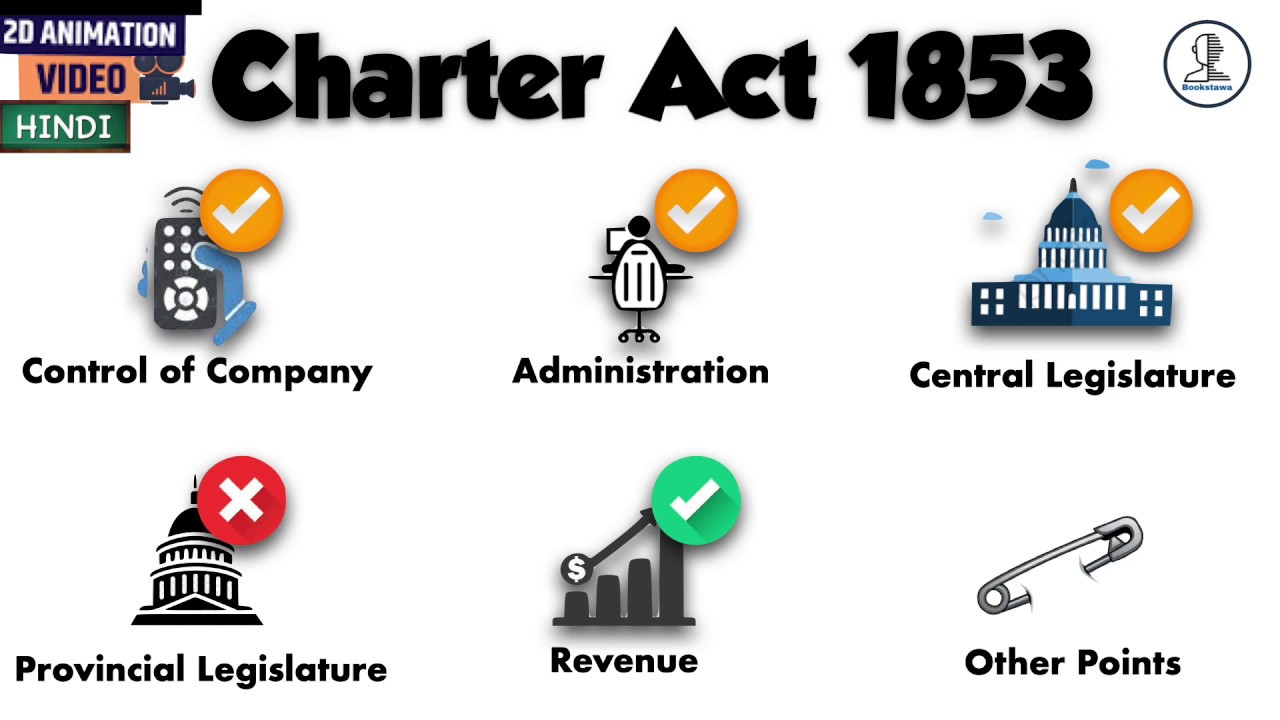
Charter Act of 1853: Separation of Powers and Open Competition
The final Charter Act separated law-making from daily administration and introduced open exams for civil service jobs.
- (i) It separated law-making and executive tasks in the Governor-General's Council by creating a separate Central Legislative Council.
- (ii) An open exam system was started to hire Civil Services officers, making jobs open to qualified Indians based on the Macaulay Committee () recommendations.
- (iii) It extended the Company's authority without setting a fixed 20-year end date, meaning Parliament could take over administration at any time.
Act for Better Government of India (1858): The End of Company Rule and Direct Crown Sovereignty
After the uprising of , this historic act ended Company rule and passed governance directly to the British Crown.
- (i) Governance of India was taken over by the Crown. The Board of Control and Court of Directors were closed. Power was given to a new position, the Secretary of State for India, assisted by a 15-member council.
- (ii) The new Secretary of State was a British Cabinet member answerable directly to the British Parliament.
- (iii) The title Governor-General of India was changed to Viceroy of India (the Crown's direct representative).
- (iv) This act ended the dual control system from and started direct rule by the British Crown, beginning the British Raj.
⚡ Quick Revision Capsule: Key British Acts (1773–1858)
This quick summary table shows the major legislative changes made by the British Parliament to rule India.
| Act Name | Main Purpose | Key Administrative Changes |
|---|---|---|
| Regulating Act () | First step toward parliamentary control over the Company | Created Governor-General of Bengal; set up Supreme Court in Calcutta (). |
| Pitt's India Act () | Separated political and commercial functions | Created the Board of Control to oversee political affairs. |
| Charter Act () | Ended most trade monopolies | Opened Indian trade to all British merchants except tea and China trade; allowed Christian missionaries. |
| Charter Act () | Full administrative centralisation | Created Governor-General of India; ended Company's commercial work completely; set up Law Commission. |
| Charter Act () | Separation of legislative and executive powers | Established Central Legislative Council; introduced open competitive exams for Civil Services. |
| Government of India Act () | End of Company rule; direct Crown governance | Created Secretary of State and Viceroy; abolished Board of Control and Court of Directors. |
📝 Summary
The laws passed from the Regulating Act of 1773 to the Act for Better Government of India (1858) show how British rule changed from a company's commercial setup into direct Crown administration. These colonial legislative measures built central management, court systems, and civil service exams that influenced modern Indian political history.
🚀 Quick Revision Points
Essential facts to review before examinations:
- (i) Diwani rights gained after gave tax collection powers in Bengal, Bihar, and Orissa.
- (ii) Dual system (–) failed because responsibility was separated from power.
- (iii) The Governor-General of India post was made under the Charter Act of .
- (iv) Direct Crown rule began with the Act for Better Government of India in .
- 💡 Exam Tip: Remember the evolution of titles: Governor of Bengal → Governor-General of Bengal () → Governor-General of India () → Viceroy of India ().
❓ Frequently Asked Questions (FAQ)
Q1: What was the main reason for the Regulating Act of 1773?
A1: It was passed because the East India Company faced financial trouble and corruption, leading the British Parliament to regulate its administration.Q2: Which act created the post of Governor-General of India?
A2: The Charter Act of changed the title of Governor-General of Bengal to Governor-General of India.Q3: When did direct rule by the British Crown begin in India?
A3: Direct rule started with the Act for Better Government of India in after the event of .