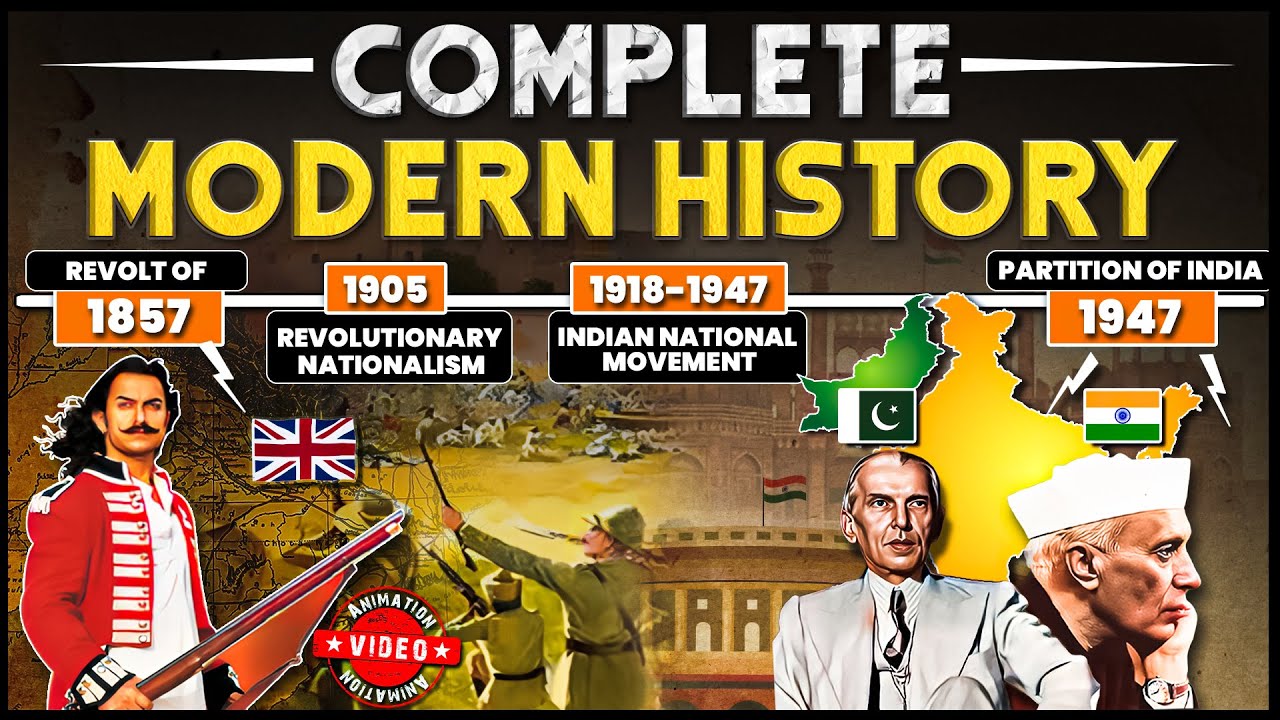
The historical journey of India from the Early Modern Period () through the British Raj () to Independent India () is an important topic for students preparing for history exams. This time period highlights how European traders settled, how national pride grew, and how people fought for freedom, leading to modern India's creation and progress.
🎯 In this chapter, you will understand:
- How European trading companies came to India and gained political control.
- The main phases of the Indian freedom movement, from simple petitions to mass nonviolent protests.
- The key events, wars, and social changes after independence in .
- The long-term lessons of colonialism, unity, and modern nation-building.
💡 Why this topic matters: Learning about these historical events helps us see how modern India's government, borders, economy, and society were built over centuries of struggle and change.
🧠 Core Idea: Foreign trade turned into colonial rule, which inspired a united national effort for self-rule and shaped a strong, democratic nation after independence.
Comprehensive History of India: Early Modern Period to Independent India (1498-Present)
The Early Modern Period () marked the gradual entry of European countries into India, which eventually led to political rule by the British. During this time, Portuguese, Dutch, French, and British merchants arrived, the Mughal Empire ruled over vast areas, and the British East India Company slowly took power, changing the country's social and political system.
- (i) : Vasco da Gama arrived at Calicut. This opened direct sea trade between Europe and India, bringing other foreign traders.
- (ii) : Babur defeated Ibrahim Lodi at the First Battle of Panipat, starting the Mughal Empire.
- (iii) : The British East India Company received an official grant from the British monarch, starting their path toward rule.
- (iv) : The British set up their first official trading base in Surat.
- (v) : Fort St. George was built in Madras to secure British trading operations.
- (vi) : The French East India Company was created to trade with India.
- (vii) : Shivaji crowned himself Chhatrapati, founding the Maratha Empire and challenging Mughal rule.
- (viii) : Battle of Plassey; Robert Clive defeated Siraj-ud-Daulah, giving the British political power in Bengal.
- (ix) : Battle of Buxar; the British firmly gained control over Bengal, Bihar, and Orissa.
- (x) : Fourth Anglo-Mysore War; Tipu Sultan was defeated, expanding British hold over South India.
- (xi) : Third Anglo-Maratha War; the British defeated the Maratha leaders, establishing main control across India.
The British Raj (1858-1947): Deep Dive into the Freedom Struggle
The period of British government rule saw a multi-part effort for freedom. People used careful request-based steps, assertive public actions, and peaceful protests led by Mahatma Gandhi.

Early Nationalism and Moderate Phase (1885-1905)
The creation of the Indian National Congress in started organized politics. Leaders like Dadabhai Naoroji, Surendranath Banerjee, and Gopal Krishna Gokhale asked for reforms using formal requests and open talks.
- (i) Formation of Congress: Focused on administrative reforms and getting more Indian representatives into government.
- (ii) Economic Critique: Dadabhai Naoroji wrote about the "Drain of Wealth" idea in his book Poverty and Un-British Rule in India, showing how British practices hurt Indian money and resources.
- (iii) Social Reform Movements: Groups like Brahmo Samaj and Arya Samaj worked for social improvements like equal treatment across groups and better rights for women, raising awareness across the nation.
Swadeshi Movement and Rise of Extremism (1905-1919)
The Partition of Bengal in caused strong national anger. The Swadeshi Movement asked people to use local products, while leaders like Lal, Bal, and Pal urged stronger opposition.
- (a) : The Swadeshi movement grew strong, focusing on self-reliance and local businesses.
- (b) Revolutionary Nationalism: Brave leaders like Khudiram Bose and Bhagat Singh supported direct action for independence.
- (c) : Creation of the All-India Muslim League; requests for separate voting groups increased social divisions.
- (d) : Morley-Minto Reforms; separate voting groups made divisions deeper.
- (e) : Lucknow Pact; a temporary shared agreement between Congress and the Muslim League.
Gandhian Era and Mass Movements (1919-1947)
Mahatma Gandhi's main idea of Satyagraha brought millions of everyday citizens into peaceful protests, putting pressure on British rulers.
- (i) : Rowlatt Act and the Jallianwala Bagh massacre raised anger against British rule across the country.
- (ii) : Non-Cooperation Movement; people stopped using British goods, schools, and titles.
- (iii) : Civil Disobedience Movement and the Salt March showed clear, peaceful public protest across the nation.
- (iv) : The Government of India Act gave some regional power, but it was not complete independence.
- (v) : The Quit India Movement demanded that the British leave immediately.
- (vi) Subhas Chandra Bose and INA: He sought military support outside the country, showing the strong drive for full freedom.
- (vii) Naval Mutiny (): Showed that British control over armed services was weakening.
- (viii) Cabinet Mission Plan (): An attempt to transfer power peacefully that did not succeed.
- (ix) : Independence and Partition; British rule ended, but the split brought great hardship and human tragedy.
Independent India (1947-Present): Nation-Building and Growth
Since , India has focused on building a united country, expanding its economy, and building international relationships while overcoming internal and external difficulties.
Major milestones in India's development after independence. - (i) : Adoption of the Indian Constitution; India became a sovereign republic.
- (ii) : Sino-Indian War; boundary conflicts along northern borders.
- (iii) : Indo-Pakistani War over border issues in Kashmir.
- (iv) : Indo-Pakistani War; led to the creation of Bangladesh.
- (v) : India carried out its first peaceful nuclear test named "Smiling Buddha."
- (vi) : The Emergency period; normal public rights were temporarily stopped under Prime Minister Indira Gandhi.
- (vii) : Economic opening reforms began, changing trade and industry policies.
- (viii) : Nuclear tests named "Pokhran-II" improved defense capabilities.
- (ix) : Kargil War with Pakistan along high-mountain borders.
- (x) : Terrorist attacks in Mumbai presented major national safety challenges.
- (xi) Present: India continues to grow as an important world economy, working to handle poverty, equality, and regional stability.
⚡ Quick Revision Capsule: Key Historical Eras of India
Here is a concise overview comparing the three primary periods of modern Indian history for quick exam revision.
| Historical Period | Timeframe | Key Features & Events |
|---|---|---|
| Early Modern Era | Arrival of European traders, Mughal rise and decline, and early British East India Company control. | |
| Moderate Phase | Formation of Indian National Congress, requests for reforms, and early economic critiques of colonial rule. | |
| Swadeshi & Extremist Phase | Partition of Bengal, focus on self-reliance (Swadeshi), and early revolutionary actions. | |
| Gandhian Mass Phase | Mass peaceful protests including Non-Cooperation, Salt March, and Quit India Movement leading to independence. | |
| Post-Independence Era | Adoption of the Constitution, key economic reforms of , and national growth. |
Summary: Significance of India's Historical Journey
The progression from the Early Modern Period to modern Independent India shows foreign encounters, the long struggle for freedom, and nation-building steps. Learning this sequence helps students understand how political, social, and financial changes shaped the nation. Core lessons focus on the rise of national unity, the impacts of foreign rule, and strategies for building a strong nation.
📝 Summary
From Vasco da Gama's arrival in to modern growth, India's history covers changing trade power, a dedicated independence effort, and continuous progress as documented in historical texts like Discovery of India.
🚀 Quick Revision Points
Essential facts to review before examinations:
- (i) Mughal Empire began in after the First Battle of Panipat.
- (ii) British control started after the Battle of Plassey in and Battle of Buxar in .
- (iii) The Indian National Congress started in to work for political reforms.
- (iv) Major peaceful movements were recorded in historical accounts like My Experiments with Truth.
- 💡 Exam Tip: Pay special attention to exact years of key events like the Battles of Panipat and Plassey, movement launch dates, and constitutional updates for direct history exam questions.
❓ Frequently Asked Questions (FAQ)
Q1: When did British rule officially start in India?
A1: British trading rule grew after the Battle of Plassey in , but direct political governance under the Crown (British Raj) officially started in .Q2: What were the main methods used during the Indian freedom movement?
A2: The movement used moderate requests, local economic actions (Swadeshi), direct patriotic resistance, and mass nonviolent protests (Satyagraha).Q3: Why is the year 1991 important in modern Indian history?
A3: In , India introduced economic opening policies that changed trade, business rules, and financial growth as recorded in economic histories like India Unbound.