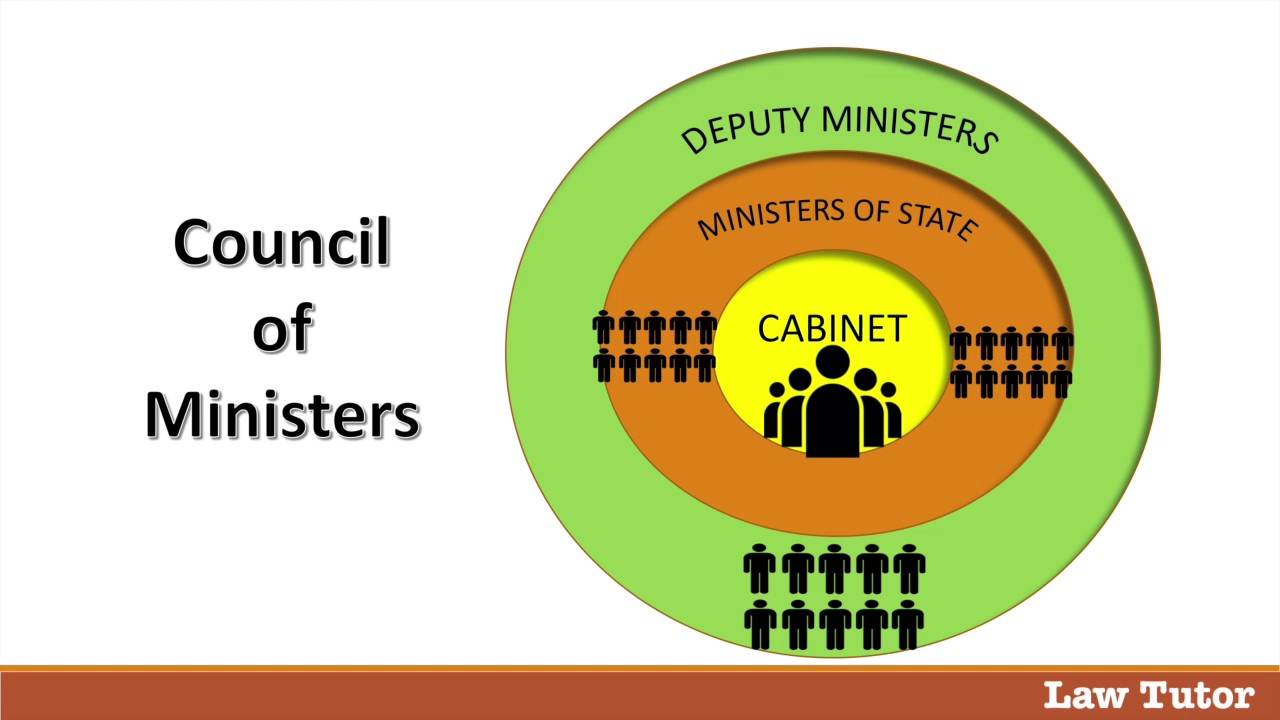
This detailed guide explores the Council of Ministers in India, a cornerstone of the Indian Polity established under the Constitution of India. Understanding the powers and functions of the Prime Minister and their cabinet is essential for students preparing for UPSC, SSC, and Law examinations as it defines the real executive authority of the nation.
🎯 In this chapter, you will understand:
- The constitutional structure and foundations of the Indian executive system.
- Key constitutional mandates under Articles 74, 75, 77, 78, and 88.
- The principle of collective responsibility and the impact of the 91st Amendment Act.
- The role of the Prime Minister as the link between the President and Parliament.
💡 Why this topic matters: It reveals how decisions governing the entire nation are made and who carries real democratic responsibility.
🧠 Core Idea: While the President is the official head of state, real administrative power rests with the elected Council of Ministers led by the Prime Minister.
Council of Ministers in India: Constitutional Framework and Executive Power 2026
The foundation of the Indian executive system is built upon the British parliamentary model, ensuring a democratic distribution of power. Imagine running a large school: the President is like the school Principal whose name appears on official certificates, while the Prime Minister and the Council of Ministers are like the active management team making everyday decisions. The Indian Constitution explicitly adopts a system where the titular head, the President, acts on the counsel of the Council of Ministers led by the Prime Minister. This structural design ensures that real executive power rests with the chosen representatives of the people. While the Constitution does not detail every minor administrative detail, Articles 74 and 75 serve as the definitive legal framework for the composition and accountability of the government.
- (i) The system prioritizes collective responsibility over individual discretion, meaning all ministers stand together behind government decisions.
- (ii) Articles 74 and 75 act as the primary pillars of the parliamentary form of government.
- (iii) The Prime Minister serves as the crucial bridge between the President and the Legislature.
Constitutional Provisions Relating to the Council of Ministers
The Constitution of India outlines specific mandates that govern how ministers are appointed, how they function daily, and their exact official relationship with the Head of State.

Article 74 — Council of Ministers to Aid and Advise the President
This article establishes the mandatory existence of the council to guide the President in exercising executive functions, ensuring the democratic essence of the executive branch. This means the President cannot run the country alone without a council.
- (i) A Council of Ministers with the Prime Minister at its head is constitutionally required to aid and advise the President, who is generally bound to act on such advice.
- (ii) Under the 42nd Amendment Act () and 44th Amendment Act (), the President may request a reconsideration of advice; however, the subsequent advice given after review must be followed strictly.
- (iii) To protect the sanctity of confidential discussion, the advice given by Ministers to the President cannot be challenged or checked in any court of law.
Article 75 — Provisions Regarding Ministers and Their Accountability
Article 75 is a multi-faceted provision that dictates the appointment process, size limits, and the doctrine of collective responsibility.
- (i) The Prime Minister is directly appointed by the President, with other ministers selected based on recommendations given by the Prime Minister.
91st Constitutional Amendment Act Impact
Before , governments could make very large councils to keep everyone happy. The 91st Constitutional Amendment Act, 2003 introduced practical rules to stop this practice.
- (a) The total size of the Council shall not exceed 15% of the total strength of the Lok Sabha.
- (b) Any Member of Parliament disqualified for defection (switching political parties improperly) is disqualified from being appointed as a minister.
- (ii) Ministers hold office during the pleasure of the President, though in practice this pleasure depends directly on maintaining the confidence of the Lok Sabha.
- (iii) The Council of Ministers is collectively responsible to the Lok Sabha, meaning they sink or swim together as a single team. If a no-confidence motion passes, all must resign.
- (iv) Every Minister must take an oath of office and secrecy administered by the President before taking charge.
- (v) A minister must be a member of Parliament; if a non-member is appointed, they must get elected within or vacate their post.
- (vi) Parliament retains full power to determine the salaries and allowances of all Ministers.
Article 77 — Conduct of Business of the Government of India
This provision handles everyday administrative formalities and the legal authentication of official government actions taken in the name of the executive head.
- (i) Every executive action of the Union government must be formally stated as being carried out in the name of the President.
- (ii) The President creates specific rules for the authentication of orders, shielding legally signed documents from court challenges regarding who signed them.
Presidential Business Allocation
To run smooth operations across many departments, rules are laid down for practical work distribution.
- (a) The President frames official rules for the easier transaction of government business.
- (b) These administrative rules govern the allocation of business among various Ministries and Ministers.
Article 78 — Duties of the Prime Minister in Relation to the President
The Prime Minister acts as the primary channel of communication between the Cabinet and the Head of State, maintaining complete operational transparency.
- (i) The Prime Minister must inform the President of all major administrative decisions and upcoming legislative proposals.
- (ii) Whenever the President asks for information regarding Union affairs, the Prime Minister is duty-bound to supply it.
- (iii) The President can request that a decision taken by an individual Minister be brought before the full Council of Ministers for collective consideration.
Article 88 — Rights of Ministers in the Houses of Parliament
Ministers enjoy specific procedural rights that allow them to present policies and answer questions in both chambers of Parliament.
- (i) A Minister has the right to speak and participate in proceedings of both the Lok Sabha and Rajya Sabha.
- (ii) This right extends to joint parliamentary sittings and any Parliamentary Committee where they are listed as a member.
- (iii) Crucial Limitation: A Minister does not have voting rights in a House of which they are not an elected or nominated member.
⚡ Quick Revision Capsule: Key Constitutional Articles
A quick comparison table summarizing primary constitutional articles governing the Council of Ministers:
| Article | Core Focus | Key Provision / Rule |
|---|---|---|
| Article 74 | Aid & Advice | Council aids President; advice is non-justiciable in court. |
| Article 75 | Appointment & Responsibility | Ministers appointed by President; collective responsibility to Lok Sabha; 15% size cap via 91st Amendment. |
| Article 77 | Conduct of Business | All Union actions expressed in President's name; rules for business allocation. |
| Article 78 | PM's Communication Duties | PM bridges Cabinet and President; supplies administrative & legislative updates. |
| Article 88 | Rights in Houses | Ministers can speak in both Houses, but can vote only in their own House. |
📝 Summary
The Council of Ministers represents the active engine of Indian democracy. By adhering to Articles 74, 75, and 78, the system ensures that the Prime Minister and their colleagues remain continuously accountable to the Lok Sabha. For students, mastering these constitutional provisions and understanding reforms like the 91st Amendment Act () is vital for understanding how executive power is exercised and balanced in the Republic of India.
🚀 Quick Revision Points
Essential facts to review before examinations:
- (i) Real executive authority rests with the Council led by the Prime Minister, while the President is the nominal head.
- (ii) Collective responsibility means the cabinet functions as one unit and answers directly to the Lok Sabha.
- (iii) The total number of ministers cannot cross 15% of the total strength of the Lok Sabha.
- (iv) A non-MP can become a minister but must secure a seat in Parliament within .
- 💡 Exam Tip: Always remember that under Article 88, a Minister can speak in either House, but can only vote in the House where they hold official membership!
❓ Frequently Asked Questions (FAQ)
Q1: What is the maximum size of the Council of Ministers in India?
A1: Under the 91st Constitutional Amendment Act, 2003, the total number of ministers cannot exceed 15% of the total member strength of the Lok Sabha.Q2: Can a court inquire into the advice tendered by Ministers to the President?
A2: No. Under Article 74(2), advice given by Ministers to the President is strictly protected and cannot be inquired into by any court of law.Q3: What happens if a Minister is not a member of either House of Parliament?
A3: A person who is not a member of Parliament can be appointed as a minister, but they will lose their position if they do not get elected or nominated to either House within .