In a democratic country like India, the government is run by elected leaders who make sure laws are followed and the nation stays safe and prosperous. Introduced after independence and modified through key amendments in and , the Council of Ministers serves as the main engine of governance, working closely with the Prime Minister and the President of India under the Constitution of India.
🎯 In this chapter, you will understand:
- The constitutional basis and rules governing the Council of Ministers in India.
- How ministers are appointed, their oath taking, and their legal responsibilities.
- The difference between the broad Council of Ministers and the smaller Cabinet team.
- The concepts of collective responsibility, individual responsibility, and the Kitchen Cabinet.
💡 Why this topic matters: Knowing how ministers govern helps us understand who actually makes major political, economic, and social decisions in our daily lives.
🧠 Core Idea: While the President is the official head of state, the real decision-making power rests with the Prime Minister and the Council of Ministers, who are together responsible to the elected parliament.
📌 Council of Ministers in India
The Indian Constitution takes inspiration from the British parliamentary model. In this setup, the real day-to-day government power lies with the Council of Ministers, which is guided and led by the Prime Minister. Although the Constitution does not write down every tiny rule of how a parliamentary system works, Articles 74 and 75 provide a clear general framework. These articles lay out who makes up the council, how it works, and what its main responsibilities are to the people and Parliament.
📜 Constitutional Provisions Relating to the Council of Ministers
The rules for how ministers function are written in key articles of our nation's foundational book, the Constitution of India. These sections explain how ministers work alongside the President and Parliament.
Article 74 — Council of Ministers to Aid and Advise the President
This article builds the bridge between the President and the ministers, ensuring that the country is governed through team decisions rather than one person's choices.
- (i) A Council of Ministers with the Prime Minister at its head must always exist to help and advise the President, who is required to act according to that advice.
- (ii) However, the President can ask the Council to rethink or reconsider its advice once. If the Council sends back the same advice after thinking it over, the President is bound to accept it.
- (iii) The secret advice given by Ministers to the President cannot be questioned or challenged in any court of law.
- (iv) Article 74 establishes that the ultimate executive power relies on team council advice. The 42nd and 44th Constitutional Amendments officially made this advice binding on the President.
- (v) Judicial rulings on Article 74:
- (a) In , the Supreme Court explained that even if the Lok Sabha (House of the People) dissolves, the Council of Ministers does not disappear and stays in office. Any executive step taken by the President without their advice is unconstitutional.
- (b) In , the Supreme Court added that whenever the Constitution mentions the personal "satisfaction" of the President, it means the collective advice of the Council of Ministers, not what the President personally feels.
Article 75 — Provisions Regarding Ministers
Article 75 lays out how ministers are chosen, how many can be picked, and who they are answerable to.
- (i) The Prime Minister is appointed directly by the President, and all other Ministers are chosen by the President based on the advice of the Prime Minister.
- (ii) To prevent governments from making too many ministers, the total size of the Council of Ministers, including the Prime Minister, cannot be more than 15% of the total strength of the Lok Sabha. This rule was added by the 91st Constitutional Amendment Act, .
- (iii) Any member of Parliament who loses their seat for switching parties unlawfully (defection) is also disqualified from being made a minister under the 91st Amendment Act, .
- (iv) Ministers stay in their positions during the pleasure of the President.
- (v) The Council of Ministers is collectively responsible to the Lok Sabha.
- (vi) Before taking up official duties, the President gives each Minister their oath of office and secrecy.
- (vii) If someone who is not a member of either House of Parliament becomes a minister, they must get elected to either the Lok Sabha or Rajya Sabha within six continuous months, or else they stop being a minister.
- (viii) The salaries and allowances of Ministers are decided directly by Parliament.
Article 77 — Conduct of Business of the Government of India
This article sets the standard for how official daily orders, contracts, and paperwork are issued by the national government.
- (i) Every official government action, decision, or contract must be taken in the name of the President.
- (ii) Any rule or order issued in the President's name must be signed according to official rules made by the President, and nobody can challenge these orders in court by claiming they were not authorized properly.
- (iii) The President creates rules to make government work run smoothly and allocates official duties among the different Ministers.
Article 78 — Duties of the Prime Minister
The Prime Minister serves as the official communication channel between the working ministers and the President.
- (i) Keep the President updated on all decisions taken by the Council of Ministers regarding national administration and proposed laws.
- (ii) Share any specific details or reports about administrative decisions or laws whenever the President asks for them.
- (iii) If the President requests it, bring any decision taken by a single minister before the full Council of Ministers for discussion if it hasn't been reviewed by them yet.
Article 88 — Rights of Ministers in Parliament
This rule lets ministers speak and participate in parliamentary debates regardless of which house they belong to.
- (i) Every Minister has the right to speak and join in proceedings of either House of Parliament (Lok Sabha or Rajya Sabha), any joint meeting of both houses, and any parliamentary committee they are named a member of.
- (ii) However, a minister cannot vote in a House of which they are not an elected or nominated member.

👥 Appointment of Ministers
Choosing ministers is a careful process that combines the decisions of the Prime Minister with the official authority of the President.
- The Prime Minister is selected and appointed directly by the President.
- All other team ministers are appointed by the President, but strictly based on the recommendations made by the Prime Minister.
- Membership requirements for becoming a Minister:
- (i) Usually, leaders chosen to be ministers are already elected members of either the Lok Sabha or Rajya Sabha.
- (ii) A person who is not a member of Parliament can still be picked as a minister, but they must win a seat in either house within six months, or they automatically lose their post.
- A minister who sits in one House can freely take part in discussions in the other House, but they can only vote in their own House.
🤝 Oath and Salary of Ministers
Before taking charge of a ministry, every leader must promise to serve the nation faithfully under the law.
- Oath of Office – Given by the President, where the minister promises to:
- (i) Remain true and faithful to the Constitution of India.
- (ii) Stand up for and defend the sovereignty and integrity of India.
- (iii) Perform their duties with total honesty and hard work.
- (iv) Do right to all people fairly, without fear, favor, affection, or ill will.
- Oath of Secrecy – The minister promises never to reveal government secrets or official information to anyone, except when required for their formal work.
- The case of Deputy Prime Minister:
- In , the oath taken by leader Devi Lal as Deputy Prime Minister was challenged in court because the Constitution only writes "Prime Minister" and "Ministers".
- The Supreme Court approved the oath, explaining that terms like Deputy Prime Minister, Minister of State, or Deputy Minister are just descriptive names and do not give extra legal powers as long as the core text of the oath stays correct.
- Salaries and Benefits:
- The pay scale is decided directly by Parliament from time to time.
- Ministers earn the regular salary of a Member of Parliament plus extras such as special allowances based on rank, official housing, free medical care, and travel benefits.
⚖️ Individual Responsibility of Ministers
Besides working together as a full team, ministers are also personally accountable for their work and conduct.
- Article 75 establishes this idea of individual responsibility:
- (i) Ministers stay in office during the pleasure of the President.
- (ii) However, the President can only remove or fire a minister if the Prime Minister advises it.
- (iii) If the Prime Minister is unhappy with a minister's work or behavior, the PM can ask for their resignation or ask the President to dismiss them.
- This ensures that team unity is maintained smoothly. As explained by legal scholar Dr. B. R. Ambedkar:
"Collective responsibility can be achieved only through the instrumentality of the Prime Minister."
🚫 Absence of Legal Responsibility
India follows a different rule regarding the legal liability of ministers compared to nations like Britain.
- In Britain:
- Every order of the Monarch must be countersigned by an official minister.
- If an order breaks the law, that minister can be taken to court and held legally responsible under the rule: "The King can do no wrong."
- In India:
- There is no constitutional requirement that presidential orders must be signed or approved by a minister to be valid.
- Courts cannot inquire into or question the advice given by ministers to the President, keeping their internal consultation private.
🏛️ Composition of the Council of Ministers
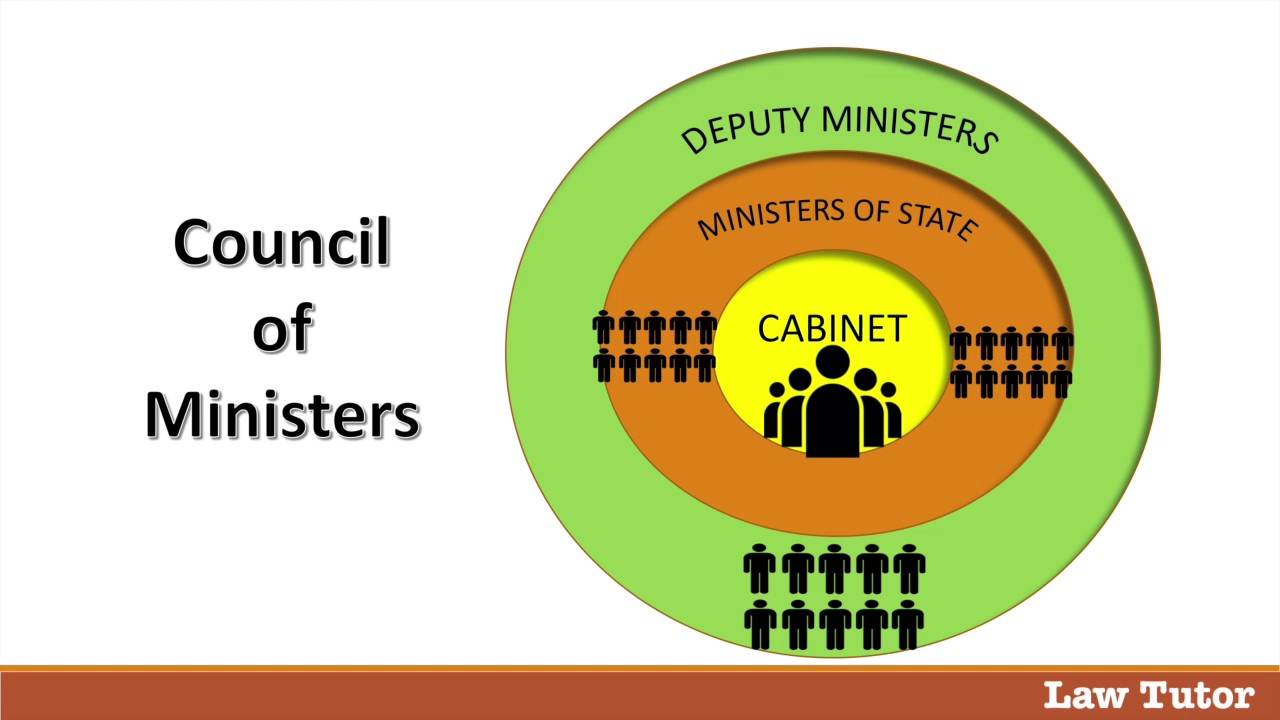
The Council of Ministers is a big team made up of leaders with different levels of experience and responsibilities.
- The council is divided into three main categories:
- (i) Cabinet Ministers:
- These senior leaders head key central ministries such as Home, Defense, Finance, and External Affairs.
- They are core members of the Cabinet, attend important decision meetings, and set national policy.
- (ii) Ministers of State:
- (a) They may be given independent charge of a smaller ministry or department.
- (b) Or they may work attached to a senior Cabinet Minister, taking care of specific departments under their guidance.
- They do not attend Cabinet meetings unless specifically invited for special discussions.
- (iii) Deputy Ministers:
- They assist Cabinet Ministers or Ministers of State in managing daily administrative, political, and parliamentary duties.
- They do not head ministries independently or join Cabinet meetings.
- (i) Cabinet Ministers:
- Parliamentary Secretaries:
- They used to form the lowest level of the team, assisting senior leaders in Parliament without holding a department.
- After , their appointment was largely stopped, except for a short period under Prime Minister Rajiv Gandhi.
- Deputy Prime Minister:
- This position is not mentioned in the Constitution, but leaders are sometimes named Deputy Prime Minister for political balance in political coalitions.
🔍 Key Differences Between Council of Ministers and Cabinet
While people often treat the terms Council of Ministers and Cabinet as meaning the exact same thing, they have major differences in size, responsibilities, and decision-making power.
⚡ Quick Revision Capsule: Council of Ministers vs. Cabinet
Comparison table breaking down key differences in structure and authority:
| Feature | Council of Ministers | Cabinet |
|---|---|---|
| Body Size | A larger group consisting of nearly 60–70 ministers. | A smaller, inner core group of about 15–20 ministers. |
| Members Included | Includes Cabinet Ministers, Ministers of State, and Deputy Ministers. | Includes only Cabinet Ministers, making it a smaller part of the Council. |
| Meeting Frequency | Does not meet as a whole group to handle daily business. | Meets frequently (usually once a week) to deliberate and make decisions. |
| Exercise of Power | Holds all executive powers on paper in theory. | Exercises these powers in practical reality on behalf of the whole group. |
| Decision-Making | Functions and duties are shaped by decisions made by the cabinet. | Directs and controls the council by taking binding policy decisions. |
| Constitutional Status | Formally written in Articles 74 & 75; backed by the Salaries and Allowances Act, 1952. | Added later by the 44th Constitutional Amendment Act, under Article 352. |
💼 Role of the Cabinet
The Cabinet is the small, powerful engine driving national policy, emergency handling, and daily administration.
- (i) Serves as the top policy-making body in the entire national government.
- (ii) Acts as the supreme executive authority of the Union Government.
- (iii) Works as the chief coordinating team for central departments.
- (iv) Functions as the main advisory group to the President, whose official advice is binding.
- (v) Manages unexpected national crises and emergency situations.
- (vi) Directs major financial and law-making proposals before Parliament.
- (vii) Oversees important appointments, including constitutional positions and senior department officers.
- (viii) Shapes India's foreign policy and international dealings with other nations.
💬 Views on the Cabinet’s Role
Famous thinkers and experts have used visual sayings to describe how vital the Cabinet is to running a country:
- Ramsay Muir: "The Cabinet is the steering wheel of the ship of the state."
- Lowell: "The Cabinet is the keystone of the political arch."
- Sir John Marriott: "The Cabinet is the pivot of the political machinery."
- Gladstone: "The Cabinet is the solar orb around which others revolve."
- Barker: "The Cabinet is the magnet of policy."
- Bagehot: "The Cabinet is the hyphen that joins, the buckle that binds, the executive and legislature."
- Sir Ivor Jennings: "The Cabinet is the core of the British Constitutional System, providing unity."
- L.S. Amery: "The Cabinet is the central directing instrument of Government."
- Ramsay Muir also famously described it as a "Dictatorship of the Cabinet" in his book How Britain is Governed, pointing out how powerful a cabinet becomes when it holds a strong parliamentary majority.
🔑 Kitchen Cabinet (Inner Cabinet)
Apart from the formal cabinet, Prime Ministers often rely on an informal smaller circle for swift and private discussions.
- While the formal cabinet has 15–20 leaders, an informal smaller circle called the Kitchen Cabinet or Inner Cabinet often becomes the real power center.
- Who makes up this group:
- The Prime Minister alongside 2 to 4 trusted team members.
- It can sometimes include non-ministers, close friends, or family members whose opinions the PM trusts.
- Former Prime Minister Indira Gandhi relied heavily on a prominent Kitchen Cabinet during her time in office.
- Advantages of a Kitchen Cabinet:
- (i) Smaller group size allows faster and more direct decisions.
- (ii) Can gather quickly on short notice to deal with urgent issues.
- (iii) Helps the Prime Minister maintain secrecy on sensitive political matters.
- Disadvantages of a Kitchen Cabinet:
- (i) Reduces the authority and importance of the full formal cabinet.
- (ii) Allows un-elected advisors to influence government decisions.
- This practice is not restricted to India — similar inner circles exist in Britain and the United States of America.
📑 Articles Related to Central Council of Ministers
Here is a quick constitutional summary of key articles governing central governance:
- (i) Article 74 – Council of Ministers to aid and advise the President.
- (ii) Article 75 – Provisions regarding appointment, tenure, and responsibility of Ministers.
- (iii) Article 77 – Conduct of Union government's business in the President's name.
- (iv) Article 78 – Duties of the Prime Minister to share information with the President.
📝 Summary
The Council of Ministers, led by the Prime Minister, forms the executive core of India's parliamentary democracy under the Constitution of India. Strengthened through constitutional updates in and , the Council ensures that all government work remains accountable to the elected members of the Lok Sabha. Through shared teamwork and clear constitutional duties, this leadership structure maintains stability, directs foreign and economic policy, and manages the day-to-day administrative affairs of the entire nation.
🚀 Quick Revision Points
Essential facts to review before examinations:
- (i) Article 74 makes the aid and advice of the Council of Ministers binding upon the President.
- (ii) Under Article 75, the total minister count cannot cross 15% of the total seats in the Lok Sabha.
- (iii) The concept of collective responsibility means all ministers stand or fall together before the Lok Sabha.
- (iv) As noted in How Britain is Governed, the Cabinet acts as the principal policy-making body of the government.
- 💡 Exam Tip: Remember that ministers are collectively responsible only to the Lok Sabha, not to the Rajya Sabha or Parliament as a whole!
❓ Frequently Asked Questions (FAQ)
Q1: What is collective responsibility in the Council of Ministers?
A1: It means that all ministers are jointly answerable to the Lok Sabha for every decision. If the Lok Sabha passes a no-confidence motion, the entire Council of Ministers must step down together.Q2: Can a person who is not an MP become a Minister in India?
A2: Yes, a non-MP can be appointed as a minister, but they must get elected to either the Lok Sabha or Rajya Sabha within six months to remain in office.Q3: What is the main difference between the Council of Ministers and the Cabinet?
A3: The Council of Ministers is a larger team of 60-70 ministers, whereas the Cabinet is a smaller inner group of 15-20 senior ministers who meet regularly to make key national policy decisions under the Constitution of India.