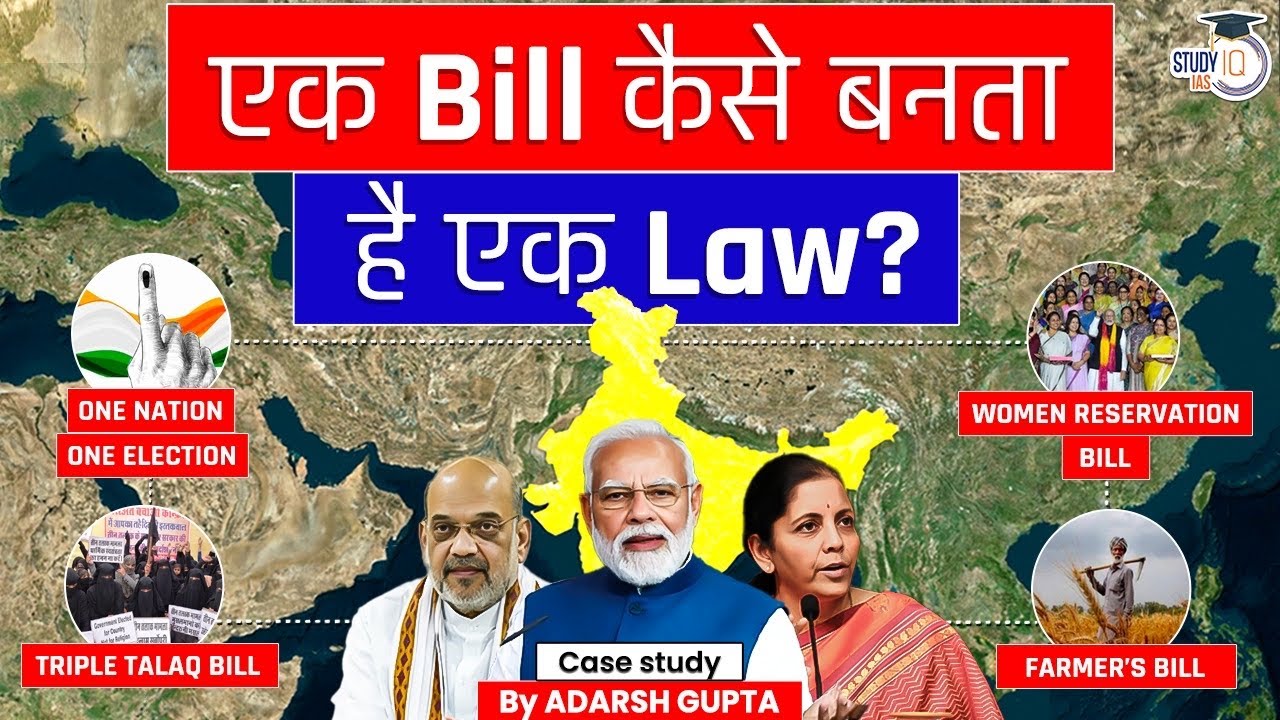
In the Indian system of governance, making new rules and modifying old ones follows a precise step-by-step path inside the Parliament of India. A proposed law starts its journey as a draft text called a bill, and once both Lok Sabha and Rajya Sabha pass it and receive official consent from the President, it becomes an official law or act. Since the founding of the republic under the Constitution of India in , every legislative proposal must go through structured readings, detailed debates, committee checks, and voting to safeguard democracy.
🎯 In this chapter, you will understand:
- The differences between public government bills and private member bills.
- The five stages an ordinary bill goes through before becoming a law.
- The special Constitutional status and rules governing Money Bills and Financial Bills.
- How a Joint Sitting is used to resolve disagreements between the Lok Sabha and Rajya Sabha.
💡 Why this topic matters: Laws affect every aspect of daily life, from taxes and schools to public safety. Understanding how bills move through Parliament shows how elected leaders discuss, improve, and enact democratic rules.
🧠 Core Idea: A bill is just a written proposal for a new law. It can only become an official Act on the national Statute Book after passing identical stages of debate and approval in both Houses of Parliament and receiving assent from the President.
Types and Classification of Bills
The legislative process is designed to be uniform across both Houses of Parliament, meaning every proposed law follows identical stages whether it starts in the Lok Sabha or the Rajya Sabha. Before examining these stages, it is important to categorize legislative proposals based on who introduces them and what topic they address.
- Introductory Distinctions:
- Public Bills (Government Bills): Drafted and presented by a government minister to enact ruling party policies.
- Private Bills (Private Members' Bills): Introduced by any Member of Parliament (MP) who is not a minister.
- Both types follow the same standard legislative procedure inside the House, though their administrative preparation and success rates differ greatly.
- Four Main Categories of Bills:
- (i) Ordinary Bills: Deals with general administrative or social matters other than fiscal and financial subjects.
- (ii) Money Bills: Deals strictly with financial matters such as taxation, government borrowings, and public expenditure under Article 110.
- (iii) Financial Bills: Deals with fiscal and monetary issues, but contains extra legal provisions beyond pure taxation or expenditure.
- (iv) Constitution Amendment Bills: Dedicated to changing, adding, or repealing provisions written in the Constitution of India.
Comparison: Public Bill vs Private Bill
While both categories of bills are formally introduced on the floor of the House, their preparation, political weight, and chances of becoming law are distinctly different.
- Public Bill
- (i) Introduced in Parliament by an official minister of the government.
- (ii) Directly reflects the policy decisions and agenda of the ruling government.
- (iii) Possesses a high probability of being approved due to the ruling party's majority support.
- (iv) Its rejection by the House signifies a loss of parliamentary confidence in the government, which can lead to its resignation.
- (v) Requires at least seven days of advance notice before it can be introduced on the floor.
- (vi) Drafted carefully by officials in the concerned government department in consultation with legal experts in the Law Department.
- Private Bill
- (i) Introduced by any Member of Parliament who is not part of the council of ministers.
- (ii) Highlights opposition views or individual MP stances on important public topics.
- (iii) Has a low chance of being passed by Parliament.
- (iv) Its rejection does not affect government stability or indicate a loss of parliamentary confidence.
- (v) Requires one full month of advance notice prior to introduction in the House.
- (vi) Drafted entirely by the individual member proposing it, with help from personal staff.
Five Stages of Ordinary Bills
Every ordinary bill must cross five distinct legislative steps in Parliament before it can be entered into the official Statute Book as an enforceable law. These stages ensure thorough discussion and prevent hasty legislation.

1. First Reading
An ordinary bill can originate in either the Lok Sabha or the Rajya Sabha. The member or minister in charge asks for leave of the House to introduce the bill. After permission is granted, the title and main objectives are read aloud. No debate or voting happens at this stage. The bill is then published in the official government publication, the Gazette of India. The introduction and publication together complete the first reading.
2. Second Reading
This is the most critical and detailed stage of the legislative process, where the bill is examined line by line. It is divided into three consecutive sub-stages:
(a) Stage of General Discussion
Printed copies of the draft bill are handed out to all members. MPs debate the general principles of the text, but specific line-by-line changes are delayed. At this point, the House can choose one of four paths:
- (i) Take up the bill for immediate consideration or set a fixed date to discuss it;
- (ii) Send the bill to a Select Committee made up of members from that single House;
- (iii) Send the bill to a Joint Committee containing members from both Lok Sabha and Rajya Sabha;
- (iv) Circulate the draft publicly to collect opinions from people and experts.
(b) Committee Stage
If referred to a Select Committee, members examine every clause in detail. They invite expert testimony, debate specific terms, and suggest amendments to improve the bill, without altering its core goal. After completing the review, the committee submits its detailed report back to the House.
(c) Consideration Stage
The House studies the committee's report and goes through the bill clause by clause. Members discuss each section individually, propose specific amendments, and vote on each proposed edit before accepting or rejecting it.
3. Third Reading
During the third reading, debate is limited to whether the bill as a whole should be accepted or rejected. No new individual edits or clause amendments are allowed at this late point. If a majority of members present and voting vote in favor, the bill passes the originating House. The presiding officer signs it, and it is sent over to the second House.
4. Bill in the Second House
When the bill reaches the second House, it must again go through the same three reading stages (first reading, detailed second reading, and final third reading). The second House has four choices:
- (a) Pass the bill in its original form without any amendments;
- (b) Pass the bill with proposed changes and send it back to the first House for reconsideration;
- (c) Reject the bill completely;
- (d) Keep the bill pending by taking no action at all.
If both Houses agree on the text, the bill is sent to the President. If a deadlock occurs—such as complete rejection, disagreement over edits, or inaction for more than six months—the President can call a joint sitting of both Houses to resolve the disagreement.
5. Assent of the President
Once both Houses pass the bill (separately or together in a joint sitting), it is presented to the President for final approval. The President has three Constitutionally granted choices:
- (a) Grant assent, which officially turns the bill into an act placed on the Statute Book;
- (b) Withhold assent, which stops the bill completely so it does not become law;
- (c) Send the bill back to Parliament for reconsideration. However, if both Houses pass the bill again (with or without changes), the President is required to sign it, exercising a temporary suspensive veto.
Money Bills & Special Powers
Article 110 of the Constitution defines a money bill. A bill is classified as a money bill if it deals strictly and exclusively with financial matters like national taxation, spending, and public funds.
- What Qualifies as a Money Bill:
- (i) Imposition, abolition, remission, alteration, or regulation of any tax.
- (ii) Regulation of borrowing of money or financial guarantees made by the Central Government.
- (iii) Custody of the Consolidated Fund of India or the Contingency Fund of India, including adding or taking money from these funds.
- (iv) Appropriation of money out of the Consolidated Fund of India for official government expenses.
- (v) Declaration or increase of any expenditure charged directly on the Consolidated Fund of India.
- (vi) Receipt, custody, issue, or audit of money connected to government accounts.
- (vii) Any operational matter directly related to the items listed above.
- Items Excluded from Money Bills: A bill is not treated as a money bill simply because it includes fines, municipal fees, or simple license fees charged by local authorities for local services.
- Absolute Authority of the Speaker: The Speaker of the Lok Sabha holds the final constitutional authority to decide whether a proposed law is a money bill. The Speaker's decision is final and cannot be challenged in any court, inside either House of Parliament, or by the President.
- Special Procedure for Money Bills:
- (i) Can only be introduced in the Lok Sabha and requires prior recommendation from the President.
- (ii) Treated strictly as a government bill, meaning only a government minister can introduce it.
- (iii) After passing the Lok Sabha, it travels to the Rajya Sabha, which has limited constitutional powers over financial legislation.
- (iv) The Rajya Sabha cannot reject or amend a money bill; it can only offer suggestions within .
- (v) The Lok Sabha can accept or reject any recommendation from the Rajya Sabha. If rejected, the bill passes in its original Lok Sabha form.
- (vi) If the Rajya Sabha holds the bill longer than without returning it, the bill automatically counts as passed by both Houses.
Comparison of Ordinary Bills and Money Bills
The rules, powers, and procedures differ significantly when comparing ordinary bills to money bills.
| Feature / Aspect | Ordinary Bill | Money Bill (Article 110) |
|---|---|---|
| House of Origin | Can be introduced in either Lok Sabha or Rajya Sabha. | Can only be introduced in the Lok Sabha. |
| Who Can Introduce | Introduced by a minister or a private member. | Introduced exclusively by a government minister. |
| President's Recommendation | Introduced without prior recommendation of the President. | Requires prior recommendation of the President. |
| Rajya Sabha Powers | Rajya Sabha can amend, reject, or delay up to six months. | Cannot amend or reject; can only delay for up to . |
| Speaker Certification & Deadlocks | Does not require Speaker endorsement; deadlock resolved via Joint Sitting. | Requires Speaker certificate; no joint sitting allowed or needed. |
Financial Bills (Type I and Type II)
Financial bills deal with public income (revenue) and expenditure (expenditure). While all money bills are financial bills, not all financial bills are money bills. Only financial bills containing pure Article 110 subjects get certified by the Speaker as Money Bills. Other financial matters fall into two categories:
Financial Bills (I)
Financial Bills (I) are covered under Article 117(1). They contain matters from Article 110 along with general non-financial rules (for example, a clause dealing with loans embedded in a general administration bill).
- Similarities to Money Bills:
- (a) Can only be introduced in the Lok Sabha.
- (b) Needs prior recommendation from the President before introduction.
- Similarities to Ordinary Bills:
- (a) Once introduced, it follows ordinary bill procedures in all other steps.
- (b) The Rajya Sabha has full power to edit or reject it.
- (c) If both Houses disagree, the President can call a joint sitting to resolve the deadlock.
- (d) The President can sign, withhold assent, or send the bill back for review.
Financial Bills (II)
Financial Bills (II) fall under Article 117(3). These bills involve spending money from the Consolidated Fund of India, but do not contain any specific taxation or borrowing items listed under Article 110.
- (i) Treated like an ordinary bill in every procedural respect.
- (ii) Can be introduced in either House of Parliament without prior permission from the President.
- (iii) However, neither House can pass the bill into law unless the President explicitly recommends its consideration.
- (iv) Both Houses enjoy equal rights to approve, amend, or reject the bill, and disagreements can be settled using a joint sitting.
Joint Sitting Mechanism
A joint sitting is an extraordinary legislative measure provided in Article 108 of the Constitution to break a deadlock between the Lok Sabha and the Rajya Sabha when passing a law.
- When a Deadlock Occurs: A deadlock is officially recognized if a bill passed by one House reaches the second House and:
- (i) The second House rejects the bill entirely;
- (ii) Both Houses disagree on proposed amendments;
- (iii) The second House holds the bill for more than six months without passing it.
- Rules Governing Joint Sittings:
- (i) Called exclusively by the President to vote on ordinary or financial bills.
- (ii) Joint sittings are strictly forbidden for Money Bills and Constitution Amendment Bills.
- (iii) The Speaker of the Lok Sabha presides over the joint sitting. If absent, the Deputy Speaker presides; if also absent, the Deputy Chairman of the Rajya Sabha takes the chair. The Chairman of the Rajya Sabha (Vice-President) never presides because they are not an elected member of Parliament.
- (iv) Quorum requires one-tenth of the combined total membership of both Houses.
- (v) The meeting operates under Lok Sabha procedural rules, and decisions pass by a simple majority of members present and voting. Because the Lok Sabha has more than twice as many members as the Rajya Sabha, its preference usually prevails.
- Historical Joint Sittings: Since , joint sittings have been summoned only three times in Indian history:
- (i) Dowry Prohibition Bill, 1960 (in )
- (ii) Banking Service Commission (Repeal) Bill, 1977 (in )
- (iii) Prevention of Terrorism Bill, 2002
⚡ Quick Revision Capsule: Legislative Bill Categories
Below is a quick reference summary contrasting the four primary classifications of bills in the Parliament of India.
| Bill Type | Constitutional Article | Originating House | Joint Sitting Option? |
|---|---|---|---|
| Ordinary Bill | Articles 107 & 108 | Either Lok Sabha or Rajya Sabha | Yes (Available in case of deadlock) |
| Money Bill | Article 110 | Lok Sabha only | No (Lok Sabha holds ultimate power) |
| Financial Bill (I) | Article 117(1) | Lok Sabha only | Yes (Follows ordinary procedure after start) |
| Financial Bill (II) | Article 117(3) | Either Lok Sabha or Rajya Sabha | Yes (Follows ordinary procedure) |
📝 Summary
The legislative framework established in ensures that making laws in India is a balanced, deliberative process. Ordinary bills undergo five stages—including three detailed readings—in both Houses before reaching the President for assent. Money Bills under Article 110 place primary financial authority in the Lok Sabha, granting the Rajya Sabha only for advisory review. When disagreements arise between Houses over ordinary or financial bills, Article 108 permits a joint sitting presided over by the Speaker to maintain smooth national governance.
🚀 Quick Revision Points
Essential facts to review before examinations:
- (i) A bill becomes an act only after passing Parliament and receiving Presidential assent.
- (ii) Article 110 money bills can start only in Lok Sabha with prior recommendation from the President.
- (iii) The Speaker of the Lok Sabha holds final authority to certify whether a bill is a Money Bill.
- (iv) Article 108 joint sittings apply only to ordinary and financial bills, never to money bills or Constitution amendments.
- 💡 Exam Tip: Remember that the Chairman of Rajya Sabha (Vice-President of India) NEVER presides over a joint sitting because they are not an elected MP. The Lok Sabha Speaker always presides!
❓ Frequently Asked Questions (FAQ)
Q1: What happens if the Rajya Sabha delays a Money Bill for more than 14 days?
A1: If the Rajya Sabha does not return a money bill within , the bill is automatically deemed passed by both Houses in its original Lok Sabha form.Q2: Can a Private Member introduce a Money Bill in Parliament?
A2: No. Every money bill is legally considered a government bill and must be introduced exclusively by a government minister with prior recommendation from the President.Q3: Who presides over a Joint Sitting of Parliament if the Lok Sabha Speaker is absent?
A3: If the Speaker is absent, the Deputy Speaker of Lok Sabha presides. If the Deputy Speaker is also absent, the Deputy Chairman of Rajya Sabha takes the chair.